



-
Houston Colt 45's Hoodie
Regular price $85.00 CADRegular priceUnit price per -
-
-
Barcelona Dragons Hoodie
Regular price $85.00 CADRegular priceUnit price per -
-
-
-
Montreal Concordes Hoodie
Regular price $85.00 CADRegular priceUnit price per -
-
California Golden Seals Hoodie
Regular price $85.00 CADRegular priceUnit price per -
-
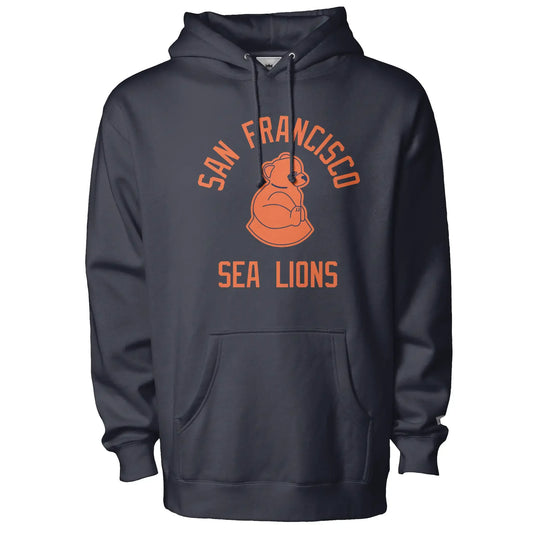
San Francisco Sea Lions Hoodie
Regular price $85.00 CADRegular priceUnit price per -




Hoodies — Throwback Pullover & Zip-Up Hooded Sweatshirts
76 Active Hoodie Designs. Football, Baseball, Hockey & Basketball. Pullover & Zip-Up. Sizes S–5XL on Most Styles.
Royal Retros carries 76 throwback hoodies live and ready to ship today — hooded pullovers and one full-zip style, spread across ten sports and leagues that nobody else stocks at this depth: the USFL and XFL/UFL spring-football eras, our exclusive AF1 (Arena Football One) line, the CFL, early international football, the Negro Leagues, the WHA plus a run of orphaned NHL and pre-NHL cities, the ABA, and a shelf of defunct-MLB and regional baseball designs. Most hoodies run a flat $59.99. A run of AF1 team hoodies is $64.99, and the premium AF1 On Field pullover line is $79.99 — no hidden size upcharges anywhere. Sizes go up to 5XL on the majority of styles, though not all — see the Sizes section below for exactly which ones do. This is the hooded half of our fleece catalog. If you want a crewneck instead, the separate Sweatshirts collection is where to look — full scope note further down.
A hoodie is the piece of throwback apparel people actually wear the most, and not by accident — it's the one item in a fan's closet that does double duty as a jersey substitute in October and a genuinely warm daily-wear piece in January. That's why this catalog leans heavyweight rather than fashion-weight, and why it spans this many leagues instead of just the two or three that get the most attention: the whole point of a defunct-league hoodie is wearing a design nobody else in the room has.
Shop Hoodies by Sport
Football Hoodies — 44 of the 76, the largest group by far, and the reason this collection exists. It spans thirteen USFL teams from the 1983–85 and 2022–23 eras, five XFL/UFL revival franchises, eighteen designs across our exclusive AF1 line, two CFL teams, two early-international-football clubs, and four regional and heritage designs. Cross-shop the wider football jersey catalog and football T-shirts for the same graphics in other cuts.
Baseball Hoodies — 15 designs: six Negro Leagues teams, four defunct-MLB clubs, and five regional and minor-league designs that collectors specifically hunt for because nobody else carries them. See the full baseball jersey range and baseball tees for more of the same teams.
Hockey Hoodies — 13 designs: five from the World Hockey Association, two from the International Hockey League, five from other defunct NHL franchises, and one from the pre-NHL Pacific Coast Hockey Association — a genuine deep cut. Browse the hockey jersey collection and hockey tees to build out a set.
Basketball Hoodies — Two, and both are worth knowing about: an ABA cult-classic design and a West Coast ABA-into-NBA design. See the basketball jersey catalog and basketball tees for the wider range.
Royal Retros Branded — Two house-brand pieces that aren't tied to any team: a classic pullover and a performance zip-up, both built the same way as the throwback designs but carrying our own name instead of a defunct franchise's.
Shop Hoodies by League & Team
USFL — 13 hoodies at $59.99, covering both the original 1983–85 league and the 2022–23 revival: San Antonio Gunslingers, Chicago Blitz, Houston Gamblers, the Oklahoma Outlaws, Washington Federals, Jacksonville Bulls, Pittsburgh Maulers, the Breakers, Philadelphia Stars, Tampa Bay Bandits, a Birmingham Stallions throwback, New Jersey Generals, and a Michigan Panthers throwback. For the full USFL catalog across every product type, see the USFL collection.
XFL & UFL — Five hoodies at $59.99 covering the modern spring-football revival: San Antonio Brahmas, a St Louis Battlehawks throwback, a DC Defenders throwback, San Francisco Demons, and New York Guardians. See the full XFL and UFL collections for jerseys and tees from the same clubs.
AF1 (Arena Football One) — Our biggest single group at 18 designs, split between the $64.99 core team line and the $79.99 On Field premium pullover: Nashville Kats, Michigan Arsenal, Beaumont Renegades, Oceanside Bombers, Kentucky Barrels, Washington Wolfpack (Everett, Washington, not the capital), Minnesota Monsters, and Albany Firebirds — each carried in both the standard cut and the On Field version — plus a league-branded design. Browse the complete AF1 collection for jerseys, tees and hats from every team we carry.
CFL — Two hoodies at $59.99: the Baltimore Stallions, the only CFL franchise to have ever played south of the Canadian border, and the Montreal Concordes, the Alouettes' predecessor identity from the early 1980s. Browse CFLPA for the wider Canadian football range.
Early International Football — Two hoodies at $59.99 from the World League/NFL Europe era: Rhein Fire, a German-market club, and Barcelona Dragons, the Spanish-market side from the same league. Browse the full WLAF collection for every club that league fielded.
Negro Leagues Baseball — Six hoodies at $59.99: San Francisco Sea Lions, Homestead Grays, Indianapolis Clowns, Newark Eagles, Seattle Steelheads, and Pittsburgh Crawfords. The full Negro Leagues collection runs to 175 products across every format.
Defunct MLB — Four hoodies at $59.99: St Louis Browns, Seattle Pilots, Houston Colt .45's, and Washington Senators — four franchises that no longer exist under those names anywhere in the majors.
Regional & Legacy Baseball — Five hoodies: North Pole Nicks, a genuine Alaska deep cut; Portland Mavericks, the only fan-owned, unaffiliated pro baseball team of the modern era; Tampa Smokers, a Florida State League original; and two designs tied to a Bay Area stadium's baseball history, filed under the Candlestick Collection. See the Legacy Baseball collection for the wider range.
WHA (World Hockey Association) — Five hoodies at $59.99: two Quebec Nordiques designs (one throwback, one proposed-logo variant), Cleveland Crusaders, Toronto Toros, and a Hartford WHA design. Browse the full WHA collection for every club the league ever fielded.
IHL & Other Defunct Hockey — Eight hoodies covering cities that no longer have the franchise they once did: San Francisco Spiders and Detroit Vipers from the International Hockey League; Minnesota North Stars, Kansas City Scouts, a Denver NHL club from the late 1970s, Cleveland Barons, and California Golden Seals from the NHL's relocation-heavy 1970s; and Vancouver Millionaires, a Stanley Cup winner from the pre-NHL Pacific Coast Hockey Association. The IHL collection and Legacy Hockey collection cover the rest.
ABA & Legacy Basketball — Two hoodies: Spirits of St Louis, the ABA team so famously mismanaged that its owners still collect a share of NBA television revenue decades later, and a San Diego design honoring the city's ABA-into-NBA basketball history. The ABA collection covers the wider league.
Fabric Weights & Fits
Almost every hoodie in this collection is a pullover. There is exactly one full-zip style — the Royal Retros Performance Zip Hoodie — for anyone who wants to layer a hoodie over a jersey or tee without pulling it over their head. Everything else is a classic kangaroo-pocket pullover with a fixed hood.
Construction runs in three tiers, tied to price. The $59.99 core line is heavyweight cotton-blend fleece — the bulk of the collection, 57 of the 76 active designs — built for daily wear and cold-weather game days rather than as a fashion-weight layering piece. The $64.99 tier covers the standard-cut AF1 team hoodies plus the Royal Retros Performance Zip Hoodie, a slightly different construction aimed at year-round wear. The $79.99 AF1 On Field line is our premium pullover build, with a more structured fit and a heavier hand than the core line — it is also, not coincidentally, the only tier that tops out at 2XL instead of running further up the size chart; see the Sizes section for exactly why that matters before you order.
Every hoodie graphic is applied to the same brushed-fleece exterior, whether it is a simple wordmark or a full front-and-back design, and every hood is lined the same way as the body fabric rather than a mismatched interior — a detail cheaper reproductions routinely skip.
Sizes
Sizing is not one flat range across this collection, and we are not going to tell you it is. Here is exactly how it breaks down across the 76 active hoodies:
- S–5XL on 45 designs — the majority of the $59.99 core line and most of the $64.99 tier.
- S–3XL on 22 designs — a mix of $59.99 and $64.99 styles.
- S–2XL on all nine of the $79.99 AF1 On Field pullovers — every single one of them, without exception, so if you are sizing 3XL or above, look to the $59.99 or $64.99 AF1 team hoodies instead.
Check the size chart on each individual product page before you order — the range is listed there for that specific style, not inferred from a store-wide rule.
Why Royal Retros Is the Home of Throwback Hoodies
- Ten sports and leagues in one hoodie catalog. USFL, XFL/UFL, AF1, CFL, WLAF, Negro Leagues, WHA, IHL, ABA and defunct MLB — no other vintage retailer stocks hoodies across this many categories.
- Flat, honest pricing by tier. $59.99 core, $64.99 AF1 team, $79.99 AF1 On Field premium — no size upcharge within any tier.
- Teams nobody else bothers with. North Pole Nicks. Tampa Smokers. Vancouver Millionaires. Kansas City Scouts. These are the designs that get skipped everywhere else and carried here.
- Consistent, hood-lined construction. Every hood is lined in matching fabric, not a mismatched liner bolted onto a cheaper build.
- Deep coverage beyond hoodies. Cross-shop the same graphics as jerseys, tees, jackets and hats across the entire catalog.
- Honest sizing information. We tell you which styles run to 5XL, which stop at 3XL, and which stop at 2XL — before you order, not after a return.
Hoodie Buying FAQ
What sizes do Royal Retros hoodies come in?
It depends on the specific hoodie. 45 of our 76 active styles run S–5XL, 22 run S–3XL, and the nine AF1 On Field pullovers run S–2XL. Check the size chart on the product page you're looking at — do not assume S–5XL across the board.
What's the difference between the Hoodies collection and the Sweatshirts collection?
Silhouette. This collection is hooded pullovers and zip-ups only. The separate Sweatshirts collection covers crewneck pullovers plus a general fleece overview — its own hoodie section defers back here for the full hooded catalog. If you specifically want a hood, you're in the right place; if you want a plain crewneck, go to Sweatshirts instead.
Are these hoodies pullover or zip-up?
Almost entirely pullover. There is one full-zip style in the collection, the Royal Retros Performance Zip Hoodie. Every other hoodie here — throwback and branded alike — is a classic kangaroo-pocket pullover.
What are the hoodies made from?
Heavyweight cotton-blend fleece on the $59.99 core line, a comparable blend on the $64.99 tier, and a more structured, heavier-hand premium build on the $79.99 AF1 On Field pullovers. See Fabric Weights & Fits above for the full breakdown.
How much do the hoodies cost?
$59.99 flat on 57 of the 76 active designs, $64.99 on 10 AF1 and Royal Retros branded styles, and $79.99 on the nine AF1 On Field premium pullovers. No hidden size upcharge within any tier.
How fast does it ship and what's the return policy?
Stock hoodies ship within 3–5 business days. Standard items follow our return policy at /pages/returns.
Gift Ideas for the Hoodie Buyer
- For the fan who wants something warm on gameday: The $59.99 heavyweight core line covers every sport in the catalog.
- For the deep-cut collector: North Pole Nicks, Vancouver Millionaires or Tampa Smokers — nobody at the tailgate will have seen these before.
- For someone who layers over a jersey: The Royal Retros Performance Zip Hoodie is the only full-zip in the catalog.
- For the AF1 fan: The $79.99 On Field pullover is our premium build, sized S–2XL.
- Year-round demand. Unlike a lot of seasonal merchandise, hoodies sell from the first cold snap in October through the end of winter.
How Did the Hoodie Become Sports Apparel?
The hoodie became sports apparel because it started as cold-weather workwear, not fashion — the athletic use case came second and simply never let go. Knitwear manufacturers in upstate New York began attaching hoods to heavyweight sweatshirts in the 1930s for laborers working outdoors in freezing warehouses and cold-storage facilities, where a fixed hood solved a problem a jacket collar couldn't. The same heavyweight fleece and hood combination made an obvious jump to cold-weather athletic wear soon after — practice gear for football and other outdoor programs that needed players warm between reps without adding bulk that restricted movement. That practical, unglamorous origin is the entire reason the hoodie works as sports apparel today: it was built to keep a working body warm in bad weather, and a sideline in November is exactly that problem.
From there the hoodie moved in two directions at once. Athletic programs kept using it as practical cold-weather gear — the plain, team-color pullover that shows up in every locker room and every sideline photo from the 1950s onward. And outside of sports, the same silhouette got picked up by skateboarding, hip-hop and other youth subcultures through the 1970s and 80s, which is where the hoodie's reputation as a piece of identity-driven clothing — not just a garment — really took hold. Licensed sports merchandise caught up to both threads by the 1990s: a hooded sweatshirt with a team graphic on it became a mainstream retail category in its own right, distinct from the plain gym-issue version that started it all. That is the lineage a throwback hoodie sits inside today — practical cold-weather gear that became a genuine piece of fan identity.
What's the Difference Between Loopback and Brushed Fleece?
The difference is which side of the fabric is finished for wear: loopback fleece leaves its interior loops uncut and exposed, while brushed fleece runs those same loops through a brushing process that breaks them into a soft, fuzzy nap. Almost every hoodie you'll find at retail, including everything in this collection, uses brushed fleece on the inside — it's what makes a hoodie feel soft against skin instead of like a looped-knit T-shirt. Loopback fleece, left unbrushed, is a different product entirely: a firmer, more structured hand that some premium streetwear brands use specifically because it drapes and ages differently than a brushed interior. Neither is objectively better — loopback is prized for structure and a slightly vintage feel over time, brushed is prized for immediate softness and warmth — but they are not interchangeable, and "fleece" alone doesn't tell you which one you're getting.
What Does GSM Mean on a Hoodie?
GSM stands for grams per square meter, and it's the standard measure of how heavy — and by extension how warm and durable — a piece of knit fabric is. Lightweight hoodie fleece generally sits in the 240–280 GSM range, similar to a heavy T-shirt jersey with a napped interior. Midweight fleece, the range most everyday hoodies fall into, runs roughly 280–340 GSM. Heavyweight fleece, the category most throwback and vintage-style hoodies are built from because it holds up to repeated washing and heavy graphics without going thin, typically starts around 340 GSM and can run past 400 on the heaviest athletic-grade builds. A higher GSM number means more fabric per square inch, which means more warmth, more structure, and generally more durability — at the cost of a bit more weight and a slower dry time. It's a useful number to know when you're comparing hoodies across brands, even when a specific listing doesn't publish it.
Cotton vs. Cotton-Poly Blend — Which Drapes and Wears Better?
A cotton-poly blend generally holds its shape and resists pilling better over repeated washes, while a higher-cotton build breathes better and softens more with age — and most hoodies, including the ones sold here, are a blend rather than either extreme for exactly that reason. Pure cotton fleece is soft and breathable from day one but stretches out at the cuffs and hem faster and is more prone to shrinkage in a hot dryer. Adding polyester fiber to the blend — commonly somewhere in the 10–35% range on mainstream hoodies — adds recovery, meaning the garment snaps back to shape after stretching, and it resists the fuzzy pilling that shows up on pure-cotton fleece after enough washes. The tradeoff is that a heavier poly blend can feel slightly less breathable and won't soften with age quite the way 100% cotton does. A cotton-blend build is the practical middle ground for something meant to be worn repeatedly through a whole season rather than babied.
Pullover vs. Full-Zip Hoodie — What's the Real Difference?
The real difference isn't warmth, it's how you put it on and take it off, and that changes what the front of the hoodie can carry graphically. A pullover has an unbroken front panel, which is why almost every team-graphic hoodie — including 75 of the 76 in this collection — is built that way: it gives a designer a single, uninterrupted surface for a full chest graphic or a large wordmark. A full-zip breaks that surface with a center seam and zipper track, which means large centered graphics either have to work around the zipper or get split across the two front panels — a real design constraint, not just a style choice. In exchange, a full-zip is easier to put on and take off without disturbing your hair or glasses, easier to vent when you warm up, and easier to layer over a jersey or T-shirt without pulling anything over your head. That tradeoff — graphic real estate versus in-and-out convenience — is exactly why the pullover dominates throwback team apparel and the zip-up shows up more often on performance and everyday pieces, which is exactly the split you'll find in this collection.
How Does Screen Printing Behave Differently on Fleece Than on a T-Shirt?
Screen printing on fleece needs a thicker ink deposit and more careful curing than on a T-shirt, because a brushed-fleece surface is textured and slightly compressible instead of flat and firm the way jersey knit is. A thin, water-based ink that lays down cleanly on a tee's smooth surface will sink unevenly into a fleece's raised nap and look patchy or thin. Printers compensate with thicker plastisol inks, sometimes with an extra underbase layer, so the ink sits on top of the nap rather than disappearing into it — which is also why a graphic on a heavyweight hoodie often reads as slightly more raised and textured than the same design on a T-shirt. Curing takes longer too, since the thicker fleece substrate holds heat differently than a thin cotton tee during the heat-set process. None of this is visible to the naked eye on a finished product, but it's the reason a cheap hoodie print cracks and flakes within a season while a properly cured one doesn't.
Why Do Some Team Hoodies Use Embroidery Instead of a Print?
Embroidery shows up on smaller, simpler marks — a chest logo or a small wordmark — because stitching a large, multi-color design into fleece gets heavy, stiff and expensive fast, while a big screen-printed graphic stays flexible and light regardless of its size. An embroidered logo is genuinely more durable than a printed one in the same spot: thread doesn't crack, fade or peel the way ink can, and it survives washing better over a long lifespan. That durability comes at a cost, though — embroidery adds real weight and a stiff patch of fabric wherever it's stitched, which is fine for a two-inch chest mark and impractical for a full back graphic. That's why you'll typically see embroidery reserved for a small primary logo while the larger graphic elements on the same hoodie are printed.
Why Do Some Throwback Hoodies Cost More Than a Team T-Shirt?
A hoodie costs more than a T-shirt of the same design mainly because it uses far more fabric and far more labor, not because the graphic itself is more expensive to apply. A heavyweight fleece hoodie runs several times the raw material of a lightweight cotton tee — a full hood, a kangaroo pocket, ribbed cuffs and hem, and drawstring hardware all add fabric and sewing steps a T-shirt simply doesn't have. Cutting and assembling a hooded garment also takes meaningfully more machine time than a two-panel tee, since the hood alone is typically three separate fabric pieces sewn together before it's ever attached to the body. None of that shows up in the graphic — the same screen-printed design costs roughly the same to apply to either garment — but the blank itself is a fundamentally bigger, more labor-intensive product, and that's reflected in the price difference between our $29.99 tees and our $59.99–$79.99 hoodies.
Does the Sleeve Construction on a Hoodie Actually Matter?
Yes — a raglan sleeve, which runs in a single diagonal seam from the collar to the underarm, allows a wider range of shoulder movement than a set-in sleeve, which attaches at a seam that circles the shoulder itself. Athletic and performance-oriented hoodies lean toward raglan construction for exactly that reason: less fabric restriction when reaching overhead or across the body, which matters on a sideline or in a gym. A set-in sleeve, by contrast, gives a cleaner, more tailored shoulder line and is easier to print a large chest-and-shoulder graphic across without the seam interrupting the design — which is why most graphic-heavy team hoodies, including the bulk of this collection, use set-in construction rather than raglan. Neither one is wrong; a raglan seam favors movement, a set-in seam favors a clean graphic canvas, and which one a specific hoodie uses says something about whether it was designed as performance gear or as a graphic-first fan piece.
How Do You Wash a Throwback Hoodie Without Shrinking It or Cracking the Graphic?
Wash it inside-out in cold water on a gentle cycle, and skip the dryer's heat entirely — air dry flat or on a hanger instead. Cold water and a gentle cycle protect both the cotton-blend fleece from excess shrinkage and the printed or embroidered graphic from the abrasion of a rougher wash cycle. Turning the hoodie inside-out keeps the outward-facing graphic from rubbing directly against zippers, buttons or other garments in the load. Heat is the real enemy of both fabric and print: a hot dryer cycle is the single biggest cause of hoodie shrinkage, and sustained heat is also what eventually cracks a plastisol print, since the ink layer and the fabric underneath expand and contract at different rates. If you need to speed-dry a hoodie, a low-heat or no-heat tumble setting is far safer than a standard hot cycle, and skipping fabric softener helps a printed graphic hold its texture longer too.
What Makes Ours Period-Correct
Built to hold up. Heavyweight fleece with real substance, a soft brushed hood lining, and graphics applied to last through repeated washes — reviewed for quality before anything goes live.
More Frequently Asked Questions
How many hoodie designs does Royal Retros carry?
76 active designs across football, baseball, hockey and basketball, spanning ten different sports and leagues. That number changes as new designs launch and older ones sell through, so it's worth checking back.
What's the warmest hoodie in the collection?
The $59.99 core heavyweight line and the $79.99 AF1 On Field premium pullovers are both built from heavier fleece than the lighter end of the hoodie market generally uses. Between the two, the AF1 On Field line has the more structured, heavier-hand build, though it only runs up to 2XL.
Do the AF1 hoodies fit the same as the throwback team hoodies?
Not necessarily. The $64.99 AF1 core team line and the $79.99 On Field premium line are different builds with different size ranges — the On Field pullovers stop at 2XL where most of the $59.99 and $64.99 tiers continue to 3XL or 5XL. Check the specific product page rather than assuming AF1 sizing matches the rest of the catalog.
What's the difference between the $59.99, $64.99 and $79.99 hoodies?
Mostly construction tier and size range, not sport. $59.99 covers the core throwback line across every league in the catalog. $64.99 covers the standard-cut AF1 team hoodies and the Royal Retros Performance Zip Hoodie. $79.99 is exclusively the nine AF1 On Field premium pullovers, which also happen to be the only styles capped at 2XL rather than running further up the chart.
Can I return a hoodie if it doesn't fit?
Standard hoodies follow our normal return policy at /pages/returns. Check the specific product listing for any exceptions before you order.
Why do some of these teams no longer exist?
Most of this catalog is built around leagues and franchises that folded, merged or relocated decades ago — the USFL's original run, the WHA, a wave of NHL franchises that moved cities in the 1970s and 80s, and the Negro Leagues, which operated before Major League Baseball's color line fell. That history is exactly what this collection is for — apparel for teams that current licensed retailers generally don't carry because the team, or the league, isn't around to sell it anymore.
Is there a hoodie for every team Royal Retros carries in jerseys?
No — the hoodie catalog is a subset of the wider team catalog, not a mirror of it. If a specific team isn't listed above, check that team's own collection page or the relevant league hub (USFL, XFL, UFL, AF1, Negro Leagues, WHA) to see what's available in jerseys and tees even where a hoodie doesn't exist yet.
Do throwback hoodies run true to size?
Generally yes on the $59.99 and $64.99 tiers, which fit like a standard heavyweight athletic hoodie. The $79.99 AF1 On Field line has a more structured, athletic-cut build — if you're between sizes on that specific tier, sizing up is usually the safer call given it only runs to 2XL. Every product page carries its own size chart; use that over any general rule of thumb.
Why do some hoodies only go up to 2XL while most go to 5XL?
It's tied to the construction tier, not the team or league. The nine $79.99 AF1 On Field pullovers all use the same premium build, and that build's manufacturer only offers it up to 2XL. Every other tier in this collection — the $59.99 core line and the $64.99 AF1 team line — includes styles that go to 3XL or 5XL. If you need a larger size, look outside the On Field line specifically.
What's the best hoodie for someone new to a defunct league?
Start with whichever league already has your attention rather than the deepest cut in the catalog. The USFL and XFL/UFL hoodies carry recognizable spring-football branding for anyone who watched the modern revival; the Negro Leagues designs carry some of the strongest, most collectible graphics in the whole store; and the WHA and defunct-NHL hockey hoodies are the pick for anyone whose current team used to play under a different name in a different city.
Shop Related Collections
- ABA — The wider American Basketball Association catalog.
- AAFC — All-America Football Conference gear from the 1940s.
- AF1 — The complete Arena Football One catalog across every product type.
- Alliance of American Football — The 2019 spring league.
- Baseball Jerseys and Baseball T-Shirts — The same teams in other cuts.
- Candlestick Collection — Bay Area stadium heritage designs.
- CFLPA — Canadian Football League gear.
- Football Jerseys and Football T-Shirts — 207 and 362 products.
- Hockey Jerseys and Hockey T-Shirts — The same clubs in other formats.
- IHL — International Hockey League gear.
- Jackets — Sideline and satin styles across the whole store.
- Legacy Baseball — Regional and minor-league throwbacks.
- Legacy Hockey — Defunct and relocated NHL franchises.
- Negro Leagues (NLB) — 175 products across every format.
- Other Football — Minor and independent football leagues.
- Sweatshirts — Crewneck pullovers, the non-hooded half of our fleece catalog.
- Trucker Hats, Snapbacks and Unstructured Hats — Every headwear style we make.
- UFL and USFL — Spring football, past and present.
- WHA — The World Hockey Association's full run, 1972–79.
- WLAF — World League/NFL Europe-era international football.
- XFL — The modern revival league.
Hoodies at Royal Retros — 76 Throwback Designs. Pullover & Zip-Up. Ten Sports and Leagues. Sizes Up to 5XL.