The Nashville Kats Collection — Royal Retros Nashville Kats Fan Shop
Authentic Nashville Kats Arena Football Gear. 2026 Arena Crown Champions. Custom Names & Numbers. Sizes S–5XL.
Royal Retros carries the deepest Nashville Kats collection on the open web — 33 products spanning three decades of Music City arena football, from 1990s AFL throwbacks to the 2026 Arena Crown championship run. Jerseys $69.99–$119.99, T-shirts $24.99–$49.99, hats $29.99–$39.99, hoodies and sweatshirts $59.99–$79.99, plus track and satin jackets, a performance polo, fleece shorts, drinkware, a throwback mini helmet and a full-size arena football. Free custom name and number on most jerseys. Sizes Small through 5XL, no big & tall upcharge. Whether you were at Nashville Arena on May 2, 1997 for the 47–21 win over the San Jose SaberCats, sat through the ArenaBowl XIV heartbreak in 2000, or watched the goal-line stand that won the 2026 Arena Crown, there is Kats gear here from the era you remember.
What You Can Shop in the Nashville Kats Collection
Nashville Kats Jerseys — Five active builds covering the full arc of the franchise: the 2026 Arena Crown AF1 jersey ($119.99) in tackle twill, the Custom 2026 AF1 jersey ($84.99) with your own name and number, the 1990's Nashville Kats jersey ($84.99) in the royal, silver and black of the original club, the AF1 Throwback jersey ($84.99) as the alternate throwback cut, and the lighter Replica jersey ($69.99). Free custom name and number on most styles. Sizes S–5XL.
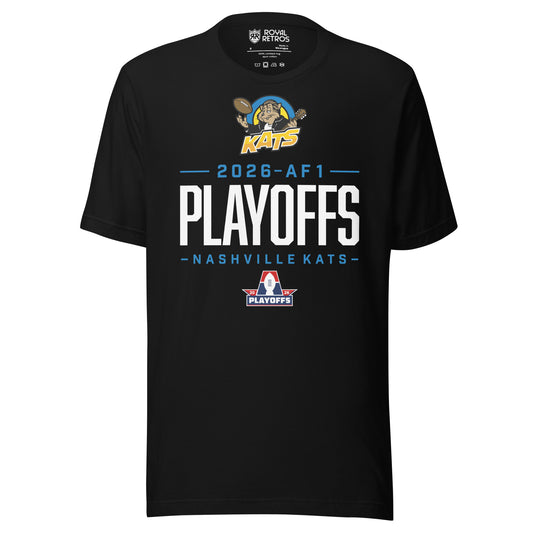
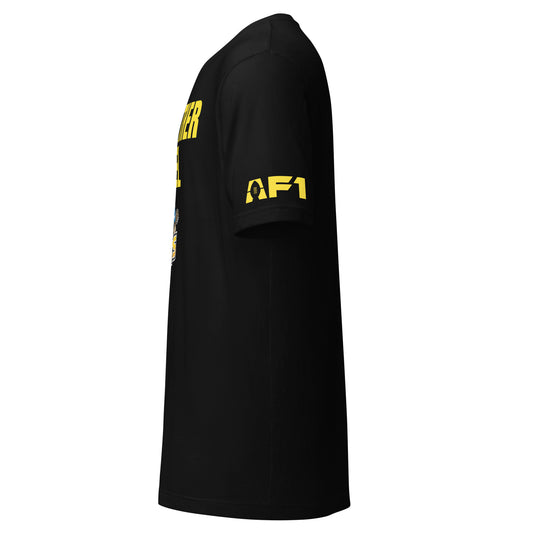
Nashville Kats T-Shirts — Thirteen active tees, $24.99–$49.99. Everyday wear: the classic Kats tee, the throwback tee, the Another Level tee and the long sleeve. The championship run has its own tier: the 2026 Champions tee ($29.99), the Commemorative Arena Crown Roster tee ($44.99) carrying the full title-winning roster, the Arena Crown Matchup tee ($39.99), and the in-the-moment playoff pieces made during the run itself — the Claim The Crown tee, the Chase The Crown tee and the Playoffs tee. On-field styling comes from the On Field Performance tee ($49.99), with a women's tee ($29.99) and youth tee ($24.99) for the rest of the family.
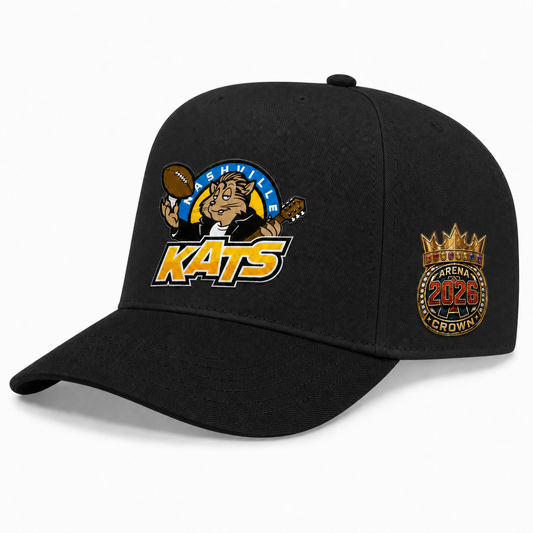
Nashville Kats Hats — Five active caps, $29.99–$39.99: the limited 2026 Arena Crown snapback ($39.99), the Kats snapback ($34.99), the trucker cap ($32.99), the Playoffs trucker ($29.99) and the unstructured dad hat ($29.99). Adjustable backs, one size fits most.
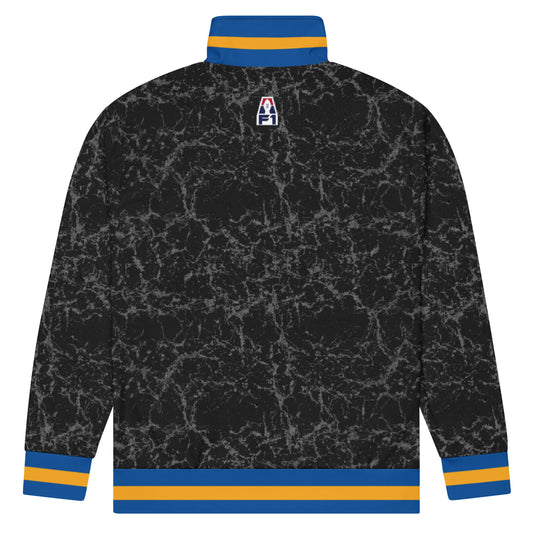
Nashville Kats Hoodies, Sweatshirts & Jackets — The Kats hoodie ($64.99) is the core heavyweight pullover, the On Field hoodie ($79.99) the sideline-styled build, and the quarter-zip ($59.99) the layer for spring arena-football weather in Middle Tennessee. Outerwear runs from the retro track jacket ($99.99) to the made-to-order satin varsity jacket ($219.99–$249.99), the one Kats garment built to be handed down. Sizes S–5XL.
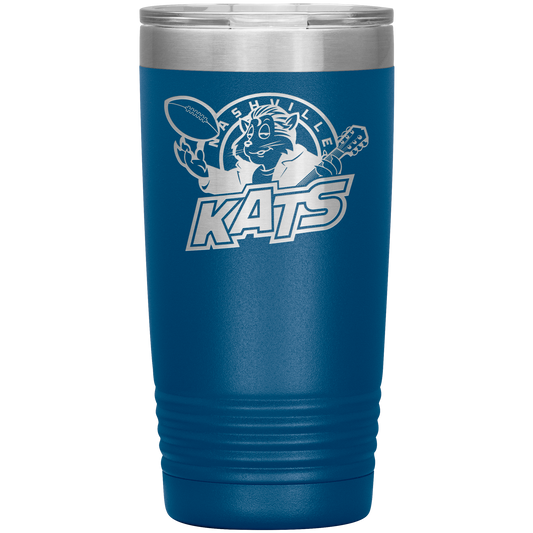
Nashville Kats Activewear, Collectibles & Drinkware — The performance polo ($54.99) works for the golf course or the office and the fleece shorts ($39.99) round out a full Kats fit. For the shelf rather than the closet: the throwback mini helmet ($64.99), the Nashville Kats AF1 football ($69.99) and the Kats tumbler ($34.99).
Customization & Sizes — Free custom name and number on most jerseys. Put a Kats name on the back — Andy Kelly, Corey Fleming or Darryl Hammond from the original AFL years, Tyler Kulka or Malik Honeycutt from the 2026 Arena Crown roster — or your own. Custom items are made to order and final sale. Sizes Small through 5XL on virtually every adult product, plus a youth tee and a women's cut, with no big & tall upcharge.
Shop the Kats by Era — What Each Build Means
The Original AFL Kats, 1997–2001 — royal, silver and black. The first Kats played downtown at what was then Nashville Arena, the $144 million building that opened in 1996 and is Bridgestone Arena today; they were its first pro tenant. This is the era of Andy Kelly throwing to Corey Fleming, the Stray Kats on the sideline, and the rockabilly cat in a leather jacket with a guitar neck in one paw. The 1990's Nashville Kats jersey and the AF1 Throwback jersey are the two builds pointed at this decade, with the throwback tee and throwback mini helmet alongside them.
The Titans-Colored Kats, 2005–2007 — light blue, red and white. When Bud Adams brought the Kats back in 2005, the uniforms were repainted in Tennessee Titans colors and a mascot called Kool Kat took the floor. We do not currently carry a 2005–2007-specific build; the throwback line reaches back to the 1990s original look, which is the one collectors ask for by name. If you want the Titans-colored Kats, tell us — demand drives what gets built.
The Modern AF1 Kats, 2024–present — blue, yellow, black and white. The revived Kats debuted in the relaunched Arena Football League in 2024, moved to Arena Football One in 2025, and now play at F&M Bank Arena in Clarksville. The replica jersey, custom 2026 jersey, classic tee, snapback and unstructured hat all live in this era. This is the gear you wear to a game.
The 2026 Arena Crown Championship — 11–1, then a goal-line stand. The 2026 Kats went 11–1, took the No. 1 seed and beat the Albany Firebirds 59–53 on August 9, 2026, for the first championship in Nashville Kats history across all three incarnations. The whole championship tier is built around it: the 2026 Arena Crown jersey, the Arena Crown snapback, the Champions tee, the roster tee and the matchup commemorative tee. Championship product is limited edition — when a run is over, the reorders stop.
Why Royal Retros Is the Home of Nashville Kats Gear
-
The deepest Nashville Kats collection on the open web. 33 active products — jerseys, tees, hats, hoodies, jackets, a polo, shorts, drinkware, a mini helmet and a football. No other retailer carries the Kats this wide.
-
Three eras in one place. 1990s AFL throwbacks, the modern AF1 look, and the 2026 Arena Crown championship line. Most shops carry one. We carry the arc.
-
Championship product while it is still current. The 2026 Arena Crown jersey, snapback, Champions tee, roster tee and matchup tee are limited-edition pieces, not generic gear with a year printed on it.
-
Free customization on most jerseys. Name and number at no extra cost on eligible styles.
-
Real price range. Jerseys $69.99–$119.99, tees from $24.99, hats from $29.99 — you can start a Kats collection for under thirty dollars or go to a $249.99 made-to-order satin varsity jacket.
-
Sizes Small through 5XL. No big & tall upcharge, plus women's and youth cuts.
-
Arena football cross-shopping. Pair a Kats piece with the wider AF1 collection, the Arena Football League archive, the AF2 collection, or Tennessee's broader Tennessee sports apparel.
-
Officially licensed. This is licensed arena football product.
Quick Buying Questions
What sizes do Nashville Kats jerseys come in?
Small through 5XL on virtually every jersey style, with no big & tall upcharge. Hats are one-size-fits-most with adjustable closures, and there is a youth tee and a women's cut for the rest of the family.
Can I add my name and number to a Nashville Kats jersey?
Yes — most styles offer free customization. Put a Kats original on the back, pick a name from the 2026 Arena Crown roster, or use your own. Look for the "Custom" option on the listing.
What's the difference between the replica jersey and the tackle twill jersey?
The replica ($69.99) is the lighter everyday build — screened graphics, comfortable for a full game day. The 2026 Arena Crown jersey ($119.99) is tackle twill: sewn, layered lettering and numbers with real weight to them. The custom AF1 jersey ($84.99) sits between the two and is the one most people buy.
Is the 2026 Arena Crown gear limited?
Yes. Championship product is produced for the moment it commemorates. Once a title run is finished, restocks are not guaranteed on the jersey, the snapback, the roster tee or the matchup tee.
Are the 1990s throwbacks accurate to the original Kats?
The throwback line is built to the original franchise's royal, silver and black era at Nashville Arena, including the rockabilly-cat mark. It's a heritage tribute to the 1997–2001 club, cut for modern sizing rather than reproduced as a museum piece. Construction runs tackle twill on the premium jerseys, performance knit on the replica, pre-shrunk cotton on the tees, heavyweight fleece on the hoodies and a satin shell with knit trim on the varsity jacket.
How fast does it ship and what's the return policy?
Standard products ship within 3–5 business days. Custom items with personalized name and number are made to order and ship within 7–10 business days; the made-to-order satin jacket runs longer. Custom items are final sale. Standard items follow our return policy at /pages/returns.
Is this officially licensed?
Yes.
Gift Ideas for the Nashville Kats Fan
-
For the fan who was there in 1997: The 1990's Kats jersey is the royal-silver-black look from the year the franchise set the AFL record for wins by an expansion club. That season is a specific Nashville memory, and almost nobody makes gear for it.
-
For the 2026 championship: The Commemorative Arena Crown Roster tee carries the full title-winning roster. First championship in franchise history — there is no second one to buy yet.
-
For the Clarksville season-ticket holder: A quarter-zip or the On Field hoodie. Spring arena football in Middle Tennessee is warm inside and cold on the walk back to the car.
-
For the collector: The throwback mini helmet ($64.99) or the AF1 football ($69.99) — display pieces, not closet pieces. For the big gift, the satin varsity jacket ($219.99–$249.99).
-
For under $40: The youth tee ($24.99), the tumbler ($34.99), the unstructured hat ($29.99) or the classic tee ($29.99). Stocking-stuffer tier that still reads as real fandom.
-
Year-round demand. Arena football runs spring into summer, which makes Kats gear one of the few sports gifts not competing with an autumn calendar.
About the Nashville Kats
The Nashville Kats are one of the most distinctive franchises in arena football history — and one of the very few that has lived three separate lives under the same name. There was the original club that played in the Arena Football League from 1997 through 2001 and made the playoffs in every single season it existed. There was the Bud Adams expansion revival that ran from 2005 through 2007 in Tennessee Titans colors. And there is the current team, launched in 2024, now a member of Arena Football One, playing out of F&M Bank Arena in Clarksville and reigning 2026 Arena Crown champion.
The name itself is pure Nashville. It comes from "Nashville Cats," the 1967 Lovin' Spoonful hit about Music City session players — the studio musicians who could, in the song's telling, play clean as country water and wild as mountain dew. The logo followed the name: an anthropomorphic tabby in a 1950s leather jacket, holding the neck of a guitar in one paw and juggling a football in the other. The mascot version was called Wild Fang. The cheer squad was the Stray Kats. Nobody has ever accused the Nashville Kats of a generic identity.
What ties all three incarnations together is that the Kats have almost always been good and have almost never been the problem. The original team made the playoffs five times in five years and reached back-to-back ArenaBowls; the revival made the playoffs in year two; the current team has been to two straight championship games and won the second. Every time the Kats have gone away it was a lease, an owner's attention span or a league collapsing — never Nashville failing to show up.
Arena Football and Why Nashville Was Built for It
Arena football is a fundamentally different game from the outdoor version. It's played on a 50-yard field inside a hockey-sized arena, eight players a side, with padded walls instead of sidelines and rebound nets flanking the goalposts that keep missed kicks and incomplete passes live. Scores in the 50s and 60s are routine, most players go both ways under the "ironman" tradition the league was built on, and the whole product is engineered for a mid-size indoor building and a crowd close enough to hear the collisions.
Nashville in the mid-1990s was, on paper, a perfect market for it: a city that had just spent $144 million on a downtown arena that opened in 1996 with no anchor tenant confirmed, a huge regional football audience with no NFL team of its own until the Oilers relocated, and a downtown entertainment district that a Saturday-night indoor football game slotted into cleanly.
The AFL awarded Nashville an expansion franchise on January 4, 1996. Technically the club was a reactivation of the dormant Denver Dynamite franchise — one of the four charter teams from the AFL's 1987 debut season, winner of the very first ArenaBowl, and idle since 1991. The paperwork lineage matters less than the effect: Nashville got a team, the team got the new building first, and for two years the Kats were the only professional franchise playing in downtown Nashville's brand-new arena.
The Original Kats, 1997–2001 — Five Seasons, Five Playoff Berths
The Nashville Kats played their first game on May 2, 1997, beating the San Jose SaberCats 47–21 in front of 11,582 at Nashville Arena. They did not slow down. The 1997 Kats finished 10–4, a new Arena Football League record for wins by an expansion club, and the league named them its Organization of the Year. Interest compounded across the summer, and the team announced its first sellout for the regular-season finale against the Orlando Predators in July.
The original ownership group was a Nashville business coalition led by majority owner Mark Bloom, with Hollis Godfrey, Larry Papel, Al Ross, Ronnie Scott, David Wachtel Jr. and Raymond Zimmerman. Country music star Travis Tritt held a small piece — the first of what became a running theme of Nashville entertainment figures attaching themselves to this franchise.
The first head coach was Eddie Khayat, who ran the team in 1997 and 1998. His offensive coordinator was Jay Gruden, in the first coaching job of Gruden's career — the same Jay Gruden who would become an Arena Football Hall of Famer as a player and eventually an NFL head coach. Khayat was succeeded by Pat Sperduto, who would coach the rest of the original Kats' existence and the entire second incarnation on top of it.
Two former University of Tennessee stars anchored the roster and gave the team an immediate in-state identity. Quarterback Andy Kelly had been a two-year starter for the Vols in 1990 and 1991. Wide receiver Corey Fleming was a third-round Dallas Cowboys draft pick in 1994 whose NFL career ended in 1996. Both played all five seasons in Nashville, 1997 through 2001, which in a league with that much roster churn is close to unheard of. Fleming was twice named to All-Arena teams and once to an All-Ironman team.
The Kats made the playoffs in every one of their five seasons. That is the single most underrated fact about this franchise: five years of existence, five postseason appearances, zero rebuilding years.
ArenaBowl XIV and XV — Two Finals, Two Losses
The 2000 Kats reached ArenaBowl XIV and lost 41–38 to the Orlando Predators when Predators kicker David Cool made a 19-yard field goal on the final play. Three points, one snap, and the franchise's first championship went the other way. It remained the closest a Nashville Kats team came to a title until 2026.
Nashville got straight back to the championship game in 2001. ArenaBowl XV, played August 19, 2001, went the other direction entirely — the Grand Rapids Rampage won 64–42. It was not close, and it turned out to be the last game the original Nashville Kats ever played.
Two consecutive ArenaBowl appearances in a franchise's fourth and fifth seasons is genuinely rare in the sport. The Kats never won one under the original ownership, and the losses have a particular flavor in Nashville memory: the one decided by a field goal, and the one that got away early.
Why the Kats Left the First Time — The Lease, Not the Fans
The original Kats did not fail. They were sold and moved, and the reason was a building.
The NHL's Nashville Predators began play in 1998, two seasons after the Kats opened the arena, and as primary tenant the Predators effectively controlled arena management and the terms available to secondary tenants. Mark Bloom's group could not reach a lease it considered workable. There was no attendance crisis — the Kats out-drew several ongoing AFL franchises — and no competitive crisis, since the team had just played in back-to-back ArenaBowls. It was purely an economics-of-the-building problem.
In late 2001 Bloom sold the franchise to Atlanta businessman Virgil Williams. The reported price has been given as roughly $10 million and as $12 million depending on the source, but every account agrees it was a record sale price for an Arena Football League franchise at the time. The team relocated for 2002 and was rechristened the Georgia Force. For Nashville it was a strange kind of loss: the team was good, the crowds were real, the identity was beloved, and it left anyway.
The Second Life, 2005–2007 — Bud Adams, Tim McGraw and Kool Kat
Almost immediately after the original franchise's departure was arranged, the AFL awarded a Nashville expansion franchise to Bud Adams, owner of the NFL's Tennessee Titans, who also purchased the rights to the Kats identity, logo and marks. Adams became the eighth NFL owner to buy into the Arena Football League during a period when the AFL was actively courting NFL money.
It took Adams four years to get the team on the floor, for exactly the same reason the first team left: he could not initially reach an arena agreement he liked with the Predators. Nashville's other large indoor rooms were unusable — Municipal Auditorium's floor was too small for a regulation arena football field, and Vanderbilt's Memorial Gym ran a no-alcohol policy for on-campus athletic events. Adams went as far as exploring building his own roughly 10,000-seat arena. In the summer of 2004 the Predators finally agreed to a deal, and the Kats returned in 2005 to the building the original team had opened.
Country music star Tim McGraw came in as a minority investor. McGraw, Faith Hill and their children were regularly on the front row of the sideline seats behind the south end zone, and the arena PA played his hit "I Like It, I Love It" after every Kats touchdown. The uniforms were rebuilt in Titans colors — light blue, red and white, replacing the original royal, silver and black — and the logo picked up the lighter brown-and-blue AFL ball of that era.
One detail from the relaunch matters more than it looks. When the Kats came back, they reclaimed the history and records of the original franchise from the Georgia Force, the same arrangement the NFL made with the Cleveland Browns and the CFL made with the Montreal Alouettes. The 1997–2001 seasons belong to Nashville, not Atlanta, by agreement.
The on-field results were mixed. The 2005 team started badly — one opening road win, then nothing until week eight — before ripping off five straight wins to finish 6–9–1. That season included a 41–41 tie at the Dallas Desperados on April 8, only the second tie in AFL history, and it prompted the league to rewrite its overtime rules to eliminate ties before the 2006 season. The 2006 Kats went 8–8, made the playoffs, and lost in the opening round to the Chicago Rush. The 2007 team went 7–9 and missed the postseason on the last weekend when a Utah Blaze win closed the door.
On October 10, 2007, Adams shut the operation down. Ticket sales had been strong at the relaunch but never recovered from the poor 2005 debut season, and the owner's interest had visibly faded. The second Nashville Kats folded after three seasons.
The Wilderness Years, 2008–2023
The Kats were not among the franchises mentioned when the AFL reorganized and relaunched in 2010, though Nashville fans kept asking for the team back at what had become Bridgestone Arena. The one interruption came in 2014, when the Nashville Venom began play at Nashville Municipal Auditorium in the Professional Indoor Football League — a different, smaller-field code than arena football, which is how it fit in a building that could never host the Kats. The Venom won their league's championship in that first season and then disappeared along with the entire league after 2015.
For roughly sixteen years, from Bud Adams pulling the plug in October 2007 to the announcement in November 2023, the Nashville Kats existed only as a logo people still owned shirts of. Which is a large part of why the throwback demand for this team is as durable as it is.
The Revival — 2024, Arena Football One, and the 2026 Arena Crown
On November 1, 2023, a relaunched Arena Football League announced the return of the Nashville Kats. The new club is legally unrelated to the earlier franchises but deliberately built on their identity, and the ownership story got Nashville's attention immediately: Jeff Fisher, the former Tennessee Titans head coach, came in as a partner and president of football operations. Longtime broadcaster Eli Gold — the former voice of the original AFL on TNN and NBC Sports, and the former voice of Alabama football and NASCAR — was named the team's new radio voice.
The 2024 season was played mostly at Nashville Municipal Auditorium with a game at F&M Bank Arena in Clarksville. The Kats finished 3–4, then beat Orlando 62–32 in the quarterfinals before losing the semifinal to the eventual champion Billings Outlaws 35–32. That league did not survive the year. On September 4, 2024, the Kats and the seven other surviving members formed Arena Football One, with Fisher named permanent commissioner while keeping his role with the Kats.
The off-season was turbulent. The ownership entity sued its own chairman, Chuck McDowell, over an alleged unpaid $2.5 million promissory note; the dispute settled and McDowell led a ceremonial coin toss at a 2025 home game on his way out. Head coach Dean Cokinos left quietly for the European League of Football, and in February 2025 the Kats hired Darren Arbet — four-time ArenaBowl-winning head coach with the San Jose SaberCats and a two-time league coach of the year. In May 2025 Jeff Fisher became majority owner alongside Greg Pogue and CEO Bobby Devoursney, then Jon Gruden joined leading football operations, then former NASCAR driver Michael Waltrip in June, then professional wrestler Jeff Jarrett as managing partner in March 2026. It is, once again, a very Nashville ownership table.
On the floor, the 2025 Kats went 6–4, finished second in the AF1 East, beat the Southwest Kansas Storm 62–32 in the semifinals, and lost the first Arena Crown championship game to the Albany Firebirds 60–57. Another three-point championship loss, twenty-five years after ArenaBowl XIV.
Then came 2026. The Kats went 11–1 in the regular season and took the No. 1 seed. Quarterback Tyler Kulka led AF1 with 2,835 passing yards and 56 touchdown passes. Wide receiver Malik Honeycutt led the league with 1,047 receiving yards, a league-best 95.2 yards per game, 19 receiving touchdowns and 114 points. Nashville beat Michigan in the semifinal to move to 12–1 and drew Albany again in the Arena Crown, this time at home.
On August 9, 2026, in front of a sellout crowd of 4,066 at F&M Bank Arena in Clarksville, the Kats and Firebirds went to 53–53 inside the final minute. Kulka found Honeycutt for a 25-yard touchdown to put Nashville ahead. Albany drove back. On the last play of the game, Kats defender Roderick Perry stopped Albany quarterback Sam Castronova short of the goal line on a sneak. Final: Nashville 59, Albany 53.
It is the first championship in the history of the Nashville Kats name — across the 1997–2001 club, the 2005–2007 club and the current one. Three incarnations, two ArenaBowl losses, one Arena Crown loss, and finally a title.
Notable Nashville Kats Players and Coaches
Andy Kelly — Quarterback, 1997–2001. A two-year starter at Tennessee in 1990 and 1991 who then played all five seasons of the original franchise. The face of the first Kats era.
Corey Fleming — Wide receiver/linebacker, 1997–2001. Another Vol, a 1994 third-round Dallas Cowboys pick, and a two-time All-Arena and All-Ironman selection with the Kats.
Darryl Hammond — Wide receiver/defensive back, 1997–2001. An All-Arena and two-time All-Ironman selection and a 2013 inductee into the Arena Football League Hall of Fame. Hammond died in February 2017 at 50 after a battle with ALS. He is the player the original Kats' surviving fanbase names first.
James Baron — Offensive line/defensive line. Five All-Arena selections, the most of any Kats player, plus two All-Ironman selections.
Jay Gruden — Offensive coordinator, 1997–1998. His first coaching job anywhere, taken before an Arena Football Hall of Fame playing career and a later NFL head coaching career.
Pat Sperduto — Head coach. Took over from Eddie Khayat, coached the original Kats to consecutive ArenaBowl appearances in 2000 and 2001, then returned for the entire 2005–2007 revival.
Darren Arbet — Head coach, 2025–present. Four ArenaBowl championships with the San Jose SaberCats and two coach-of-the-year awards before Nashville, then the 2026 Arena Crown in his second season with the Kats.
Tyler Kulka and Malik Honeycutt — The 2026 championship connection. Kulka led AF1 in passing yards and touchdown passes; Honeycutt led it in receiving yards, yards per game, receiving touchdowns and points. They combined for the go-ahead score in the Arena Crown, and Roderick Perry's goal-line stop on the final snap finished it.
The Kats in the Tennessee Sports Landscape
Nashville's professional sports history is shorter than the city's size suggests, and the Kats are woven through the beginning of it. When they debuted in May 1997, the Predators had not yet played a game and the Oilers had not yet finished becoming the Titans. For two seasons the Kats were the professional team in that downtown arena.
The Kats' fortunes have been shaped by the two bigger franchises ever since. The Predators' status as arena anchor is the direct reason the original Kats left in 2001 and the reason it took Bud Adams four years to get the second version off the ground — and Adams, the Titans' owner, then shut that second version down. The modern club is led by Jeff Fisher, who coached the Titans for seventeen seasons, with Jon Gruden and Michael Waltrip in the ownership group.
The move to Clarksville for the 2026 season is a genuine shift and worth understanding before you buy. F&M Bank Arena opened in 2023 and makes the Kats the priority tenant rather than the club working around a hockey schedule — which, given that arena leases have ended this franchise twice, is arguably the most important thing that has ever happened to it. Clarksville sits about 45 miles northwest of downtown Nashville, and the team keeps the Nashville name and identity. For Tennessee fans generally, the Kats are the deep cut in the Tennessee collection — the team you wear to signal you followed Nashville sports before it was a national story.
Why the Kats Folded — Twice — and Why This Time Looks Different
The first Kats died of a lease: good team, good crowds, two straight championship games, no workable arena deal, sold and relocated in 2001. The second Kats died of ownership attention — Bud Adams spent four years assembling the return, watched a rough 2005 season damage the ticket base, and shut it down in October 2007 with the team coming off a 7–9 near-miss. Neither time did the market fail.
The third Kats have already survived more than either predecessor faced. The league they launched in collapsed after one season. Their chairman was sued by their own ownership entity. Their head coach left mid-transition. They came out of it with a stable league they helped found, a four-time championship head coach, a locally credible ownership group, an arena where they are the primary tenant rather than the afterthought, back-to-back championship game appearances and a title. Nothing in arena football is permanent, but this is the healthiest the Nashville Kats have ever been at the exact moment they won something.
What Makes Ours Period-Correct
Construction and accuracy. Sewn-on tackle-twill numbers and lettering where the original build called for it, era-correct fonts and colors, and true-to-original construction — every Nashville Kats design is checked against period references before it goes live.
More Frequently Asked Questions About the Nashville Kats
Who are the Nashville Kats?
An arena football franchise from Nashville, Tennessee, that has existed in three incarnations: the original Arena Football League club from 1997 to 2001, a second AFL club owned by Bud Adams from 2005 to 2007, and the current team founded in 2024 that now plays in Arena Football One. The current Kats are the 2026 Arena Crown champions.
Why are they called the Kats?
The name comes from "Nashville Cats," the 1967 Lovin' Spoonful song about Music City's session musicians. The logo is a rockabilly tabby in a leather jacket with a guitar in one paw and a football in the other. The mascot was Wild Fang; the cheer squad was the Stray Kats.
Did the Nashville Kats ever win a championship?
Yes — once, in 2026. The Kats won the AF1 Arena Crown 59–53 over the Albany Firebirds on August 9, 2026, at F&M Bank Arena. Before that the franchise had lost three championship games: ArenaBowl XIV in 2000 (41–38 to Orlando), ArenaBowl XV in 2001 (64–42 to Grand Rapids) and the 2025 Arena Crown (60–57 to Albany).
Why did the original Nashville Kats leave?
An arena lease dispute, not a lack of support. As primary tenant of the downtown arena, the NHL's Nashville Predators controlled the terms available to secondary tenants, and Mark Bloom's group could not reach a workable agreement. Bloom sold to an Atlanta group in late 2001 for a then-record AFL price — reported between roughly $10 million and $12 million — and the team became the Georgia Force in 2002.
Do the Kats own the original team's history?
The 2005 revival reclaimed the 1997–2001 records and history from the Georgia Force by agreement, the same way the Cleveland Browns and Montreal Alouettes arrangements worked. The current 2024 club is legally a separate franchise but is built on the same name, identity and heritage.
Where do the Nashville Kats play now?
F&M Bank Arena in Clarksville, Tennessee, as of the 2026 season. Earlier modern seasons were mostly at Nashville Municipal Auditorium. The original and second incarnations both played downtown at what is now Bridgestone Arena.
What is Arena Football One?
AF1 is the league formed on September 4, 2024, by the eight surviving members of the collapsed 2024 Arena Football League, with former Titans head coach Jeff Fisher as commissioner. Its championship game is called the Arena Crown. The Kats compete in the East Division alongside the Albany Firebirds and the Orlando Predators. Browse the full AF1 collection and AF1 League Gear.
What's the difference between the AFL, AF2 and AF1?
The Arena Football League ran from 1987 to 2019 and is the league the original and second Kats played in — note that in arena football "AFL" means the Arena Football League, not the 1960s American Football League. AF2 was its developmental league from 2000 to 2009. AF1, Arena Football One, is the current league, founded in 2024 and playing from 2025.
How many Nashville Kats products does Royal Retros carry?
33 active products — five jerseys, thirteen T-shirts, five hats, three hoodies and sweatshirts, two jackets, a performance polo, fleece shorts, a tumbler, a throwback mini helmet and an AF1 football. It is the largest Kats-specific collection anywhere on the open web.
Where can I find related Royal Retros arena football collections?
Start with the full AF1 collection, then the AF1 League Gear line, the Arena Football League archive, AF2, the Kats' championship-game rival the Albany Firebirds, statewide Tennessee apparel, and our custom football jerseys.
Shop Related Arena Football and Tennessee Collections
-
AF1 — The full Arena Football One collection across every current franchise.
-
AF1 League Gear — League-branded arena football apparel, not tied to one team.
-
Arena Football League — The 1987–2019 AFL archive, including the era the original Kats played in. (Arena Football League, not the 1960s AFL.)
-
AF2 — The AFL's developmental league, 2000–2009.
-
Albany Firebirds — The Kats' opponent in both the 2025 and 2026 Arena Crown championship games. The rivalry that made the title mean something.
-
Tennessee — Statewide Tennessee sports apparel across every sport we carry.
-
Custom Football Jerseys — The full custom football jersey program, name and number included.
The Nashville Kats at Royal Retros — 2026 Arena Crown Champions. 1990s Throwbacks to Modern AF1. Custom Names & Numbers. Sizes S–5XL.