














Recently Viewed
International Soccer Jerseys — Spain, Mexico, USA and Canada National Team Apparel
Four Countries, One World Cup Summer. 4 Active Styles, $84.99 Flat. Free Custom Names & Numbers. Sizes S–5XL.
Royal Retros carries 4 active international soccer jerseys, and this July, all four countries they represent were part of the biggest story in the sport. Spain, Mexico, the United States and Canada — the countries in this collection — split cleanly across the 2026 World Cup: three of them co-hosted the first-ever 48-team, three-country tournament, and the fourth won it. Every jersey here is a made-to-order, vintage-inspired national-team design, priced at a flat $84.99 with free name, number or custom text personalization in sizes S–5XL. This isn't a wall of jerseys for every country FIFA recognizes — it's four specific national identities, each with a real design story, sold alongside the actual history of what just happened this summer. Two more countries, Argentina and Colombia, are currently out of stock and not shown here. Below: how to shop each country, and the World Cup that ties all four together.
What You Can Shop
Every product in this collection is the same core item — a made-to-order national-team jersey — built differently for each country's design story. All four run S–5XL at a flat $84.99, with free name, number or custom text personalization included and lead time shown at checkout. Customized jerseys are made to order and final sale, standard for personalized product across the site. There are no hats, tees or hoodies tagged to this collection today — just jerseys, and the design differences between the four are the entire point of this page.
Shop by Country
Four countries, four different jersey stories — one built around a specific historic kit, three built around a country's colors and soccer culture more broadly.
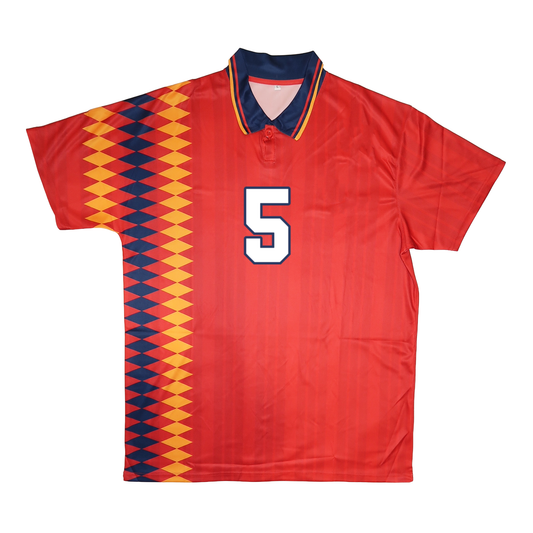
- Spain — the collection's only jersey tied to one specific historic kit: a mid-1990s La Roja design built around a diamond-harlequin sash, offered in both the red home and blue away colorways with the yellow-and-red trim of the Spanish flag. It's also, as of this July, the jersey of soccer's reigning world champion. Shop the jersey.
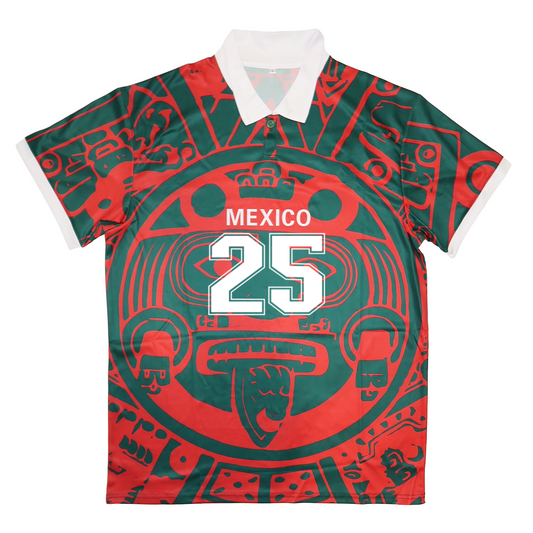
- Mexico — green, white and red styling built around more than a century of fútbol mexicano, tracing back to British miners who brought the game to Pachuca in the late 1800s. Shop the jersey, or browse the wider Mexico collection for baseball and football product too.
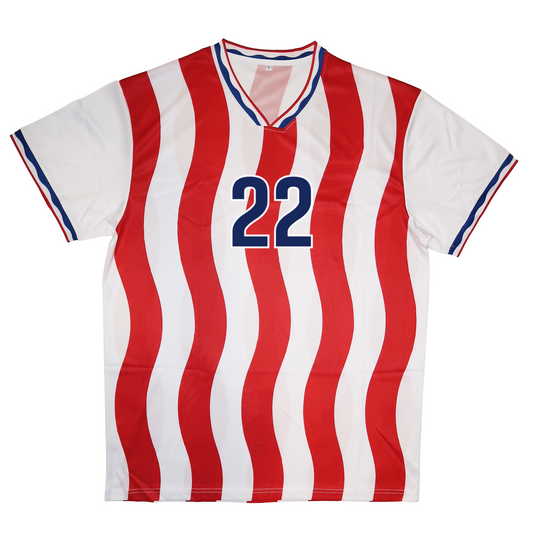
- USA — red, white and blue styling honoring more than a century of American soccer, from East Coast industrial-town clubs in the late 1800s to today's national program. Shop the jersey.
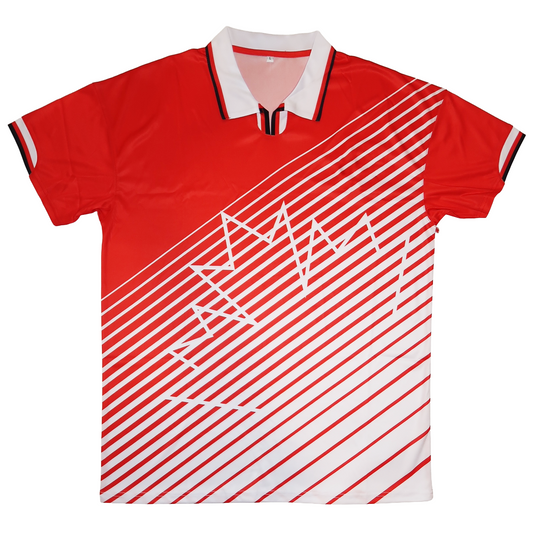
- Canada — red-and-white styling for a soccer culture played coast to coast since the nineteenth century and woven into the country's multicultural identity. Shop the jersey.
Two more countries — Argentina and Colombia — are tagged to this same product line but currently out of stock, so they're not shown or linked here. Check back; availability shifts as designs cycle back into stock.
Wearing It Beyond World Cup Summer
None of this reads as costume once the tournament ends. Lightweight, printed polyester jerseys in national colors have become a genuine streetwear staple well outside match days — worn open over a tee, tied at the waist, or layered under a jacket the same way any graphic-forward piece gets worn. The Spain jersey's red-and-blue harlequin design and the tricolor Mexico jersey both read as bold statement pieces on their own; the USA and Canada jerseys, in cleaner red-white-and-blue and red-and-white builds, work a little more like an everyday layering piece. A personalized name and number makes any of the four a one-of-one rather than a shelf item, which is a meaningfully different pitch than a plain flag-colored tee. This is gear for people who'll still be wearing it long after the last Round of 16 recap has been written.
Why Royal Retros for International Soccer Gear
- Four national-team designs in one place, each built from a real design detail — Spain's actual mid-1990s harlequin kit, not a generic flag-colored placeholder.
- Free name, number or custom text personalization on every jersey, sizes S–5XL, one flat $84.99 price with no big-and-tall upcharge.
- A straightforward, heritage-first approach: nothing here is claimed as officially licensed, and the FAQ below says so plainly.
- Real, current research — this page was written weeks after the actual 2026 World Cup final, not built around guesswork about a tournament still to come.
- Stock items ship within a few business days; every jersey here is made to order, so check the lead time shown at checkout.
- Part of a wider Royal Retros international catalog — the full Mexico collection, plus Japan and Puerto Rico baseball, sit alongside this page.
Quick Buying Questions
What sizes are available?
All four jerseys run S–5XL at a single flat price, with no big-and-tall upcharge.
Is customization free?
Yes. Every jersey includes free name, number or custom text personalization. Choose your details and size at checkout.
How fast does it ship?
Every jersey on this page is made to order. Lead time is shown in the customization screen before you complete your order.
What's the return policy?
Customized jerseys are made to order and final sale — no returns or exchanges, standard for personalized product across the site.
Are these officially licensed?
No. These are vintage-inspired reproductions, not affiliated with, endorsed by or sponsored by any team, league or federation. They're heritage tribute apparel, not officially licensed merchandise, and we say so plainly rather than letting a national-colors design imply a license we don't hold.
Good Gifts From This Collection
- For a Spain fan celebrating July — the jersey doubles as both a specific 1990s design tribute and, this year, the shirt of the actual world champion.
- For someone into World Cup history generally — pairing the USA or Canada jersey with the story of this year's three-host tournament makes for a gift with a real hook behind it.
- For a Mexico fan — start with the jersey here, then browse the full Mexico collection for baseball, soccer and football product together.
- For a simple, low-risk personalized gift — any of the four jerseys can carry a name and number that means something to the recipient, not just a country name.
What Made the 2026 World Cup Different From Every World Cup Before It?
It was the first World Cup ever played across three host countries, and the first played with 48 teams instead of 32. Canada, Mexico and the United States shared hosting duties across 16 stadiums in 16 cities — eleven in the U.S., three in Mexico and two in Canada — for a tournament that ran 104 matches from June through July 2026 and used the expanded bracket for the first time, adding an entire extra knockout round, the Round of 32, ahead of the traditional Round of 16. That expansion is part of why Spain's championship run went eight matches deep instead of the usual seven, one game longer than any previous World Cup winner has had to play. Three of the four countries represented in this collection — Mexico, the United States and Canada — hosted matches on home soil; the fourth, Spain, won the whole tournament.
How Did Spain Win the 2026 World Cup Final?
Spain beat reigning champion Argentina 1-0 in extra time on July 19, 2026, at New York New Jersey Stadium, with substitute Ferran Torres scoring the winner 39 seconds into the second period of extra time — an 8-yard finish in the 106th minute, after coming on in the 62nd. Argentina played the finish a man down: midfielder Enzo Fernández was sent off for a reckless foul on Spanish defender Pau Cubarsí, and goalkeeper Emiliano Martínez made several strong saves to keep the match scoreless as long as he did. Spain dominated the underlying numbers by a wide margin — 1.94 expected goals from 20 shots against Argentina's 0.2 from two attempts — and closed the tournament having allowed just a single goal across all eight matches, the fewest of any World Cup champion in the competition's history, despite playing the longest championship run on record.
Why Is Spain Considered International Soccer's Most Dominant Modern Team?
Because no other men's national team has strung together the run Spain put up between 2008 and 2012, and because the 2026 title extended a run of success that's now spanned nearly two decades. Spain is the only men's national team ever to win three consecutive major tournaments — the 2008 European Championship, the 2010 World Cup and the 2012 European Championship — a treble no country had managed before and none has matched since. The 2026 World Cup title, Spain's second, came sixteen years after the first, which Spain won 1-0 in extra time over the Netherlands in Johannesburg in 2010. Between those two World Cup titles, Spain added a fourth European Championship in 2024, winning all seven matches of that tournament — a Euros record — and beating England 2-1 in the final on a late goal from Mikel Oyarzabal, plus a 2023 UEFA Nations League title. That's four Euros in total (1964, 2008, 2012, 2024) alongside the two World Cups. Head coach Luis de la Fuente, appointed in December 2022 after that year's World Cup, has now delivered the Nations League, the Euros and the World Cup inside four years — the most successful stretch for the program in over a decade — and signed a contract extension through the 2028 European Championship. The jersey on this page draws on the mid-1990s La Roja kit that predates all of that success, a reminder that Spain's soccer identity existed well before the golden era that's defined the program for the last two decades.
How Did the Three Host Nations Perform at Their Own World Cup?
All three reached the Round of 16 before being eliminated — a genuinely strong showing for a 48-team field, even without a deep run. Canada, Mexico and the United States each won their Round of 32 match to advance, then lost in the Round of 16: Canada fell to Morocco, Mexico fell to England, and the United States fell to Belgium. None of the three hosts reached the quarterfinal, but reaching the Round of 16 as co-hosts, in a field nearly 50 percent larger than any previous World Cup, is its own kind of milestone — especially for two of the three programs, covered in more depth below.
Why Was 2026 a Milestone for Canadian Soccer?
Because it was just the third World Cup in the history of the Canadian men's program, and the second appearance in a row after a 36-year gap that separated the first two. Canada's only prior World Cup appearance before 2022 came in 1986; the program didn't return to the tournament again until 2022, when Bayern Munich's Alphonso Davies scored the country's first-ever World Cup goal just 68 seconds into its opening match against Croatia. Co-hosting in 2026 gave Canada a second straight World Cup appearance for the first time in program history, plus a Round of 32 win before the Round of 16 loss to Morocco — real progress from a program that spent more than three decades between its first two tournaments.
How Did American Soccer Go From a 40-Year World Cup Absence to Co-Hosting the Tournament?
Slowly, then suddenly. The United States men's team went 40 years without qualifying for a World Cup before returning in 1990, and that comeback tournament went poorly — the team lost all three group games in Italy. Four years later, the U.S. hosted the World Cup outright, a tournament FIFA had awarded amid real skepticism about a country with no major professional outdoor league at the time; that 1994 tournament became the catalyst for Major League Soccer's launch two years later. The program's signature moment came in 2002: a 2-0 Round of 16 win over Mexico in Jeonju, South Korea — Brian McBride scoring in the 8th minute and Landon Donovan sealing it with a header in the 65th — that sent the U.S. to the quarterfinal for the first time since 1930 and gave the rivalry its lasting "Dos a Cero" nickname. The team appeared in every tournament from 1990 through 2014 before a shocking qualifying miss kept it out of the 2018 field. By 2026, the U.S. was back — hosting a World Cup for the second time, alongside Canada and Mexico, with a Round of 32 win before its Round of 16 exit against Belgium.
What Individual Storylines Defined the 2026 World Cup?
Two storylines stood out above the rest: a 39-year-old writing the final World Cup chapter of his career, and a Spanish squad that spread its individual honors across the roster rather than concentrating them in one star. Lionel Messi delivered the most productive World Cup of his career in his record sixth appearance — eight goals and four assists, both career highs — before going quiet in the final itself and coming up just short in what he and his teammates have since described as very likely his farewell to international football. On the Spanish side, midfielder Rodri was named the tournament's Golden Ball winner as its best overall player, teenage defender Pau Cubarsí took home the Young Player award after his role anchoring the final, and goalkeeper Unai Simón collected the Golden Glove behind Spain's historically stingy defense. The tournament's outright top scorer, with 10 goals, played for France rather than any of the four countries in this collection — a reminder that Spain's title came from a complete team performance, not a single dominant scoring run.
Where Does Mexico's Soccer Story Fit In?
Mexico's soccer history runs deeper than any single paragraph here can cover, and Royal Retros gives it the full treatment on its own dedicated page — the most decorated men's national team in the CONCACAF region, two World Cups hosted on home soil in 1970 and 1986, and a 2026 Round of 16 run as a third-time host. Read the full Mexico story, including the national baseball and Golden Aztecs football history that sits alongside the soccer program on that page.
What's Actually in These Jerseys: Construction and Materials
Every jersey in this collection is 100% polyester with printed, not embroidered, graphics — built to be lightweight and breathable for everyday wear rather than heavyweight replica-kit fabric. Personalization is applied as part of the same made-to-order print process, not a separate patch or iron-on. None of the four jerseys reproduces a current club, federation or governing-body crest; the designs work from national colors and, in Spain's case, a specific historic kit pattern, without using any team, league or federation's protected marks. That's a deliberate distinction, not an oversight — it's the same construction and disclosure standard applied across every unlicensed collection on this site.
Color options are set per country rather than shared across the collection: Spain offers blue and red, Mexico offers green and a green/red split, Canada offers red and white, and USA offers red and blue. Every color option carries the same $84.99 price and the same free personalization — the choice is purely aesthetic, not a pricing tier.
Extended FAQ
Why are Argentina and Colombia not shown on this page?
Both are tagged to this same international soccer product line but are currently out of stock, so they're not linked or described as available here. Check back — availability shifts as designs cycle back into stock.
Did Argentina make the 2026 World Cup final?
Yes. Argentina entered the final as the reigning 2022 champion and lost 1-0 in extra time to Spain, finishing the match a man down after a second-half red card.
Is this collection tied to any single country's professional club league?
No. Every jersey here represents a national team, not a domestic club. Royal Retros carries separate collections for domestic and historic club soccer, including NASL and MISL.
Can I mix countries in one order?
Yes. Every product on this page ships from the same Royal Retros catalog regardless of country.
Does Royal Retros carry more than just soccer for these countries?
Yes. Mexico has its own dedicated collection spanning baseball, soccer and football — shop Mexico. The United States and Canada also have broader multi-sport collections beyond this soccer-specific page — shop USA or shop Canada.
How many goals did Spain concede across the entire 2026 World Cup?
One, across eight matches — the fewest of any World Cup champion in the tournament's history, set despite the champion's run being a full game longer than in any previous, 32-team edition.
Which stadium hosted the 2026 World Cup final?
New York New Jersey Stadium, on July 19, 2026.
How many major titles has Spain won overall?
Six: two World Cups (2010, 2026), four European Championships (1964, 2008, 2012, 2024) and, separately, the 2023 UEFA Nations League.
Did Canada, Mexico and the USA have to qualify for the 2026 World Cup?
No. FIFA automatically qualified all three host nations for the tournament, consistent with longstanding World Cup practice for host countries. Their three automatic slots were deducted from the CONCACAF region's overall allocation rather than added on top of it.
Are these jerseys the same as what the national teams wore at the 2026 tournament?
No. These are vintage-inspired reproductions built around each country's colors and, for Spain, a specific historic 1990s kit design — not reproductions of any team's current match-worn uniform, and not licensed by any federation.
Shop Related Collections
Four Countries, One World Cup Summer — International Soccer Jerseys at Royal Retros. Sizes S–5XL.