



-
CUSTOM
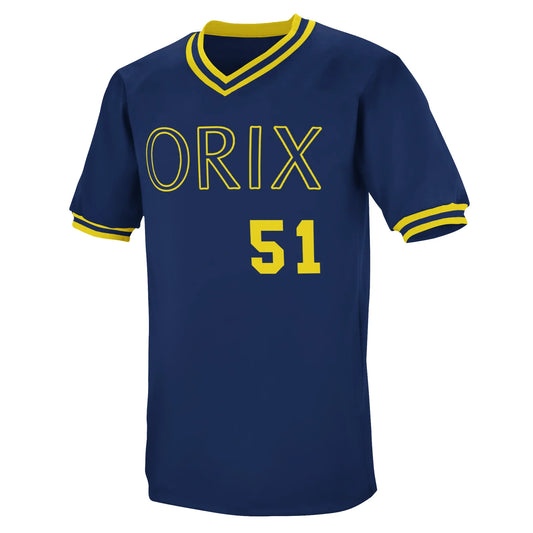
Orix Blue Wave Jersey
Regular price Starting at $123.00 CADRegular priceUnit price per -
-
-
CUSTOM
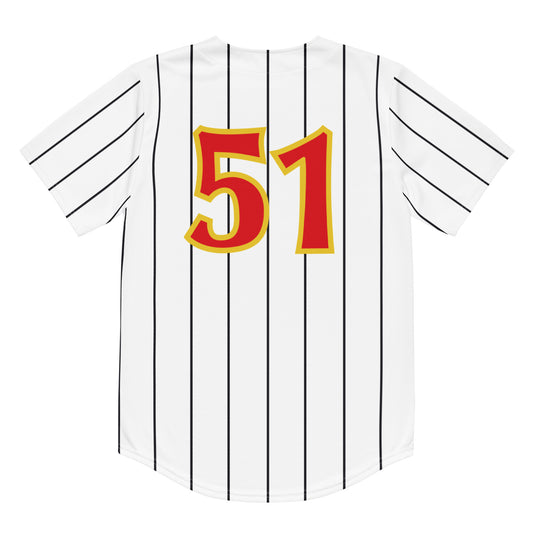
1990's Japan Baseball Jersey
Regular price Starting at $123.00 CADRegular priceUnit price per -
-
Japan Replica Baseball Jersey
Regular price $102.00 CADRegular priceUnit price per -
-
CUSTOM
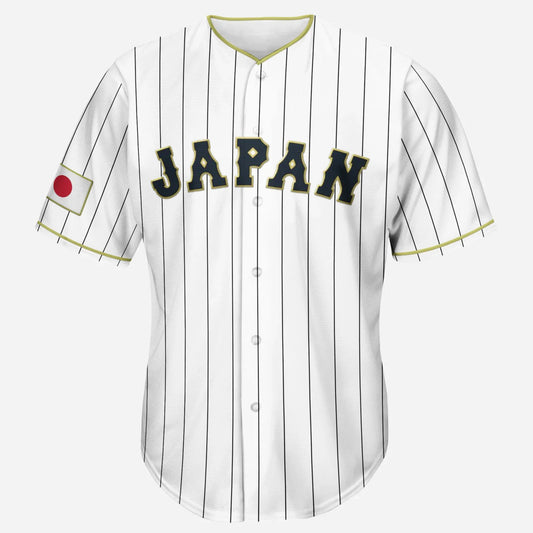
Japan Baseball Jersey
Regular price Starting at $123.00 CADRegular priceUnit price per -








Japan Baseball Streetwear — Samurai Japan & Orix Blue Wave Jerseys, Hats & Tees
Navy and Red National-Team Style. Kobe Heritage. 6 Active Styles, $29.99–$84.99. Free Custom Names & Numbers. Sizes S–5XL.
This is gear for people who know Japanese baseball is the deepest, most disciplined baseball culture on the planet — and want to wear that knowledge instead of explaining it. Royal Retros carries 6 active Japan-tagged styles: national-team jerseys in the navy-and-red look that's defined Samurai Japan since the 1990s, a number-select replica built like a World Baseball Classic jersey, a snapback, and a tribute line for the Orix Blue Wave — the real Kobe ballclub that carried Ichiro Suzuki through the back half of his NPB career before it merged into a combined franchise after the 2004 season. Prices run $29.99 for the Orix Blue Wave T-Shirt to $84.99 for a fully custom jersey, most jerseys with free name-and-number personalization in sizes S–5XL. This isn't a market most U.S. retailers touch — you'll find plenty of sellers doing Japanese streetwear or anime graphics, far fewer doing the actual on-field identity of a team that's beaten the rest of the world at its own tournament three times. Below: how to shop it by look, by team, and by the history behind each design.
Shop by Design and Aesthetic
Navy and red, national-team standard. The 1990's Japan Baseball Jersey and the modern Japan Baseball Jersey both work from the navy base that's defined Samurai Japan's look for three decades, with the newer style adding white and black options for a different read on the same identity. Shop the '90s jersey or the modern jersey.
Tournament replica, number-select. The Japan Replica Baseball Jersey is built like a World Baseball Classic tournament jersey, with number options at 16, 18, 51 or blank — pick a number that means something to you rather than a fixed design. Shop the replica.
Kobe navy and white — Orix Blue Wave. The Orix Blue Wave Jersey's white and navy colorway is a direct throwback to the Kobe-based club's actual on-field look before the 2004 merger, not a generic reinterpretation. Shop the jersey.
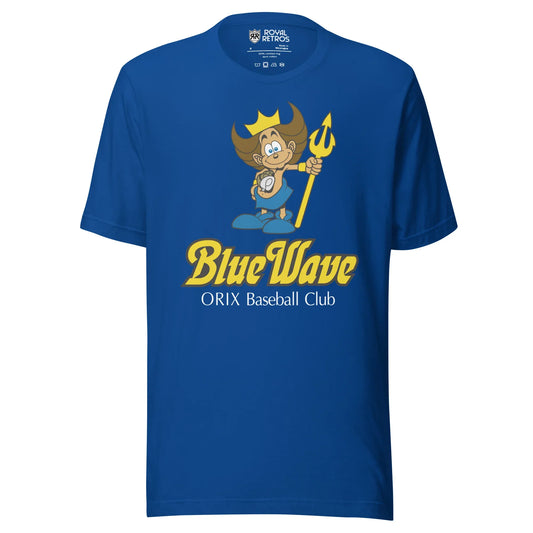
Five-way Blue Wave tee. The Orix Blue Wave T-Shirt spans navy, true royal, gold, athletic heather and white — the widest color range in this collection, and the easiest single piece to build a rotation around. Shop the tee.
One-size navy snapback. The Japan Snapback Hat's navy shell matches the national-team jerseys exactly, making it the simplest way to cap off either look. Shop the hat.
Mix eras freely — a Blue Wave tee under a national-team jersey, or the snapback with either look, reads as intentional rather than mismatched, because both product families pull from the same navy-forward palette.
Shop by Team
Samurai Japan, the national team. Three active styles carry the national-team identity: the '90s jersey, the modern jersey and the number-select replica, plus the snapback. This is the team that's turned the World Baseball Classic into a three-time victory lap — more on that below. Shop the national-team jersey.
Orix Blue Wave, the Kobe club. Two active styles carry the Blue Wave name — a jersey and a tee — tied to the actual Nippon Professional Baseball franchise that played in Kobe from 1991 until its 2004 merger with the Kintetsu Buffaloes. This is real team history, not an invented design. See more Asian baseball on Royal Retros.
Two products, two very different stories — a still-active national program that just keeps winning, and a defunct club name that produced one of the sport's biggest stars before it stopped existing as its own franchise. Both are shoppable here, and neither one is padding the other out. If you're buying for someone who follows Samurai Japan every tournament cycle, start with the national-team jerseys or the replica. If you're buying for someone who remembers Japanese baseball in the 1990s specifically — or who knows exactly whose rookie card they own — the Orix Blue Wave line is the more personal, more specific gift.
Wearing It Beyond Opening Day
None of this reads as costume. The Orix Blue Wave T-Shirt's athletic heather and true royal options work into a normal rotation the same way any well-made cotton tee would — pair it with jeans and it disappears into an everyday look rather than announcing a specific game. The navy national-team jerseys read as a statement piece worn on their own, or layered over a long-sleeve tee on a cooler day; save the white or black variant of the modern jersey for when you want a lighter or more understated version of the same identity. The snapback is a one-size grab that works with either family — throw it on with the tee for a low-key look, or with the jersey when you want the full identity. This is gear built for people who follow the sport year-round, not just during a tournament week — the kind of collection you build one piece at a time rather than buy all at once for a single event.
That distinction matters more here than on a typical fan-shop page, because this isn't licensed merchandise chasing a current season's hype. It's a small, specific, well-researched catalog built for people who already know what they're looking for — whether that's the exact navy the national team wore through the 1990s, or a Blue Wave jersey that references a franchise most American retailers have never heard of.
Sizes and Customization
- Custom jerseys — the 1990's Japan Baseball Jersey, the modern Japan Baseball Jersey and the Orix Blue Wave Jersey all run S–5XL with free name-and-number personalization.
- Replica jersey — the Japan Replica Baseball Jersey runs S–5XL with number selection only (16, 18, 51 or blank) — no name field, matching how a real tournament replica is built.
- T-shirt — the Orix Blue Wave T-Shirt runs S–5XL across five colors.
- Hat — the Japan Snapback Hat is one-size adjustable.
- Customization — free name and number on the three custom jerseys; custom orders are made to order and final sale.
Construction varies by product line: the custom jerseys use applied lettering and numbering built to order, while the replica jersey is a fixed style with number selection only — a real distinction, not a typo, and worth knowing before you order expecting a name on the back.
Why Royal Retros for Japan Baseball Gear
- One of the only U.S. sellers carrying both a Samurai Japan national-team line and a real Orix Blue Wave heritage tribute in the same place.
- Free name and number customization on three of six active styles, sizes S–5XL.
- Real research behind every product — the Blue Wave name traces to an actual Kobe franchise, not a made-up design pretending to be historic.
- A straightforward, heritage-first approach: nothing here is claimed as officially licensed, and the FAQ below says so plainly.
- Stock items ship within a few business days; custom jerseys take longer since every one is built to order.
- No guesswork on availability — every product linked from this page is confirmed active and orderable.
Good Gifts From This Collection
- For the Samurai Japan superfan — the number-select replica jersey lets them pick a number that means something, without a name field pretending to be something it isn't.
- For someone who followed 1990s Japanese baseball — the Orix Blue Wave Jersey or T-Shirt is a specific, researched gift rather than a generic "Japan" souvenir.
- For an everyday-wear gift — the Orix Blue Wave T-Shirt's five colors make it easy to match to someone's existing wardrobe rather than guessing.
- For a simple, low-risk add-on — the one-size Japan Snapback Hat pairs with either product family and never has a sizing question attached.
Quick Buying Questions
What sizes are available?
Jerseys and the tee run S–5XL. The hat is one-size adjustable.
Is customization free?
Free name and number on the three custom jerseys — the 1990's Japan jersey, the modern Japan jersey and the Orix Blue Wave jersey. The replica jersey offers number selection only, no name field.
How fast does it ship?
Stock items — the tee and hat — ship within a few business days. Custom and replica jerseys take longer since they're built to order.
Are these officially licensed?
No. These are heritage tribute reproductions — Royal Retros does not hold a league or team license for Japanese baseball. The designs are built from real team history and real colorways, but they are tribute apparel, not licensed product.
How Did Samurai Japan Become the World Baseball Classic's Most Dominant Team?
Japan has won more World Baseball Classic titles than any other country — three, in 2006, 2009 and 2023 — built on a pitching-and-fundamentals culture that Japanese amateur and professional baseball have prioritized for generations. The 2023 run stands as the tournament's high-water mark: Japan went a perfect 7-0, just the second champion ever to finish the tournament unbeaten, and closed it out by beating the United States in the final on March 21, 2023, in Miami. Shohei Ohtani, who both pitched and hit throughout the tournament, was named the event's Most Valuable Player. That result wasn't a surprise so much as a confirmation — Japan had already established itself as the WBC's benchmark program with its 2006 and 2009 titles, and the national program has layered Olympic and other international gold on top of that record since. The navy-and-red look on this page is the on-field identity behind every one of those wins.
What Happened to the Orix Blue Wave?
The Orix Blue Wave stopped existing as its own franchise after the 2004 Nippon Professional Baseball season, when financial pressure across the league pushed the club into a merger with the Kintetsu Buffaloes of Osaka to form a single combined team starting in 2005. Before that, the franchise had a long history under different names and cities — it was founded in 1936 as a railway-company club in Osaka, and moved to Kobe in 1991, taking the Blue Wave name at that point. Its signature era came immediately after that move: with a young outfielder named Ichiro Suzuki leading the way, the Blue Wave won the Pacific League championship in both 1995 and 1996, and took the 1996 Japan Series title outright, ending a 12-year pennant drought along the way. Ichiro's numbers in that navy-and-white uniform are the reason the Blue Wave name still means something today — nine seasons in Kobe produced a combined .353 batting average, seven straight batting titles from 1994 through 2000, three Pacific League MVP awards, and a 1994 season in which he became the first player in the league's modern 130-game format to top 200 hits. He went on to an even bigger career after crossing to affiliated pro ball in the United States, but the Blue Wave jersey on this page is the look he wore first — real Kobe team history, not a design built around a player who never actually wore it. Nobody else selling Japanese baseball apparel in the U.S. is telling this specific story; most of what's out there is generic "Japan" branding with no team behind it.
How Is Japanese Professional Baseball Organized?
Nippon Professional Baseball has run as two six-team leagues, Central and Pacific, since a realignment split the sport that way in 1950 — a structure that's stayed essentially intact for more than seven decades. Professional baseball in Japan predates that split by well over a decade; the country's first pro league formed in the 1930s, the same era the Orix franchise itself traces back to, and the sport grew through the postwar decades into the deeply organized, fundamentals-first culture that now regularly sends its best talent to the World Baseball Classic roster and, increasingly, to affiliated pro ball overseas. That pipeline runs in both directions — American and Latin players have gone the other way to play in Japan for decades, subject to a foreign-player rule that currently caps each team at four non-Japanese players on the active roster for any given game, a limit that's loosened considerably since the stricter two-player caps of past decades. The twelve NPB clubs split evenly between the two leagues — six in the Central League, six in the Pacific League, the same division Orix has played in since the Blue Wave era — and the regular-season champions from each side meet every fall in the Japan Series, the same stage the Blue Wave won outright in 1996. The national-team jerseys on this page represent the home side of the international exchange that grew out of that domestic structure: the program that's beaten the rest of the world at its own tournament three times.
Why Does Every Japan Jersey on This Page Trace Back to Koshien?
Because Japan built a national baseball obsession around high school players decades before it built a professional league around adults. The National High School Baseball Championship — universally known as Koshien, after the Hanshin Koshien Stadium built in 1924 specifically to host it, in Nishinomiya, the city between Osaka and Kobe that also anchors the Orix franchise's home region — started in 1915, more than twenty years before Japan's first professional league formed in the 1930s. By the time professional baseball had teams and standings that mattered to adult fans, an entire country had already spent two decades treating a high school tournament as its biggest annual sporting event. That's not ancient trivia; it's still true today. Koshien remains the largest amateur sporting event in Japan, and the discipline, team-first culture and sheer emotional stakes it instills in teenage players are the same qualities that show up, one level up, in the navy-and-red uniforms Samurai Japan wears at the World Baseball Classic. Wear the jersey, and you're wearing the end point of a pipeline that starts on a field built a century ago.
Extended FAQ
What's the difference between the '90s jersey and the modern jersey?
The 1990's Japan Baseball Jersey comes only in navy, matching the exact era that first established the national team's current look. The modern Japan Baseball Jersey adds white and black options on the same navy-based identity — same team, three color choices instead of one.
Does the replica jersey let me put my own name on it?
No. The Japan Replica Baseball Jersey offers number selection only — 16, 18, 51 or blank — built to match how an actual tournament replica jersey is produced. If you want a name added, choose one of the three custom jerseys instead.
Is the Orix Blue Wave still a team today?
Not under that name. It merged with the Kintetsu Buffaloes after the 2004 season to form a single combined Kobe/Osaka franchise that has played under a different name since 2005. The Blue Wave name and colors on this page reflect the franchise as it existed through that 2004 season, when the Ichiro-era teams won their championships.
Does Royal Retros carry other Japanese or Asian baseball teams?
Yes — beyond this collection, Royal Retros carries additional Asian baseball tributes. Browse Asian baseball.
Can I mix the national-team look with the Orix Blue Wave look in one order?
Yes. Every product on this page ships from the same Royal Retros catalog regardless of which team it represents.
How does this compare to Royal Retros' other international baseball pages?
Japan sits alongside Puerto Rico and Mexico as one of three country-specific international baseball pages, and all three roll up into the wider international baseball and Latin America collections.
How many World Baseball Classic titles has Japan won?
Three — 2006, 2009 and 2023 — more than any other country in the tournament's history. The 2023 title came with a perfect 7-0 record, the second unbeaten championship run in the event's history.
What is Koshien, and why does it matter for a jersey collection?
Koshien is Japan's National High School Baseball Championship, running since 1915 and played at Hanshin Koshien Stadium since 1924. It's the country's largest amateur sporting event and the cultural foundation the entire professional and national-team system is built on top of — including the Samurai Japan identity represented on this page.
Are there roster limits on non-Japanese players in Nippon Professional Baseball?
Yes. Current rules cap each NPB team at four foreign players on the active roster for any given game, with a maximum of three at either pitcher or position player at once. The limit has loosened substantially since the stricter two-player caps of earlier decades.
What did Ichiro Suzuki accomplish with the Orix Blue Wave before he left Japan?
Over nine seasons in Kobe, Ichiro hit a combined .353, won seven consecutive Pacific League batting titles from 1994 through 2000, took three Pacific League MVP awards, and in 1994 became the first player in the league's modern 130-game format to record more than 200 hits in a season. He anchored the Blue Wave's back-to-back Pacific League titles in 1995 and 1996 and the outright Japan Series championship in 1996 before later crossing to affiliated pro ball in the United States.
Is the Japan collection part of a bigger set of country pages?
Yes. Royal Retros treats Japan the same way it treats Puerto Rico and Mexico — a focused, country-specific page built from real product and real team history rather than a generic "world baseball" grab bag. All three connect through the wider international and Latin America collections linked below.
Shop Related Collections
- Asia
- Custom Jerseys
- Hats
- International Baseball
- Latin America
- Legacy Baseball
- Mexico
- Puerto Rico
- Snapback Hats
Samurai Japan navy and Kobe Blue Wave heritage, worn proud. Sizes S–5XL.