



-
CUSTOM
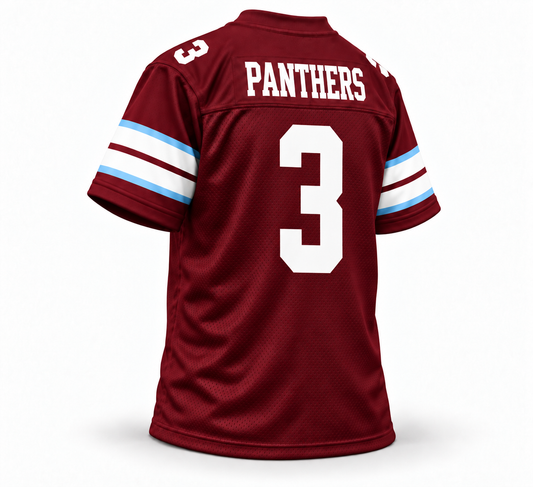
1983-85 Michigan Panthers USFL Jersey
Regular price Starting at $164.00 CADRegular priceUnit price per -
-
CUSTOM
Michigan Panthers Hunting Season UFL Jersey
Regular price Starting at $171.00 CADRegular priceUnit price per -
-
Michigan Panthers DynastyDry T-Shirt
Regular price $43.00 CADRegular priceUnit price per -
-
Michigan Panthers Throwback Hoodie
Regular price $86.00 CADRegular priceUnit price per -
-
Michigan Panthers Helmet T-Shirt
Regular price $43.00 CADRegular priceUnit price per -
Michigan Panthers T-Shirt
Regular price $43.00 CADRegular priceUnit price per -
-
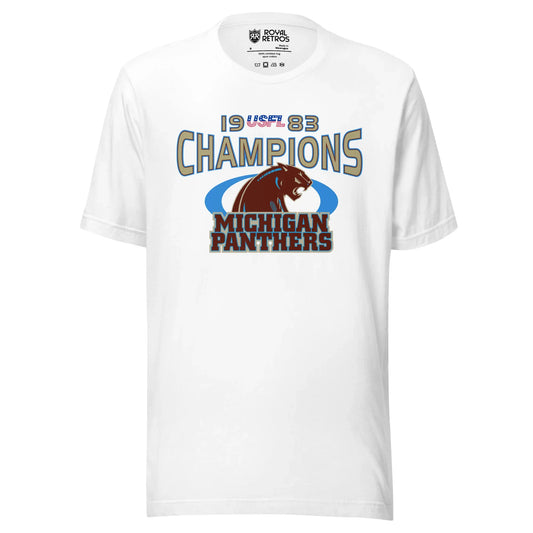
Michigan Panthers Champions T-Shirt
Regular price $43.00 CADRegular priceUnit price per -
-
Michigan Panthers Throwback T-Shirt
Regular price $43.00 CADRegular priceUnit price per -
-
CUSTOM
2022-23 Michigan Panthers USFL Jersey
Regular price Starting at $164.00 CADRegular priceUnit price per -










Recently Viewed
The Michigan Panthers Collection — Royal Retros Michigan Panthers Fan Shop
Officially Licensed Panthers Gear Across Three Eras. Custom Names & Numbers. Sizes S–5XL. The First USFL Champions, 1983.
Royal Retros carries the deepest Michigan Panthers collection anywhere on the open web — 10 in-stock products covering all three lives of the franchise: the original USFL Panthers who won the very first league championship in 1983, the USFL revival Panthers of 2022–23, and the UFL Panthers who reached the 2025 championship game. Four officially licensed jerseys at $109.99–$119.99, five T-shirts at $29.99, and a $59.99 throwback hoodie. Free custom name and number on most jerseys. Sizes Small through 5XL on every jersey, with no big & tall upcharge. One thing to know before you scroll: the Panthers did not return for the 2026 UFL season. Nobody is making new Panthers gear on an ongoing basis.
What You Can Shop in the Michigan Panthers Collection
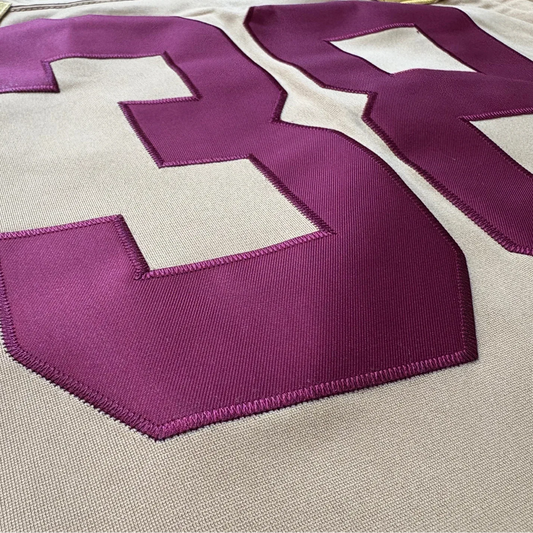
Michigan Panthers Jerseys — Four, and they are the reason this page exists. The 1983–85 USFL throwback at $109.99 is the anchor: the Pontiac Silverdome look in maroon and white, built to the original championship-season cut. The Vintage Cream USFL jersey at $109.99 is our Cream Collection treatment of the same era — an off-white base with the Panthers mark. The 2022–23 USFL jersey at $109.99 is the revival design in maroon and white, built to the FOX-era template rather than a 1980s recolor. And the Hunting Season UFL jersey at $119.99 is the gold alternate from the merger era — the loudest Panthers uniform ever made. All four use sewn-on tackle-twill numbers and lettering rather than screen print, in sizes Small through 5XL. Free custom name and number on most styles. Cross-shop the wider football jersey catalog and the Cream Collection.
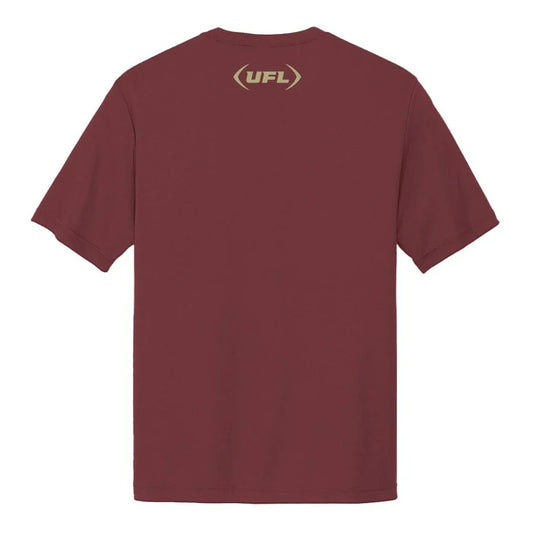
Michigan Panthers T-Shirts — Five tees, all $29.99. The Throwback tee carries the original wordmark in maroon, athletic heather, heather dust and white, S–5XL. The Champions tee marks the 1983 title in maroon or white, S–5XL. The Michigan Panthers tee is the modern-era wordmark in maroon, athletic heather, soft cream and white, S–5XL. The Helmet T-Shirt is a screen-printed helmet graphic, S–4XL. And the DynastyDry performance tee is a maroon moisture-wicking knit, S–4XL. Browse the wider football T-shirt range or the full activewear collection.
Michigan Panthers Hoodie — One, and it earns its place: the throwback pullover hoodie at $59.99 in maroon, sizes S–3XL. Heavyweight cotton-blend fleece, ribbed cuffs and hem, front pouch, original Panthers wordmark. Spring football in Michigan is not spring in any meaningful sense — the Silverdome was a dome for a reason. See more in hoodies and sweatshirts.
Customization — Free custom name and number on most Michigan Panthers jerseys. Put a name on the back that means something: the quarterback who won the first USFL championship, the receiver who caught the pass that decided it, a 2025 UFL starter, or your own. Custom items are made to order and final sale. See the full custom jersey program.
Sizes — Small through 5XL on all four jerseys and on the Throwback, Champions and Michigan Panthers tees. The Helmet tee and DynastyDry tee run S–4XL; the throwback hoodie runs S–3XL. No big & tall upcharge anywhere — a 5XL jersey costs the same $109.99 as a Medium.
Shop the Panthers by Era — Three Franchises, One Name
Very few teams in American football can offer this. The Panthers have a 1980s original identity, a 2020s revival identity and a merger-league identity — three different objects with forty years between them. We sell them as separate products rather than one generic "vintage Michigan" graphic, because the fan who sat in the Silverdome in 1983 and the fan who found the league on FOX in 2022 are not buying the same shirt.
1983–1985 — The Original USFL Panthers. The Pontiac Silverdome era: A. Alfred Taubman writing the checks, a rookie quarterback out of Northwestern State throwing to a rookie receiver out of the University of Michigan, and a defensive end nobody had heard of setting a sack record that still stands. The Panthers started 1–4 and finished as champions of the entire league. The 1983–85 USFL jersey is the anchor of this era, the Vintage Cream jersey is its collector's alternate, and the Champions tee, Throwback tee, Helmet tee and throwback hoodie all carry the original wordmark. Cross-shop the full USFL collection.
2022–2023 — The USFL Revival. FOX Sports brought the league back in March 2022 and put the Panthers name on a field for the first time since 1984. The 2022 season was played almost entirely in Birmingham as a single hub; in 2023 Michigan finally came home to Ford Field. The 2022–23 USFL jersey in maroon or white is the revival design with the era's detailing, not a recolor of the 1983 shell. Cross-shop the USFL collection and the wider Spring Football HQ.
2024–2025 — The UFL Panthers. The USFL and XFL merged on January 1, 2024, and Michigan was one of four USFL franchises to survive. Two seasons later the Panthers had the best record in the league, beat the three-time champion Birmingham Stallions 44–29 in the conference final, and played in the 2025 UFL championship game. The gold Hunting Season UFL jersey at $119.99 is that era's signature piece, with the modern Michigan Panthers tee and the DynastyDry performance tee alongside it. It is also the era with a hard end date: the Panthers did not return for 2026. Cross-shop the full UFL collection.
Why Royal Retros Is the Home of Michigan Panthers Gear
- Officially licensed. Our football program is licensed. What you buy here is legitimate league-and-team gear.
- All three eras, properly separated. 1983–85, 2022–23 and 2024–25 are distinct products with era-correct fonts, colors and collar treatment. Most retailers carry one Panthers design, if any.
- The first champions of spring football. Michigan won the inaugural USFL title in 1983 — a claim exactly one franchise on earth can make.
- Real tackle-twill construction. Sewn-on twill numbers and lettering, not heat-pressed vinyl. The difference shows up the first time you wash it.
- Free customization on most jerseys. Name and number at no extra cost on eligible styles. Most retailers charge $30–$50 for this.
- Honest pricing. No "collector's" markup on the 1983 throwback.
- Sizes S–5XL with no big & tall upcharge. Same price at 5XL as at Medium.
- The full spring-football lineage in one store. Cross-shop Spring Football HQ — UFL, USFL, XFL, AAF, WLAF and the original UFL.
- A closed chapter, stocked properly. The Panthers left the field after 2025. Franchises disappear from schedules; they do not disappear from this store.
Quick Buying Questions
What sizes do Michigan Panthers jerseys come in?
Small through 5XL on all four jerseys and on the Throwback, Champions and Michigan Panthers tees. The Helmet tee and the DynastyDry performance tee run S–4XL; the throwback hoodie runs S–3XL. We do not upcharge for big & tall sizes.
Can I add my own name and number to a Panthers jersey?
Yes — most jersey styles include free custom name and number. Choose an original 1983 champion, a UFL starter, or your own. Look for the "Custom" option on the product page. Custom items are made to order and final sale.
Which Michigan Panthers jersey should I pick?
If you were in the Silverdome in the 1980s, take the 1983–85 USFL throwback. If you want the same era with a softer, more collectible look, take the Vintage Cream jersey. If you found the team through the FOX revival, take the 2022–23 USFL jersey. If you want the boldest thing we make, take the gold Hunting Season UFL jersey.
What are the jerseys made from?
Heavyweight athletic mesh and poly-twill shells with sewn-on tackle-twill numbers and lettering. Tees are pre-shrunk cotton, or moisture-wicking performance knit on the DynastyDry line. The hoodie is heavyweight cotton-blend fleece.
How much does Michigan Panthers gear cost?
The three USFL-era jerseys — 1983–85, Vintage Cream and 2022–23 — are $109.99 each. The Hunting Season UFL jersey is $119.99. All five T-shirts are $29.99. The throwback hoodie is $59.99.
How fast does it ship, and what is the return policy?
Stock items ship within 3–5 business days. Custom jerseys are sewn to order and typically ship within 7–10 business days. Custom items are final sale. Standard items follow our return policy at /pages/returns.
Is this officially licensed?
Yes. Our football program is officially licensed.
Gift Ideas for the Michigan Panthers Fan
- For the fan who was actually in the Silverdome: The 1983–85 USFL throwback jersey, or the throwback hoodie and Champions tee as a pair. Almost nobody sells this era.
- For the person who cares how it looks first: The Vintage Cream USFL jersey — off-white, understated, and the piece most likely to get asked about.
- For the FOX-era convert: The 2022–23 USFL jersey — their era, not their father's.
- For the fan who wants to be seen: The gold Hunting Season UFL jersey at $119.99. There is nothing quiet about it.
- For a first-title bragging right: The Champions tee at $29.99. Most people do not know Michigan won the first one.
- Buy it before it is gone: The Panthers did not return for 2026, and merchandise for a franchise that no longer plays does not get restocked forever.
About the Michigan Panthers
The Michigan Panthers were the first champions of the United States Football League, and by extension the first champions of the modern era of American spring professional football. They existed for two seasons under their own name in the 1980s, won a title in the first of them, lost a triple-overtime playoff game in the second, and were then merged out of existence by a league decision that had nothing to do with how good they were. The name sat dormant for thirty-seven years, came back with the 2022 USFL revival, carried into the merged United Football League in 2024, reached the UFL championship game in 2025, and was retired again ahead of 2026. Two lives, forty years apart, one championship, and a fan base asked twice to love a team that would not be allowed to stay.
1982 — A Shopping-Mall Fortune Buys a Football Team
The USFL was the idea of David Dixon, a New Orleans antiques dealer and sports promoter who had spent years arguing that a real audience existed for professional football in the spring. His plan was disciplined: modest budgets, a hard salary cap around $1.8 million per team, regional television, and patience. Twelve franchises were awarded for the inaugural 1983 season, and Michigan was one of them.
The owner was A. Alfred Taubman, the Detroit-area real estate developer who effectively invented the modern enclosed shopping mall — an owner with both the resources and the temperament to ignore a salary cap he considered an obstacle. He hired Jim Stanley, the former Oklahoma State head coach, and installed the team at the Pontiac Silverdome, the enormous air-supported stadium the Detroit Lions had called home since 1975.
The building mattered. The Silverdome seated around 80,000, far more than a startup spring league needed, but it was a dome — and a schedule starting in early March is otherwise a genuinely bad idea in Michigan. This was one of the few USFL markets where the weather argument for spring football did not apply, because the roof settled it.
1983 — Down 1–4, and Then the Best Team in the League
The Panthers opened the inaugural season badly, losing four of their first five games. The general assumption was that Michigan had a talented young quarterback, a talented young receiver and not enough of anything else.
The quarterback was Bobby Hebert, an undrafted rookie out of Northwestern State in Louisiana with a live arm and no professional pedigree whatsoever. The receiver was Anthony Carter, the University of Michigan star who had spent four years as the most exciting player in the Big Ten and signed with the Panthers rather than enter the NFL. Hebert to Carter was, almost immediately, the connection that made the USFL look on television like something worth watching.
What Michigan did not have was a line to protect any of it. Taubman solved that with a checkbook, signing three Pittsburgh Steelers offensive linemen mid-season — Ray Pinney, Thom Dornbrook and Tyrone McGriff. It was open contempt for the league's salary structure and the clearest signal yet that the USFL's cost discipline was dead. Pinney had started for a Super Bowl winner. He was, abruptly, blocking in Pontiac.
The team changed completely, winning eleven of its last thirteen games to finish 12–6 and take the Central Division. On defense, end John Corker recorded 28 sacks — a single-season total no NFL player has ever matched — and was named the league's Defensive Player of the Year. In the playoffs Michigan beat the Oakland Invaders 37–21, setting up a title game against the team everybody expected to win it.
July 17, 1983 — The First USFL Championship
The Philadelphia Stars had finished 15–3, the best record in the league. Jim Mora coached them, Chuck Fusina played quarterback, Kelvin Bryant ran the ball, and Sam Mills — an undrafted linebacker out of Montclair State who became one of the great defenders of his NFL generation — anchored the middle. They were the class of the USFL.
The game was played at Mile High Stadium in Denver on July 17, 1983, a neutral site chosen before anyone knew who would qualify. Michigan led, Philadelphia clawed back, and with the game hanging on a single possession in the fourth quarter Bobby Hebert threw deep to Anthony Carter for a 48-yard touchdown. It was the play the league needed: the two young players it had been selling all spring, connecting for the score that decided the first championship it ever awarded. Michigan held on 24–22, and Hebert was named most valuable player.
It cost Taubman a reported $6 million to get there — roughly three times what David Dixon had said an entire franchise could afford to lose in year one, and a number that told every other owner exactly what winning was going to require.
The Pontiac Silverdome Era
The Silverdome is central to how the Panthers are remembered. Opened in 1975 and seating around 80,000, it was roofed by a fiberglass membrane held up by air pressure rather than beams — one of the strangest buildings in American sports. It hosted the Detroit Lions for twenty-seven seasons, Super Bowl XVI in January 1982, WrestleMania III in 1987, and matches at the 1994 FIFA World Cup, the first World Cup games ever played indoors.
For a spring football team it was both a gift and a problem. The roof meant Michigan could schedule March football without weather risk. But 80,000 seats is a merciless room for a startup league: a crowd that would have looked healthy in a 25,000-seat stadium looked like an abandoned building in Pontiac — a lesson the modern UFL learned again the hard way forty years later.
The building outlived the team by decades. The Lions left for Ford Field in 2002, the Silverdome was sold at auction, its roof deflated and collapsed under snow, and a partial implosion in December 2017 famously failed to bring the structure down on the first attempt. Demolition finished the following year. There is no Panthers marker on the site. There is a jersey.
1984 — The Longest Game in Professional Football History
The 1984 USFL expanded from twelve teams to eighteen, and the rookie class was extraordinary: Steve Young to Los Angeles, Jim Kelly to the Houston Gamblers, Reggie White to the Memphis Showboats, Mike Rozier to Pittsburgh. Established NFL names came across too. The league was, briefly, spending like a rival major league.
Michigan defended reasonably well, finishing 10–8 and returning to the playoffs. Then came the game the franchise is remembered for almost as much as the championship. On June 30, 1984, at the Silverdome, the Panthers played the Los Angeles Express in a quarterfinal that went to a third overtime before Los Angeles won 27–21. At 93 minutes and 33 seconds of playing time, it remains the longest game in professional football history. Steve Young ran for the winning touchdown.
1985 — Merged Out of Existence
On August 22, 1984, the USFL's owners voted to abandon the spring and move to a fall schedule in 1986, competing directly against the NFL. It was a strategy built around an antitrust lawsuit rather than a business plan, and it detonated the league from the inside.
The consequences hit immediately. The Pittsburgh Maulers folded rather than compete with the Steelers. The defending champion Philadelphia Stars left for Baltimore. And the Michigan Panthers — the reigning first champions of the league, in a market with a domed stadium and a real fan base — announced they would not play in Detroit and merged into Tad Taube's Oakland Invaders for 1985.
The reasoning was brutally simple. A fall schedule in 1986 meant going head to head with the Detroit Lions in the Lions' own building, and Taubman had no interest in that fight. Rather than move the team or fold it, he folded it into somebody else's. He took a stake in the combined Oakland club, the best Panthers players went west, and the Michigan Panthers stopped existing without ever having had a losing season.
There is a bitter footnote. The merged Invaders, carrying half a Panthers roster, went 13–4–1 in 1985 and reached the championship game — where they lost 28–24 to the Baltimore Stars at Giants Stadium on July 14, 1985, the last game the United States Football League ever played. In effect the first title game and the last one were the same matchup, with the Panthers wearing somebody else's colors the second time.
How the Original USFL Ended
The USFL sued the National Football League for antitrust violations, and on July 29, 1986 a jury found the NFL to be an illegal monopoly — and awarded the USFL damages of one dollar, trebled to three. The owners voted to suspend operations five days later. Not one of the scheduled 1986 fall games was ever played.
The league had lasted three seasons and produced three champions: Michigan in 1983, Philadelphia in 1984, and the relocated Baltimore Stars in 1985. Read the full story in the USFL collection.
The Dormant Years — 1985 to 2021
The Panthers name vanished for thirty-seven years, and southeastern Michigan spent them as one of the most persistently tested markets in alternative professional football. The Detroit Drive played in the Arena Football League from 1988 to 1993 and won four ArenaBowls. The Detroit Fury followed from 2001 to 2004 and won nothing. Earlier, the Detroit Wheels played the World Football League's single full season in 1974 and were one of the most spectacular failures in American sports business, folding mid-season having played home games in Ypsilanti. Add the Michigan Stags of the World Hockey Association and the Detroit Vipers of the International Hockey League, and you have a region sold on a lot of leagues that outlived nearly all of them. Browse more of it in the Michigan collection, Legacy Football and the World Football League collection.
Through all of it the 1983 Panthers stayed unusually well remembered — partly because they won, partly because Anthony Carter was already a Michigan folk hero before he played a professional down, and partly because the royal plum and champagne silver was one of the best-looking identities the 1980s produced.
2022 — The Name Comes Back
The USFL returned in March 2022, backed by FOX Sports. No figures from the original league were involved; the revival licensed the historic names and marks and rebuilt from scratch. Eight teams took the field under old names: the Birmingham Stallions, Houston Gamblers, Michigan Panthers, New Jersey Generals, New Orleans Breakers, Philadelphia Stars, Pittsburgh Maulers and Tampa Bay Bandits.
To control costs the league played essentially the entire 2022 season in Birmingham, which meant the revived Panthers spent their first season nowhere near Michigan. Jeff Fisher took the job. The team struggled badly in a season Birmingham won outright. What mattered more was the name being on a jersey again for the first time since 1984.
2023 — Home to Ford Field
For 2023 the league expanded from one hub to four: Birmingham, Detroit, Memphis and Canton, Ohio. Michigan finally came home, playing its home schedule at Ford Field — the Lions' downtown stadium, opened in 2002, a very different room from the Silverdome and about fifteen miles south of where the original Panthers played. The 2023 Panthers were better without being good, and the franchise got the thing it had not had in 2022: an actual home crowd in the actual market. The Memphis Showboats returned that same year in place of the Bandits.
2024 — Surviving the Merger
The USFL and XFL merger closed on December 31, 2023, and on January 1, 2024 the combined entity was named the United Football League. Eight franchises survived out of sixteen. From the USFL: Birmingham, the Houston Roughnecks, the Memphis Showboats and the Michigan Panthers. From the XFL: the DC Defenders, the St. Louis Battlehawks, the Arlington Renegades and the San Antonio Brahmas. Eight clubs were shuttered, including the Generals, Stars, Maulers, Bandits and the Seattle Sea Dragons.
Michigan made the cut, which was not a foregone conclusion for a team with two poor seasons behind it. The Panthers entered the inaugural UFL season in the USFL Conference alongside Birmingham, Houston and Memphis, with Mike Nolan — a former NFL head coach — taking over the sideline. The first UFL year was a rebuilding one. The second was not.
2025 — The Best Season the Modern Panthers Ever Had
The 2025 Michigan Panthers were, for ten weeks, the best team in professional spring football. They finished the regular season 8–2, the strongest record in the UFL, playing an aggressive brand of offense out of Ford Field. Then, in the conference championship game, they did the thing nobody had managed in four springs: they beat the Birmingham Stallions 44–29, ending Birmingham's run of three straight spring titles.
The championship game, on June 14, 2025, did not go the same way. The DC Defenders beat the Panthers 58–34 in the highest-scoring game in UFL history, outscoring Michigan 31–6 in the second quarter alone. Defenders quarterback Jordan Ta'amu threw for a league-record 390 yards and was named the game's most valuable player. Michigan scored 34 points in a championship game and lost by 24.
Stated plainly, because the record deserves accuracy: the Michigan Panthers did not win the 2025 UFL championship. They lost it. The franchise's one and only title remains the 1983 USFL championship — which, as first-ever championships go, is a considerably better one to own.
2026 — Why the Panthers Are Not on the Field
The Michigan Panthers did not return for the 2026 UFL season. Neither did the Memphis Showboats nor the San Antonio Brahmas. In their place the league launched three expansion franchises: the Columbus Aviators, the Louisville Kings and the Orlando Storm. Players and staff under contract to the departing clubs transferred to the new ones — Michigan's to Columbus — but the league was explicit that the expansion franchises are separate entities and do not inherit the records or history of the teams they replaced. The 1983 championship stays with the Panthers.
The reasoning was the reasoning behind every recent UFL decision: buildings. Under co-owner Mike Repole the league has been open about wanting 10,000 to 15,000 fans in stadiums that hold 15,000 to 25,000, rather than respectable crowds swallowed by 65,000-seat NFL venues. Ford Field seats around 65,000, and the Panthers ran into precisely the same optical problem the original team had at the Silverdome. Forty-two years apart, the same franchise was undone twice by playing in a room that was too big. The same logic later removed Birmingham and Houston from the 2027 schedule.
Notable Michigan Panthers Players and Coaches
The original era. Bobby Hebert is the quarterback of the 1983 Panthers — an undrafted rookie out of Northwestern State, named most valuable player of the first USFL championship game, later a long-serving NFL starter in New Orleans and Atlanta. Anthony Carter is the receiver, a University of Michigan legend who caught the 48-yard touchdown that decided that title game and became a three-time NFL Pro Bowler. John Corker recorded 28 sacks in 1983 and was the league's Defensive Player of the Year. Ray Pinney, Thom Dornbrook and Tyrone McGriff were the Steelers linemen who saved the season. Jim Stanley coached all of it; A. Alfred Taubman paid for all of it.
The modern era. Jeff Fisher, with more than 250 NFL games as a head coach behind him, ran the 2022 and 2023 revival Panthers. Mike Nolan took over for the UFL years and built the 8–2 team of 2025. Bryce Perkins, Danny Etling, E.J. Perry and Rocky Lombardi all took snaps at quarterback across the revival and merger seasons. Kenny Willekes, the Michigan State pass rusher, came home to play in Detroit. Siaosi Mariner, Samson Nacua, Marcus Simms, Malik Turner and Toa Taua defined the modern skill positions, and many of those Panthers have since signed NFL contracts.
None of these names appear on our jerseys by default. You choose — most Michigan Panthers jerseys include free custom name and number, so put a 1983 champion on the back, or a 2025 starter, or yourself.
The Silverdome, Ford Field and Detroit Football Culture
Detroit is one of the great football cities in the United States and one of the most frustrated. The Lions have played in the city since 1934 and spent most of the last seventy years testing the patience of a fan base that keeps showing up anyway. The University of Michigan plays forty miles west in the largest stadium in the Western Hemisphere. Into that environment, in 1983, arrived a professional team that won a championship in its first season — with a Michigan icon at wide receiver, playing indoors, in the Lions' own building, in a league that would not exist three years later.
That is the essential shape of Michigan Panthers fandom. It is not the nostalgia of a long-suffering franchise, because the Panthers were never long-suffering; they were good immediately and then removed. It is closer to the memory of a very good year, handed back to a new generation in 2022 before being taken away again. The venues tell the same story: the Silverdome was too big and it is gone, Ford Field is too big and the Panthers are gone. The stadium was demolished, the league folded twice, the franchise was merged once and retired once. The one durable object in the whole story is the shirt. Browse the wider Michigan collection for the rest of the state's sports history.
What Makes Ours Period-Correct
Construction and accuracy. Sewn-on tackle-twill numbers and lettering where the original build called for it, era-correct fonts and colors, and true-to-original construction — every Michigan Panthers design is checked against period references before it goes live.
More Frequently Asked Questions About the Michigan Panthers
Did the Michigan Panthers win a championship?
Yes — the 1983 USFL championship, the first title the league ever awarded, won 24–22 over the Philadelphia Stars at Mile High Stadium in Denver on July 17, 1983.
Did the Michigan Panthers win the 2025 UFL championship?
No. They reached it and lost. The DC Defenders beat Michigan 58–34 on June 14, 2025, in the highest-scoring game in UFL history. The Panthers' only championship is the 1983 USFL title.
Are the 1980s Panthers and the modern Panthers the same team?
No. They share a name, a state and a set of licensed marks, and nothing else — no ownership, personnel or corporate continuity. The original franchise merged into the Oakland Invaders after 1984; the name was revived by FOX Sports in 2022. That is exactly why we sell the eras as separate products.
Whatever happened to the original Michigan Panthers?
After the USFL voted in August 1984 to move to a fall schedule, the Panthers declined to play in Detroit against the Lions and merged into the Oakland Invaders for 1985. The combined team reached the 1985 championship game and lost to the Baltimore Stars. The Panthers never had a losing season in their own name.
Where did the Michigan Panthers play?
The original Panthers played at the Pontiac Silverdome in 1983 and 1984. The revival Panthers played in Birmingham during the 2022 single-hub USFL season, then at Ford Field in Detroit from 2023 through 2025.
Why are the Michigan Panthers not in the UFL anymore?
The Panthers, Memphis Showboats and San Antonio Brahmas did not return for 2026, replaced by expansion franchises in Columbus, Louisville and Orlando. The league wants full crowds in 15,000 to 25,000-seat stadiums rather than sparse ones in NFL venues, and Ford Field seats around 65,000. Michigan's players and staff transferred to Columbus, but the new club does not inherit the Panthers' history.
What was the longest game in professional football history?
Los Angeles Express 27, Michigan Panthers 21, a triple-overtime USFL quarterfinal at the Pontiac Silverdome on June 30, 1984 — 93 minutes and 33 seconds of playing time, longer than any NFL game before or since.
What colors did the Michigan Panthers wear?
Royal plum and champagne silver in the original USFL era — a deep maroon-purple that we list simply as maroon on our jerseys and tees — widely regarded as one of the best designs the 1980s produced in any sport. The revival and UFL eras carried the same core identity forward, with the gold Hunting Season alternate added as a UFL-era special.
Is Michigan Panthers apparel officially licensed?
Ours is. Royal Retros carries officially licensed USFL, XFL and UFL apparel.
How many Michigan Panthers products does Royal Retros carry?
10 in-stock products — four jerseys, five T-shirts and a throwback hoodie — spanning all three eras. Additional Panthers styles move in and out of the range, so it is worth checking back.
Will you still sell Panthers gear now that the team is gone?
Yes. We carry the New Jersey Generals, Tampa Bay Bandits, Oakland Invaders and Seattle Sea Dragons long after they stopped playing. That said, programs for departed franchises do not get restocked indefinitely — if there is a specific era or size you want, now is the better time.
Shop Related Collections
- USFL — Both USFLs: the 1983–85 original and the 2022–23 FOX revival. 125 products.
- UFL — The 2024 merger league and the Panthers' final home. 82 products.
- XFL — The other half of the merger. 63 products.
- Spring Football HQ — Every spring league we carry in one place.
- Philadelphia Stars — Beaten 24–22 in the first USFL championship game.
- Oakland Invaders — Beaten in the 1983 playoffs, then merged with the Panthers in 1985.
- Birmingham Stallions — Beaten 44–29 by Michigan in the 2025 conference final.
- DC Defenders — 2025 UFL champions, 58–34 over the Panthers.
- Memphis Showboats — Reggie White's original USFL team, retired alongside Michigan.
- Michigan — Panthers country, and the rest of Michigan sports history.
- Cream Collection — Including the Michigan Panthers Vintage Cream jersey.
- Custom Football Jerseys — The full catalog, S–5XL, free name and number on most.
- Football T-Shirts — Every football tee we make.
The Michigan Panthers at Royal Retros — Officially Licensed Gear Across Three Eras. Custom Names & Numbers. Sizes S–5XL. First USFL Champions, 1983.