The USFL Collection — Royal Retros USFL Fan Shop
Officially Licensed USFL Throwbacks. Custom Names & Numbers. Sizes S–5XL. 1983 Panthers to the 2023 Stallions.
Royal Retros carries the deepest United States Football League collection on the open web — 112 USFL apparel, headwear and outerwear products covering both lives of the league: the original 1983–85 spring experiment and the 2022–23 Fox-backed revival. Forty officially licensed USFL jerseys at a flat $109.99, thirty-four T-shirts at $29.99, thirteen hoodies at $59.99, twenty-two hats from $14.99 to $34.99, and three jackets including a $119.99 satin piece. Free custom name and number on most jerseys. Sizes Small through 5XL with no big & tall upcharge. Whether you were there in 1983, watched a Heisman winner turn pro three years early, remember a quarterback throwing forty-four touchdowns for a Houston team in a single season, or found the league for the first time on Fox in 2022, the jersey from your era is here — officially licensed.
What You Can Shop in the USFL Collection
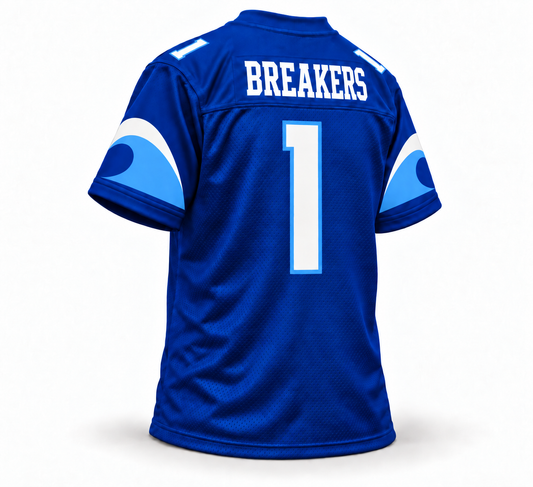
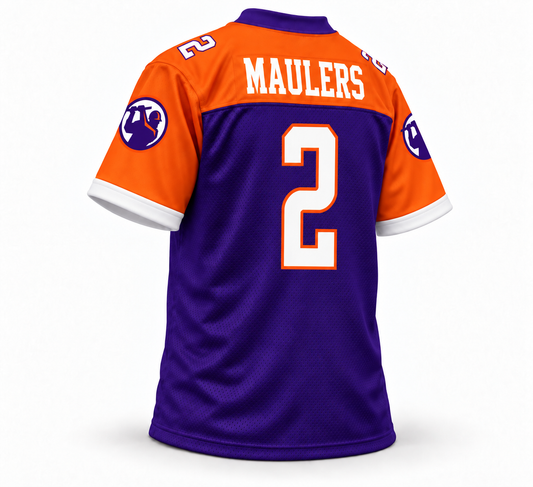
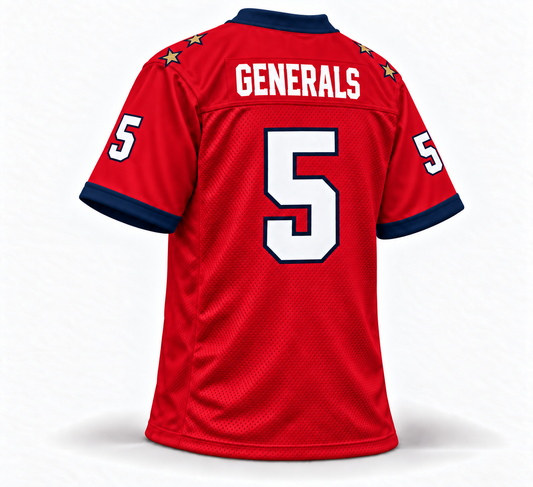
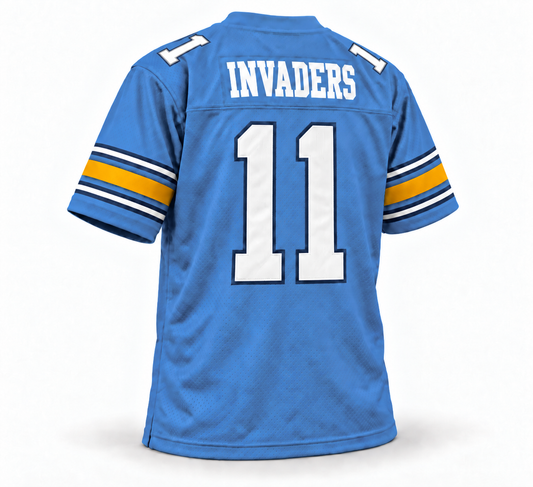
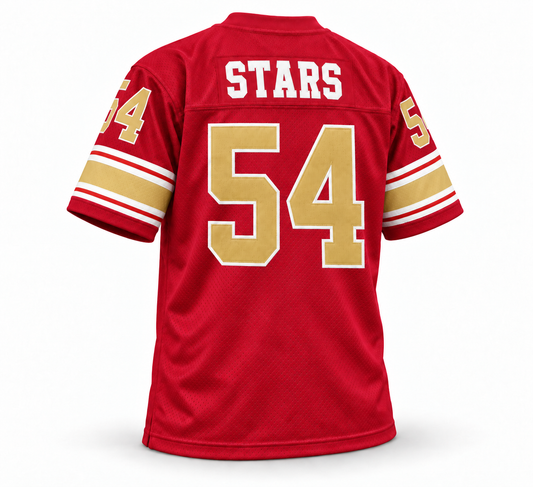
USFL Jerseys — Forty of them, every one $109.99, and they are the heart of this collection. The original-era jerseys cover the teams by year the way collectors actually ask for them: the 1983–85 Michigan Panthers, the 1983–85 Philadelphia Stars plus a separate Stars championship jersey, the 1983–85 Birmingham Stallions, the 1983 and 1984 Denver Gold, the 1983 Chicago Blitz, the 1983 and 1984 Arizona Wranglers, the 1984–85 Memphis Showboats, and single-look builds for the Houston Gamblers, New Jersey Generals, LA Express, Oakland Invaders, Tampa Bay Bandits, Jacksonville Bulls, Pittsburgh Maulers, San Antonio Gunslingers, Washington Federals, the Oklahoma Outlaws, the Orlando Renegades, the 1985 Arizona Outlaws and the Breakers. The revival era is covered just as carefully, with 2022–23 jerseys for nine franchises plus remix builds and one Cream Collection jersey. Sewn twill numbering, period-correct fonts and collar treatment, home and road styling by era. Free custom name and number on most styles.
USFL Hats — Twenty-two caps from $14.99 to $34.99. The core of the range is the $29.99 unstructured dad hat, carried for eighteen teams: Wranglers, Outlaws, Stallions, Renegades, Breakers, Gold, Gunslingers, Federals, Showboats, Bulls, Stars, Bandits, Invaders, Generals, Maulers, Blitz, Express and Gamblers. Beyond those there is a Michigan Panthers beanie at $22.99, a Birmingham Stallions trucker cap at $32.99, a Memphis Showboats script snapback at $14.99 and a Birmingham Stallions script snapback at $34.99, all adjustable one-size-fits-most. Cross-shop the wider unstructured hat, snapback and trucker cap ranges.
USFL T-Shirts — Thirty-four tees, all $29.99, all sizes S–5XL, on soft pre-shrunk cotton. This is where the collection gets genuinely deep for a defunct league: classic wordmark tees for the Stars, Stallions, Generals, Breakers, Showboats and Bandits; championship tees marking the 1984 Philadelphia Stars title and the Michigan Panthers title; throwback tees for the Panthers, Gamblers and Stallions; and single-team tees for the Wranglers, Gunslingers, Outlaws, Bulls, Maulers, Renegades, Blitz, Federals, Gold and Invaders. There is a Bay Area Invaders tee for people who remember the Oakland side by its region, a 2023 Pittsburgh Maulers tee, 2022–23 tees for the Generals, Stars and New Orleans Breakers, a plain USFL League tee, and — a genuine deep cut — a Spirit of Miami tee, for the Miami USFL franchise that was announced, sold, staffed and then canceled before it ever played a down. For football graphics beyond this league, the full football T-shirt range runs to 362 products.
USFL Hoodies & Sweatshirts — Thirteen heavyweight pullovers at a flat $59.99, covering the Gunslingers, Blitz, Gamblers, Outlaws, Federals, Bulls, Maulers, Breakers, Stars, Bandits, Generals, and throwback builds for the Stallions and Panthers. These are the pieces that actually get worn in the fall and winter, which is worth noting for a league that mostly played in the spring. Browse the wider hoodie range to build out a multi-league set.
USFL Jackets — Three, and they are the sleeper items here. Two sideline jackets at $29.99 — one for the Houston Gamblers, one dual-branded for the Philadelphia Stars and Baltimore Stars, which is exactly right for a franchise that won titles under both names. And one Michigan Panthers satin jacket at $119.99, the most striking piece in the USFL range and the closest thing we carry to a genuine 1983 sideline look. Compare against the full jacket collection.
Customization — Free custom name and number on most jerseys. Put a USFL original on the back — Herschel Walker, Jim Kelly, Steve Young, Reggie White, Bobby Hebert, Anthony Carter, Kelvin Bryant, Sam Mills, Chuck Fusina, Mike Rozier, Doug Flutie, Joe Cribbs — or your own name and number. Custom items are made to order and final sale.
Sizes — Small through 5XL on virtually every jersey, tee, hoodie and jacket. No big & tall upcharge. Hats are adjustable one-size-fits-most.
Shop the Marquee USFL Teams
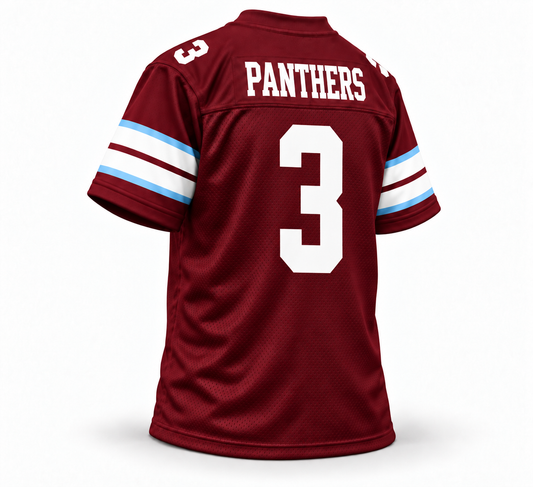
Michigan Panthers — The first USFL champions and our biggest team collection at 21 products: the 1983–85 jersey, a championship jersey, a Vintage Cream jersey, the 2022–23 revival jersey, the throwback hoodie, three tees, the beanie, and the $119.99 satin jacket. Owner A. Alfred Taubman bought NFL veterans mid-season, the team went 1–4 and then tore through the rest of the year, and on July 17, 1983 beat the Philadelphia Stars 24–22 at Mile High Stadium for the league's first title. Shop the full Michigan Panthers collection.
Birmingham Stallions — 24 products, the deepest single-team range here, and the only franchise with silverware from both eras: the 1983–85 throwback jersey, a USFL Champions jersey, the 2022–23 revival jersey, the throwback hoodie, a classic tee, a trucker cap, a script snapback and an unstructured throwback hat. Birmingham was the best-supported city in the original league's back half, and in the revival the Stallions won the 2022 and 2023 USFL titles and then the first UFL championship in 2024. Shop the full Birmingham Stallions collection, or browse everything Alabama.
Philadelphia Stars — 13 products: the 1983–85 jersey, a USFL Championship jersey, the 2022–23 revival jersey, the hoodie, three tees, the unstructured hat and the Philadelphia–Baltimore dual sideline jacket. The Stars were the most consistently excellent team in USFL history — best record in the league in 1983 and 1984, three straight trips to the title game, champions in 1984 in Philadelphia and again in 1985 as the Baltimore Stars. Shop the full Philadelphia Stars collection, or browse everything Philadelphia.
Memphis Showboats — 20 products, and one of the strongest tee ranges in the whole store: four separate tees, plus the 1984–85 jersey, a remix jersey, the 2023 revival jersey, the unstructured throwback hat and the $14.99 script snapback — the best-value item in the USFL collection. Memphis joined as a 1984 expansion team, signed a defensive end out of Tennessee named Reggie White, and came back four decades later as a 2023 revival franchise. Shop the full Memphis Showboats collection, or browse everything Tennessee.
Houston Gamblers — 9 products: the original USFL jersey, the 2022–23 revival jersey, the throwback tee, the hoodie, the unstructured hat and the $29.99 sideline jacket. The 1984 Gamblers ran the run-and-shoot under Jack Pardee and put up numbers nobody in pro football was matching — a rookie quarterback out of Miami threw 44 touchdowns and better than 5,000 yards and dragged an expansion team to 13–5. Shop the full Houston Gamblers collection, or browse everything Houston.
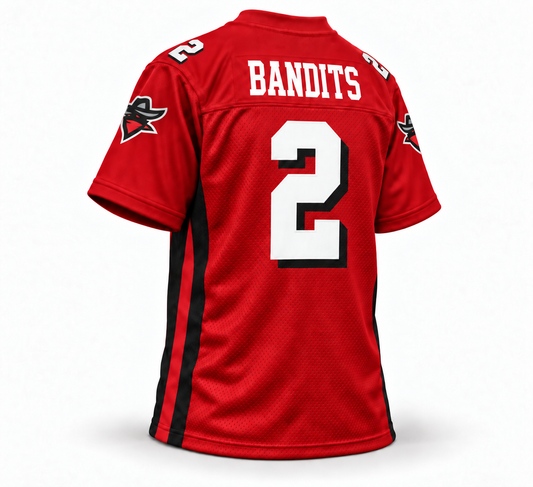
Tampa Bay Bandits — 8 products: the USFL jersey, a remix jersey, the 2022 revival jersey, the hoodie, two tees and the unstructured hat. The Bandits were the best-loved franchise in the original league that never won anything — John Bassett's team, Steve Spurrier's first head-coaching job, "Bandit Ball," and consistently strong Tampa crowds. Shop the full Tampa Bay Bandits collection, or browse everything Central Florida.
New Jersey Generals — 8 products: the USFL jersey, a remix jersey, the 2022–23 revival jersey, the hoodie, two tees and the unstructured hat. The Generals signed the reigning Heisman winner straight out of Georgia in 1983 and added the 1984 Heisman winner two years later. They are also the franchise most responsible for the league's ending, which is its own kind of collector's appeal. Shop the full New Jersey Generals collection, or browse everything New Jersey.
Why Royal Retros Is the Home of USFL Throwback Gear
-
Officially licensed. Our USFL apparel is officially licensed.
-
The deepest USFL collection on the open web. 112 apparel, headwear and outerwear products across more than twenty franchises. No other vintage retailer carries the league at this depth.
-
Both eras, properly separated. Original 1983–85 designs and 2022–23 revival designs are distinct products, not one blended "vintage USFL" graphic.
-
Flat, honest pricing. Every USFL jersey is $109.99. Every tee is $29.99. Every hoodie is $59.99. Hats start at $14.99. No era surcharge and no "collector's" markup on the teams that are hard to find.
-
Free customization on most jerseys. Add a name and number at no extra cost on eligible items.
-
Sizes S–5XL. True family sizing across jerseys, tees, hoodies and jackets, with no big & tall upcharge.
-
Teams nobody else bothers with. Washington Federals. San Antonio Gunslingers. Oklahoma Outlaws. Orlando Renegades. Arizona Wranglers. The 1985 Arizona Outlaws. The Breakers. These are the franchises that get skipped, and they are all here.
-
Deep alternative-football coverage. Cross-shop the USFL with the UFL, the XFL, the Alliance of American Football and CFLPA collections — the full history of pro football outside the NFL in one store.
Quick Buying Questions
What sizes do USFL jerseys come in?
Small through 5XL on every jersey style, and the same range on tees, hoodies and jackets. Hats are adjustable one-size-fits-most. We don't upcharge for big & tall sizes.
Can I add my name and number to a USFL jersey?
Yes — most styles include free custom name and number. Choose a USFL original or your own. Look for the "Custom" option on the product page. Custom items are made to order and final sale.
Which USFL jersey should I pick?
For a champion, take the 1983–85 Michigan Panthers, the 1983–85 Philadelphia Stars or a Birmingham Stallions jersey. For the most entertaining team in league history, take the Houston Gamblers. For the deep cut nobody at the tailgate will recognize, take the Washington Federals, the San Antonio Gunslingers or the Oklahoma Outlaws. If you found the league through Fox in 2022, take a 2022–23 jersey — they are built to the revival design, not the 1980s one.
What are the jerseys made from?
Heavyweight twill on the replica builds with sewn-on lettering and numbers, era-appropriate mesh and collar treatment by year. Tees are pre-shrunk cotton, hoodies are heavyweight cotton blends.
Are these jerseys accurate to the originals?
Yes. Each design is referenced against photographic source material for the season it represents — the 1983 Panthers look is not the 2022 Panthers look, and the 1985 Arizona Outlaws are treated as their own team rather than a recolor of the Wranglers. Every product in this collection is reviewed for period accuracy before it goes live.
Is this officially licensed?
Yes. Our USFL apparel is officially licensed.
How fast does it ship and what's the return policy?
Stock items ship within 3–5 business days. Custom jerseys are made to order and typically ship within 7–10 business days. Custom items are final sale. Standard items follow our return policy at /pages/returns.
Gift Ideas for the USFL Fan
-
For the fan who was actually there in 1983: Match the jersey to the team they watched. Twelve original franchises, and we carry all twelve.
-
For the Fox-era convert: The 2022–23 jerseys are their era, not their dad's. Stallions, Panthers, Stars, Gamblers, Generals, Maulers, Bandits, Breakers, Showboats.
-
For the football history obsessive: A Washington Federals or Oklahoma Outlaws piece is a conversation that lasts twenty minutes. Nobody wears these by accident.
-
For under $20, or well over it: The Memphis Showboats script snapback at $14.99, or the Michigan Panthers satin jacket at $119.99.
-
Year-round demand. USFL nostalgia isn't seasonal, and unlike most defunct leagues it now has a living sequel keeping interest topped up.
What Was the USFL?
The United States Football League was a professional American football league that played three seasons — 1983, 1984 and 1985 — on a spring and summer schedule, deliberately positioned in the NFL's off-season. It was the most credible challenge the NFL had faced since the American Football League: ABC and ESPN television contracts, eighteen franchises at its peak, three consecutive Heisman Trophy winners, five future Pro Football Hall of Famers, and a brand of football that critics and fans both rated as genuinely good.
It also lost more than $163 million in three years, voted to abandon the exact strategy that had made it viable, staked its entire future on an antitrust lawsuit, won that lawsuit, and was awarded one dollar. It never played a fourth season. The name returned in 2022 as a Fox-backed spring league and merged into the United Football League in 2024. Both stories are on the shelves in this collection.
David Dixon and the Plan That Should Have Worked
The idea belonged to David Dixon, a New Orleans antiques dealer who had been instrumental in bringing the Saints to his city and in building the Superdome. As early as 1965 he had started thinking about football as a spring and summer sport. Football traditionally waited until September because it shared ballparks with baseball and tore up grass fields; artificial turf, television money and the construction of dozens of large college football stadiums had quietly removed those constraints.
Dixon spent fifteen years studying the AFL, which succeeded, and the World Football League, which collapsed under teams too broke to meet payroll. Then he wrote the Dixon Plan, and it is worth setting out properly, because everything that followed is a story about ignoring it.
The plan called for teams in NFL-caliber stadiums in top television markets, large first-year promotional budgets, and a territorial draft so clubs could stock up on familiar local college stars. Most importantly it called for a hard team salary cap of $1.8 million — eleven years before the NFL adopted a cap of its own — and required owners to pass detailed due diligence and post a letter of credit for emergencies. It explicitly budgeted for early losses and asked owners to be patient enough to absorb them.
Dixon signed up twelve cities — nine that already had NFL teams and three that didn't — and all but two were in the top thirteen media markets, which was the whole point: the networks had to want the inventory. He announced the USFL at the 21 Club in New York on May 11, 1982, and ESPN president Chet Simmons became commissioner that June. The television deals arrived exactly as forecast, ABC and ESPN together yielding roughly $13 million in 1983 and $16 million in 1984. On paper, at the start of 1983, the Dixon Plan was working.
1983 — The First Season, and It Was Good
The USFL kicked off in March 1983 with twelve teams: the Arizona Wranglers, Birmingham Stallions, Boston Breakers, Chicago Blitz, Denver Gold, Los Angeles Express, Michigan Panthers, New Jersey Generals, Oakland Invaders, Philadelphia Stars, Tampa Bay Bandits and Washington Federals. Two had already been pushed sideways by stadium pressure before a snap was taken — the intended Los Angeles club ended up in Tempe as the Wranglers, and the San Diego group, blocked from Jack Murphy Stadium by the Padres, became the Los Angeles Express instead. Boston, unable to get Harvard Stadium, Sullivan Stadium, Fenway or Alumni Stadium, ended up at Boston University's 21,000-seat Nickerson Field, too small to break even even when sold out.
Despite all that, the season worked. Attendance averaged roughly 25,000 a game, in line with projections, and ratings beat target — an average Nielsen of 6.1 against a goal of 5.0. The football was entertaining, and the championship game was widely regarded as better than most Super Bowls of the era.
George Allen's Chicago Blitz were the preseason favorite, stacked with NFL veterans. In week two the Wranglers came from 29–12 down in the fourth quarter to beat them 30–29 in what is still called the biggest upset in league history. The Blitz lost five more, missed the division to Michigan, then blew a 38–17 fourth-quarter lead in the playoffs to lose 44–38 in overtime to Philadelphia.
The Stars finished 15–3, the league's best record. Jim Mora coached, Chuck Fusina played quarterback, Kelvin Bryant ran the ball, and Sam Mills — an undrafted linebacker out of Montclair State who became one of the great NFL defenders of his generation — held the middle. They reached the title game and nearly came back from 17–3 down in the third quarter. They lost, because A. Alfred Taubman had decided to buy his way out of trouble: after a 1–4 start the Michigan Panthers signed NFL veterans, jelled, and went 11–2 the rest of the way. They beat Oakland 37–21 in the playoffs and held off Philadelphia 24–22 at Mile High Stadium on July 17, 1983 to become the first USFL champions.
Elsewhere, Ron Blanding's Denver Gold won only seven of eighteen but led the league in attendance at 41,736 a game and became the only USFL team to turn a profit in 1983 — because Blanding was the only owner who actually stuck to the budget. The Oakland Invaders went 9–9 and won the Pacific Division behind Fred Besana, a 29-year-old out of the California Football League who finished as the league's second-rated passer.
Herschel Walker, and the Crack in the Plan
The league's biggest splash was also its first serious breach of its own rules. Herschel Walker, the 1982 Heisman winner, was an underclassman at Georgia, and like the NFL the USFL barred underclassmen — but league officials were privately certain the rule would not survive a court challenge, and they wanted the reigning Heisman winner badly enough to let it go.
Walker signed with the New Jersey Generals on a three-year deal valued at $4.2 million with a $1 million bonus, structured as a personal-services contract with owner J. Walter Duncan to get around the cap. No other owner objected; having Walker lent the league instant credibility. He delivered, running for 1,812 yards and 17 touchdowns as the USFL's first genuine superstar, even though the Generals won only six games.
The problem was the precedent. Once the cap was a suggestion, it was a suggestion for everybody. The Panthers reportedly lost $6 million winning the 1983 title — three times what Dixon said a team could afford in year one. Within eighteen months almost every club had blown past the cap, because none could afford to be the one that didn't. Instead of pulling back, the league chased new revenue, expanding by six teams in 1984 rather than the four Dixon envisioned — two extra expansion fees pocketed immediately, against a television contract never designed to carry eighteen teams. Dixon sold his stake and got out.
1984 — Eighteen Teams, and the Money Gets Loud
The 1984 additions were the Pittsburgh Maulers, Houston Gamblers, San Antonio Gunslingers, Memphis Showboats, Oklahoma Outlaws and Jacksonville Bulls. The Gamblers were not technically an expansion team: Dixon had reserved a franchise for himself at the founding, and when he left he sold it, and it became Houston. The Outlaws were supposed to be in San Diego and, like the Express before them, couldn't get a Jack Murphy lease, so they opened in Tulsa at Skelly Stadium — and even as a declared lame duck they drew 21,038 a game.
The strangest transaction in league history happened that offseason. Blitz owner Ted Diethrich sold Chicago to Milwaukee surgeon James Hoffman and simultaneously bought the Wranglers — then the two men swapped their team assets outright, coaches and players and all. Chicago fans watched an elite roster ship out to a team that had tied for the league's worst record, and got the 4–14 roster back. Season tickets flatlined, Hoffman walked away before the season started, and the league took the Blitz over mid-year to protect a television deal that required a Chicago team.
Meanwhile the two biggest markets got the two biggest spenders. Donald Trump had bought the Generals in September 1983, having originally been tapped as the founding owner before backing out to chase the NFL's Baltimore Colts. J. William Oldenburg bought the Los Angeles Express on an apparent net worth of $100 million. Trump poached NFL starters including 1980 NFL MVP Brian Sipe; Oldenburg landed BYU quarterback Steve Young on a $40 million guaranteed contract — by an enormous margin the largest deal in professional football history at the time. That June, federal and press investigations established that Oldenburg did not have a fraction of the money he claimed, and he walked away during the playoffs.
The 1984 rookie class was extraordinary: Young and Gary Zimmerman to Los Angeles, Jim Kelly to Houston, Reggie White to Memphis, 1983 Heisman winner Mike Rozier to Pittsburgh. Established NFL names came too — Doug Williams, Sipe, Buffalo running back Joe Cribbs, Kansas City safety Gary Barbaro. Kelly was the story: the expansion Gamblers ran the run-and-shoot, he threw 44 touchdowns for better than 5,000 yards, and Houston won the Central at 13–5 before losing 17–16 to Arizona in the playoffs. The Express lost an estimated $15 million but beat the defending champion Panthers 27–21 in triple overtime before falling to Arizona 35–23.
The Philadelphia Stars again had the league's best record at 16–2, and this time finished the job, beating George Allen's Arizona Wranglers 23–3 for the 1984 title in July. Washington went 3–15. Mid-season the Federals were announced as sold to a buyer who intended to move them to Miami with Howard Schnellenberger coaching; the deal collapsed, and Bandits minority owner Donald Dizney bought the team days later and moved it to Orlando as the Renegades. The Miami USFL team was announced, sold, staffed and canceled without playing a game — which is exactly why the Spirit of Miami tee in this collection means something.
August 22, 1984 — The Vote
During 1984 the league began seriously discussing a move to a fall schedule in 1986 to compete with the NFL head-on. The strongest advocates were Chicago's Eddie Einhorn and New Jersey's Donald Trump, and their argument was strategic rather than sporting: play in the fall, force the NFL into a merger that absorbs at least some USFL clubs, and the surviving owners' original investments more than double.
A consulting firm hired by the league recommended staying in the spring, as did the old guard who had signed up for the Dixon Plan. On August 22, 1984 the owners voted to move to the fall anyway, and on April 29, 1985 they voted 13–2 to reaffirm it.
The consequences arrived immediately, before a single fall game was ever scheduled. The Pittsburgh Maulers folded rather than compete with the Steelers. The Breakers — already relocated once from Boston to New Orleans — moved again, to Portland. The defending champion Philadelphia Stars left for Baltimore, only to find the Orioles held the only usable Baltimore stadium through spring and summer, which left them playing home games in College Park, Maryland while calling themselves the Baltimore Stars. The 1983 champion Michigan Panthers announced they would not play in Detroit and merged into Tad Taube's Oakland Invaders. Einhorn simply sat 1985 out. Diethrich's Wranglers assets were absorbed by the Tathams and the merged roster became the Arizona Outlaws.
Within weeks of one vote the USFL had abandoned four major markets, aborted a move into a fifth and suspended operations in a sixth. Then it turned down the money: ABC offered a four-year, $175 million deal to keep playing in the spring in 1986, and ESPN offered $70 million over three years — roughly $67 million a year, guaranteed. There were no longer enough spring advocates in the room to accept it. Tampa Bay's John Bassett, one of the two dissenting votes, announced he would pull the Bandits out to start a rival spring league; cancer forced him to abandon the plan, and he died in May 1986.
1985 — The Lame-Duck Season
Fourteen teams played the 1985 season knowing it was the last spring campaign, and it showed at the gate. Denver's attendance collapsed because fans would not choose between the Gold and the Broncos in the fall; when Denver earned a home playoff game, ABC forced the league to move it to Memphis rather than televise a near-empty Mile High Stadium.
San Antonio was worse. Owner Clinton Manges had been so lightly vetted on the strength of his apparent oil wealth that the league never required an initial capital investment — he simply paid bills as they arose, from an operation run out of a double-wide trailer. With about a month left he stopped paying altogether, and the Gunslingers' franchise was revoked.
Birmingham nearly went under for reasons that had nothing to do with football. Stallions owner Marvin Warner lost control of the club when Home State Savings Bank — the Cincinnati savings and loan he controlled — was destroyed in a bank run, one of the first casualties of the savings and loan crisis, which also rendered the Stallions' emergency letter of credit worthless. Team president Jerry Sklar persuaded the limited partners to put in more money and persuaded the city of Birmingham to buy a $100,000 stake plus a $900,000 credit line. That is how the Stallions finished the season, and it goes some way to explaining why Birmingham has been the most loyal spring-football city in America ever since.
The football itself stayed good. On July 14, 1985 at Giants Stadium in East Rutherford, in front of 49,263 people, the Baltimore Stars beat the Oakland Invaders 28–24, with Kelvin Bryant named most valuable player. It was in effect a rematch of the first title game — the Stars against the franchise the Panthers had merged into — and it was the last game the United States Football League ever played. Afterwards came more mergers for the fall: Denver folded into Jacksonville, and Trump bought the Gamblers' assets and merged them into the Generals. Eight teams were scheduled for an eighteen-game fall season in 1986. Not one of those games was played.
USFL v. NFL — The Three-Dollar Verdict
The USFL's endgame was the courtroom. It sued the NFL for antitrust violations, claiming the older league had monopolized professional football, had bullied ABC, CBS and NBC into refusing to televise USFL games in the fall, and had in places blocked stadium access. It sought $567 million, which under antitrust law would have been trebled to roughly $1.7 billion.
The case went before Judge Peter K. Leisure in the Southern District of New York. USFL counsel Harvey Myerson built it on documents he considered smoking guns, chief among them a 1983 memo from NFL management council director Jack Donlan laying out plans for NFL teams to raise salary offers or risk losing players to the USFL, and a 1984 presentation to NFL executives by Harvard Business School professor Michael Porter on how to conquer the USFL. Al Davis of the Los Angeles Raiders testified for the USFL and had his team excluded from the defendant list in exchange; Howard Cosell was also a key witness.
The trial ran 42 days in 1986. On July 29 a six-person jury returned a verdict for the USFL — and destroyed it in the process. The jury declared the NFL a duly adjudicated illegal monopoly that had willfully acquired and maintained that status through predatory tactics, then rejected essentially everything else. It found the NFL had not forced the USFL off television, and that the USFL had abandoned a working strategy for a riskier one aimed at forcing a merger — a switch that had itself cost the league six major markets. The jury even cited a memo Tad Taube had written quoting Pogo: "we have met the enemy and he is us." Having established that the NFL was an illegal monopoly that had harmed the USFL, it awarded damages of one dollar, trebled to three.
On August 4, 1986, five days later, the USFL owners voted to suspend operations, intending to return in 1987 and hoping the coming NFL players' strike would hand them access to star talent. It didn't matter: most of their players had already signed NFL contracts, and the league was roughly $160 million in debt. In January 1987 the Arizona Outlaws tried to interest the CFL in a merger; the CFL was lukewarm and declined. The USFL never reopened.
The Best Teams the USFL Produced
The Philadelphia Stars are the correct answer to "who was the best USFL team," full stop: best record in the league in 1983 (15–3) and 1984 (16–2), three consecutive championship game appearances, and titles in 1984 and 1985 — the second won in Baltimore colors. Jim Mora went from that job to a long NFL head-coaching career; Sam Mills went from undrafted small-college linebacker to one of the great NFL defensive careers.
The Michigan Panthers won the first one, which counts for more than the record suggests: Bobby Hebert to Anthony Carter was the most exciting connection in the league in 1983. The Houston Gamblers never won anything and are remembered better than teams that did, because the 1984 run-and-shoot was doing things nobody else in professional football was doing.
Add the 1984 Arizona Wranglers, who reached the title game with a roster physically swapped in from Chicago; the 1983 Chicago Blitz, the best team never to win a division; the Oakland Invaders, division winners in 1983 and finalists in 1985; and the Birmingham Stallions, well-supported in a market that had no business sustaining pro football and has now done it three times.
The Players Who Made the League
Three consecutive Heisman Trophy winners signed with USFL teams straight out of college: Herschel Walker of Georgia and Doug Flutie of Boston College to the New Jersey Generals, and Mike Rozier of Nebraska to the Pittsburgh Maulers. No rival league before or since has managed that.
Five future Pro Football Hall of Famers began their professional careers in the USFL. Defensive end Reggie White, out of Tennessee, started with the Memphis Showboats. Offensive tackle Gary Zimmerman of Oregon and quarterback Steve Young of BYU both started with the Los Angeles Express. Quarterback Jim Kelly of Miami started with the Houston Gamblers. Linebacker Sam Mills of Montclair State started with the Philadelphia Stars.
The league also worked in the other direction, taking NFL role players like Chuck Fusina and Cliff Stoudt and making them stars, and taking NFL starters in their prime, including 1980 NFL MVP Brian Sipe, Buffalo's Joe Cribbs and Kansas City's Gary Barbaro. Coaching talent ran deep too: George Allen, Jim Mora, Jack Pardee, Steve Spurrier and Marc Trestman all worked USFL sidelines.
What the NFL Took From the USFL
The USFL lost the war and won a surprising number of arguments. The salary cap it wrote into its founding document in 1982 arrived in the NFL in 1994, as did the two-point conversion, standard in the USFL from 1983, and the coach-to-quarterback radio. Instant replay review, which the USFL trialled in 1985, is now the spine of NFL officiating.
The talent transfer was more immediate: when the league folded its players went straight into the NFL. And the strategic lesson has outlived everything else. Every spring football league since — the World League, the original XFL, the UFL of 2009, the Alliance of American Football, the 2020 XFL, the 2022 USFL — has been built on the proposition that the USFL had it right the first time and lost its nerve.
2022 — The Name Comes Back
The USFL returned in March 2022, backed by Fox Sports and by Brian Woods, who had been running the developmental Spring League. Despite the branding, no figures from the original league were involved; the revival licensed the names and marks and rebuilt from scratch.
The 2022 season fielded eight teams under the old names: the Birmingham Stallions, Houston Gamblers, Michigan Panthers, New Jersey Generals, New Orleans Breakers, Philadelphia Stars, Pittsburgh Maulers and Tampa Bay Bandits. Rather than run eight separate market operations, the league used Birmingham as a single hub, with most games at the newly built Protective Stadium — a cost-control decision the original league's owners would have understood perfectly and probably ignored. Birmingham won the first revival championship on July 3, 2022, beating the Philadelphia Stars 33–30.
For 2023 the league expanded to four hub cities: Birmingham at Protective Stadium, Detroit at Ford Field, Memphis at Simmons Bank Liberty Stadium and Canton, Ohio at Tom Benson Hall of Fame Stadium. The Tampa Bay Bandits took a hiatus and the Memphis Showboats returned in their place — the first Showboats football since 1985. Birmingham won again, beating the Pittsburgh Maulers 28–12, for back-to-back USFL titles.
2024 — The UFL Merger
In December 2023 the revived USFL announced a merger with the XFL to form the United Football League, taking eight franchises, four from each side. The first UFL game was played on March 30, 2024 between the Arlington Renegades, the 2023 XFL champions, and the Birmingham Stallions, the 2023 USFL champions. At the end of that season Birmingham beat the San Antonio Brahmas 25–0 in the UFL Championship Game — the only shutout of the season — for a third consecutive spring football title.
That merger is why the USFL name now sits in a curious place: a defunct 1980s league, a defunct 2020s league, and a live one carrying half its DNA. For collectors that is a feature — a 1983 Michigan Panthers jersey and a 2022 Michigan Panthers jersey are genuinely different objects with forty years between them, and this collection carries both. The UFL collection picks up exactly where the USFL leaves off.
Why USFL Gear Still Sells Forty Years Later
Defunct-league apparel usually runs on nostalgia, and nostalgia has a shelf life. The USFL is different for three reasons. First, the designs were good. The early 1980s were the high-water mark of American sports design confidence, and a startup league with no heritage to respect went hard: the Panthers' purple and silver, the Bandits' outlaw script, the Gamblers' cards-and-dice identity, the Showboats' riverboat mark, the Gold's clean single-color kit. These jerseys look better in 2026 than most of what the NFL was wearing at the time.
Second, the story is genuinely great — the best available case study in how a well-designed business plan gets destroyed by the people who signed it. It gets rediscovered every few years, most recently through the ESPN documentary Small Potatoes: Who Killed the USFL? and the 2022 revival itself.
Third, the players. Steve Young, Jim Kelly, Reggie White, Herschel Walker, Doug Flutie, Sam Mills and Gary Zimmerman all turned pro in this league. A USFL jersey is not a novelty item; it is where several Hall of Fame careers actually started. There is no current team selling most of these marks — for the USFL fan, the throwback is the jersey.
More Frequently Asked Questions About the USFL
What was the USFL?
A professional American football league that played spring and summer seasons in 1983, 1984 and 1985 as an alternative to the NFL, then folded in 1986 without playing its planned fall season. The name was revived as a Fox-backed spring league in 2022 and merged into the United Football League in 2024.
Who won the USFL championships?
Original league: the Michigan Panthers beat the Philadelphia Stars 24–22 on July 17, 1983 at Mile High Stadium; the Philadelphia Stars beat the Arizona Wranglers 23–3 in July 1984; and the Baltimore Stars — the relocated Philadelphia franchise — beat the Oakland Invaders 28–24 at Giants Stadium on July 14, 1985. Revival league: the Birmingham Stallions beat the Philadelphia Stars 33–30 in 2022 and the Pittsburgh Maulers 28–12 in 2023.
How many teams were in the USFL?
Twelve in 1983, eighteen in 1984 after six expansion franchises were added, and fourteen in 1985 after the fall-schedule vote triggered folds, mergers and shutdowns. The revival league fielded eight teams in 2022 and eight in 2023.
Why did the USFL fold?
Directly: the August 1984 decision to move to a fall schedule in 1986 and compete head-on with the NFL. That vote cost the league six major markets before a fall game was ever played, and led it to reject a four-year, $175 million ABC offer to keep playing in the spring. Underneath that: chronic overspending against a salary cap the owners had written themselves and then ignored.
Did the USFL really only win $1 in its lawsuit against the NFL?
Yes. On July 29, 1986 a six-person jury found the NFL to be a duly adjudicated illegal monopoly that had used predatory tactics — and then awarded the USFL nominal damages of one dollar, trebled to three under antitrust law. The jury concluded that most of the USFL's problems were self-inflicted, particularly the move to the fall. The league voted to suspend operations five days later.
Which famous players started in the USFL?
Steve Young and Gary Zimmerman with the Los Angeles Express, Jim Kelly with the Houston Gamblers, Reggie White with the Memphis Showboats, Sam Mills with the Philadelphia Stars — all five Pro Football Hall of Famers. Herschel Walker and Doug Flutie played for the New Jersey Generals and Mike Rozier for the Pittsburgh Maulers, making three consecutive Heisman winners who turned pro in the USFL.
What is the difference between the 1980s USFL and the 2022 USFL?
They share names and marks but nothing else — no ownership, personnel or corporate continuity. The 2022 league was created by Fox Sports and Brian Woods and licensed the historic identities. That's why we sell the eras as separate products.
Where did the Philadelphia Stars go?
To Baltimore, after the 1984 title, to prepare for fall play in a market the NFL's Colts had just abandoned. Because the Orioles controlled Baltimore's only usable stadium in spring and summer, the team actually played its 1985 home games in College Park, Maryland while carrying the Baltimore Stars name — and won the final USFL championship under it.
Whatever happened to the Michigan Panthers?
The 1983 champions merged into the Oakland Invaders after the fall-schedule vote rather than play in Detroit in 1985. The combined team reached the 1985 championship game and lost to the Baltimore Stars. The Panthers name returned in the 2022 revival and now competes in the UFL.
Is USFL apparel officially licensed?
Ours is. Royal Retros carries officially licensed USFL apparel.
How many USFL products does Royal Retros carry?
112 USFL apparel, headwear and outerwear products — 40 jerseys, 34 T-shirts, 22 hats, 13 hoodies and 3 jackets — spanning more than twenty franchises across both eras. It's the deepest USFL collection on the open web.
Shop USFL Teams
-
Arizona Wranglers — 1983–85. The biggest upset in league history, and 1984 title-game runners-up. 5 products.
-
Birmingham Stallions — 1983–85 and 2022–23. Back-to-back revival titles plus the 2024 UFL championship. 24 products.
-
Chicago Blitz — 1983–84. George Allen's NFL-caliber roster, and the strangest franchise swap in pro football. 6 products.
-
Denver Gold — 1983–85. Led the league in 1983 attendance and the only USFL club ever to turn a profit. 5 products.
-
Houston Gamblers — 1984–85 and 2022–23. The run-and-shoot, and 44 touchdown passes in one season. 9 products.
-
Jacksonville Bulls — 1984–85. The 1984 expansion class, and the surviving side of the Denver merger. 6 products.
-
LA Express — 1983–85. The $40 million quarterback, and two owners who weren't as rich as they said. 4 products.
-
Memphis Showboats — 1984–85 and 2023. Reggie White's first pro team, and one of the best logo sets in league history. 20 products.
-
Michigan Panthers — 1983–84 and 2022–23. The first USFL champions. 21 products.
-
New Jersey Generals — 1983–85 and 2022–23. Two Heisman winners, one very consequential owner. 8 products.
-
Oakland Invaders — 1983–85. Division champions in 1983 and title-game finalists in 1985. 5 products.
-
Philadelphia Stars — 1983–84 and 2022–23. The best team in USFL history: three straight title games, two championships. 13 products.
-
Pittsburgh Maulers — 1984 and 2022–23. Mike Rozier's pro debut, and a revival run to the 2023 final. 7 products.
-
San Antonio Gunslingers — 1984–85. The double-wide trailer and the revoked franchise. The purest deep cut here. 5 products.
-
Tampa Bay Bandits — 1983–85 and 2022. Bandit Ball, John Bassett, and the vote against the fall. 8 products.
-
Washington Federals — 1983–84. The worst team in the league and one of the most collectible jerseys in it. 5 products.
Shop Related Football Collections
-
UFL — Where the USFL story continues. The 2024 merger league, 82 products.
-
XFL — The other half of the merger, and the USFL's direct rival from 2020 to 2023. 63 products.
-
Alliance of American Football — The 2019 spring league that ran between the XFL eras. 16 products.
-
CFLPA — Canadian Football League gear, including the league the Arizona Outlaws tried to merge into in 1987.
-
Custom Football Jerseys — The full football jersey catalog, 206 products, S–5XL, free name and number on most.
-
Football T-Shirts — 362 football tees across every league we carry.
-
Hoodies and Jackets — Outerwear across the whole store.
-
Unstructured Hats, Snapbacks and Trucker Caps — Every headwear style we make.
-
Cream Collection — Including the Michigan Panthers cream jersey.
Shop USFL Cities
The USFL at Royal Retros — Officially Licensed Throwbacks. Custom Names & Numbers. Sizes S–5XL. 1983 to 2023, Every Team We Carry.