




-
Sacramento Gold Miners Mini Helmet
Regular price $80.00 CADRegular priceUnit price per -
Sacramento Gold Miners T-Shirt
Regular price $44.00 CADRegular priceUnit price per -
-
CUSTOM
Sacramento Gold Miners Jersey
Regular price Starting at $123.00 CADRegular priceUnit price per -




The Sacramento Gold Miners Collection — Royal Retros Sacramento Gold Miners Fan Shop
Heritage Tribute Gear From the CFL's First American Club. Custom Sizes S–5XL.
The Sacramento Gold Miners were the team that started it all — the first American franchise the Canadian Football League ever fielded, playing two seasons at Hornet Stadium in 1993 and 1994 before relocating to Texas. Royal Retros carries the deepest Gold Miners throwback collection anywhere online: three products built around those two Sacramento seasons, in the team's aqua, gold, black and white identity. A jersey, a five-colorway T-shirt and a mini helmet. The jersey is $84.99, tees are $29.99, and the mini helmet is $54.99. Sizes run Small through 5XL on the jersey and most tees. There is no current Sacramento Gold Miners store to buy this from — the franchise itself moved on to Texas three decades ago — which makes this the rare piece of Sacramento sports history you can still actually wear.
What You Can Shop in the Sacramento Gold Miners Collection
Sacramento Gold Miners Jersey — The Gold Miners jersey in aqua or white, sewn twill lettering built to the team's on-field look across both Sacramento seasons. Runs Small through 5XL. $84.99.
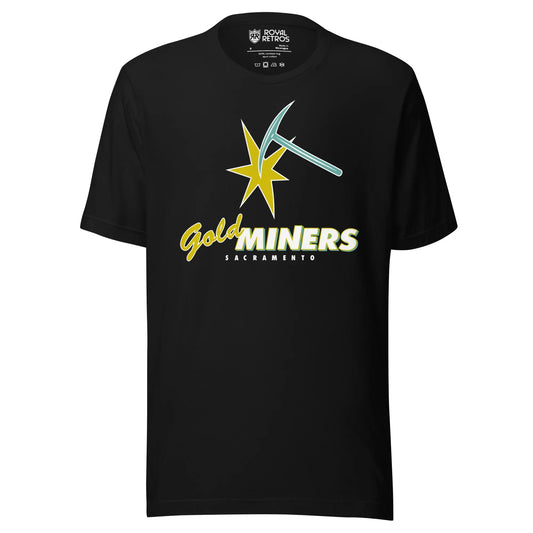
Sacramento Gold Miners T-Shirt — The Gold Miners tee, offered in Black, Athletic Heather and White (S–5XL) and Aqua and Soft Cream (S–4XL). Soft pre-shrunk cotton, vintage Gold Miners graphics. $29.99.
Sacramento Gold Miners Mini Helmet — A Riddell Speed mini helmet in the Gold Miners' aqua, gold and black scheme. $54.99. A shelf piece for anyone who remembers Hornet Stadium in 1993 or 1994.
Sizes — Small through 5XL on the jersey and on Black, Athletic Heather and White tees; Aqua and Soft Cream run S–4XL. No big & tall upcharge on any style.
Shop by Colorway — Aqua, Gold and Black
Aqua and White — The Gold Miners' primary jersey colors, worn home and away across both seasons. The jersey is built in both. This is the look from the Hornet Stadium photos and the David Archer highlight reels.
Black, Athletic Heather and Soft Cream — Everyday colorways for the tee that pull from the Gold Miners' full aqua, gold, black and white identity without needing the full uniform look. Shop the Gold Miners tee for the full five-colorway lineup.
Why Royal Retros Is the Home of Sacramento Gold Miners Gear
- The team that opened the door. Before Birmingham, Memphis, Shreveport or Baltimore, there was Sacramento — the CFL's first American franchise, and the one every later expansion club followed.
- Full wardrobe from a two-year franchise. A jersey, a five-colorway tee and a mini helmet — most short-lived CFL American expansion teams get a single generic design if they get anything at all.
- Flat, honest pricing. $84.99 for the jersey, $29.99 for tees, $54.99 for the mini helmet. No "rare team" markup.
- Sizes S–5XL on the jersey. True family sizing, no big & tall upcharge.
- Deep coverage of the CFL's American experiment. Cross-shop the Gold Miners with the San Antonio CFL club it became, plus the Birmingham Barracudas and Baltimore Stallions — the five clubs that made up the CFL's mid-1990s push into the United States.
- Northern California football roots. The Gold Miners sit inside our broader Sacramento collection, alongside the rest of the city's pro and historic sports apparel.
Quick Buying Questions
What sizes does the Sacramento Gold Miners jersey come in?
Small through 5XL. Tee sizing runs S–5XL in Black, Athletic Heather and White, and S–4XL in Aqua and Soft Cream.
Is Sacramento Gold Miners gear officially licensed?
No. The franchise relocated out of Sacramento after 1994 and no license currently covers this defunct CFL club. These are heritage tribute reproductions, built to look and fit like the real 1993–94 uniforms, not officially licensed merchandise.
How fast does it ship and what's the return policy?
Stock items ship within 3–5 business days. Standard items follow our return policy at /pages/returns.
Is this the same team as the San Antonio Texans?
Yes — the exact same franchise, ownership and front office. The Gold Miners moved from Sacramento to Texas for the 1995 season and were renamed. Shop the San Antonio CFL collection for that franchise's third and final season.
Gift Ideas for the Sacramento Gold Miners Fan
- For anyone who was at Hornet Stadium in 1993 or 1994: The aqua or white jersey is the exact look from either Sacramento season.
- For the CFL completist: Pair the Gold Miners with the San Antonio CFL collection to own the entire arc of one franchise across two markets.
- For the "first of its kind" collector: No American city fielded a CFL team before Sacramento did. This is where the whole experiment started.
- For the Sacramento sports fan who wants something different: A pro football team that actually called the city home for two seasons, not a repeat of the usual local gear.
- Year-round demand. Two-season novelty franchises like this move steadily for birthdays, Father's Day and the start of football season.
About the Sacramento Gold Miners
The Sacramento Gold Miners were the first American franchise in Canadian Football League history, playing two seasons — 1993 and 1994 — at Hornet Stadium before relocating to Texas and becoming the San Antonio Texans for 1995. Owned by Fred Anderson, who had previously run the World League of American Football's Sacramento Surge, the Gold Miners were built on the idea that a market that had already shown it would support pro football in an unfamiliar league might do the same again in a different one. They never had a winning season in Sacramento and never made the playoffs there, but the franchise's two years in California set the template — for better and worse — that every other American CFL club that followed would repeat, right down to the eventual relocation or shutdown that ended each of their stories in turn.
Why Was There a CFL Team in Sacramento? The First American Experiment
Fred Anderson's path into the CFL ran directly through a league that no longer existed. He had owned the Sacramento Surge of the NFL-backed World League of American Football, a team that actually won the league's 1992 World Bowl championship, defeating the Orlando Thunder 21–17 in Montreal, before the WLAF suspended operations later that year. Rather than walk away from professional football in a city that had just proven it would show up for a champion, Anderson found a new league willing to try the same market: the Canadian Football League, which was looking for ways to shore up its finances by expanding into the United States. Sacramento became the CFL's first American club in 1993, a full two years before the league's better-known 1995 push into Birmingham, Memphis, San Antonio and Baltimore. Everything those later clubs would experience — a curious opening crowd, a hard sales pitch to fans who already knew a different game, and eventually a business model that didn't hold up — happened in Sacramento first, two full years before anyone else in the CFL's American expansion tried it.
Kay Stephenson and David Archer
To run the new franchise, Anderson brought in Kay Stephenson, a former NFL head coach with previous experience leading the Buffalo Bills, giving the expansion Gold Miners a level of coaching pedigree that few brand-new CFL clubs could claim. Under center, the Gold Miners turned to David Archer, a veteran passer who had spent most of his NFL career with the Atlanta Falcons. Archer took immediately to the CFL's more wide-open passing game: in the 1993 season he finished second in the entire league in passing yards with 6,023, trailing only Doug Flutie — as strong a debut season as any American CFL quarterback would post over the league's entire U.S. expansion era.
The Supporting Cast Behind Archer
The Gold Miners were never a one-man operation. Wide receiver Rod Harris was Archer's primary target in both seasons, catching 90 passes for 1,379 yards in 1993 and 86 for 1,280 in 1994 — genuinely elite receiving numbers by any era's standard. The running game shifted from Mike Oliphant, who led the team with 760 rushing yards in the 1993 debut season, to Troy Mills, who broke out with 1,230 rushing yards in 1994. On defense, Bobby Humphery, Kip Texada and pass-rusher Mark Ledbetter anchored the 1993 unit, while Maurice Miller and a trio of edge rushers in James King, Curtis Moore and Willie Fears carried the improved 1994 defense. It was, by American CFL expansion standards, a genuinely talented roster — one more reason the Gold Miners' modest win totals undersell how competitive the team actually was on the field.
1993 — The Debut Season
The Gold Miners' first CFL season ended with a 6–12 record, last place in the West Division. The results on the scoreboard didn't match Archer's individual numbers, but the season established something more important for the league: an American market could draw real, sustained crowds for CFL football, at least for a little while. Average home attendance in 1993 ran close to 17,000 a game — respectable numbers that gave CFL officials genuine hope that the American experiment could work in more than one city.
1994 — A Modest Improvement, and New Company
Sacramento improved to 9–8–1 in 1994, good for fifth in the West Division, but still missed the playoffs. The Gold Miners were no longer the CFL's only American club that year — the league also fielded the Las Vegas Posse for a single, chaotic 1994 season before that franchise folded outright, along with the debut of the Shreveport Pirates and a Baltimore franchise that spent the entire season fighting a trademark dispute over its own name before eventually becoming the Baltimore Stallions. Even with a better record than its debut season, Sacramento's average home attendance fell to roughly 14,000 a game — a meaningful drop that mirrored a leaguewide pattern of American crowds thinning out in a team's second year.
Hornet Stadium — A Ballpark That Never Quite Fit
The Gold Miners played their home games at a football stadium on the Sacramento State University campus, seating just over 21,000 — a venue built for one level of football and asked to host a different, professional one. It had briefly carried temporary end-zone seating up to roughly 26,000 for the earlier WLAF Sacramento Surge, but that overflow capacity was removed before the Gold Miners' first CFL season to accommodate the CFL's wider, longer field. What was left was a facility widely described at the time as below professional standard — threadbare amenities, and fans making do with portable restrooms rather than permanent ones. It was serviceable for two seasons of an expansion franchise finding its footing. It was not the kind of facility that made a long-term commitment to professional football look inevitable.
Why Did the Gold Miners Leave Sacramento?
Owner Fred Anderson wanted an upgraded home facility for a franchise he hoped would be more than a two-year novelty, and pushed for stadium improvements that never materialized. Without a credible path to a better venue, and with attendance already trending down between 1993 and 1994, Anderson made the call to move the franchise rather than fight the market and the building at the same time. The Gold Miners relocated to Texas for the 1995 season, taking their ownership group, front office and much of their roster with them, and were renamed the San Antonio Texans — a franchise that would go on to have, by a wide margin, the best season any CFL American club produced. Shop the San Antonio CFL collection to see how that story ended.
How Was CFL Football Different From the Game Sacramento Fans Already Knew?
Like every American CFL expansion club, the Gold Miners played on a 110-yard field with 20-yard end zones, fielded twelve players per side instead of eleven, and worked with only three downs instead of four — rules that rewarded exactly the kind of downfield passing attack that helped David Archer post such a strong statistical debut. The CFL also allowed a single point, the "rouge," for a missed kick that goes into the end zone and isn't returned out — a rule with no American equivalent that occasionally turned a close game on a single special-teams play. For the full breakdown of how CFL rules differed from the American game, see the Barracudas collection, which covers the rules story in depth.
What Happened to the CFL's American Experiment?
Sacramento's own story ended with a relocation rather than a fold, but the larger experiment it started did not end well. San Antonio reached the South Division final in 1995 before the CFL abandoned its American expansion entirely that winter — Birmingham, Memphis, Shreveport and San Antonio all folded within weeks of each other, and only the Baltimore franchise, by then the 1995 Grey Cup-winning Stallions, survived in any form, relocating north to become the Montreal Alouettes. No CFL franchise has played in California, or anywhere else in the United States, since. The Gold Miners' two Sacramento seasons remain the opening chapter of a five-year experiment that never quite found a permanent American home.
What Makes Ours Period-Correct
Construction and accuracy. Sewn-on tackle-twill numbers and lettering where the original build called for it, era-correct fonts and colors, and true-to-original construction — every Sacramento Gold Miners design is checked against period references before it goes live.
More Frequently Asked Questions About the Sacramento Gold Miners
Who were the Sacramento Gold Miners?
The first American franchise in Canadian Football League history, playing two seasons, 1993 and 1994, at Hornet Stadium in Sacramento, California, before relocating to Texas and becoming the San Antonio Texans.
Why did the Sacramento Gold Miners leave Sacramento?
Owner Fred Anderson wanted an upgraded home stadium and couldn't secure one. With attendance already declining between 1993 and 1994, the franchise relocated to Texas for the 1995 season rather than continue at Hornet Stadium.
What was the Gold Miners' record?
6–12 in 1993, last in the West Division. 9–8–1 in 1994, fifth in the West Division, missing the playoffs both years.
Who was the Sacramento Gold Miners' quarterback?
David Archer, a veteran passer who had spent most of his NFL career with the Atlanta Falcons, started for Sacramento. He finished second in the entire CFL in passing yards in 1993, with 6,023.
Who owned and coached the Gold Miners?
Fred Anderson, previously the owner of the World League's Sacramento Surge, owned the franchise. Kay Stephenson, a former NFL head coach with the Buffalo Bills, was the Gold Miners' head coach.
Did the Gold Miners ever make the playoffs?
No, not while based in Sacramento. The franchise's only CFL playoff appearance came the year after the move, in its first season as the San Antonio Texans.
What happened to Fred Anderson and Kay Stephenson after Sacramento?
Fred Anderson, a Sacramento businessman who had built a major building-materials company before moving into sports ownership, kept the franchise together through its move to Texas and remained its owner through the San Antonio Texans' 1995 season and the CFL's American shutdown that followed. He died in 1997. Kay Stephenson coached both Sacramento seasons before the franchise transitioned to new leadership in San Antonio.
How many Sacramento Gold Miners products does Royal Retros carry?
Three — a jersey, a five-colorway T-shirt and a mini helmet. It's the deepest Gold Miners-specific collection on the open web.
Did any other American cities have CFL teams besides Sacramento?
Yes — Sacramento was the first of what eventually grew to five American CFL clubs across 1993–1995, alongside Birmingham, Memphis, Shreveport and the league champion Baltimore Stallions. A Las Vegas franchise also played a single 1994 season and folded before the league's American expansion reached its peak in 1995.
Did the Gold Miners ever play Birmingham or Memphis?
No. Sacramento's franchise had already relocated to Texas before the Birmingham Barracudas or Memphis Mad Dogs ever took the field — those two clubs only existed in 1995, a full season after the Gold Miners name was retired. The two eras of CFL American expansion never actually overlapped in Sacramento.
How big was Hornet Stadium compared to other CFL American venues?
At just over 21,000 seats, Hornet Stadium was among the smaller venues used by the CFL's American clubs — a fraction of the size of stadiums like Birmingham's Legion Field or Memphis' Liberty Bowl Memorial Stadium, both of which seated well over 60,000. Ironically, the smaller building suited Sacramento's actual crowds better than the oversized stadiums did in some of the CFL's other American markets, even though the facility itself was considered below professional standard.
Shop Related CFL American Expansion and Sacramento Collections
- San Antonio CFL — This exact franchise's third and final season, after relocating from Sacramento to Texas.
- Baltimore Stallions — The CFL's American flagship and 1995 Grey Cup champion, before relocating north to become the Montreal Alouettes.
- Birmingham Barracudas — Another one-season CFL American club from the league's 1995 expansion wave.
- Shreveport CFL — A two-season CFL American club that joined the year after Sacramento.
- International Football HQ — The full collection of CFL, WLAF and other international football apparel we carry.
- Sacramento Collection — Sacramento apparel across every sport we carry.
- Custom Football Jerseys — The full football jersey catalog, S–5XL, free name and number on most.
The Sacramento Gold Miners at Royal Retros — Heritage Tribute Gear From the CFL's First American Club. Sizes S–5XL. 1993–1994, Where the Experiment Started.