




-
CUSTOM
Birmingham Barracudas Custom Jersey
Regular price Starting at $123.00 CADRegular priceUnit price per -
-
Birmingham Barracudas Replica Jersey
Regular price $102.00 CADRegular priceUnit price per -
Birmingham Barracudas T-Shirt
Regular price $44.00 CADRegular priceUnit price per -
-
-
Birmingham Barracudas Unstructured Hat
Regular price $44.00 CADRegular priceUnit price per -
-
Birmingham Barracudas Mini Helmet
Regular price $80.00 CADRegular priceUnit price per

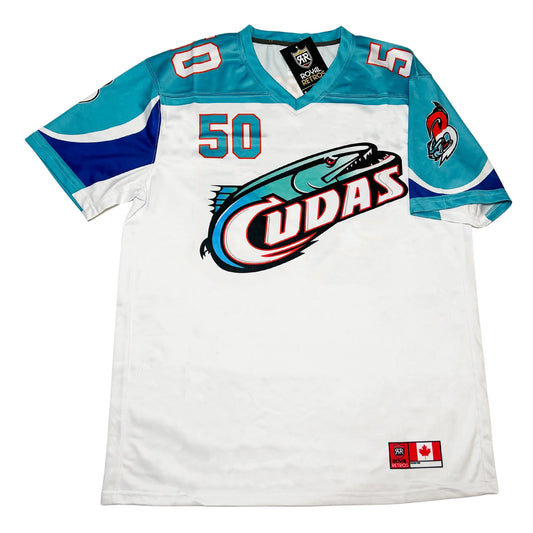


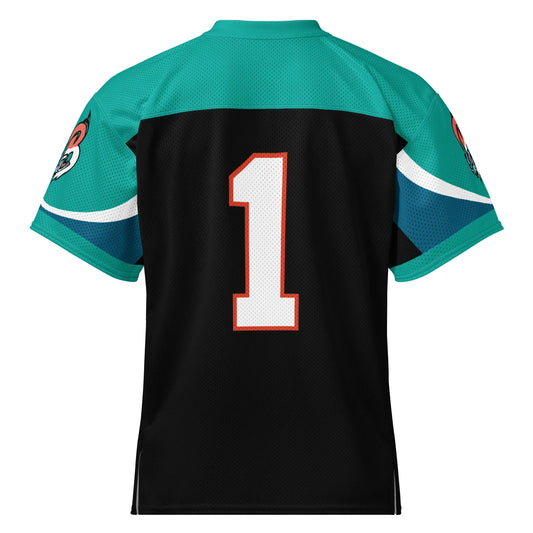


The Birmingham Barracudas Collection — Royal Retros Birmingham Barracudas Fan Shop
Heritage Tribute Gear From the CFL's One Wild Season in Alabama. Custom Names & Numbers. Sizes S–5XL.
The Birmingham Barracudas played exactly one season of professional football — 1995, the Canadian Football League's short-lived experiment south of the border — and Royal Retros carries the deepest 'Cudas throwback collection anywhere online. Six products built around that single wide-open season: a custom jersey and a replica cut in the team's black and white, two T-shirt designs in black and the team's signature aqua, an unstructured dad hat, and a mini helmet. Every jersey is $84.99, the replica is $69.99, tees are $29.99, the hat is $29.99, and the mini helmet is $54.99. Sizes run Small through 5XL on the jerseys and most tees, with free custom name and number on eligible jersey styles. There is no current Birmingham Barracudas store to buy this from — this is heritage tribute apparel built for a franchise that only ever existed for one Alabama summer and fall.
What You Can Shop in the Birmingham Barracudas Collection
Birmingham Barracudas Jerseys — The custom jersey in black or white, sewn twill lettering and full name-and-number customization, and the replica jersey for a truer game-worn look at a lower price point. Both run Small through 5XL. $84.99 for the custom build, $69.99 for the replica.
Birmingham Barracudas T-Shirts — The Barracudas T-shirt, offered in Black (S–5XL) and the team's aqua (S–4XL), and the Cudas tee, which adds an Athletic Heather option (S–2XL) alongside Black and Aqua. Soft pre-shrunk cotton, vintage 'Cudas graphics. $29.99.
Birmingham Barracudas Hat — The unstructured dad hat in black, adjustable one-size-fits-most. $29.99.
Birmingham Barracudas Mini Helmet — A Riddell Speed mini helmet in the 'Cudas' black, teal and burnt-orange scheme. $54.99. A shelf piece for anyone who remembers Legion Field in 1995.
Customization — Free custom name and number is available on eligible jersey styles. Put a 'Cudas original on the back or your own name and number. Custom items are made to order and final sale.
Sizes — Small through 5XL on the jerseys. Tee sizing varies slightly by colorway: Black runs S–5XL on both styles, Aqua runs S–4XL, and the Cudas tee's Athletic Heather option runs S–2XL. No big & tall upcharge on any style.
Shop by Colorway — Black, White and 'Cudas Teal
Black and White — The primary Barracudas jersey colors, worn both home and away across the 1995 season. The custom and replica jerseys are built in both. This is the look from the Legion Field photos and the Matt Dunigan highlight reels.
Aqua/Teal — The Barracudas' signature accent color, drawn from the team's black, teal, blue, burnt-orange and white identity. It shows up on the tees rather than the jerseys and is the closest thing this franchise has to a "third color" flex piece. Shop the Cudas tee for the teal option.
Why Royal Retros Is the Home of Birmingham Barracudas Gear
- The only team that ever wore this uniform. One season, 1995, and nobody has worn a Barracudas jersey competitively since. There is no current club to buy from.
- Full wardrobe from a one-year franchise. Jersey, replica, two tee designs, a hat and a mini helmet — most one-season CFL American expansion teams get a single generic design if they get anything at all.
- Flat, honest pricing. $84.99 for the custom jersey, $69.99 for the replica, $29.99 for tees and the hat, $54.99 for the mini helmet. No "rare team" markup.
- Free customization on eligible jerseys. Add a name and number at no extra cost.
- Sizes S–5XL on jerseys. True family sizing, no big & tall upcharge.
- Deep coverage of the CFL's American experiment. Cross-shop the Barracudas with the Memphis Mad Dogs, Baltimore Stallions, San Antonio CFL and Shreveport CFL — the five clubs that made up the CFL's 1995 push into the United States.
- Alabama football roots. The Barracudas sit inside our broader Alabama collection, alongside the rest of the state's pro and historic sports apparel.
Quick Buying Questions
What sizes do Birmingham Barracudas jerseys come in?
Small through 5XL on both the custom and replica jerseys, in black or white. The hat is adjustable one-size-fits-most, and tee sizing runs S–5XL in Black, S–4XL in Aqua.
Can I add my name and number to a Barracudas jersey?
Yes — the custom jersey includes free name and number customization. Choose a Barracudas original or your own. Custom items are made to order and final sale.
Is Birmingham Barracudas gear officially licensed?
No. The Barracudas franchise folded in early 1996 and no license currently covers this one-season CFL club. These are heritage tribute reproductions, built to look and fit like the real 1995 uniforms, not officially licensed merchandise.
How fast does it ship and what's the return policy?
Stock items ship within 3–5 business days. Custom jerseys are made to order and typically ship within 7–10 business days. Custom items are final sale. Standard items follow our return policy at /pages/returns.
Gift Ideas for the Birmingham Barracudas Fan
- For anyone who was at Legion Field in 1995: The jersey or replica in black or white is the exact look from that one summer and fall.
- For the CFL completist: Pair the Barracudas with the Memphis Mad Dogs or Baltimore Stallions for a set from the league's American expansion era.
- For the "team that only lasted one year" collector: Few pro franchises anywhere have a shorter competitive history than the 'Cudas — one season, one story, done.
- For the Alabama football fan who wants something different: A pro team that actually called the state home for a summer, not a repeat of the usual local gear.
- Year-round demand. One-season novelty franchises like this move steadily for birthdays, Father's Day and the start of football season.
About the Birmingham Barracudas
The Birmingham Barracudas were a professional football team that played a single season, 1995, in the Canadian Football League — part of a short, aggressive attempt by the CFL to expand into the United States. They played their home games at Legion Field in Birmingham, Alabama, finished third in the CFL's South Division at 10–8, made one playoff appearance, and then ceased to exist within a few months of their only season ending. In that one year, though, the Barracudas produced a career-best season from a well-traveled CFL quarterback, some of the largest crowds in the league, and one of the stranger business stories in North American pro sports expansion history. Three decades later, the Barracudas remain a niche but real piece of Alabama sports history — a team most casual fans have never heard of, and one that the people who were there tend to remember in exact detail.
Why Was There a CFL Team in Alabama? The American Expansion Gamble
In the early 1990s, the Canadian Football League — squeezed financially and looking for new markets — began awarding franchises to American cities, betting that U.S. fans wanted a faster, wide-open alternative to the sport they already knew. Birmingham was part of the league's second wave of American expansion for the 1995 season, joining a South Division built almost entirely of new U.S. clubs. The pitch was simple: bigger fields, only three downs, a rouge, and end zones that stretched twenty yards deep — "longer, wider, faster" football, sold directly into American football country.
Why Did the CFL Want to Expand Into the United States in the First Place?
The Canadian Football League expanded into the United States because its Canadian business, on its own, was shrinking. Television revenue in Canada's much smaller market could not keep pace with rising player salaries, several Canadian franchises were losing money every year, and league officials believed a handful of American markets — with bigger stadiums, bigger media markets and, in theory, a built-in appetite for football of any kind — could generate the kind of expansion fees and broadcast interest that would keep the whole league solvent. The pitch to ownership groups like Art Williams' was straightforward: buy in cheap relative to NFL or MLB expansion prices, inherit a stadium and a fan base primed for football, and get in early on a "new" pro sport before anyone else could claim the market. It worked well enough to attract five ownership groups in three years. It did not work well enough to keep any of them north of one or two seasons, and the expansion fees those five franchises paid did help keep several Canadian clubs afloat through the mid-1990s even after the American venture collapsed.
Birmingham's Place in the CFL's Five-City American Gamble
The Barracudas were never a solo experiment — they were one-fifth of a single, short-lived business plan. The Canadian Football League's push into the United States began in 1993 with the Sacramento Gold Miners, the first American club, which moved to Texas for 1995 and became the San Antonio CFL club. The Shreveport CFL franchise joined in 1994 and never had a winning season. By 1995 the league had expanded to five American clubs — Birmingham, Memphis, San Antonio, Shreveport and the league's flagship, the Baltimore Stallions — grouped into their own South Division so the U.S. clubs would play each other more often than they played Canadian teams. Only Baltimore ever turned a real on-field and business success out of the experiment, winning the 1995 Grey Cup outright. The other four, including Birmingham, folded within a year of that championship, and the CFL has not fielded an American franchise since. Shopping the Barracudas alongside its four American cousins is the closest thing left to shopping the whole failed experiment at once.
Who Owned the Barracudas? Art Williams and the Name Nobody Forgot
The Birmingham franchise was awarded to Art Williams, an insurance industry entrepreneur, motivational speaker and former high school football coach who had built and sold a large financial services company before turning to sports ownership. Williams wanted a name that would intimidate, telling those putting the franchise together he wanted something that would "scare the spit out of people." The result, after a fan-facing name search, was Barracudas — a name that had nothing to do with Alabama geography and everything to do with sounding dangerous. The team took the field in black, teal, blue, burnt-orange and white, a color scheme built to stand out against every other club in the league.
Why Teal, Burnt-Orange and Black? The Barracudas' Uniform Identity
Nothing about the Barracudas' color scheme referenced Alabama tradition on purpose — that was the point. Where several other American CFL expansion clubs leaned on colors close to their region's existing football identity, Birmingham's ownership group deliberately built a look with no local precedent: black as a base, teal and a lighter aqua as the primary accent, a deep blue, and burnt-orange trim, all wrapped around a shark-toothed wordmark meant to look aggressive on a helmet or a jersey chest. The result reads, three decades later, as more late-1990s extreme-sports branding than classic gridiron football — closer in spirit to the era's minor-league hockey and arena football rebrands than to a traditional pro football crest. That is exactly why the kit still stands out in a throwback market crowded with teams wearing recognizable regional color families: nobody mistakes a Barracudas piece for anything else in the case, and nobody has reissued a version with the colors softened or "modernized" the way some vintage properties eventually get watered down. What Royal Retros sells today is built to match that original, unapologetically 1995 look — teal, burnt-orange, black and white, exactly as Legion Field saw it.
Jack Pardee's Wide-Open Football Résumé
To run the team on the field, Williams hired Jack Pardee, a coach with an unusually varied résumé: college football at the top level, a stop in the short-lived World Football League, time in the USFL, and NFL head coaching experience. Pardee was also one of the few players to reach professional football after starting in six-man football, the wide-open, high-scoring game played in small Texas towns — a background that, by most accounts, suited him well for adapting to the CFL's larger field and faster tempo. He brought a coaching staff built for exactly the kind of improvisational, big-play football that the Barracudas would need to compete.
Matt Dunigan's Career Year in Birmingham
The single most important football decision the Barracudas made was signing Matt Dunigan, a veteran CFL quarterback with a decade of starting experience across multiple Canadian franchises. In Birmingham, in 1995, Dunigan had the best statistical season of his career: 362 completions on 643 attempts for 4,911 passing yards and 34 touchdown passes across just 15 games. Those are elite CFL passing numbers by any era's standard, and they made the Barracudas competitive from their first week to their last. Dunigan's season is the single biggest reason Birmingham finished with a winning record in a league its market barely understood.
The Legion Field Home Opener — 51-28 in Front of 31,000
The Barracudas debuted at 75,000-seat Legion Field on July 15, 1995, and beat the Hamilton Tiger-Cats 51-28 in front of roughly 31,000 fans — a legitimately big pro football crowd, and a signal that Birmingham, a city with a long history of supporting football at every level, might actually embrace the CFL. Legion Field had hosted big-time football continuously for decades by 1995, and its sheer size meant even a good CFL crowd looked modest next to the stadium's capacity — a gap that would matter more as the season wore on. Early season crowds were among the largest anywhere in the league that year, and for a few weeks it genuinely looked like the market might sustain a second, wide-open brand of football alongside everything else the stadium hosted every fall. The Barracudas had opened their competitive history on the road a week earlier with a 38-10 win over the Winnipeg Blue Bombers, so the home opener extended a hot start into a genuine early buzz around the franchise.
The Baltimore Game — The Season's Biggest Disappointment
The Barracudas' most anticipated home date of 1995 was against the Baltimore Stallions, the league's flagship American club and eventual Grey Cup champion that year. It was also Birmingham's worst home performance of the season, a 36-8 loss in front of a big crowd that had come expecting a signature win. The Stallions, built as the model for how an American CFL franchise should be run on and off the field, were simply a different level of team — and the loss was an early hint of the gap between Birmingham's on-field competitiveness and its business fundamentals.
Why Did Barracudas Attendance Collapse in the Fall?
Attendance collapsed because the CFL's Thursday-Friday-Saturday game schedule put the Barracudas in direct competition with the exact audience Alabama already had claimed every autumn weekend: Friday night high school football and a full Saturday slate of major college football filled the fall calendar across the state, and Birmingham-area fans overwhelmingly stayed with the football they already knew. Owner Art Williams, who understood the market well enough to see this coming, persuaded the league to let the Barracudas move their September and October home games to Sundays specifically to avoid competing head-to-head with high school Fridays and college Saturdays — reasoning that going up against National Football League broadcasts on television, in a state without strong single-team NFL loyalty, was the safer risk. It did not work. The team's last four home games drew fewer than 9,000 fans each, a crowd that looked especially small rattling around an 83,000-seat stadium built for the state's biggest football weekends.
How Was CFL Football Actually Different From the Game Alabama Already Knew?
CFL football used a longer, wider field — 110 yards long with 20-yard end zones, compared to the 100-yard field and 10-yard end zones of the American game — and put twelve players on a side instead of eleven, with only three downs to gain a first down instead of four. The extra down of pressure forced offenses to throw more and push the ball downfield faster, which is a large part of why a passer like Matt Dunigan could put up numbers that would have been unusual even in a pass-heavy American league that year. The CFL also kept the "rouge," a single point awarded when a missed field goal or punt goes into the end zone and isn't returned out, a rule with no American equivalent that regularly decided close games. For a market that had spent generations learning the four-down, eleven-a-side game inside and out, these were not small tweaks — they were a genuinely different sport wearing a familiar uniform, and it was one more reason casual fans found it easier to stay with the football they already knew once the 'Cudas' honeymoon crowds thinned out.
The Playoff Run and a Broken Finger
Birmingham finished the regular season 10-8, good for third in the South Division, and qualified for the playoffs. Disaster struck in the penultimate game of the season, when Matt Dunigan broke the index finger on his throwing hand — an injury that would force backup quarterback Jimmy Klingler into the lineup for the Barracudas' biggest games of the year. Birmingham lost a shootout in its regular-season finale in San Antonio, finishing third rather than higher in the division, then traveled back to San Antonio for the South Division Semi-Final against the Texans. The Texans blew Birmingham out 52-9 in the Alamodome. It was the last game the Birmingham Barracudas ever played.
Art Williams' Push to Remake the CFL — and Why It Failed
Williams estimated he had spent roughly $10 million launching the Barracudas and lost at least that much across the single season. In the aftermath, he went public with a list of changes he believed the CFL needed to make to survive in the United States: shrink the field to American dimensions, drop from twelve players per side to eleven, rebrand the league to look more American, and — the biggest ask — move the entire season to spring so American CFL clubs would never again have to compete head-to-head with college football in the fall. It was, in effect, a proposal to turn the CFL into a different, more American-shaped league altogether rather than ask American fans to learn the Canadian one. League executives in Canada were unwilling to remake the sport's core rules for the sake of five money-losing American clubs, and smaller-market Canadian owners worried publicly that Williams' proposed changes would gut the very things that made the league Canadian in the first place. When the league declined to make those changes, Williams decided to get out.
The Sale That Was Supposed to Move the Team to Shreveport
In January 1996, Williams sold the Barracudas for $750,000 — a steep loss against his own spending estimate — to a group called the Ark-La-Tex Football Association, which planned to relocate the franchise to Shreveport as a replacement for the collapsed Shreveport Pirates franchise. The plan was part of a larger reshuffling meant to keep several American clubs in the league at once, with Baltimore's championship franchise facing its own relocation pressure and San Antonio expected to anchor the group. For a few weeks in early 1996, it looked like Birmingham's roster and identity might simply move a few hundred miles west under a new name.
The End of the CFL's American Experiment
It never happened. By the end of January 1996, CFL ownership had lost confidence in the American expansion project entirely. The league rejected the sale and ordered the Barracudas shut down outright. The Memphis Mad Dogs had already folded a month earlier. Baltimore's ownership group surrendered its American franchise and reclaimed the dormant Montreal Alouettes name instead, which began play in 1996 as a Canadian club. With too few American partners left to sustain the division, San Antonio's ownership folded that franchise too. Within a matter of weeks, the CFL's entire push into the United States — five clubs, one Grey Cup champion, one legitimately competitive Alabama season — was over for good.
What Happened to Art Williams and the Barracudas' Legacy
Art Williams moved on to other sports ownership, purchasing the Tampa Bay Lightning of the National Hockey League in 1998 and selling the club roughly a year later. Head coach Jack Pardee, whose only CFL head-coaching job was that one Barracudas season, returned to college football and later coaching consulting before his death in 2013; his 1995 Birmingham team remains a footnote in a long, varied résumé that also included NFL and USFL head-coaching stops. The Barracudas name has never been revived. No CFL, arena, or American football league has since fielded a Birmingham franchise under any name connected to the 1995 club, which is part of why the merchandise still resonates with people who were there: there has never been anything to compete with it or replace it in the decades since.
Could a CFL Team Ever Return to an American City Like Birmingham?
Almost certainly not in the form the Barracudas took. The CFL's American expansion is now widely treated inside the league as a cautionary tale rather than a blueprint — five ownership groups, one clear success in Baltimore, and four failures that cost their owners tens of millions of dollars combined in a single season or two. League officials have occasionally floated the idea of exhibition games or a limited American presence since 1996, but nothing resembling a full American CFL franchise, in Birmingham or anywhere else, has been seriously pursued in the decades since. For collectors, that finality is part of the appeal: the Barracudas kit is not a "current era, might expand again" throwback — it is a closed chapter, frozen at exactly one season, that will not be reopened or reissued by a new ownership group down the road.
What Makes Ours Period-Correct
Construction and accuracy. Sewn-on tackle-twill numbers and lettering where the original build called for it, era-correct fonts and colors, and true-to-original construction — every Birmingham Barracudas design is checked against period references before it goes live.
More Frequently Asked Questions About the Birmingham Barracudas
Who were the Birmingham Barracudas?
A professional football team that played one season, 1995, in the Canadian Football League as part of the league's attempt to expand into the United States. They played at Legion Field in Birmingham, Alabama and finished 10-8.
Why did the Birmingham Barracudas only last one season?
Attendance collapsed in the fall once the team's Sunday-shifted home schedule still could not compete with high school and college football filling the state's Friday and Saturday calendar. Owner Art Williams estimated roughly $10 million in losses and pushed for major league changes; when the CFL refused, he sold the team, the league blocked a planned relocation to Shreveport, and the franchise was shut down in early 1996.
What was the Barracudas' record?
10-8, third place in the CFL's South Division, with one playoff appearance — a 52-9 loss to the San Antonio Texans in the South Division Semi-Final.
Who was the Barracudas' quarterback?
Matt Dunigan, a veteran CFL passer who had the best statistical season of his career in Birmingham: 362 completions on 643 attempts for 4,911 yards and 34 touchdowns in 15 games.
Where did the Barracudas play their home games?
Legion Field in Birmingham, Alabama, a stadium that seated more than 80,000 — far larger than the crowds the Barracudas drew by the end of the season.
Did the Barracudas move to another city?
A sale intended to relocate the franchise to Shreveport, Louisiana was arranged in January 1996, but the CFL rejected it and shut the team down instead. The Barracudas never played another game under any name.
Is Birmingham Barracudas gear officially licensed?
No. The franchise folded in 1996 and no license currently covers this one-season CFL club. These are heritage tribute reproductions, not officially licensed merchandise.
How many Birmingham Barracudas products does Royal Retros carry?
Six — a custom jersey, a replica jersey, two T-shirt designs, an unstructured hat and a mini helmet. It's the deepest Barracudas-specific collection on the open web.
What made CFL football different from the American game Alabama fans already followed?
A longer field (110 yards with 20-yard end zones instead of 100 yards with 10-yard end zones), twelve players per side instead of eleven, only three downs instead of four, and the rouge — a single point for an unreturned kick into the end zone. It produced a faster, more pass-heavy style, which is part of why Matt Dunigan's 1995 passing numbers were so large.
Were the Barracudas related to Birmingham's other pro football teams, like the Fire or the Bolts?
No. The Barracudas (CFL, 1995) share only a home city with Birmingham's other short-lived pro football clubs — the World League's Birmingham Fire and the XFL's Birmingham Bolts among them. Each played in a different league, a different era, and under different ownership. Shop the full Alabama collection to browse every Birmingham-area throwback we carry.
Did any other American cities have CFL teams besides Birmingham?
Yes — Birmingham was one of five American CFL clubs in 1995, alongside Memphis, San Antonio, Shreveport and the league champion Baltimore Stallions. Only Baltimore's franchise survived the CFL's retreat back to Canada, relocating north to become the Montreal Alouettes.
Shop Related CFL American Expansion and Alabama Collections
- Baltimore Stallions — The CFL's American flagship and 1995 Grey Cup champion, before relocating north to become the Montreal Alouettes.
- Memphis Mad Dogs — Birmingham's South Division rival, another one-season 1995 CFL American club.
- San Antonio CFL — The market's CFL club, which ended the Barracudas' only playoff run 52-9 in the Alamodome.
- Shreveport CFL — The struggling franchise the Barracudas were meant to replace before the CFL shut down its American experiment.
- International Football HQ — The full collection of CFL, WLAF and other international football apparel we carry.
- Alabama Collection — Birmingham and Alabama apparel across every sport we carry.
- Custom Football Jerseys — The full football jersey catalog, S–5XL, free name and number on most.
The Birmingham Barracudas at Royal Retros — Heritage Tribute Gear From the CFL's One Wild Alabama Season. Custom Names & Numbers. Sizes S–5XL. 1995, Once and Never Again.