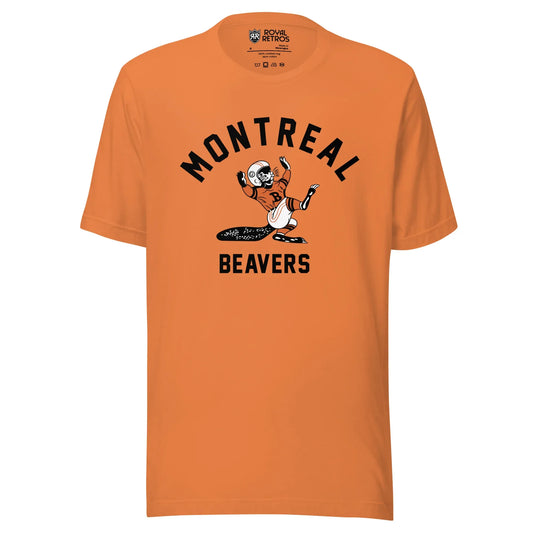
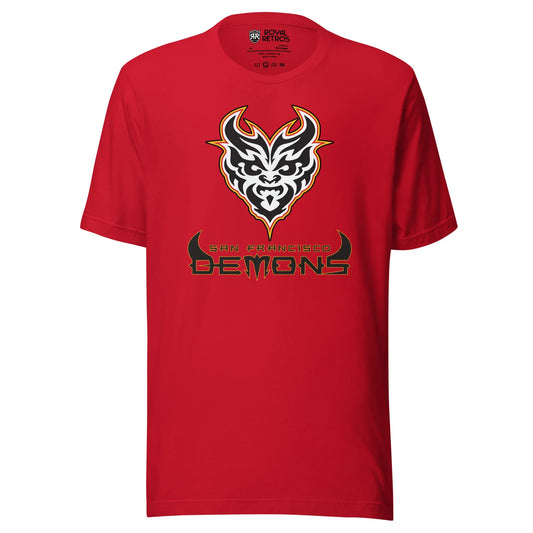
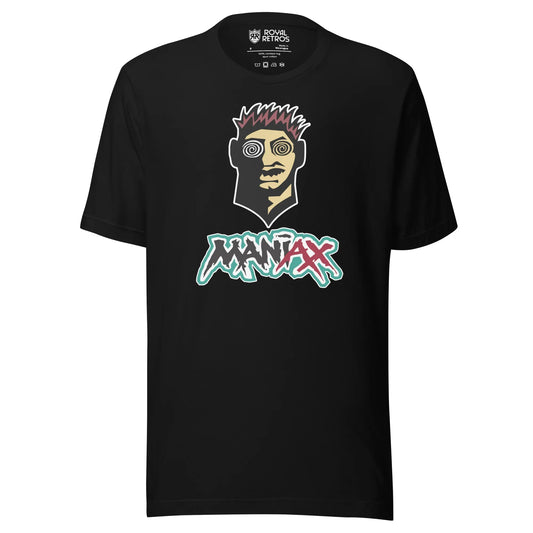
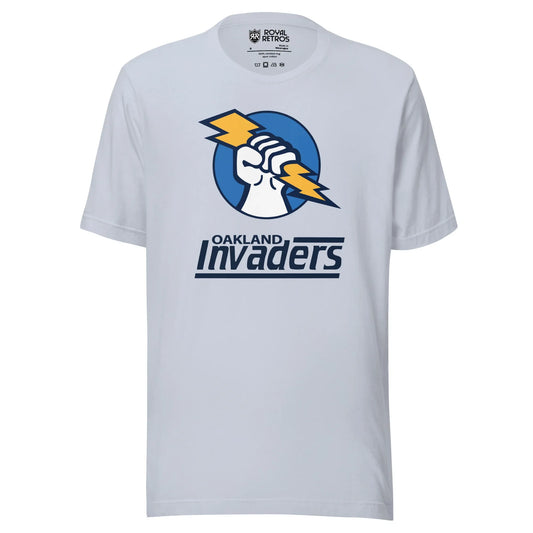
Football T-Shirts — Vintage & Throwback Tees from Every Pro Football League
351 football tees. Every defunct league, every spring-football revival, every arena circuit — nobody else stocks this deep. Sizes S–5XL.
Royal Retros carries 351 active football T-shirts spanning fourteen leagues and nearly eighty years of professional football that most retailers have never heard of. Standard tees run $29.99 in sizes S–5XL; long sleeve tees are $34.99 (S–4XL); moisture-wicking DynastyDry tees are $29.99 (S–XXL); and the premium AF1 On Field Performance Tee runs $49.99 (S–4XL). This is not a novelty rack of generic sports graphics — every design ties back to a real franchise, a real season, and a real league, from the USFL and XFL to leagues most fans have forgotten ever existed: the WFL, the AAFC, the original UFL, and the CFL's short-lived American expansion era. If a pro football league operated on this continent and folded, faded, or got absorbed, there is a decent chance Royal Retros has a shirt for it.
Shop Football T-Shirts by League
Fourteen leagues, one collection. Every link below goes to a league hub with real, in-stock inventory — not a placeholder page. Counts below reflect T-shirts specifically; each league hub also carries other product types where available.
AF1 (Arena Football One) T-Shirts — 58
The AF1 catalog is the single deepest team lineup in this collection — 58 tees across throwback, League Gear, On Field Performance, and Postseason designs for teams like the Nashville Kats, Albany Firebirds, Minnesota Monsters, Michigan Arsenal, and Kentucky Barrels. Shop AF1 T-Shirts.
Arena Football League T-Shirts — 48
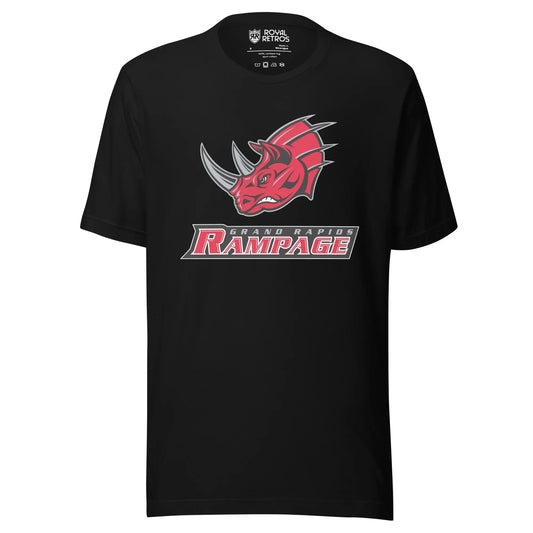
Before AF1, there was the original Arena Football League, which ran from 1987 into the late 2000s across markets that never got another shot at pro football — Tampa Bay, San Jose, Grand Rapids, Des Moines. 48 tees cover its teams and identities. Shop Arena Football League T-Shirts.
USFL T-Shirts — 32
The USFL is the backbone of this collection — the original 1983–1985 spring league that signed marquee college talent straight into the pros, and the revived 2022–2023 version that brought the name back before merging into the UFL. 32 tees across both eras. Shop USFL T-Shirts.
World Football League T-Shirts — 22
The WFL lasted barely a season and a half (1974–1975) but left behind some of the strangest, most memorable team identities in football history — the Hawaiians, the Chicago Winds, the Portland Storm. 22 tees keep that short, chaotic era alive. Shop World Football League T-Shirts.
UFL T-Shirts — 22
The current UFL — the 2024 merger of the USFL and XFL — fields teams like the DC Defenders, St Louis Battlehawks, and Arlington Renegades. 22 tees, including the DynastyDry moisture-wicking line and Long Sleeve options. Shop UFL T-Shirts.
WLAF / NFL Europe T-Shirts — 19
The World League of American Football launched in 1991 as the NFL's first real international experiment, later rebranding as NFL Europe and NFL Europa before folding in 2007. 19 tees cover teams from London, Barcelona, Frankfurt, and Berlin to homegrown WLAF clubs like the Sacramento Surge and Raleigh-Durham Skyhawks. Shop WLAF T-Shirts.
XFL T-Shirts — 18
Both XFL eras are here — the single-season 2001 original (Las Vegas Outlaws, Memphis Maniax, LA Xtreme) and the 2020/2023 reboot (Seattle Sea Dragons, Vegas Vipers, Orlando Guardians). 18 tees. Shop XFL T-Shirts.
AF2 T-Shirts — 15
AF2 was arena football's minor league from 2000 to 2009, developing players and filling out mid-size markets that never had pro football of their own — Cincinnati, Corpus Christi, Peoria, Roanoke. 15 tees. Shop AF2 T-Shirts.
Canadian Football T-Shirts — 12
In the mid-1990s the CFL made a run at American expansion, fielding teams in Sacramento, Las Vegas, Shreveport, Birmingham, and Baltimore — whose Stallions remain the only U.S.-based team ever to win the Grey Cup. 12 tees. Shop Canadian Football T-Shirts.
AAFC T-Shirts — 9
The All-America Football Conference ran from 1946 to 1949 as a genuine rival to the NFL before folding and sending several of its franchises into the league it once competed with. 9 tees cover clubs like the Chicago Rockets, Chicago Hornets, Los Angeles Dons, and Buffalo Bisons. Shop AAFC T-Shirts.
Alliance of American Football T-Shirts — 8
The AAF played exactly one partial season, folding in April 2019 before its first year was finished — a spring-football cautionary tale with a surprisingly loyal following. 8 tees for Atlanta, Memphis, Orlando, San Diego, Birmingham, Arizona, San Antonio, and Salt Lake City. Shop AAF T-Shirts.
Minor League & Original UFL T-Shirts — 12
The deepest cuts in the catalog: 6 tees from the Continental Football League and Atlantic Coast Football League (1960s–70s minor-league circuits), plus 6 from the original UFL — a completely different, unrelated league that ran 2009–2012 before folding, years before the current USFL/XFL-merger UFL existed. Shop Minor League Football T-Shirts or shop the original 2009–2012 UFL.
Other Football T-Shirts — 5
Pre-1952 NFL-era franchises and 1960s American Football League clubs that never made the jump to a merged, modern league — a small but genuinely rare 5-tee corner of the catalog. Shop Other Football T-Shirts.
Shop Football T-Shirts by Team
Some franchises show up again and again across this catalog — throwback, helmet graphic, championship, League Gear, and On Field Performance versions of the same identity. Here are the deepest team lineups.
-
Nashville Kats (AF1) — 11 tees, from throwback wordmark to Postseason League Gear. Shop AF1 T-Shirts.
-
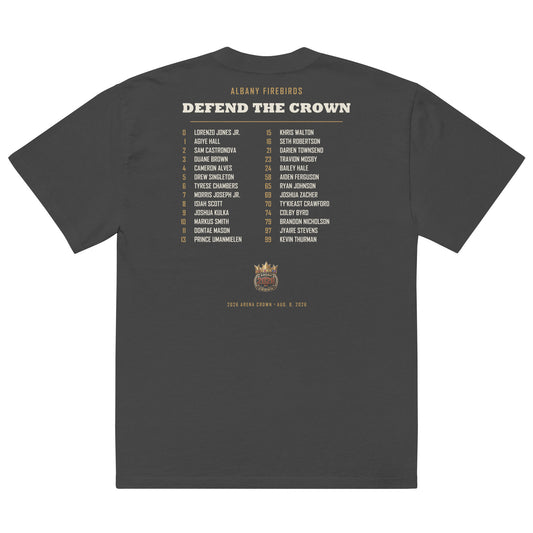
Albany Firebirds (AF1) — 10 tees across every AF1 product line, including Long Sleeve and On Field Performance. Shop AF1 T-Shirts.
-
Memphis Showboats (USFL/UFL) — 7 tees, including Helmet Graphic, Alternate Logo, and DynastyDry versions. Shop USFL T-Shirts.
-
Birmingham Stallions (USFL/UFL) — 5 tees spanning the revived USFL and current UFL eras, plus a Long Sleeve option. Shop UFL T-Shirts.
-
DC Defenders (UFL) — 4 tees, including Helmet Graphic and DynastyDry. Shop UFL T-Shirts.
-
St Louis Battlehawks (UFL) — 4 tees across throwback, DynastyDry, and Long Sleeve. Shop UFL T-Shirts.
Shop Football T-Shirts by Graphic Style
Every design in this collection falls into one of a handful of real graphic treatments — not stock clip art.
-
League Gear (19 tees). League-branded designs without a specific team logo — for fans of the league itself, not just one franchise.
-
Long Sleeve T-Shirts (15 tees). The same throwback and team designs in a long sleeve cut, priced at $34.99, sizes S–4XL.
-
Championship tees (12 tees). Designs built around a specific title run or championship season.
-
Helmet Graphic tees (10 tees). Team helmet artwork printed as the primary front graphic on a standard tee.
-
Throwback & Classic wordmark tees (9 tees). Vintage team wordmarks and script logos built to look like they came off a shelf during the team's actual playing days.
-
DynastyDry performance tees (8 tees). 100% polyester moisture-wicking fabric, $29.99, sizes S–XXL only — built for wear, not just display.
-
On Field Performance Tee (8 tees). AF1's premium line at $49.99, sizes S–4XL, in Castlerock/White.
-
Alternate Logo tees (2 tees). A small, genuinely rare pair of secondary-logo designs for collectors who already have the primary version.
Materials, Fit & Sizes
Sizing and fabric vary by product line, so here is exactly what you are buying:
-
Standard cotton tees ($29.99): 100% cotton (52% cotton / 48% polyester on heather colors), 4.2 oz combed and ring-spun, unisex classic fit, pre-shrunk and side-seamed. Sizes S–5XL — the largest size range in this collection.
-
DynastyDry performance tees ($29.99): 100% polyester moisture-wicking fabric, lightweight, league logo on the back collar. Sizes S–XXL only — this line does not currently go past XXL.
-
Long Sleeve T-Shirts ($34.99): 100% cotton, classic fit, league logo on the sleeve. Sizes S–4XL.
-
AF1 On Field Performance Tee ($49.99): 100% cotton (52/48 blend on heather colors), extra soft and lightweight, unisex classic fit. Sizes S–4XL, currently offered in Castlerock/White.
Printed graphics on every style, pre-shrunk fabric, and side-seamed construction on the standard tee line to prevent twisting after washing.
Why Royal Retros
-
351 active football T-shirts across fourteen leagues — the deepest defunct and current-league football tee catalog we know of.
-
Real franchises, real graphics, real eras — not generic novelty sports designs.
-
Fourteen leagues in one place. No other retailer we've found stocks current spring/arena leagues and defunct 1940s–1990s circuits side by side.
-
Inclusive sizing. S–5XL on the standard tee line, with clearly labeled size ranges on every other style.
-
Coverage nobody else has. The AAFC, WFL, original UFL, COFL, and ACFL sections exist here because almost no other retailer bothers with them.
-
Researched, not templated. Every league section on this page is written around verified dates, franchises, and outcomes — not a generic sports-retail template with the league name swapped in.
Quick Buying FAQ
What sizes do these football tees run?
Standard cotton tees run S–5XL. Long Sleeve T-Shirts and the AF1 On Field Performance Tee run S–4XL. DynastyDry moisture-wicking tees run S–XXL only. Check the size chart on each product page before ordering, since the range differs by style.
What are these shirts made of?
Standard and Long Sleeve tees are 100% cotton (a 52% cotton / 48% polyester blend on heather colors). DynastyDry tees are 100% polyester moisture-wicking fabric. All are printed graphics, not embroidered.
How fast do orders ship?
Standard processing is 3–5 business days before the order ships from our facility.
What is your return policy?
Returns are handled through our standard returns process — see the returns page linked in the site footer for the current policy and window.
Do you offer free returns or exchanges for sizing?
Check the returns page for current policy details before ordering if sizing is a concern; when in doubt on a borderline size, sizing up is usually the safer call on the unisex classic fit.
Are these reproductions or original game-worn apparel?
These are newly manufactured reproduction designs, not vintage game-worn or original-run apparel from the years these teams were actually active. See the throwback-versus-vintage section above for more on that distinction.
Gift Ideas
- For the fan who insists they've "seen it all" — an AAFC or WFL tee from a league they've probably never heard of.
- For an Arena Football One supporter — the AF1 On Field Performance Tee at $49.99 is the standout premium piece in the catalog.
- For a spring-football diehard — a Long Sleeve T-Shirt from the current UFL, wearable well past summer.
- For a completionist collector — an Alternate Logo tee, one of only two in the entire collection.
- For someone who grew up watching a specific league — matching a gift to the exact years that league operated (checking the era notes in the league sections above) makes the shirt feel personal rather than generic.
How Many of These Fourteen Leagues Are Still Active Today?
Of the fourteen leagues covered in this collection, only two are currently playing games: the UFL (the 2024 USFL/XFL merger) and AF1. Every other league here — the original Arena Football League, AF2, USFL (1983–1985), XFL (2001 and 2020/2023), AAF, WLAF/NFL Europe, WFL, AAFC, the original UFL (2009–2012), the CFL's American-expansion era, and the pre-1970s minor circuits like COFL and ACFL — is fully defunct. That split is exactly why this catalog exists: active-league merchandise is easy to find through official channels, but defunct-league merchandise disappears from the market entirely once a league folds, which is what makes a catalog this deep genuinely hard to replicate.
What Is the Difference Between a Throwback Tee and a Vintage Tee?
A throwback tee is a newly manufactured shirt designed to replicate an older team identity, while a true vintage tee is an original garment actually produced and sold during the years a team was active — and everything in this collection is the former, not the latter. That distinction matters for buyers: a throwback design can be printed accurately and researched carefully (which is the standard this catalog holds itself to), but it will never carry the decades of wear, fading, or scarcity value of a surviving original-run shirt from a league that stopped producing merchandise forty or fifty years ago. If accuracy to the team's actual era-appropriate branding matters to you, a well-researched throwback is the practical way to wear that history today.
Why Do So Many American Football Leagues Fail?
Most of these leagues failed for the same handful of reasons: undercapitalized ownership groups, television deals that didn't cover operating costs, and direct competition with an NFL that already owned the national audience. Spring and alternative football leagues have launched roughly once a decade since the 1960s, and nearly all of them have folded within one to three seasons — not because the football was bad, but because the business model rarely survives contact with an NFL-saturated sports market. The leagues that have lasted longest, like Arena Football and its current AF1 successor, have generally done so by carving out a niche the NFL doesn't compete in directly rather than trying to go head-to-head with it.
Why Did the USFL Fold in 1985?
The original USFL folded after its 1985 season because it bet everything on a move to a fall schedule that would put it in direct competition with the NFL, then lost an antitrust lawsuit against the NFL that awarded it just $1 in damages (trebled to $3) instead of the hundreds of millions it needed to survive the move. The USFL played three spring seasons, from 1983 to 1985, and built a genuinely talented league — its clubs signed a wave of major college prospects directly out of school, something the NFL's draft rules hadn't anticipated. But rapid expansion, aggressive spending on player contracts, and the decision to challenge the NFL directly on its own turf proved to be more than the league's ownership groups could sustain. The league never played its planned fall 1986 season. The USFL name returned in 2022 as a new spring league before merging with the XFL in 2024 to form the UFL.
What Happened to the XFL?
The XFL has folded and relaunched twice. The original 2001 XFL, a joint venture between the WWF and NBC, lasted a single season — low football quality and sliding TV ratings led both partners to shut it down before a second year. A rebuilt XFL returned in 2020 under new ownership with a renewed emphasis on actual football quality, only to suspend its season within weeks due to the COVID-19 pandemic; it relaunched fully in 2023. In 2024, the XFL merged with the USFL to form the current UFL, ending the XFL as a standalone brand while keeping several of its team identities and markets alive under the new league.
What Was the AAFC and Why Did It Merge Into the NFL?
The All-America Football Conference operated from 1946 to 1949 as a legitimate rival to the NFL, signing top talent and drawing strong attendance in several markets. It merged into the NFL after the 1949 season because continued competition was proving too costly for both leagues, and only three AAFC franchises were absorbed into the NFL as part of the deal — the rest of the league's clubs folded outright. Teams like the Chicago Rockets, Chicago Hornets, Los Angeles Dons, Brooklyn Dodgers, Miami Seahawks, and Buffalo Bisons never made the cut and are remembered today almost entirely through collectors and history sites rather than any surviving franchise.
Why Did the World Football League Collapse So Fast?
The World Football League collapsed because it spent money it never had — signing star college and NFL talent to contracts the league's undercapitalized ownership groups could not actually afford, all while operating on wildly inflated (and in some cases fabricated) attendance figures. The WFL played a partial 1974 season and folded during its 1975 season, lasting barely eighteen months in total. Franchises relocated, folded, and merged mid-season as the league scrambled to stay solvent, which is part of why WFL team identities — the Hawaiians, the Chicago Winds, the Portland Storm and Thunder, the Shreveport Steamer — feel so scattered and short-lived compared to almost any other league in this collection.
Why Did the CFL Try American Expansion in the 1990s?
The CFL expanded into the United States in the 1990s to chase larger media markets and a bigger revenue base after years of financial strain among its Canadian franchises, placing teams in cities like Sacramento, Las Vegas, Shreveport, Birmingham, and Baltimore between 1993 and 1995. The experiment mostly struggled at the gate, with American fans slow to embrace Canadian football's different field dimensions and rules, but it produced one genuine success story: the Baltimore Stallions, who won the 1995 Grey Cup, becoming the only United States-based team ever to do so before the CFL ended its American experiment after that season.
Why Is Defunct-League Football Merchandise So Scarce?
Defunct-league football merchandise is scarce because almost nobody manufactures new product for a league that no longer exists, and surviving original-run gear was rarely preserved carefully in the first place — most of it was cheap, mass-produced apparel that fans wore out or threw away decades ago. Once a league folds, its trademarks often sit in limbo for years, tied up in bankruptcy proceedings or ownership disputes before anyone can legally produce new licensed product again. That combination — no ongoing production, minimal original preservation, and tangled trademark history — is exactly why a retailer with the design research and catalog depth to cover leagues like the WFL, AAFC, and original UFL is unusual.
How Do You Date a Football Graphic Design?
You can date a football graphic design by matching three details: the team name and city (which often changed multiple times even within a single league's run), the logo or wordmark style (block lettering and simple mascots dominated the 1940s–1960s, while airbrushed and gradient-heavy designs became common from the 1980s onward), and the league branding itself, since most of these leagues only existed for a handful of specific years. A shirt referencing the "Oakland Invaders" places the design in the original 1983–1985 USFL run; a "Los Angeles Xtreme" design points to the 2001 XFL specifically, since that team never existed in the 2020s reboot. Cross-referencing team name, league, and the years a given league actually operated is the fastest way to place any of these designs in time.
What Was Arena Football and How Is AF1 Different from the Original Arena Football League?
Arena football is indoor American football played on a shortened field (50 yards instead of 100) with rebound nets, lower scoring barriers, and rosters built for constant offense — and AF1 is the current league carrying that format forward, distinct from the original Arena Football League that operated from 1987 into the late 2000s. The original league built the format and a loyal following in markets like Tampa Bay, San Jose, and Des Moines before financial strain led to its shutdown; AF2 ran alongside and beneath it as a development circuit from 2000 to 2009. AF1 picked the format back up under new ownership, which is why the AF1 section of this catalog is both the deepest and the most current team lineup here. If a tee says "Arena Football League" it is referencing the older, defunct circuit; if it says AF1, it is referencing the current one.
Why Did the Original UFL (2009–2012) Fold?
The original UFL folded after the 2012 season because it never found a stable television deal or a large enough paying audience to cover its costs, despite fielding teams with real NFL-caliber talent in markets like Omaha, Hartford, Sacramento, and Las Vegas. It played four seasons, starting in 2009, and is a completely separate entity from the current UFL, which only adopted the same three-letter name in 2024 when the USFL and XFL merged. The two leagues share no ownership, no franchises, and no continuity — the shared name is a coincidence of branding, not a relaunch.
What Was the WLAF and How Did It Become NFL Europe?
The World League of American Football launched in 1991 as the NFL's attempt to grow the sport internationally, fielding a mix of American and European teams before pausing after the 1992 season and returning in 1995 as an all-European league rebranded first as NFL Europe and later NFL Europa. It ran under NFL ownership until folding after the 2007 season, when the league determined the international development model was not producing enough return to justify the cost of running six European franchises. Teams like the London Monarchs, Barcelona Dragons, and Frankfurt Galaxy played across both the original WLAF and NFL Europe eras, while early WLAF-only clubs like the Sacramento Surge, San Antonio Riders, and Raleigh-Durham Skyhawks never made the transition to the Europe-only format.
Why Do So Many of These Teams Have Multiple Different Names?
Teams in short-lived leagues change names constantly because ownership groups relocate franchises, rebrand for new markets, or simply run out of money mid-season and get sold to new owners who rename the club — all without the roster continuity or media attention that keeps a name stable in a bigger, more established league. The WFL's Portland franchise alone played as both the Portland Storm and the Portland Thunder within its brief existence; the original Arena Football League's Portland club later went through a Thunder-to-Steel rename of its own. This constant churn is part of why dating a design by team name and city is so useful — a specific name usually points to a narrow window of just one or two seasons.
Where Did These Teams Actually Play?
Football teams outside the NFL have always played wherever they could book a stadium, which usually meant sharing venues with college programs, minor-league baseball parks, or NFL stadiums on off dates rather than building anything of their own. The revived Michigan Panthers, for example, played their 2022 season on the road out of Birmingham's Protective Stadium before bringing professional spring football back to Detroit's Ford Field in 2023 — echoing the original 1983 Panthers, who played their home games at the Pontiac Silverdome and won the first-ever USFL championship at Denver's Mile High Stadium. That pattern — borrowed stadiums, shifting home markets, and title games played in neutral cities — repeats across almost every league in this catalog, and it is part of why venue history is such a common thread in vintage football research.
How to Identify a Quality Football T-Shirt
Look for four things on any football tee, vintage-style or current: fabric weight and composition (a genuine mid-weight combed cotton, roughly 4.2 oz, holds its shape and color far better than thin, cheap blanks), print quality (a properly cured, non-cracking print with clean edges — not a design that already looks worn straight out of the package unless that is the intentional style), accurate team and league details (correct colors, correct era-appropriate wordmark, no invented team names), and construction basics like side-seaming and pre-shrinking, which prevent the shirt from twisting or shrinking unevenly after the first wash. A tee that gets the history right and is built from real, mid-weight fabric is worth the extra few dollars over a cheap novelty print. Wash cold and inside-out, and skip the dryer's high-heat setting if you want the print to hold up for years rather than months — printed graphics on cotton blends crack faster under repeated high heat than almost any other point of failure on a well-made shirt.
Notable Firsts Behind These Designs
-
The first USFL championship was decided on July 17, 1983, at Denver's Mile High Stadium, when the Michigan Panthers beat the Philadelphia Stars 24–22 in the league's inaugural title game.
-
The only United States-based CFL team to win a Grey Cup was the Baltimore Stallions, who claimed the title in 1995 during the CFL's short-lived American expansion era — the same year the CFL ended that experiment.
-
The AAF's entire existence lasted less than one season — it launched in February 2019 and folded that April, before its first regular season had even finished.
-
The WFL played barely eighteen months total across a partial 1974 season and a collapsed 1975 season, making it one of the shortest-lived leagues ever to field a full slate of teams.
Extended FAQ
Is the current UFL the same league as the 2009–2012 UFL?
No. The current UFL is a completely different league, formed in 2024 by the merger of the USFL and XFL. The original UFL played from 2009 to 2012 before folding, and shares nothing with the current league except the same three-letter name. Royal Retros carries both, with the original 2009–2012 UFL kept in its own separate collection to avoid confusion.
Is /collections/afl the same as the 1960s American Football League?
No. On this site, the Arena Football League collection refers to the indoor arena football league that ran from 1987 into the late 2000s — a completely different sport format from the 1960s American Football League that eventually merged with the NFL. Products referencing that earlier 1960s league are filed under Other Football, not under Arena Football League.
What is the difference between USFL and UFL product on this site?
USFL-tagged product covers both the original 1983–1985 USFL and the revived 2022–2023 USFL. UFL-tagged product covers the current merged league that has run since 2024. Some designs, like Birmingham Stallions gear, are tagged under both because that franchise played across both eras.
Why do some teams have five or six different tees while others only have one?
Catalog depth generally follows how long a franchise has been active and how many separate design lines (throwback, helmet graphic, championship, League Gear, Long Sleeve, performance) it has appeared in. Current AF1 and UFL teams tend to have the deepest lineups because they've been through multiple product refreshes; one-off historic franchises from short-lived leagues like the WFL or AAFC often have just a single design.
What does a "Helmet Graphic" tee actually look like?
A Helmet Graphic tee is a printed t-shirt with team helmet artwork as the primary front graphic — it is apparel, not a physical collectible. Ten designs in this catalog use that treatment, spanning USFL, UFL, and WFL franchises.
Can I filter by a specific decade?
Not with a dedicated decade filter, but the league sections above map roughly to eras — AAFC and Other Football skew 1940s–1960s, WFL and the original USFL skew 1970s–1980s, WLAF and the original UFL skew 1990s–2010s, and AF1, current UFL, and current XFL/USFL product is contemporary.
Which league in this collection has been around the longest?
Counting every relaunch and rebrand together, the arena football format has the longest overall run in this catalog — from the original Arena Football League's 1987 debut, through AF2's development era, to AF1 today, indoor arena football has had some form of professional presence for close to four decades. Among leagues that never paused, the CFL's roots go back further, but its American-expansion teams covered here only existed for the 1993–1995 window.
Why does the AAFC section only have a handful of teams instead of the full league?
The AAFC fielded a rotating set of franchises across its four seasons, and this catalog focuses on the clubs whose identities never carried forward into another league — teams like the Chicago Rockets, Chicago Hornets, Los Angeles Dons, Brooklyn Dodgers, Miami Seahawks, and the Buffalo Bisons. The small number of AAFC franchises that were absorbed into the NFL in the 1950 merger are not part of this collection, since Royal Retros does not produce apparel referencing currently-operating NFL franchises.
What does "Proposed Teams" mean on some product tags?
A handful of designs in this catalog cover teams that were announced or planned but never actually took the field — CFL expansion clubs like the Atlantic Schooners and Miami Manatees, and a USFL 1986-season franchise or two that existed only on paper before the league folded. These are genuinely rare corners of football history: team identities that have a logo and a city but zero played games behind them.
Do the DynastyDry and On Field Performance tees fit the same as the standard cotton tees?
No — both performance lines run in a unisex classic fit like the standard tees, but check the size chart on each specific product page before ordering, since the DynastyDry poly fabric and the On Field Performance cotton blend can fit differently than the standard 4.2 oz cotton tee even at the same labeled size.
Why does AF2 have so many small-market teams that never appear anywhere else?
AF2 was built specifically as a lower-cost development league, which meant its ownership groups could afford to place teams in mid-size and smaller markets that never had — and never got again — any other form of professional football, from Corpus Christi and Roanoke to Peoria and New Haven. That is exactly why the 15 AF2 tees in this collection cover cities you will not find represented anywhere else in the catalog, including in the larger original Arena Football League.
Were any of these teams named after a sponsor or a stadium instead of a city identity?
A few were, particularly in arena football's early years when league and team branding leaned heavily on catchy, marketable mascots rather than traditional city-first naming — part of why arena football nicknames tend to feel more like minor-league baseball branding than NFL-style team names. That branding style is a useful visual cue on its own: a heavily stylized, mascot-forward wordmark is a strong signal you are looking at an arena-format design rather than an outdoor-league one.
Shop Related Collections
Shop Football T-Shirts at Royal Retros — 351 Tees, Fourteen Leagues, Sizes S–5XL.