




-
CUSTOM
Sacramento Senators Jersey
Regular price Starting at $123.00 CADRegular priceUnit price per -
-
Sacramento Solons Unstructured Hat
Regular price $44.00 CADRegular priceUnit price per -
-
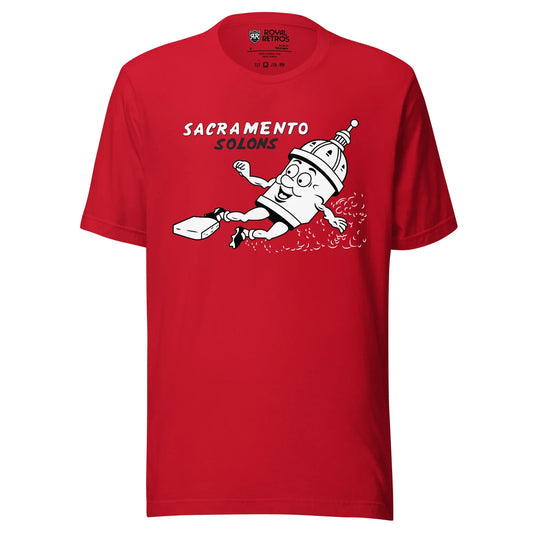
Sacramento Solons T-Shirt
Regular price $44.00 CADRegular priceUnit price per -
-
CUSTOM
Sacramento Solons Script Jersey
Regular price Starting at $123.00 CADRegular priceUnit price per -




The Sacramento Solons Collection — Royal Retros Sacramento Solons Fan Shop
Authentic Sacramento Solons & Senators Pacific Coast League Throwbacks. Custom Names & Numbers. Sizes S–5XL.
Royal Retros carries the Sacramento Solons collection — four active pieces covering both eras of Sacramento's Pacific Coast League history: the Senators name the club wore before 1935, and the Solons script uniform that followed. Two jersey builds anchor the line: the Sacramento Senators jersey at $84.99 in Gray, and the Sacramento Solons Script jersey at $84.99 with two distinct year-specific colorways — 1940 and 1943, each in Gray or Cream. The tee is $29.99 in five colors, and the unstructured Navy dad hat is $29.99, both Small through 5XL where sizing applies. Free custom name and number on most jerseys. Whether you remember Edmonds Field, know the Solons as a Branch Rickey farm club, or just want a script logo nobody else is carrying, this is the deepest Sacramento PCL collection you'll find outside a museum.
What You Can Shop in the Sacramento Solons Collection
Sacramento Senators Jersey — The pre-1935 identity, before the Solons name existed. Gray, sewn twill lettering, period-correct cut. Shop the Senators jersey. $84.99, sizes S–5XL.
Sacramento Solons Script Jersey — The Solons script look in two year-specific builds: 1940 and 1943, each available in Gray or Cream. Four total colorways on one product. Shop the Script jersey. $84.99, sizes S–5XL.
Sacramento Solons T-Shirt — Soft pre-shrunk cotton with vintage Solons graphics, in Black, Red, Athletic Heather, Natural or White. Shop the tee. $29.99, sizes S–5XL.
Sacramento Solons Hat — The unstructured Navy dad hat, adjustable one-size. $29.99.
Customization — Free custom name and number on most jerseys. Put a Solons original on the back — Tony Freitas is the obvious call — or your own name and number. Custom items are made to order and final sale.
Sizes — Small through 5XL on both jerseys and the tee. The hat is one-size adjustable. No big & tall upcharge.
Shop by Era — Senators vs. Solons vs. the 1940s Script
The Senators Era (through 1935). Before the name most fans associate with Sacramento baseball existed, the club played as the Senators — Sacramento's original Pacific Coast League identity, dating back to the league's earliest seasons. If you're a completist who wants the uniform from before the rename, this is the one jersey on the site that carries it. Shop the Senators jersey.
1940 — Early Solons Era. Five years into the Solons name and three years into Branch Rickey and the St. Louis Cardinals' ownership of the club, this is the script look from the franchise's transition into a true player-development pipeline. Available in Gray or Cream. Shop the 1940 colorway.
1943 — Wartime Solons. Baseball during the Second World War meant thinned-out rosters and reshuffled affiliations across every minor league, and the 1943 Solons played through that same disruption. The jersey marks the era. Available in Gray or Cream. Shop the 1943 colorway.
Why Royal Retros Is the Home of Sacramento Solons Throwback Gear
- Both eras, not just one generic logo. The Senators jersey and the Solons Script jersey — with two separate year colorways inside it — cover more of Sacramento's PCL identity than any single "vintage Sacramento" tee could.
- Flat, honest pricing. $84.99 for either jersey style, $29.99 for the tee, $29.99 for the hat. No "collector's" markup.
- Free customization on most jerseys. Add a name and number at no extra cost on eligible items.
- Sizes S–5XL. True family sizing, no big & tall upcharge.
- Deep Pacific Coast League coverage. Cross-shop the Solons with the San Francisco Seals, Hawaii Islanders — the club the Solons roster fed into when Sacramento left the PCL after 1960 — and the broader West Coast Minors collection.
- Sacramento roots. Find the Solons alongside the rest of the city's sports history in our Sacramento collection.
Quick Buying Questions
What sizes do Sacramento Solons jerseys come in?
Small through 5XL on both jersey styles. The hat is adjustable one-size-fits-most. We don't upcharge for big & tall sizes.
Can I add my name and number to a Solons jersey?
Yes — most styles include free custom name and number. Choose a Solons original or your own. Look for the "Custom" option on the product page. Custom items are final sale.
Which jersey should I pick — Senators or Solons?
If you want the identity from before the 1935 rename, go Senators. If you want the more widely recognized script logo, pick the Solons Script jersey in either the 1940 or 1943 colorway.
Are these officially licensed?
No. These are heritage tribute reproductions of a defunct Pacific Coast League franchise, not licensed merchandise from any current organization.
What are the jerseys made from?
Heavyweight twill with sewn-on lettering and numbers, styled to match each era's documented look.
How fast does it ship and what's the return policy?
Stock items ship within 3–5 business days. Custom jerseys are sewn to order and typically ship within 7–10 business days. Custom items are final sale. Standard items follow our return policy at /pages/returns.
Gift Ideas for the Sacramento Solons Fan
- For the lifelong Sacramentan: The Solons predate every professional team the city has now, and the Senators jersey goes back even further than that.
- For the PCL completist: Sacramento was in the Pacific Coast League on and off from the league's founding era through 1976 — few franchises have a start-to-finish story this long.
- For the Cardinals farm-system historian: Branch Rickey's Cardinals owned the club through the 1930s and '40s, tying Sacramento directly into the same player-development machine that built St. Louis's dynasty years.
- For the home-run hitter's fan: The 1974 revival Solons, playing at a short-fenced Hughes Stadium, became known for one of the most extreme home-run environments in organized baseball that decade.
- Year-round demand. Solons nostalgia isn't seasonal — Father's Day, birthdays and the Opening Day itch all work.
Who Were the Sacramento Solons?
The Sacramento Solons were Sacramento, California's professional baseball franchise in the Pacific Coast League across two separate stretches — first as the Senators and then as the Solons from the mid-1930s through 1960, and again in a short-lived 1974–1976 revival. Across those decades the club played at three different home fields, changed its name once, and spent more than a decade as a direct farm affiliate of the St. Louis Cardinals under Branch Rickey. For a mid-sized Northern California city, it's a genuinely long and layered baseball history, and one that almost nobody outside serious PCL historians remembers in any detail.
Why Were They Called the Senators Before They Were the Solons?
Sacramento's professional club took the field as the Senators in the early decades of Pacific Coast League play, dating back to the league's first seasons in the early 1900s. The Senators name had nothing to do with Sacramento being a state capital in the way it might sound — it was simply the identity the club carried into the PCL's founding era, played under across multiple ownership groups, and kept for roughly three decades before a change in the 1930s replaced it for good.
Why Did the Senators Become the Solons?
The Senators became the Solons in the mid-1930s when the club changed hands and adopted a new name derived from "solon," an old-fashioned word for a wise lawmaker or statesman — a nod to the ancient Greek statesman Solon and, loosely, to Sacramento's role as the seat of California's government. The rename coincided with new ownership connected to the St. Louis Cardinals organization under Branch Rickey, one of the most influential executives in baseball history and the architect of the modern farm system. Rickey's Cardinals took control of the club and its home ballpark in the mid-to-late 1930s, folding Sacramento directly into the pipeline that was, at the time, producing more National League talent than any other organization in the sport.
What Was Edmonds Field?
Edmonds Field was the Solons' home for most of the twentieth century, though it wore three different names across its life. It started as Buffalo Park, named for the Buffalo Brewing Company that helped fund the original wooden ballpark. A substantial 1922 rebuild brought a new name, Moreing Field, and the park hosted Sacramento's first Pacific Coast League night game on June 10, 1930 — the first night game in PCL history, a genuine first for the league rather than just for the city. A fire destroyed the ballpark in July 1948, and it was rebuilt over that winter. On September 9, 1945, before the fire, the park had already been renamed a final time — Edmonds Field, honoring Sacramento Union sports editor Dick Edmonds, who had campaigned hard to keep the Solons in Sacramento during a difficult 1944 season and died shortly after that fight was won. Edmonds Field stood until 1964, four years after the Solons themselves had already left town.
What Was the Solons' Best Season?
The 1942 Solons had the best single season in franchise history, going 105–73 and winning the Pacific Coast League pennant outright — a genuinely dominant year in a league that, at the time, functioned as something close to a third major league on the West Coast. The club also won league titles in 1927, 1931, 1932, 1934 and 1938 across its run, giving Sacramento a real run of PCL success spanning both the Senators and Solons eras, not just a single standout year.
Who Pitched for the Solons the Longest?
Tony Freitas is the defining name in Sacramento pitching history. He came up through the Sacramento Senators from 1929 to 1932, reached the majors with the Philadelphia Athletics in 1932–1933 and the Cincinnati Reds from 1934 to 1936, then came back to Sacramento in 1937 and pitched for the Solons through 1950, with a break during the war years. That two-stretch career — a young prospect who left for the majors and came home to become the franchise's signature arm for over a decade — is exactly the kind of story that PCL-level baseball produced regularly in an era before the minor leagues were strictly a feeder system with no independent identity of its own.
What Did It Mean to Be a Cardinals Farm Club in the Rickey Era?
Branch Rickey is credited with inventing the modern baseball farm system — the practice of a major league organization owning or controlling minor league affiliates outright, rather than simply buying finished players off independent clubs, so that player development could be run as a single coordinated pipeline. By the time the Cardinals took control of the Sacramento club in the mid-1930s, Rickey had already built the largest and most successful farm system in the sport, one that would help St. Louis dominate the National League for the next decade and a half. Being absorbed into that system changed what it meant to play for Sacramento: instead of an independent club buying and selling players on its own terms, the Solons became one link in a much larger machine, with prospects funneled in based on organizational need and graduates sent on to St. Louis when they were ready. It's part of why the Solons of the late 1930s and 1940s were consistently competitive — the pennants in 1938 and 1939 came directly out of that talent pipeline.
Who Is Joe Marty, and Why Does Sacramento Still Remember Him?
Joe Marty was born in Sacramento, and after a major league career as an outfielder — including time with the Chicago Cubs and Philadelphia Phillies in the late 1930s and early 1940s — he came home to finish his playing days with the Solons from 1946 to 1952. He's buried in Sacramento as well, which is part of why his name still carries weight locally in a way that transient minor leaguers who passed through for a single season never did. A hometown player who reached the majors and then chose to close out his career in front of the same fans who watched him grow up is a specific, recurring story in Pacific Coast League history, and Marty's is one of Sacramento's clearest examples of it.
Why Did Sacramento Leave the Pacific Coast League in 1960?
Sacramento's PCL run from 1918 through 1960 ended as part of a broader wave of West Coast minor league instability triggered by the arrival of major league baseball on the Pacific Coast — the Dodgers and Giants had relocated to Los Angeles and San Francisco in 1958, fundamentally changing the economics of the region's high minors. Sacramento's Solons left the PCL after the 1960 season, with much of the organization's talent pipeline and market attention shifting to the Hawaii Islanders, a PCL club that picked up a significant share of the departing Solons' affiliated structure in the years that followed. It closed out more than four decades of continuous or near-continuous PCL baseball in the city.
What Was Baseball Like in Sacramento During the 1943 Season?
The 1943 season, one of the two colorways built into the Script jersey in this collection, fell squarely in the middle of the Second World War's disruption of professional baseball across every level of the sport. Rosters across the Pacific Coast League thinned as players enlisted or were drafted, travel was affected by wartime restrictions and fuel rationing, and clubs across the country — Sacramento included — leaned on players who were older, younger or otherwise exempt from service to fill out lineups. It's a very different baseball environment from the pennant-winning 1942 club the season before it, and the jersey's 1943 colorway is a marker of that specific, disrupted wartime chapter rather than one of the franchise's championship years.
How Did Sacramento Compare to Other Pacific Coast League Cities?
Sacramento sat in the same league as San Francisco, Los Angeles, Oakland, San Diego, Portland, Seattle and Hollywood at various points — a mix of major West Coast metros and smaller state capitals and mid-sized cities that made up the PCL's footprint before major league expansion arrived in California. Sacramento was consistently one of the league's smaller markets by population, closer in size to Portland or the two San Diego-era clubs than to San Francisco or Los Angeles, which makes its run of five league titles across the 1927–1942 stretch a genuinely notable competitive accomplishment for a franchise that wasn't drawing from the biggest available fan base in the league.
Why Did the 1974 Revival Only Last Three Years?
The Solons name came back to Sacramento in 1974 when the Eugene Emeralds franchise relocated and revived it as the Triple-A affiliate of the Milwaukee Brewers. The revival is best remembered today for one specific thing: extreme offense. Playing at Hughes Stadium, a facility with short outfield fences and conditions that were widely considered poor for pitchers, the 1974 Solons became known around organized baseball as one of the most extreme home-run environments of the decade — a season the Baseball Hall of Fame's own historical writing has singled out on its own merits. But a great home-run environment wasn't a substitute for an adequate ballpark, and Hughes Stadium's shortcomings for players, especially pitchers, were serious enough that the franchise left after the 1976 season, leased out to San Jose while Sacramento waited for a stadium that wouldn't actually arrive for close to a quarter century.
What Made the 1938 and 1939 Back-to-Back Pennants Significant?
Winning the Pacific Coast League pennant in consecutive seasons, 1938 and 1939, put the Solons at the top of one of the strongest minor leagues in the country two years running, a feat that few PCL franchises managed at any point in the league's history. Coming just a few years after the Cardinals organization took over the club and installed its farm-system approach, the back-to-back titles were an early proof of concept — evidence that Rickey's player-development machine could turn a mid-sized market's franchise into a genuine contender almost immediately, rather than taking a decade to show results. The 1942 pennant a few years later, with its 105-win season, extended that stretch into one of the most successful five-year runs in franchise history.
What Does the Solons Name Say About How PCL Cities Branded Themselves?
Naming a baseball club after a body of wise statesmen, tied loosely to Sacramento's status as California's capital, was part of a broader pattern across the Pacific Coast League of the era, where team names often reached for regional identity, local industry or civic pride rather than the more standardized, marketing-driven naming conventions that dominate professional sports today. A name like "Solons" would be an unusual choice for a modern franchise launch, but it fit comfortably within a period when minor league identities were often shaped by local newspapers, civic boosters and ownership groups with direct ties to the city itself — which is part of why names like it tend to disappear along with the specific era that produced them rather than getting revived by a later generation of owners looking for something more conventional.
What Happened to Sacramento Baseball After 1976?
Sacramento went without affiliated professional baseball for more than two decades after the 1976 Solons left. The city didn't return to the Pacific Coast League until 2000, under a different name and a different ownership group entirely, in a new ballpark built specifically to end the stadium problem that had driven the Solons out in the first place. That two-decade gap is part of why the Senators and Solons eras covered in this collection feel like a genuinely closed chapter rather than a lead-in to the city's current baseball identity — there's a real, multi-decade seam between the two.
What Was Pacific Coast League Baseball Actually Like in This Era?
Through the 1930s, '40s and '50s, the Pacific Coast League operated as something close to a third major league on the West Coast, a full generation before the Dodgers and Giants ever arrived in California. With no major league franchise west of St. Louis, PCL teams like the Solons drew serious local followings, played long schedules — often well over 170 games a season, longer than the major league schedule of the same era — and developed their own homegrown stars, some of whom spent entire careers at the PCL level rather than ever getting the call to the majors, simply because the level of play and the pay were both good enough to make it worthwhile. That context matters for understanding why a city the size of Sacramento supported professional baseball as seriously as it did for as long as it did: this wasn't a farm team in the diminished, secondary sense the phrase carries today. It was appointment baseball in its own right.
What Happened to Edmonds Field in the 1948 Fire?
A fire destroyed Edmonds Field in July 1948, a serious setback for a franchise in the middle of one of its most stable and successful stretches under Cardinals ownership. Rather than relocate or fold, the club and city rebuilt the ballpark over the following winter, and it reopened in time for the 1949 season under the same name and on the same site. The fire and rebuild are a small but telling part of the Solons' story — a franchise that kept choosing to stay and rebuild rather than walk away, right up until the stadium problems of the 1960s and 1970s finally proved too much to solve twice.
Collecting Solons and Senators Memorabilia Today
Because the franchise's history spans two names, two active eras separated by a fourteen-year gap, and a stadium that no longer exists in any of its three names, Solons and Senators memorabilia occupies an unusually layered space for collectors. A Senators-era piece points to the pre-1936 identity; a Solons-era piece could reasonably represent anything from the 1936 pennant-contending years through the 1960 departure or even the short-lived 1974–1976 Hughes Stadium revival. Being specific about which era a piece represents — as this collection is, with dedicated 1940 and 1943 colorways rather than one generic "vintage Solons" design — is what separates real historical reproduction from a novelty item that just borrows the name.
What Makes Ours Period-Correct
Construction and accuracy. Sewn-on tackle-twill numbers and lettering where the original build called for it, era-correct fonts and colors, and true-to-original construction — every Sacramento Solons design is checked against period references before it goes live.
What Would a Solons Game at Edmonds Field Have Felt Like?
A fan at Edmonds Field during the club's 1930s and '40s heyday would have watched a level of baseball that took itself seriously as something close to major league quality, in a ballpark that had already been rebuilt and renamed more than once to keep up with the city's growth. Night baseball, a novelty when Sacramento hosted the league's first PCL night game in 1930, would have been fully normal by the war years, and the crowd would have included fans following prospects they knew were bound for St. Louis alongside longtime locals who'd been coming since the Senators days. The atmosphere would have been distinctly regional — no major league competition anywhere on the West Coast to split attention, a genuinely deep and competitive Pacific Coast League, and a home team that, across the stretch this collection's two jersey colorways represent, was as likely as not to be playing meaningful games in September.
Why Does This Collection Group Two Team Names Under One Page?
The Senators and the Solons are, formally, two different names carried by the same continuous Sacramento franchise across a single, unbroken ownership lineage — unlike cases where a city's baseball history is split across genuinely separate organizations. Treating them as one collection, with dedicated products for each identity rather than picking one name and ignoring the other, reflects how the actual history works: a club that changed its name once in the 1930s, kept playing in the same city under the same ballpark for another quarter century, then came back for one more run under the newer name in the 1970s. Splitting that continuous story across two unrelated pages would misrepresent it. This page tells it as what it actually was — one Sacramento franchise, two names, one long baseball history.
Extended Sacramento Solons History FAQ
When did the Senators become the Solons?
In the mid-1930s, when new ownership connected to the St. Louis Cardinals took over the club and renamed it.
Who owned the Solons in their prime years?
The St. Louis Cardinals organization, under Branch Rickey, owned and operated the club as a farm affiliate through much of the 1930s and 1940s.
What was the Solons' best season?
1942, when the club went 105–73 and won the Pacific Coast League pennant, the high point of a run that also included league titles in 1927, 1931, 1932, 1934 and 1938.
Where did the Solons play?
Edmonds Field, which went through three names across its life — Buffalo Park, Moreing Field, and finally Edmonds Field from 1945 — hosted the club for most of the twentieth century until it was demolished in 1964.
Did the Solons ever play at night?
Yes — Sacramento hosted the first night game in Pacific Coast League history on June 10, 1930, at what was then Moreing Field.
Why did the Solons leave Sacramento in 1960?
The arrival of major league baseball in Los Angeles and San Francisco in 1958 upended the economics of West Coast minor league baseball, and Sacramento's PCL run ended after the 1960 season as talent and market focus shifted elsewhere, including to the Hawaii Islanders.
Why did the 1974–1976 revival end?
Hughes Stadium, the revival club's home field, was considered inadequate for players and especially pitchers despite its reputation for huge offensive numbers, and the franchise was leased out to San Jose after the 1976 season while Sacramento waited for a proper ballpark.
Who is the most notable player in Solons history?
Pitcher Tony Freitas, who came up through the Sacramento Senators, reached the majors with the Philadelphia Athletics and Cincinnati Reds, then returned to anchor the Solons' pitching staff from 1937 through 1950. Outfielder Joe Marty, a Sacramento native who played in the majors for the Cubs and Phillies, is the club's clearest hometown-hero story, closing out his career with the Solons from 1946 to 1952.
What made Pacific Coast League baseball different from today's minor leagues?
PCL teams in this era operated with much longer schedules than the majors and drew serious independent fan followings in cities with no major league team of their own, making the league feel closer to a genuine third major league than a modern development-focused farm system.
Did Edmonds Field burn down?
Yes — a fire destroyed the ballpark in July 1948, and it was rebuilt over the following winter in time for the 1949 season.
What year did the Cardinals take over the club?
New ownership connected to the St. Louis Cardinals and Branch Rickey's farm system took control in the mid-1930s, the same period the Senators name changed to the Solons.
Did the Solons win back-to-back pennants?
Yes — 1938 and 1939, an early sign that the Cardinals' farm-system approach was working for the club almost immediately after the ownership change.
How long was the gap between the original Solons and the 1974 revival?
Fourteen years. The original run ended after the 1960 season, and the Eugene Emeralds relocated to Sacramento and revived the Solons name in 1974.
What eventually replaced the Solons in Sacramento?
Sacramento went without an affiliated professional club for more than two decades after 1976, then returned to the Pacific Coast League in 2000 under new ownership, a new name and a purpose-built ballpark meant to solve the stadium problems that had driven the Solons out.
Shop Related Collections
Hawaii Islanders · Montreal Royals · New Orleans Pelicans Baseball · New York Highlanders · PCL Padres · Sacramento · San Francisco Seals · West Coast Minors
Sacramento Solons. Senators, Solons, and the 1940s script. Six decades of PCL baseball.