




-
CUSTOM
New York Highlanders Jersey
Regular price Starting at $123.00 CADRegular priceUnit price per -
-
New York Highlanders T-Shirt
Regular price $44.00 CADRegular priceUnit price per -
-
New York Highlanders Snapback Hat
Regular price $51.00 CADRegular priceUnit price per -
-
New York Highlanders Unstructured Hat
Regular price $44.00 CADRegular priceUnit price per -



The New York Highlanders Collection — Royal Retros New York Highlanders Fan Shop
Authentic New York Highlanders 1903–1912 Throwbacks. Custom Names & Numbers. Sizes S–5XL.
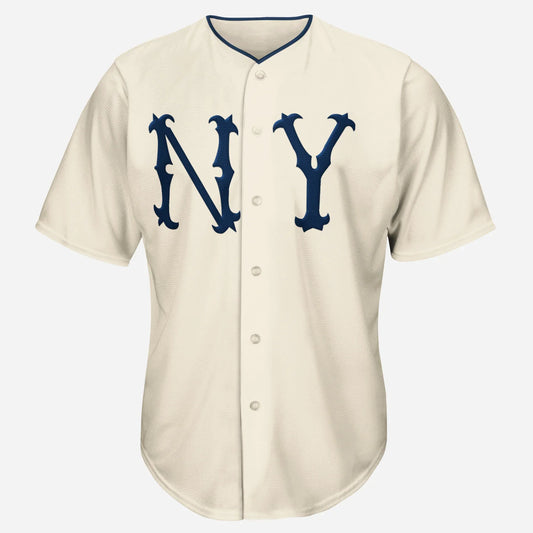
Royal Retros carries the New York Highlanders collection — four active pieces built around the uniform New York's American League club wore during its first decade, before it became the team everyone knows today. The Highlanders jersey is $84.99 in Navy or Cream, sized Small through 5XL, with free custom name and number on most orders. The tee is $29.99 in four colors, Small through 5XL. Two hat styles round it out: a $29.99 unstructured Navy dad hat and a $34.99 Navy snapback, both one-size adjustable. If you know your baseball history and want the uniform from the Hilltop Park years — the club's actual first identity, worn by Jack Chesbro during the greatest single pitching season of the twentieth century — this is the only place carrying it as its own dedicated line rather than a footnote on someone else's page.
What You Can Shop in the New York Highlanders Collection
New York Highlanders Jersey — A single flannel-styled throwback built to the 1903–1912 look: block lettering across the chest, period-correct cut, sewn construction. Available in Navy or Cream. Shop the jersey. $84.99, sizes S–5XL.
New York Highlanders T-Shirt — Soft pre-shrunk cotton with vintage Highlanders graphics, in Navy, Athletic Heather, Natural or White. Shop the tee. $29.99, sizes S–5XL.
New York Highlanders Hats — The unstructured dad hat in Navy ($29.99) and the snapback in Navy or Navy/Natural ($34.99), both adjustable one-size.
Customization — Free custom name and number on most jerseys. Put a Highlanders original on the back — Jack Chesbro, Willie Keeler, Hal Chase — or your own name and number. Custom items are made to order and final sale.
Sizes — Small through 5XL on the jersey and tee. Hats are one-size adjustable. No big & tall upcharge.
Why Royal Retros Is the Home of New York Highlanders Throwback Gear
- A dead-mark name treated with real research, not a generic vintage logo tee. The Highlanders wore this uniform for exactly one decade, 1903 through 1912, and this collection is built to that decade specifically rather than blending it into later branding.
- Flat, honest pricing. $84.99 for the jersey, $29.99 for the tee, $29.99–$34.99 for hats. No "collector's" markup.
- Free customization on most jerseys. Add a name and number at no extra cost on eligible items.
- Sizes S–5XL. True family sizing, no big & tall upcharge.
- Deep early-American-League coverage. Cross-shop the Highlanders with the Chicago Whales, another short-lived early-1900s identity, and the rest of our custom baseball jerseys catalog.
- New York roots. Find the Highlanders alongside the rest of the city's baseball history in our New York collection.
Quick Buying Questions
What sizes do New York Highlanders jerseys come in?
Small through 5XL. Hats are adjustable one-size-fits-most. We don't upcharge for big & tall sizes.
Can I add my name and number to a Highlanders jersey?
Yes — most styles include free custom name and number. Choose a Highlanders original or your own. Look for the "Custom" option on the product page. Custom items are final sale.
Is this a currently licensed product from an active franchise?
No. This is a heritage tribute to the specific 1903–1912 identity worn before the club's 1913 rebrand — we don't carry or reference any currently active franchise's licensed gear on this page. It's built and sold as a piece of early-1900s baseball history on its own terms.
What is the jersey made from?
Heavyweight twill with sewn-on lettering, styled to the early-1900s flannel look. Pre-shrunk cotton on the tee.
How fast does it ship and what's the return policy?
Stock items ship within 3–5 business days. Custom jerseys are sewn to order and typically ship within 7–10 business days. Custom items are final sale. Standard items follow our return policy at /pages/returns.
Gift Ideas for the New York Highlanders Fan
- For the deadball-era historian: The Highlanders played through the entire deadball decade — 1903 to 1912 — a jersey with a genuinely narrow, specific window behind it.
- For the Jack Chesbro collector: The 1904 season alone — 41 wins, a modern-era record that still stands — is one of the great single seasons in the sport's history, and it happened in this uniform.
- For the ballpark completist: Hilltop Park stood at 165th and Broadway in Washington Heights and was demolished in 1914. There is no way to visit it. The jersey is as close as you get.
- For the "before they were famous" gift: Almost nobody outside serious baseball fans knows this uniform existed. That is exactly the point of giving it.
- For the deep-cut collector who already owns the obvious jerseys: A Highlanders piece signals real knowledge of the sport's early history in a way that a modern replica cannot.
- Year-round demand. Deadball-era nostalgia isn't seasonal — birthdays, Father's Day and Opening Day all work.
Who Were the New York Highlanders?
The New York Highlanders were New York City's American League baseball club from 1903 through 1912 — the direct predecessor of the franchise that plays in the Bronx today, but a distinct identity with its own uniform, its own ballpark, its own ownership fights and its own decade of history that most fans have never seen. Before 1913, the team was never called by the name it carries now. For ten seasons it was the Highlanders, and this collection is built around that original identity on its own terms, without reference to anything that came after it.
Why Did New York Get an American League Team in 1903?
New York got an American League club in 1903 because the league's president, Ban Johnson, wanted a franchise in the country's biggest market and moved an existing team there to get it. The American League had been founded in 1901 as a rival to the established National League, and one of its charter franchises, the Baltimore Orioles, had struggled on the field and at the gate — a 50-88 record in 1902 left the club in bad shape and gave Johnson the opening he needed. Johnson orchestrated a sale: on January 9, 1903, gambling figure Frank Farrell and police official Bill Devery bought the franchise for $18,000 and relocated it to Manhattan. It was, in effect, the same league membership wearing a new city's name — the beginning of the club's New York life.
Farrell and Devery were not typical baseball owners. Farrell ran pool halls and gambling operations across the city and was known in the press as the "Pool Room King," while Devery was a former New York City police chief with a reputation for corruption that had followed him out of office. Neither man had run a baseball team before, and both had the kind of Tammany Hall political connections that made it possible to secure land for a ballpark on short notice in a crowded borough. Their ownership lasted until 1915, three years past the end of the Highlanders era this collection covers, when they sold the club to new owners who would go on to build the identity fans recognize today.
Why Were They Called the Highlanders?
They were called the Highlanders for two reasons that happened to line up. First, the new ballpark sat on one of the highest points in Manhattan, at 165th and 168th Streets in Washington Heights — high enough that sportswriters started calling the team "the Hilltoppers" or "the Highlanders" almost immediately after it opened. Second, the club's board president was Joseph W. Gordon, and New York newspapers liked the pun on the Gordon Highlanders, a famous Scottish military regiment whose name matched Gordon's own. The name was never made official on a uniform or in a charter document the way a modern franchise name would be — it was a nickname that stuck through repetition in headlines and box scores, which is part of why it was replaced just as easily a decade later.
Because "Highlanders" was long for a headline, New York newspapers routinely shortened it, and shorthand versions of a different, punchier nickname were already appearing in print well before the change became official. That informal drift toward a shorter name is a large part of why the identity on this page lasted only a decade — a nickname that lived and died by what fit in a print column was always going to be replaced by whatever fit better.
What Was Hilltop Park Like?
Hilltop Park, formally American League Park, was a wooden single-deck grandstand built quickly and cheaply in the spring of 1903 to get the relocated franchise a home in time for Opening Day. It sat a few blocks from the much larger Polo Grounds, home of the National League's Giants, and held roughly 16,000 fans at its peak — modest even by the standards of the day, and dwarfed by its uptown neighbor. The outfield fences were shallow enough that the park was known as a hitter's yard by the standards of the deadball era, though scoring across the whole league stayed low throughout the decade.
The Highlanders played every home game there from 1903 through 1912. When the club and the Giants worked out an arrangement to share the Polo Grounds starting in 1913, Hilltop Park's short life as a major professional ballpark was over. It was demolished in 1914, and Columbia-Presbyterian Medical Center — now part of NewYork-Presbyterian Hospital — stands on the site today. Nothing above ground marks where it stood; there is no plaque, no marker, nothing a modern visitor would recognize as a ballpark had ever been there.
Why Does 1904 Matter So Much to This Franchise?
1904 matters because it produced the closest the Highlanders ever came to a championship and the single greatest pitching season most fans have never heard of. Jack Chesbro won 41 games that year — a modern-era record that has never been approached, let alone broken — while completing 48 of his 51 starts and posting a 1.82 ERA across 454.2 innings pitched. Those numbers alone would be extraordinary for any era; in the context of a single season by one pitcher, they remain unmatched more than a century later.
The Highlanders rode Chesbro to a real pennant race, and the season came down to a doubleheader against Boston on the final day of the schedule. In a 2-2 tie in the ninth inning of the first game, Chesbro threw a spitball — legal in that era — that sailed high and away from his catcher, a wild pitch that let the winning run score from third and cost New York the pennant by a game and a half. It remains one of the most famous single pitches in the sport's early history, a doomed moment at the end of one of the greatest individual seasons ever pitched, and it happened in a Highlanders uniform, not the one that came after it. Chesbro was inducted into the Baseball Hall of Fame in 1946, with the 1904 season as the centerpiece of his case.
What Happened to the Highlanders After 1904?
After the heartbreak of 1904, the Highlanders never got that close again during the decade this collection covers. The club finished with a losing record in most of the remaining seasons through 1912, cycling through several managers and never contending seriously for another pennant. Attendance and press attention in the city gravitated toward the crosstown Giants, who won National League pennants in 1904, 1905, 1911, 1912 and 1913 and had, in John McGraw, the most famous manager in the sport. Playing in the Giants' shadow for most of the decade is a real part of the Highlanders' story — this was a club that struggled for the city's attention almost from the moment it arrived, punctuated by the one extraordinary near-miss in 1904.
The 1908 season was the low point on the field, with a last-place finish, but it also included one of the era's genuine oddities: outfielder-first baseman Hal Chase took over as player-manager for parts of the 1910 and 1911 seasons, one of the youngest men to manage a major league club at the time. Chase's tenure as manager was brief and unsuccessful, and it came during years when his reputation as a defender was already at its peak even as questions about his conduct on the field were starting to follow him — questions that would define the rest of his career long after he left New York.
What Was the Stretch Run of the 1904 Season Actually Like?
The 1904 season came down to the final weeks in a way that gripped New York's sports pages for the whole month of September. Chesbro was pitching on barely any rest for long stretches of the season's second half, a workload that would be unthinkable for a modern starting pitcher but was closer to normal for a top-tier arm in the deadball era. The Highlanders and Boston's American League club — the eventual champion — traded the league lead repeatedly through September, and by the first weekend of October the race had narrowed to the final scheduled games between the two clubs. New York needed to sweep a season-ending doubleheader at home to force a better outcome, and Chesbro started the first game on short rest, as he had done all year. The wild pitch that decided it has been retold in baseball histories for more than a century, in part because of how directly it connected one pitch to an entire pennant race, and in part because it came from the same pitcher who had done more than perhaps any player in the sport that season to get his team there in the first place.
What Was the 1908 Season Like?
The 1908 season was the roughest of the Highlanders' decade, a last-place finish that came amid real instability in the front office and on the field. Clark Griffith, who had managed the club through its formative years including the 1904 near-miss, left partway through the season, and the Highlanders cycled through interim leadership before settling on a permanent direction. It was a low point that set up the transitional years that followed — years that eventually saw Hal Chase take over as player-manager and the franchise begin drifting toward the changes that would arrive with the new ownership and new name in the years just after this collection's window closes.
How Do Historians Remember the Highlanders Today?
Baseball historians generally treat the Highlanders as a distinct, self-contained chapter rather than simply an early draft of what followed — a club defined by Hilltop Park, by the 1904 near-miss, and by a run of otherwise ordinary competitive baseball played in the shadow of a more successful crosstown rival. Because so few fans today are aware the identity existed at all, it occupies an unusual niche: well documented in box scores and period newspapers, but almost entirely absent from modern popular memory outside of serious students of the sport's early history. That combination — real depth of record, minimal public awareness — is exactly the kind of history this collection exists to surface.
Who Else Played for the Highlanders?
Beyond Chesbro, the Highlanders roster across the decade included several players who went on to the Hall of Fame or long, well-remembered careers. Wee Willie Keeler, already a legend for his "hit 'em where they ain't" approach to hitting, played for New York from 1903 to 1909 after building his reputation with Baltimore and Brooklyn in the 1890s. Keeler's contact-hitting style — he rarely struck out and rarely hit for power — was the model deadball-era approach, and his presence gave the Highlanders instant credibility when the franchise was brand new to the city.
Hal Chase arrived as a rookie first baseman in 1905 and became one of the most talented defensive players of his generation, a fielder whose glove work at first base was talked about as among the best anyone had seen at the position. His story is complicated — controversy over game-fixing allegations would eventually follow him for the rest of his career and keep him out of the Hall of Fame despite his talent — but in the Highlanders years covered by this collection, he was simply one of the most exciting players in the American League to watch. Roger Peckinpaugh broke in with the club in 1913, right at the edge of the era this collection covers, and would go on to a long career as both a player and a manager. None of these careers reached their full shape in the uniform the franchise wears now — the formative years happened here, in the Highlanders' decade.
Why Did the Name Change in 1913?
The name changed in 1913 because a shorter, punchier nickname had already been creeping into New York newspaper headlines for years, gradually crowding out "Highlanders" in print even before it became the club's official identity. Headline writers needed something that fit a tight column better than a nine-letter word, and by the early 1910s the alternative had become common enough in box scores that making it official was a formality more than a decision. The same year, the club also left Hilltop Park to share the Polo Grounds with the Giants, closing out both the ballpark and the original name in the same offseason — two separate goodbyes that happened to land together.
This collection stops its story there, at the 1913 turning point. The uniform and identity on this page belong entirely to the decade before that change, and in keeping with how we treat every dead-mark identity on this site, we do not carry, describe or reference anything from the franchise's history after it. What you're buying here is the Highlanders on their own terms — Hilltop Park, Chesbro's 41 wins, Keeler's bat, Chase's glove — not a bridge to anything that followed.
How Competitive Were the Highlanders Across the Decade?
Outside of 1904, the Highlanders were a middling to poor club for most of their existence. The 1903 debut season produced a fourth-place finish, a respectable if unspectacular start for a team relocated on short notice with a hastily built ballpark. After the 1904 near-miss, the club slid toward the bottom of the standings for several years running, including the 1908 last-place finish that came during a stretch of instability under multiple managers. A modest recovery followed in the years after, with the club finishing above .500 in a handful of seasons between 1906 and 1910, but New York never contended for a pennant again during the Highlanders era. The decade's overall shape — one extraordinary near-championship season bracketed by a great deal of ordinary and sometimes bad baseball — is part of what makes 1904 stand out so sharply in the club's early history rather than blending into a longer run of contention.
The American League's First Decade in New York
New York's arrival in the American League in 1903 was part of a much larger fight for baseball's future. The American League had declared itself a rival major league only in 1901, and for its first several years the older National League refused to fully recognize it as an equal. Placing a franchise in New York City — by far the country's largest media market and the National League Giants' home turf — was Ban Johnson's most important strategic move in that fight, because a league without a presence in New York had little claim to being a true major league at all. The Highlanders' job, in a real sense, was bigger than winning games: their presence in the city was what forced the two leagues toward the peace that produced the modern structure of the sport, including the first World Series in 1903, played the same year the Highlanders arrived in Manhattan (though New York's own club did not take part in it).
That broader context matters for understanding why a struggling, mid-table club still drew genuine press attention throughout the decade. Every Highlanders game was covered in part because the team's mere existence in New York was itself the story — proof that the upstart American League could compete for the country's biggest audience, regardless of what the standings said in any given September.
Collecting Early 1900s Baseball History
The deadball era generally, and the Highlanders' decade specifically, occupies an unusual space in baseball memorabilia and apparel: it's old enough to be genuinely rare in original form, but it produced enough documented uniform photography and box-score detail that accurate reproductions are possible today. Because the Highlanders existed for only ten seasons under that name before disappearing from box scores entirely, collectors treat the identity as a closed, finite set — there is no ongoing product line to compare it to, no current roster to confuse it with, just one decade that either interests you or doesn't. That finite quality is part of the appeal for anyone assembling an early-American-League collection alongside other short-lived identities like the Chicago Whales.
What Makes Ours Period-Correct
Construction and accuracy. Sewn-on tackle-twill numbers and lettering where the original build called for it, era-correct fonts and colors, and true-to-original construction — every New York Highlanders design is checked against period references before it goes live.
Extended Highlanders History FAQ
Did the Highlanders ever win a pennant?
No. The closest they came was 1904, when Jack Chesbro's 41-win season carried the club into a final-day pennant race that New York lost by a game and a half after a decisive wild pitch.
Where did the Highlanders play?
Hilltop Park, at 165th and 168th Streets in the Washington Heights section of Manhattan, from 1903 through 1912. The ballpark was demolished in 1914, and a hospital complex occupies the site today.
Who owned the Highlanders?
Frank Farrell and Bill Devery, who purchased the relocated Baltimore franchise for $18,000 in January 1903 and owned the club through the entire Highlanders era and beyond, selling in 1915.
Who managed the Highlanders?
Clark Griffith managed the club in its early seasons, including the 1904 pennant race, before later managers — including a stretch under player-manager Hal Chase — took over through the rest of the decade.
Why is Jack Chesbro's 1904 record still significant?
His 41 wins in a single season is a modern-era record that has stood for more than 120 years. No pitcher in the live-ball era has come remotely close to it, largely because of how the sport's pitching usage — starts, complete games, innings per outing — has changed since 1904.
Was "Highlanders" ever the team's official printed name?
It functioned as the team's name in newspapers, scorecards and common usage throughout the decade, even though it began as an unofficial nickname tied to the ballpark's location and the club president's surname rather than a name the club itself chose and trademarked.
Did the Highlanders compete with the Giants for fans?
Yes, directly. The Giants were the established, successful National League club in the same city for the Highlanders' entire existence, and New York's baseball attention leaned heavily toward the Polo Grounds tenant for most of the decade.
What happened to Hal Chase after his Highlanders years?
He continued playing in the majors for several more seasons with other clubs, but the game-fixing allegations that first attached to his name during this era followed him for the rest of his career and ultimately ended it under a permanent cloud.
Did the Highlanders ever finish in first place?
No. Their best finish across the decade was second place in 1904 and 1906; they never won an American League pennant under the Highlanders name.
Why did New York get a team in the American League at all?
League president Ban Johnson needed a franchise in the country's largest market to establish the American League as a genuine rival to the National League, and relocated a struggling Baltimore franchise to Manhattan in 1903 to get one.
Is the jersey historically accurate to a specific season?
It is built to the general 1903–1912 Hilltop Park identity rather than one single documented game-worn set, matching the block-lettered, sewn-construction look that defined the era rather than a specific year's exact roster numbers.
Why Doesn't This Collection Cover Anything After 1912?
We draw the line at 1912 on purpose. The Highlanders name, Hilltop Park, and the specific decade of baseball this collection documents form a complete, closed chapter of New York sports history — and treating it that way, rather than folding it into the story of what the franchise later became, is what makes it worth telling on its own page. Once the name changed and the club moved ballparks in 1913, its history became the property of an active, currently operating team, and we don't sell or describe currently licensed team merchandise here. Everything in this collection and everything written about it stays inside the 1903–1912 window, which keeps the page honest about what it is: a tribute to a specific, finished era rather than a workaround for anything happening today.
What Would a Highlanders Fan in 1904 Have Actually Experienced?
A fan at Hilltop Park during the 1904 pennant race would have watched baseball that looked and felt fundamentally different from the modern game — low scoring, heavy reliance on a small handful of starting pitchers working nearly every other game, and a ballpark experience built around a wooden single-deck grandstand rather than the multi-tiered stadiums that came later in the century. Tickets were cheap by any modern standard, crowds were smaller than at the Polo Grounds down the road, and the sport itself was still establishing basic norms — rules, equipment standards, even the legality of pitches like the spitball that decided the 1904 race — that would look unfamiliar to a fan watching today. That distance is part of why the era rewards real research rather than a generic "old-timey" treatment: the details are specific, documented and genuinely different from what came both before and after.
Shop Related Collections
Chicago Whales · Custom Jerseys · Custom Baseball Jerseys · Memphis Chicks · Montreal Royals · New York · Newark Bears · Sacramento Solons
New York Highlanders. 1903–1912. The decade before the name everyone knows.