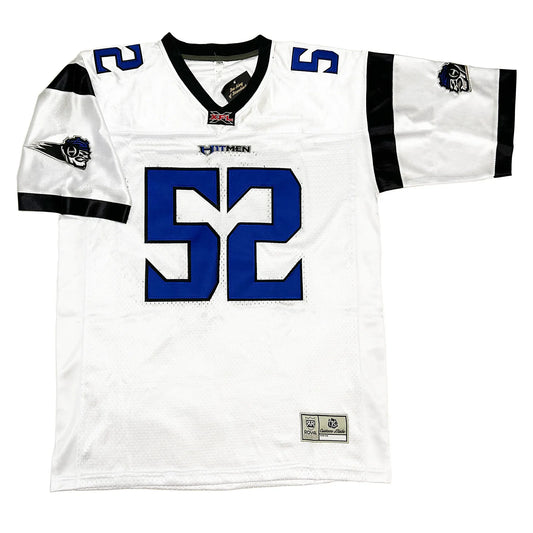
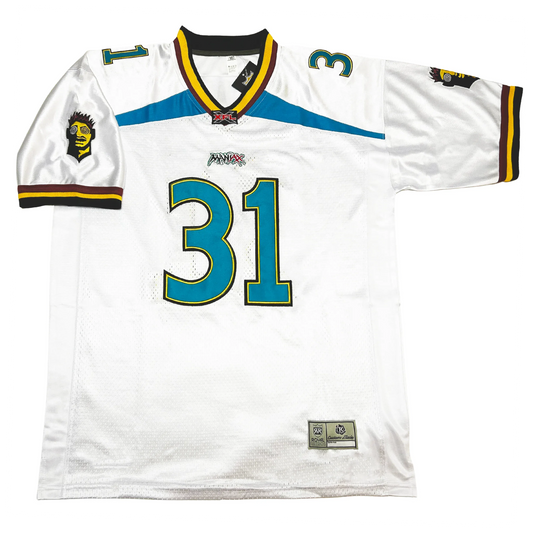
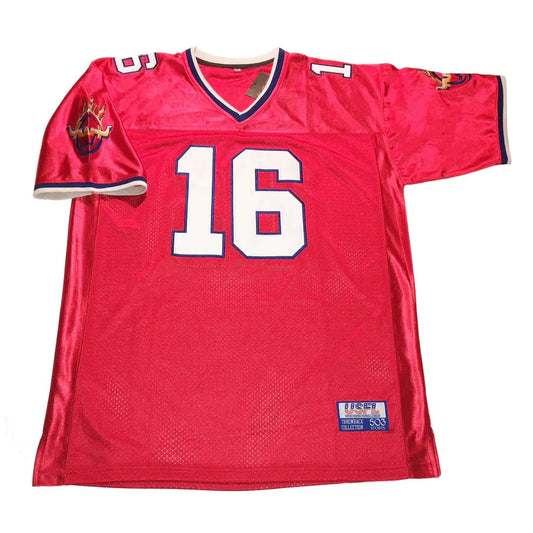
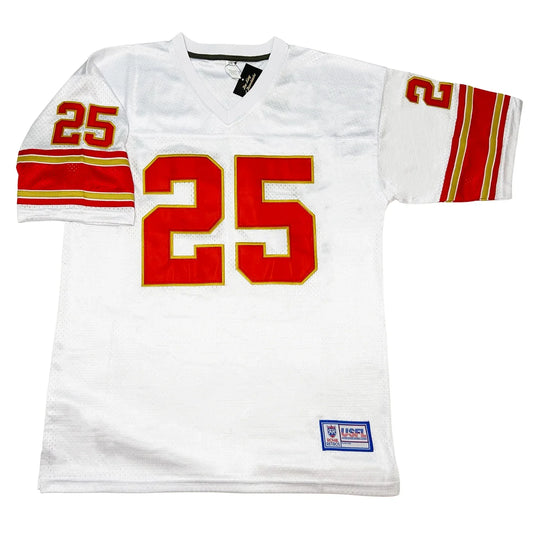
Custom Football Jerseys — Pro Stitched & Replica Throwbacks from Every Pro Football Era
170 custom football jerseys spanning defunct leagues, revived leagues, and forgotten regional favorites. Free personalization. Sizes S–5XL.
Royal Retros carries 170 active custom football jerseys, and almost none of them are for a team you can buy a jersey for anywhere else. This collection spans the USFL and XFL, the current UFL and AF1, the AAFC and WLAF/NFL Europe, a run of 1960s–70s minor-league franchises, and a deep bench of vintage-nickname designs built around old stadiums and long-gone team identities. Prices run $84.99–$119.99 depending on league and build. Every jersey is available in Pro Stitched (authentic sewn tackle-twill-style numbers and lettering) or Replica (lightweight printed graphics) construction on most styles, and every jersey ships with free personalization — your name, number, or custom text, no upcharge. Sizes run S–5XL on the large majority of designs; check the size chart on each listing, since a handful of specialty styles run a narrower range. If a pro football league operated in North America and stopped operating, there is a real chance Royal Retros has built a jersey for it — from a franchise that played four total games in a market before folding to a title-winning club that lasted barely three seasons.
That depth is deliberate. Most retailers stop at whatever league is currently playing on television, because that is where the demand is easiest to find. This collection exists for the other side of football history — the leagues that only lasted a season or two, the minor circuits that filled stadiums nobody remembers were ever used for football, and the eras where a team's entire identity shifted two or three times before anyone outside the city noticed. Every design still gets the same construction options, the same free personalization, and the same size range as the current-league jerseys sitting next to them in the catalog.
What You Can Shop
Every jersey in this collection is 100% polyester, made to order, and shipped with your choice of Pro Stitched or Replica construction on most styles. Below is exactly what that means and how sizing works before you dig into the league-by-league catalog.
Construction: Pro Stitched vs. Replica
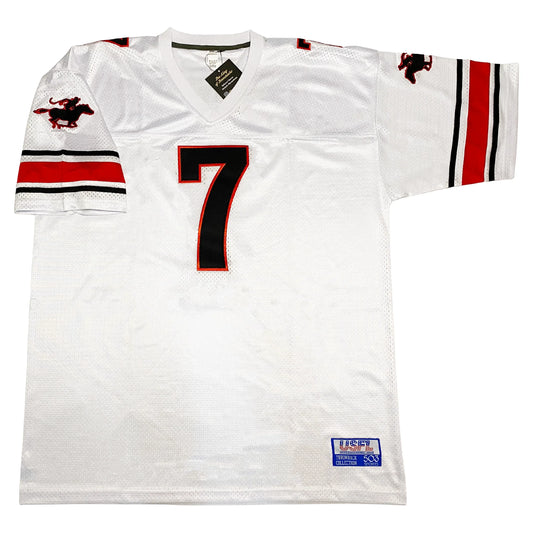
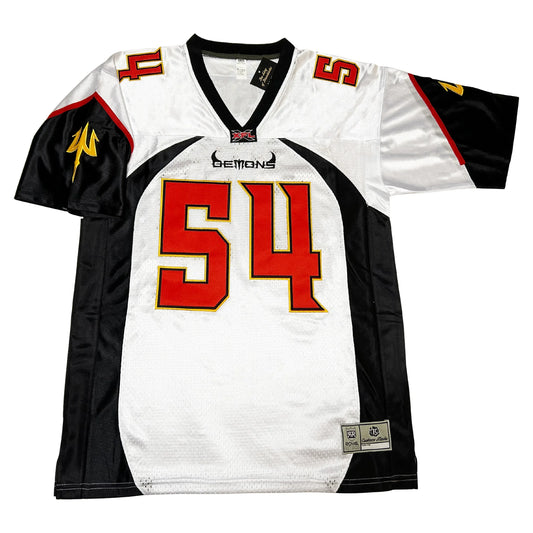
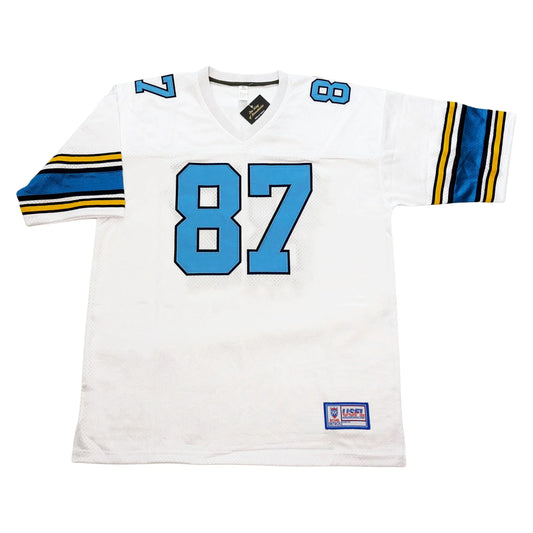
Most jerseys in this collection are offered in two builds, selected on the customization screen. Pro Stitched uses authentic stitched numbers and lettering — a heavier, more durable garment with the classic on-field look, sewn rather than printed, in the tradition of true tackle-twill construction. Replica uses high-quality printed graphics on a lighter, more breathable fabric — vibrant colors, more affordable, and better suited to everyday wear than game-day durability. Some limited designs — the AF1 Arena Crown and Championship line, most AAFC franchises, and a run of 1920s–30s legacy designs — are offered in Pro Stitched only, no Replica option. If a listing doesn't show a construction choice, check the product details before ordering; long-sleeve-only designs and a handful of premium tackle-twill pieces are single-build.
Customization
Every jersey in this collection includes free personalization — add a name, a number, or custom text at no extra cost, selected on the customization screen before checkout. Because every jersey is made to order around that personalization, customized jerseys are final sale: no returns or exchanges once an order is placed, so double-check spelling and numbers before you submit. A handful of designs also offer a custom label option and a short-sleeve/long-sleeve choice at the same step.
Sizes
Sizes run Small through 5XL on the large majority of jerseys in this collection, across every league bucket from USFL and XFL to AAFC, WLAF, and the Legacy & Regional Football line. A limited number of specialty and collaboration designs run a narrower range. Because sizing is set at the product level rather than collection-wide, check the size chart on the specific listing before ordering — especially on long-sleeve-only and limited-edition designs.
Shop Custom Football Jerseys by League
Eight real categories, all with in-stock inventory — not a placeholder page. Counts below reflect jerseys specifically; a design tagged to more than one league (a handful of Birmingham Stallions jerseys carry both USFL and UFL tags, for instance) is counted in both places it belongs.
USFL Jerseys — 37
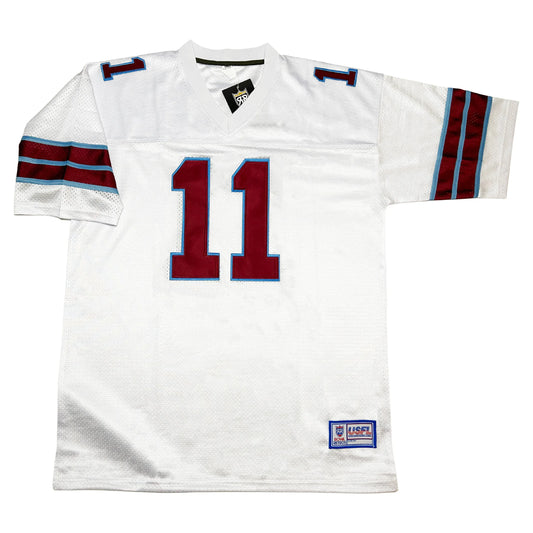
The USFL is the deepest single bucket in this collection — the original 1983–1985 spring league that signed a wave of major college talent straight into the pros, and the revived 2022–2023 version that brought the name back before merging into the current UFL. 37 jerseys span both eras, from the Michigan Panthers' inaugural 1983 championship team to the 2022–2023 revival's Birmingham Stallions and Houston Gamblers. USFL jerseys on this site are officially licensed. Shop USFL Jerseys.
XFL Jerseys — 23
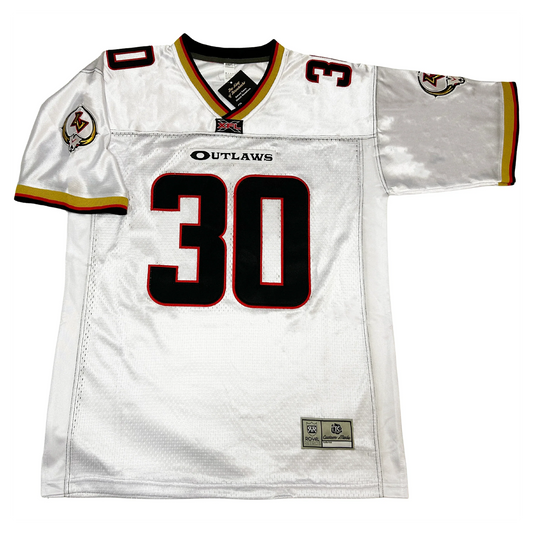
Both XFL eras are here — the single-season 2001 original (Las Vegas Outlaws, Memphis Maniax, LA Xtreme, San Francisco Demons, Birmingham Bolts) and the 2020/2023 reboot (Seattle Sea Dragons, Vegas Vipers, Orlando Guardians, DC Defenders). 23 jerseys, officially licensed. Shop XFL Jerseys.
UFL Jerseys — 11
The current UFL — the 2024 merger of the USFL and XFL — fields teams like the Arlington Renegades, DC Defenders, St Louis Battlehawks, San Antonio Brahmas, Houston Roughnecks, and Michigan Panthers. 11 jerseys, including current-roster "remix" designs printed with real player names. Officially licensed. Shop UFL Jerseys.
AF1 Jerseys — 13
Arena Football One fields the deepest current team lineup in the collection — Nashville Kats, Albany Firebirds, Washington Wolfpack, Michigan Arsenal, Minnesota Monsters, Beaumont Renegades, Kentucky Barrels, and Oceanside Bombers. 13 jerseys span the standard throwback line and the premium Arena Crown/Championship tackle-twill line. Officially licensed. Shop AF1 Jerseys.
AAFC Jerseys — 10
The All-America Football Conference ran from 1946 to 1949 as a genuine rival to the NFL before folding and sending a small number of its franchises into the league it once competed with. 10 jerseys cover clubs whose identities never carried forward — the Chicago Rockets, Chicago Hornets, Los Angeles Dons, Miami Seahawks, Brooklyn Dodgers, Buffalo Bisons, and Baltimore Colts. Shop AAFC Jerseys.
WLAF / NFL Europe Jerseys — 5
The World League of American Football launched in 1991 as the NFL's first real international experiment, later rebranding as NFL Europe before folding in 2007. 5 jerseys cover London, Barcelona, Orlando, and Sacramento clubs across the league's American and European eras. Shop WLAF Jerseys.
Minor League Football Jerseys — 11
The deepest cuts in the catalog: 1960s–70s regional pro circuits — the Atlantic Coast Football League and the Continental Football League — fielding teams in markets that never had another shot at pro football, from Waterbury and Pottstown to Roanoke, Richmond, and San Jose. 11 jerseys. Shop Minor League Football Jerseys or browse the ACFL hub directly.
Legacy & Regional Football Jerseys — 64
The largest bucket in the collection: vintage-stadium and nickname-driven designs inspired by the sport's colorful eras and iconic ballparks — Candlestick, Kezar, the Astrodome, the Polo Grounds, the Meadowlands — plus genuinely defunct franchises like the Chicago Cardinals, Cleveland Rams, Dallas Texans, Boston Redskins, and New York Yanks, none of which have a currently-operating trademark. 64 jerseys, independently designed by Royal Retros and not licensed by or affiliated with any team, league, or organization. Shop Legacy & Regional Football Jerseys.
Why Royal Retros
-
170 active custom football jerseys across eight real categories — the deepest defunct-and-current football jersey catalog we know of.
-
Free personalization on every jersey. Name, number, or custom text at no extra cost.
-
Two real construction options. Pro Stitched sewn tackle-twill-style lettering or lightweight printed Replica — your choice on most styles.
-
Inclusive sizing. S–5XL on the large majority of designs, with sizing clearly labeled on every listing.
-
Genuinely licensed where it matters. USFL, XFL, UFL, and AF1 jerseys are officially licensed — not workaround merchandise.
-
Coverage nobody else has. The AAFC, WLAF, and 1960s–70s minor-league sections exist here because almost no other retailer bothers with them.
-
Researched, not templated. Every historical section on this page is built around verified franchises, dates, and outcomes — not a generic sports-retail template with a league name swapped in.
Quick Buying FAQ
What sizes do these jerseys run?
Small through 5XL on the large majority of designs. A limited number of specialty and collaboration jerseys run a narrower range — check the size chart on the specific listing before ordering.
What's the difference between Pro Stitched and Replica?
Pro Stitched uses authentic stitched, sewn-on numbers and lettering for a heavier, more durable, classic on-field look. Replica uses high-quality printed graphics on lighter, more breathable fabric. Most styles let you choose either build on the customization screen; a handful of premium and long-sleeve-only designs are Pro Stitched only.
Is personalization really free?
Yes — every jersey in this collection includes free personalization (name, number, or custom text) as part of the standard price, selected during checkout on the customization screen.
Can I return a customized jersey?
No. Because every jersey is made to order around your personalization, customized jerseys are final sale — no returns or exchanges. Double-check spelling and numbers carefully before submitting your order.
How long does a custom jersey take to arrive?
Lead time is shown on the customization screen for each specific product before you complete your order, since made-to-order production time varies by design and current order volume.
Are these officially licensed?
It depends on the league. USFL, XFL, current UFL, and AF1 jerseys are officially licensed. AAFC, WLAF, minor-league (ACFL/COFL), and Legacy & Regional Football jerseys are independently designed by Royal Retros and are not affiliated with, endorsed by, or sponsored by any team, league, or organization — heritage tribute designs, not licensed product. Each product page states its status plainly.
Gift Ideas
- For the fan who insists they've "seen it all" — an AAFC or minor-league jersey from a franchise they've probably never heard of.
- For a current UFL or AF1 supporter — a Pro Stitched jersey with their own name and number on the back.
- For a collector who wants the real construction — the sewn tackle-twill-style Pro Stitched build over a printed Replica.
- For someone from a city whose old team is long gone — the Legacy & Regional Football line covers venues and eras most retailers never touch.
- For a spring-football diehard — matching the jersey to the exact seasons a league operated (checking the era notes in the sections above) makes the gift feel personal rather than generic.
How Did Football Jersey Construction Change Over the Decades?
Football jersey construction moved through a few distinct eras, broadly: heavier durene and wool-blend knits dominated through the 1950s and into the 1960s, nylon mesh and lighter synthetic weaves became standard through the 1970s and 1980s as teams prioritized ventilation and player mobility, and double-knit polyester blends took over from the 1980s onward as manufacturing shifted almost entirely to synthetic fabric. Today's jerseys — including every jersey in this collection — are built from 100% polyester, whether finished with sewn Pro Stitched lettering or printed Replica graphics. The underlying goal never really changed: a durable, close-fitting garment that could take contact and hold a number through a full season, but the materials and construction methods used to get there shifted generation by generation.
Why Is Pro Stitched Construction More Durable Than a Printed Design?
Pro Stitched construction is more durable because the numbers and lettering are sewn directly into the fabric rather than printed onto its surface, so there is no ink layer to crack, peel, or fade with repeated washing the way a printed graphic eventually can. That sewn-on approach is closer to true tackle-twill construction — the traditional method used on authentic on-field jerseys, where separate fabric letters and numbers are stitched to the base garment rather than applied as a surface print. A Replica build trades some of that long-term durability for a lighter, more breathable fabric and a lower price point, which is why Royal Retros offers both: Pro Stitched for buyers who want the classic on-field weight and permanence, Replica for buyers who want a lighter everyday-wear option.
Why Are Defunct-League Football Jerseys So Hard to Find?
Defunct-league football jerseys are scarce because almost nobody manufactures new product for a league that no longer exists, and whatever original-run gear survived from the era it was actually sold in was rarely preserved carefully — most of it was inexpensive apparel that fans wore out or discarded decades ago. Once a league folds, its trademarks and team identities can sit in limbo for years, tied up in ownership disputes or simply forgotten, before anyone has both the legal standing and the research depth to reproduce them accurately. That combination — no ongoing production, minimal original preservation, and tangled or abandoned trademark history — is exactly why a catalog covering leagues like the AAFC, the WLAF's early years, and 1960s minor-league circuits is unusual among football retailers.
How Do You Date a Football Jersey Design?
You can date a football jersey design by matching three details: the team name and city (which changed constantly even within a single league's short run), the league itself (since most of the leagues in this collection only operated for a handful of specific years), and construction details like fabric and lettering style, which shifted decade by decade as described above. A jersey referencing the "Oakland Invaders" places the design in the original 1983–1985 USFL run; a "Los Angeles Xtreme" design points specifically to the 2001 XFL, since that team never existed in the 2020s reboot. Cross-referencing team name, league, and the years that league actually operated is the fastest way to place any of these designs in time.
Why Do the Same Team Names Keep Reappearing Across Different Football Eras?
The same team names keep reappearing because when a spring or alternative league revives, the new ownership groups usually license the old team names and colors on purpose — there's built-in nostalgia in a name like the Michigan Panthers or the Tampa Bay Bandits that a brand-new identity simply doesn't have. That's why this catalog carries three separate eras of Michigan Panthers jerseys (the original 1983–1984 USFL, the 2022–2023 revival, and current-roster UFL designs), three eras of Tampa Bay Bandits, and both the 1983–1985 original and the 2022–23 revived Birmingham Stallions, which then continued straight into the current UFL without even changing its name again. The jersey construction, league branding, and roster details differ by exact year even when the team name doesn't, which is why the date and league tag on each design matter as much as the city and nickname.
Why Did the 2001 XFL Fold After Just One Season?
The original 2001 XFL folded after a single season because television ratings collapsed almost as fast as they had spiked — a huge opening-week audience curious about the joint venture between a professional wrestling promotion and a major broadcast network fell off a cliff within weeks once viewers decided the on-field product wasn't compelling enough to keep watching. The league had leaned hard into spectacle in its early broadcasts, and when the football itself didn't hold up to that promotion, both partners cut their losses rather than commit to a second year. The Las Vegas Outlaws, one of the league's most colorfully branded clubs, finished 4–6 at Sam Boyd Stadium in that lone 2001 campaign — a snapshot of a league that never got a second chance to fix what didn't work the first time. The XFL name returned in 2020 under entirely new ownership with a renewed emphasis on football quality, and merged with the USFL in 2024 to form the current UFL.
What Made the Michigan Panthers the USFL's First Champions?
The Michigan Panthers became the USFL's first champions by building one of the most balanced rosters in the league's inaugural 1983 season — a strong offensive line that allowed only 17 sacks all year, a receiver who led the league, and a quarterback who was named the championship game's MVP — and riding that balance to a 12–6 regular season before beating the Philadelphia Stars 24–22 in the league's first title game on July 17, 1983, at Denver's Mile High Stadium. The Panthers followed with a 10–8 season in 1984 before merging with another USFL franchise ahead of a planned 1985 season that never happened once the league's fall-schedule gamble collapsed. The name returned in the 2022 USFL revival, playing home games out of Birmingham before bringing professional spring football back to Michigan for the 2023 season, and continued into the current UFL after the 2024 merger — one of the few franchise identities in this collection with a continuous thread from the original 1983 season through to today.
How Did a Minor-League Sideline Job Launch a Hall-of-Fame Coaching Career?
A minor-league sideline job can launch a major coaching career when the right person takes it as a first real head-coaching test rather than a step down — which is exactly what happened with the San Jose Apaches, a semi-pro club that joined the Continental Football League for the 1967 season wearing hand-me-down uniforms passed along from other pro teams. The Apaches hired a young, largely unproven assistant as their first head coach that year, and he led the club to an 8–4 record in its only professional season before the franchise folded. That coach moved on to major-college and then professional ranks the following year, eventually becoming one of the most influential offensive minds in the sport's history. It's a reminder that minor-league football wasn't just a graveyard for forgotten franchises — it was also where some real coaching careers actually started.
What Was the AAFC and Why Did It Merge Into the NFL?
The All-America Football Conference operated from 1946 to 1949 as a legitimate rival to the older established pro league, signing top talent and drawing strong attendance in several markets before merging after the 1949 season because continued head-to-head competition was proving too costly for both sides. Only a small number of AAFC franchises were absorbed in that merger — the rest of the league's clubs folded outright. Teams like the Chicago Rockets, Chicago Hornets, Los Angeles Dons, Brooklyn Dodgers, Miami Seahawks, Buffalo Bisons, and the AAFC-era Baltimore Colts (an entirely separate franchise from any team that has played under that name since) are remembered today almost entirely through collectors and history sites rather than any surviving club.
Why Did Buffalo's AAFC Franchise Never Reach the Merger?
Buffalo's AAFC club — entering the league as the Bisons in 1946 and renamed the following year — built a genuine contender behind quarterback George Ratterman, tying for its division lead in 1948 and reaching that year's championship game at Civic Stadium. When the AAFC dissolved after 1949 and a handful of its franchises were carried into the older league, Buffalo was not selected despite a local petition and fundraising campaign, and the franchise folded outright. The city went without major professional football until an entirely new team took the field in 1960 — a different franchise altogether, playing in a different league, more than a decade later.
What Was the WLAF and How Did It Become NFL Europe?
The World League of American Football launched in 1991 as the NFL's attempt to grow the sport internationally, fielding a mix of American and European teams before pausing after the 1992 season and returning in 1995 as an all-European league, later rebranded NFL Europe. It ran until folding after the 2007 season, when the league determined the international development model no longer justified the cost of running its European franchises. The London Monarchs were one of the league's flagship clubs, capturing the inaugural 1991 World Bowl in front of more than 60,000 fans at Wembley Stadium — the first time a European city won a championship in American professional football — before the franchise relaunched as the England Monarchs for 1998–1999 and folded when NFL Europe consolidated to mainland European markets.
Why Did So Many 1960s–70s Minor Football Leagues Disappear?
Minor football leagues like the Atlantic Coast Football League and the Continental Football League struggled because they operated on thin margins in mid-size markets, competing for attention against college programs, the established major league, and each other, with almost no national television revenue to fall back on when local attendance came up short. Franchises moved constantly — sometimes within their first season — chasing whichever city had just built or renovated a stadium, and rosters were filled with players hoping to be noticed by a bigger league rather than committed to the market they were playing in. The Waterbury Orbits are a case study: awarded to a different city entirely, moved to Waterbury on short notice, drew barely half the crowd local officials predicted for a freshly renovated stadium, and relocated again after two seasons once the money ran out.
What Made 1920s and 1930s Pro Football Franchises So Unstable?
Early professional football franchises folded constantly because the sport itself was still fighting for legitimacy against college football, which drew far bigger crowds and more newspaper coverage through the 1920s and into the Depression years. Teams played in borrowed stadiums, cycled through team names as ownership changed, and simply could not survive a single bad season financially — the Duluth Eskimos famously played nearly an entire season on the road because their home city couldn't support a full slate of home games, while the St Louis Gunners existed for barely more than a month before folding after 1934. The Great Depression finished off several franchises that had otherwise found some stability, including title-winning clubs like the Frankford Yellow Jackets and Providence Steam Roller, both of which won championships in the late 1920s before folding by 1931.
Why Did the Frankford Yellow Jackets and Providence Steam Roller Both Fold by 1931?
Both the Frankford Yellow Jackets and Providence Steam Roller won league championships in the late 1920s — Frankford in 1926, Providence in 1928 — and both folded within a few years of that peak once the Depression-era economy made travel costs and gate-dependent revenue unsustainable. Frankford, built out of an amateur Philadelphia club and playing home dates on Saturdays because of the city's Sunday blue laws, folded partway through the 1931 season. Providence, which played its home games at a converted bicycle-racing velodrome called the Cycledrome and hosted the first professional night game under floodlights, shut down after that same 1931 season. Two title-winning franchises, both gone within roughly the same eighteen-month window.
How Many of These Eight Categories Are Still Playing Today?
Of the eight categories covered in this collection, only two field teams that are currently playing: the UFL (the 2024 USFL/XFL merger) and AF1. Every other category here — the original 1983–1985 USFL, both eras of the XFL, the AAFC, the WLAF and NFL Europe, the Atlantic Coast and Continental Football Leagues, and every franchise in the Legacy & Regional Football bucket — is fully defunct. That split is exactly why this catalog exists: current-league merchandise is easy to find through official channels, but defunct-league merchandise disappears from the market entirely once a league folds, which is what makes a catalog covering six defunct categories alongside two active ones genuinely hard to replicate.
Notable Firsts Behind These Designs
-
The first USFL championship was decided on July 17, 1983, at Denver's Mile High Stadium, when the Michigan Panthers beat the Philadelphia Stars 24–22 in the league's inaugural title game.
-
The first WLAF championship — World Bowl I — was won by the London Monarchs in 1991, making London the first European city to win a title in American professional football.
-
The first professional night game under floodlights was hosted by the Providence Steam Roller at the Cycledrome, a converted bicycle-racing velodrome, in the year after their 1928 championship season.
-
The only club in its league's history to play an entire season almost exclusively on the road was the 1926 Duluth Eskimos, who played a single home game and then barnstormed 29 games in 112 days around a single star player.
-
Back-to-back minor-league titles were won by the Pottstown Firebirds in 1969 and 1970, two championships across the franchise's three total ACFL seasons.
How to Identify a Quality Custom Football Jersey
Look for four things on any custom football jersey, historic-league or current: construction method (genuine Pro Stitched sewn lettering will outlast a printed design over repeated wear and washing), fabric weight (100% polyester should feel substantial, not paper-thin, regardless of build), accurate team and league details (correct colors, correct era-appropriate wordmark, no invented team names or years), and honest labeling of whether the design is officially licensed or an independently created heritage tribute. A jersey that gets the history right, discloses its licensing status accurately, and is built from a real Pro Stitched or genuine printed Replica construction is worth more than a cheap novelty blank with a name slapped on it. Because these are made-to-order and final sale once personalized, confirm your size against the chart on the specific listing — not a blanket collection-wide assumption — before you submit your name and number.
Extended FAQ
Is the current UFL the same league as the original XFL or USFL?
No. The current UFL is a distinct league formed in 2024 by the merger of the revived USFL and the rebooted XFL. This collection carries jerseys from both predecessor leagues as well as the merged current UFL, and product tags reflect all three where a franchise's history spans more than one era.
What is the difference between the AAFC-era Baltimore Colts and any later team with a similar name?
The AAFC's Baltimore Colts played from 1947 to 1950 and are an entirely separate franchise, with no shared ownership or continuity, from any team that has played under a similar name in the decades since. The jersey in this collection represents that original 1947–1950 AAFC-era club specifically.
Why do some franchises have two or three different jersey designs while others have just one?
Catalog depth generally follows how long a franchise operated and how many distinct eras or design refreshes it went through. Current AF1 and UFL teams and franchises that played across both the original and revived USFL tend to have the deepest lineups; one-off historic clubs from short-lived leagues like the AAFC or the 1960s minor circuits often have just a single design.
What does a "remix" jersey mean?
A remix jersey is a current-roster design printed with real player names from a recent UFL or XFL season — a different style from the standard team-identity jerseys that carry only a franchise's name and colors without individual player names attached.
Can I get a jersey in long sleeve instead of short sleeve?
Some designs offer a short-sleeve/long-sleeve choice on the customization screen; a handful of legacy designs — including several 1920s–30s franchises and select AAFC clubs — are long-sleeve only. Check the product details on each listing to confirm which options a specific design offers.
Do these jerseys use the same sizing across every league?
Sizing follows the same general S–5XL range on most designs, but it is set at the product level rather than uniformly across the whole collection. Always check the size chart on the specific listing rather than assuming a blanket range, particularly on specialty and collaboration designs.
Why does the AAFC section only cover a handful of teams instead of the full league?
The AAFC fielded a rotating set of franchises across its four seasons, and this catalog focuses on the clubs whose identities never carried forward into another league — teams like the Chicago Rockets, Chicago Hornets, Los Angeles Dons, Brooklyn Dodgers, Miami Seahawks, Buffalo Bisons, and the AAFC-era Baltimore Colts. The small number of AAFC franchises that were absorbed into a merger in 1950 are not part of this collection, since Royal Retros does not produce apparel referencing currently-operating football franchises.
What does the Legacy & Regional Football section actually cover?
It covers independently designed, non-licensed jerseys built around vintage stadiums, city nicknames, and genuinely defunct team identities — Candlestick, Kezar, the Astrodome, the Polo Grounds, and franchises like the Chicago Cardinals, Cleveland Rams, Dallas Texans, Boston Redskins, and New York Yanks that no longer have any currently-operating trademark. These are heritage tribute designs, not licensed product, and each product page states that plainly.
Are minor-league jerseys from the ACFL and COFL the same construction as the licensed leagues?
Yes — every jersey in this collection, licensed or not, uses the same 100% polyester construction with a Pro Stitched or Replica build choice on most styles. Licensing status affects whether a design can be marketed as officially affiliated with a league; it does not change the underlying garment construction or the free personalization offered on every jersey.
Why did the original USFL fold after just three seasons?
The original USFL folded after its 1985 season because the league bet its future on moving to a fall schedule that would put it in direct competition for the same audience as the sport's dominant established league, then lost an antitrust lawsuit that awarded only nominal damages instead of the money it needed to survive that move. The league played three spring seasons, from 1983 to 1985, before that planned fall move collapsed its finances entirely. The USFL name returned in 2022 as a new spring league before merging with the XFL in 2024 to form the current UFL.
What's the difference between a jersey's "jock tag" and its custom label?
A jock tag is the small manufacturer-style tag sewn into most jerseys carrying the league's name — a detail meant to echo genuine on-field construction. A custom label, offered as an add-on on select designs, is a separate personalization option for the inside collar or tag area. Not every design offers both; check the product details on the specific listing.
Does Royal Retros make jerseys for teams that were only proposed and never actually played?
Occasionally. A handful of designs across this catalog's history sections cover franchises that existed on paper — announced, branded, and sometimes even rostered — before folding, merging, or relocating before ever taking the field under that specific identity. These are genuinely rare corners of football history: a team name and a city with a shorter on-field record than almost anything else in the collection.
Shop Related Collections
-
Arena Football HQ — AF1 gathered with the rest of the site's arena-format football catalog.
-
Football T-Shirts — the same league catalog in T-shirt form, 351 active designs.
-
International Football HQ — WLAF and international football product together.
-
Legacy Football — the site's broader historic-football hub, including AAFC and minor-league product across every product type.
-
Spring Football HQ — USFL, XFL, UFL, and WLAF gathered in one spring-football hub.
Shop Custom Football Jerseys at Royal Retros — 170 Jerseys, Eight Leagues, Free Personalization, Sizes S–5XL.