Custom Basketball Jerseys — Royal Retros Basketball Fan Shop
80 Custom Throwback Basketball Jerseys. Free Name & Number on Most. The Deepest ABA & Early-NBA Catalog Anywhere. Sizes S–5XL.
Royal Retros carries 80 custom basketball jerseys built around the eras nobody else stocks in depth — the American Basketball Association from its 1967 launch through the 1976 merger, the Basketball Association of America's chaotic founding seasons, and the long list of NBA-era franchises that got renamed, relocated or folded outright before most fans were born. Every jersey is $84.99 in a home and away colorway, with free custom name and number on most styles and sizes Small through 5XL on every build — no big & tall upcharge. Where most throwback shops carry a handful of NBA reissues, we carry the deep cuts: Kentucky Colonels, Virginia Squires, Spirits of St. Louis, Carolina Cougars, the Miami Floridians, the Pittsburgh Ironmen, and dozens more, most in multiple year-specific versions. If you know these names without looking them up, this is your collection.
Shop by League & Era
This collection breaks into five groups: 41 American Basketball Association jerseys, 10 from the founding years of the Basketball Association of America and the NBA's earliest chaotic seasons, 26 from NBA-era franchises that later moved cities or changed names, 2 USA National Team Olympic jerseys, and 1 international club jersey. Below is what each group covers and why it exists.
ABA (41 jerseys) — The American Basketball Association ran nine seasons, 1967–68 through 1975–76, and it is the single deepest vein of material in this collection. Every major ABA franchise is represented, several in three or four year-specific builds: the 1967, 1970 and 1975 Kentucky Colonels; the Virginia Squires in its base, 1974–75 and 1975–76 versions; the Utah Stars across 1970–72, 1972–74, 1974–75 and 1975–76; and the Spirits of St. Louis in original, Remix and Vintage Cream builds. Add the Carolina Cougars (1969, 1971, 1974), the Denver Rockets (1970s, Denver ABA), the Memphis franchise across its three names — Houston Mavericks to New Orleans Buccaneers to Memphis Pros, Memphis Tams and Memphis Sounds — the Pittsburgh Pipers and Condors, the Oakland Oaks that became the Washington Caps that became the Squires, the San Diego Conquistadors and Sails, the Anaheim Amigos that became the Los Angeles Stars and then the Utah Stars, the Minnesota Muskies that became the Miami Floridians and later The Floridians, the New Jersey Americans, the Dallas Chaparrals that became the San Antonio ABA franchise, and the Indiana ABA jersey. Two ABA All-Star Game jerseys round it out — the base and 1974 builds.
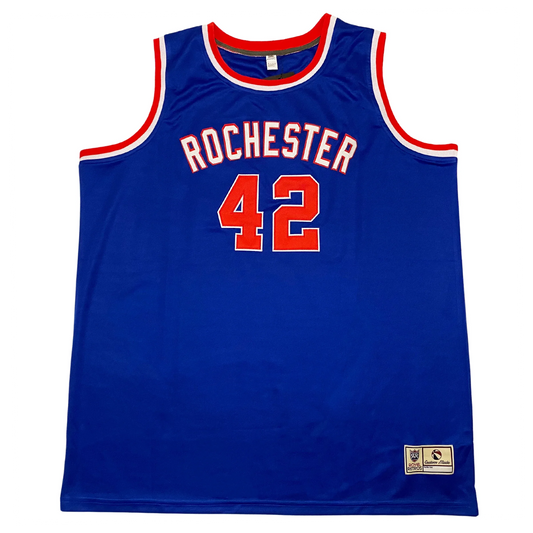
BAA / Founding NBA Era (10 jerseys) — The Basketball Association of America launched in 1946 and merged with the rival National Basketball League in 1949 to form the NBA. Both leagues' first seasons were a graveyard of one- and two-year franchises. This collection carries the Pittsburgh Ironmen and Toronto Huskies, both of which folded after a single 1946–47 season; the Chicago Stags, who lasted until 1950; the Philadelphia Warriors, a BAA original that eventually moved to San Francisco and is now Golden State; the Syracuse Nationals in base and 1960 versions, later relocated to become Philadelphia's current NBA franchise; the Rochester Royals, one of the NBL clubs that came over in the 1949 merger; the Minneapolis BAA jersey, from the NBA's first true dynasty franchise before it moved west; and the Sheboygan Red Skins, a small-market NBL club that played a single NBA season during the league's most unstable years. The Chicago Zephyrs jersey, from the early-1960s Chicago Packers/Zephyrs franchise that later relocated to Baltimore, closes out the group.
Legacy Basketball — Relocated & Renamed NBA-Era (26 jerseys) — This is the largest non-ABA group: franchises that started in one city under one name and now play somewhere else under a different one. It includes three eras of the Cincinnati Royals (1965, 1971), the franchise's later Kansas City and Kansas chapters, the Buffalo franchise in two looks, the Baltimore/Washington 1971 and base Bullets jerseys, the 1968 and base St. Louis franchise jerseys, plus generic-era city jerseys for Detroit, Philadelphia, Chicago, Cleveland, San Francisco, Phoenix, Seattle and San Diego, plus the San Diego "Green and Gold" jersey from the franchise's brief San Diego chapter before it moved to Houston. Five NBA All-Star Game jerseys — 1967, 1970, 1972, 1975 and 1977 — and the Boots x RR Denver collab close out the group.
Olympic & International (3 jerseys) — The 1960 and 1984 USA Basketball jerseys cover two of the most storied U.S. Olympic rosters, and the Stefanel Trieste jersey brings in Italian club basketball from the Serie A/LBA era.
Shop by Team — The Full Franchise Lineages
The NBA side has its own multi-stop lineages worth tracking. The Minneapolis franchise that became the Minneapolis BAA jersey here later relocated west; the Rochester Royals moved to Cincinnati and eventually Kansas City before landing on the West Coast; and the Syracuse Nationals, represented here in two seasons, relocated in the early 1960s and now play under a different name entirely. The St. Louis franchise and the Baltimore/Washington Bullets franchise both eventually moved and rebranded as well — the throughline across almost every jersey in the BAA and Legacy Basketball groups is a team that no longer plays under the name on its chest, in the city on its tag.
Several ABA teams changed cities and names more than once, and this collection tracks the whole chain rather than picking one stop. The Minnesota Muskies became the Miami Floridians (rebranded again mid-run as simply "The Floridians") — shop Minnesota, Miami or The Floridians. The Anaheim Amigos moved to Los Angeles as the Stars, then to Utah — Anaheim, Los Angeles or the four-year run of Utah Stars jerseys. The Oakland Oaks moved to Washington, D.C. as the Caps, then to Virginia as the Squires — Oakland, Washington or Virginia. The New Orleans Buccaneers moved to Memphis and rebranded twice — New Orleans, then the Houston Mavericks merged in, followed by the Pros, Tams and Sounds eras in Memphis. And on the NBA side, the Cincinnati Royals ran through 1965, 1969 and 1971 before relocating to Kansas City.
Notable ABA Moments and Franchises in This Collection
The Indiana Pacers won more ABA championships than any other franchise — three, in 1970, 1972 and 1973 — before surviving the 1976 merger and continuing on in the NBA under the same name to this day, which makes the Indiana ABA jersey the closest thing this collection has to a dynasty piece. The Kentucky Colonels won their only ABA title in 1975, the year before the merger, then declined to pay the NBA's entry terms and folded instead — owner John Y. Brown Jr. took the buyout money, bought the Buffalo Braves the following year, and was later elected Governor of Kentucky. The 1975 Kentucky Colonels jersey in this collection is that championship season.
The Spirits of St. Louis never won a title and folded at the merger, but they may be the most financially notorious team in pro sports history. Owners Ozzie and Daniel Silna turned down a modest buyout in favor of a perpetual cut of the four surviving ABA teams' national television revenue — an arrangement that reportedly paid out for decades, far beyond what anyone expected in 1976, until the NBA finally bought the Silnas out in a lump-sum settlement in 2014. All three Spirits jerseys in this collection — the original, the Remix and the Vintage Cream — carry that story with them.
Julius "Dr. J" Erving is the ABA's signature player, and two franchises in this collection carried him: he started his ABA career with the Virginia Squires before a contract dispute sent him to the New Jersey Americans franchise's successor, the New York Nets, where he won two ABA titles and then delivered the league's signature moment — the free-throw-line dunk that won the first Slam Dunk Contest at the 1976 ABA All-Star Game, the same season the league folded into the NBA.
Gift Ideas for the Basketball Fan
-
For the ABA obsessive: A year-specific jersey from a franchise that no longer exists — Spirits of St. Louis, Carolina Cougars, Kentucky Colonels — reads as a genuinely deep cut rather than a mass-market throwback.
-
For the fan of a current team's roots: The Denver ABA, San Antonio ABA and Indiana ABA jerseys are the direct ancestors of today's Nuggets, Spurs and Pacers rosters — a gift that connects a modern fan to the team's actual origin story.
-
For the uniform-history collector: Pair a BAA-era jersey — Pittsburgh Ironmen, Toronto Huskies, Chicago Stags — with a later ABA piece to show the full arc from the NBA's founding chaos to the ABA's 1976 merger.
-
For the customization request: Add a name and number to almost any jersey here for free — a personal touch on a piece of basketball history nobody else is likely to have.
Construction & Cut — Tank vs. Shooting Shirt, Mesh vs. Tricot
Basketball jerseys changed shape more than almost any other pro uniform, and the cut on a Royal Retros throwback follows the era it represents rather than a single house pattern. The earliest BAA and NBL jerseys of the late 1940s were built like the wool basketball uniforms of the college and industrial-league game they grew out of — a sleeveless tank cut, often in a heavier knit, with felt or chenille lettering sewn directly to the front. By the 1950s and into the ABA years, manufacturers shifted to lighter-weight tricot knits — a warp-knit fabric with a smooth, slightly shiny face — which let sewn-on twill numbers and lettering lie flatter and survive more wash cycles than felt. The ABA era is also when mesh started showing up on game jerseys, first as a ventilation panel and later, by the 1970s, as the primary body fabric on some franchises' road sets, because it breathed better under arena lighting and TV cameras than solid tricot.
"Tank" and "shooting shirt" describe two different silhouettes you will see across this collection. A tank-cut jersey has a straight, closely armholed sleeveless body — the standard game-jersey shape from the 1940s through today, and what most of the ABA and NBA-era jerseys here are built as. A shooting shirt is a looser, often warm-up-weight piece, sometimes with a partial button front, worn over a jersey before tip-off or during practice; it is not the same garment as a game jersey, and Royal Retros' basketball catalog is built around game-cut jerseys rather than shooting shirts. Home and away colorways follow the era's actual palette — most ABA and legacy-NBA teams here run a light home set and a darker or team-color road set, matched to period photography rather than a modern reissue's simplified color story.
Lettering and numbering also tell you what era a jersey is from. The BAA and 1950s NBA-era jerseys in this collection favor block serif or simple sans-serif numerals in a single team color, sewn flat with felt or early twill. By the ABA years, franchises leaned into bolder, more stylized wordmarks and drop-shadowed or outlined numbers — part of the same push toward a flashier visual identity that produced the red-white-and-blue ball and the three-point line. A handful of ABA franchises in this collection ran two distinct primary looks across their run — the Spirits of St. Louis and the Miami Floridians/Floridians rebrand both changed their full graphic package mid-existence — which is why some franchises here are represented by more than one visually distinct jersey rather than one team carrying one look for its entire history.
Customization
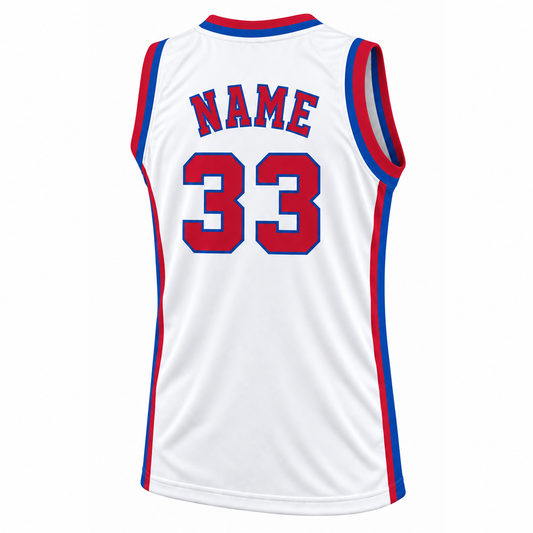
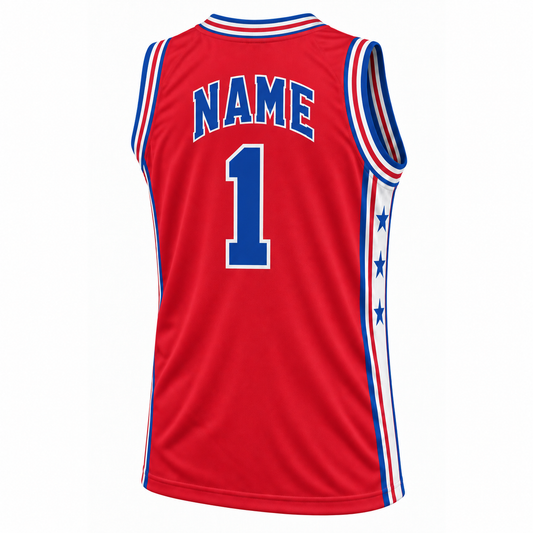
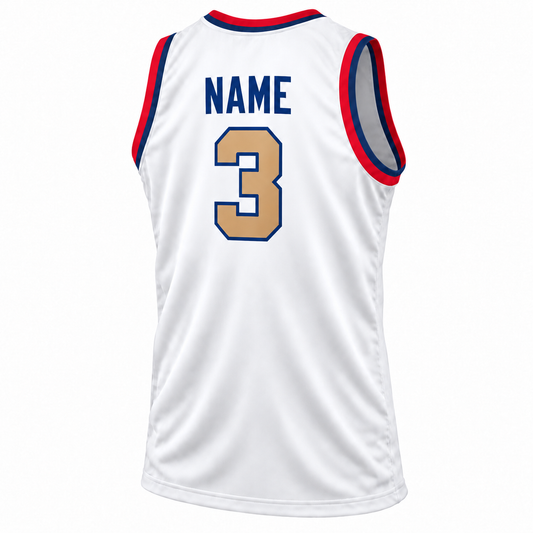
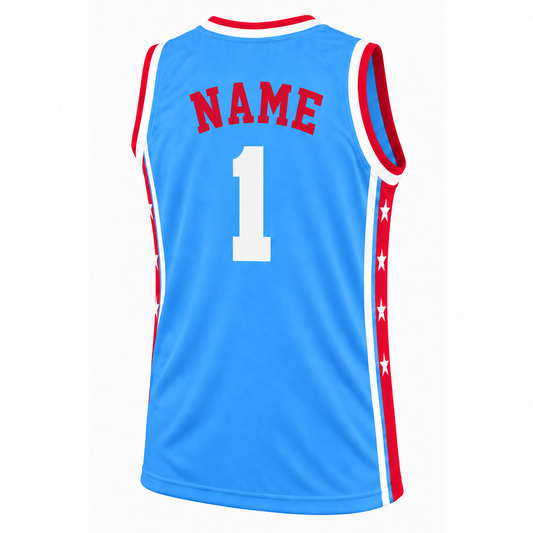
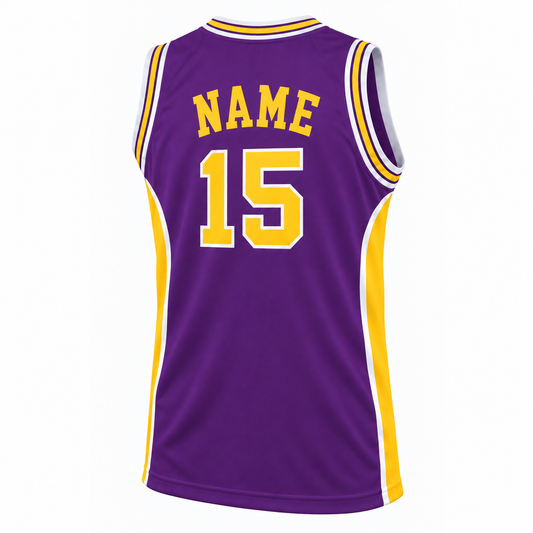
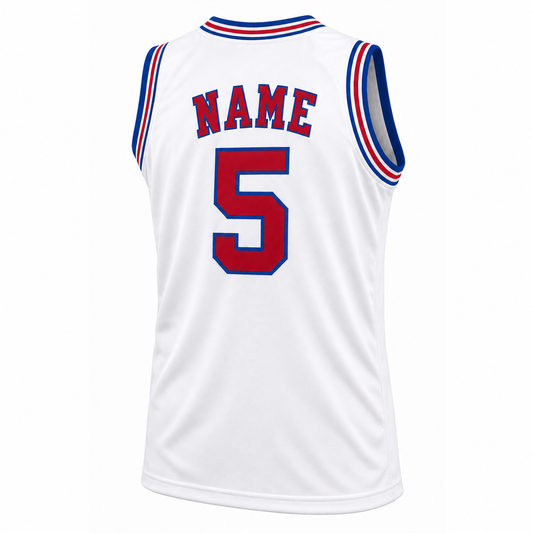
Free custom name and number on most jerseys in this collection — put an ABA original on the back (a Julius Erving, a Dan Issel, a George McGinnis, a Rick Barry) or your own name and number. Custom items are made to order and typically ship within 7–14 business days. Custom items are final sale — double-check spelling and number before submitting.
Sizes
Small through 5XL on virtually every jersey in this collection, in both home and away colorways. No big & tall upcharge. Check the individual product page for the exact color options on that specific year and team, since some early-era jerseys carry a third "preseason" or alternate color option beyond the standard home/away pair.
Why Royal Retros Is the Home of Basketball Throwback Gear
-
80 jerseys, not eight. The deepest ABA and early-NBA throwback catalog anywhere — most shops carry a handful of NBA reissues; we carry Kentucky Colonels, Spirits of St. Louis, Carolina Cougars, and franchise-lineage jerseys most fans have never seen reproduced.
-
Multiple year-specific builds per franchise. The Utah Stars alone run four separate seasons; the Kentucky Colonels and Virginia Squires each run three. This is era-accurate depth, not one generic "vintage" logo.
-
Flat, honest pricing. Every jersey is $84.99. No era surcharge, no "collector's" markup.
-
Free customization on most jerseys. Add a name and number at no extra cost on eligible items.
-
Sizes S–5XL. True family sizing, no big & tall upcharge.
-
Heritage tribute reproductions, not licensed merchandise — and we say so. These are historically researched fan apparel, priced and described honestly.
-
Coverage most catalogs skip entirely. Franchises that folded after one season (Pittsburgh Ironmen, Toronto Huskies), franchises that folded mid-season (Utah Stars, 1976), and franchises that turned down an NBA merger spot outright (Kentucky Colonels, Spirits of St. Louis) are all in stock here.
Quick Buying Questions
Are these officially licensed?
No. These are heritage tribute reproductions built from historical research and period photography, not officially licensed league or team merchandise. We describe them honestly as fan apparel rather than claiming a license we do not have.
What sizes do basketball jerseys come in?
Small through 5XL on virtually every jersey style, in home and away colorways. We don't upcharge for big & tall sizes.
Can I add my name and number to a jersey?
Yes — most styles include free custom name and number. Choose a franchise original from the roster history or your own name and number on the product page. Custom items are final sale.
What are the jerseys made from?
Construction follows the era: tricot-style knit bodies with sewn-on twill lettering and numbers on most builds, with mesh panels or mesh-primary bodies on jerseys from franchises and seasons that actually used mesh. Check the individual product description for era-specific fabric notes.
How fast does it ship and what's the return policy?
Stock items ship within 3–5 business days. Custom jerseys are made to order and typically ship within 7–14 business days. Custom items are final sale. Standard items follow our return policy at /pages/returns.
Which era should I pick if I don't know where to start?
If you want the deepest well, go ABA — nine seasons, dozens of franchises, most represented in multiple years here. If you want the NBA's chaotic founding years, look at the BAA group: Pittsburgh Ironmen, Toronto Huskies and Chicago Stags all folded within a few seasons and are genuinely hard to find reproduced anywhere. If you're chasing a specific relocated franchise's earliest identity — before it moved and got a new name — the Legacy Basketball group is built for exactly that.
Why Did the ABA Use a Red, White and Blue Basketball?
The ABA adopted the red-white-and-blue ball as one of its founding visual signatures in 1967, a deliberate break from the NBA's plain leather ball meant to make the upstart league instantly recognizable on the young medium of color television and easier for fans in the stands to track in flight. It became the league's single most identifiable piece of branding — more people who never saw an ABA game can picture the striped ball than can name a single ABA franchise.
Who Invented the Three-Point Line?
The ABA introduced the three-point shot in its first season, 1967–68, adopting a rule the rival American Basketball League had experimented with a few years earlier and turning it into a permanent, marquee part of the game. It took more than a decade for the idea to cross over — the NBA didn't add the three-point line until the 1979–80 season, three years after the ABA itself had folded into it. Every three-pointer shot in an NBA game today traces back to a rule the ABA popularized to differentiate itself from the league it would eventually merge into.
What Is the Story Behind the ABA Slam Dunk Contest?
The ABA staged the first Slam Dunk Contest at its final All-Star Game in 1976, the same season the league folded into the NBA. Julius "Dr. J" Erving, then with the New York Nets, won it with a free-throw-line takeoff dunk that became one of the most replayed highlights in basketball history and gave the NBA a format it would formally adopt in 1984. The dunk contest is arguably the ABA's most enduring cultural export — the merger dissolved the league itself, but the format it invented for one 1976 exhibition is still an NBA All-Star weekend fixture today.
What Happened in the 1976 ABA–NBA Merger?
After nine seasons of financial strain, the ABA and NBA merged for the 1976–77 season. Four ABA franchises joined the NBA outright and are still playing today under NBA ownership: the New York Nets (now the Brooklyn Nets), the Denver Nuggets, the Indiana Pacers and the San Antonio Spurs, the last of these having relocated from Dallas as the Chaparrals a few years earlier. Several other ABA teams did not survive the transition. The Kentucky Colonels and Spirits of St. Louis both declined to join the NBA and folded rather than pay the entry terms, and the Spirits' owners famously negotiated a share of the four surviving teams' future national television money instead — a deal that reportedly kept paying out for decades. The Virginia Squires and Utah Stars had already collapsed financially before the merger even happened, the Stars folding mid-season in January 1976. The jerseys in this collection cover both sides of that story: the four merger survivors and the franchises that never made it across.
Which ABA Franchises Still Exist Today?
Four: the team that is now the Brooklyn Nets (originally the New Jersey Americans, then New York Nets), the Denver Nuggets (originally the Denver Rockets), the Indiana Pacers, and the San Antonio Spurs (originally the Dallas Chaparrals). All four kept playing continuously in the NBA after 1976, which makes them the only ABA lineages you can still watch play a regular NBA season. Every other team in this collection's ABA lineup — Kentucky Colonels, Virginia Squires, Spirits of St. Louis, Carolina Cougars, Miami Floridians, Pittsburgh Pipers/Condors, Memphis's three-name run, Oakland Oaks/Washington Caps, San Diego Conquistadors/Sails, Houston Mavericks, New Orleans Buccaneers, Anaheim Amigos and Utah Stars — folded, merged into another club, or simply stopped existing when the league did.
Why Did So Many ABA Franchises Relocate Mid-League?
Because the league itself was underfunded from the start and most of its owners were betting on a merger with the NBA that took nine years to actually happen. A franchise that couldn't draw a paying crowd in its original market — Anaheim, Oakland, Minnesota, New Orleans — was cheaper to relocate than fold, especially with an eventual NBA merger dangling as the payoff for staying solvent long enough. That's the practical reason this collection's ABA lineup reads less like a stable ten-team league and more like a handful of core rosters that kept changing addresses: the same players and front offices moving from Anaheim to Los Angeles to Utah, from Oakland to Washington to Virginia, from New Orleans to Memphis, because the alternative was ceasing to exist entirely before the merger money arrived.
What Was the Basketball Association of America?
The Basketball Association of America launched in 1946 with 11 franchises playing mostly in large arenas built for hockey and boxing, an attempt to build a major professional basketball league in the biggest East Coast and Midwest markets. It was not an instant success — the Pittsburgh Ironmen and Toronto Huskies both folded after a single 1946–47 season, and several other original clubs did not last much longer. In 1949 the BAA merged with the rival National Basketball League, a Midwest-and-small-market circuit that included clubs like the Rochester Royals, Syracuse Nationals and Sheboygan Red Skins, to form the National Basketball Association. The newly merged league started its first season with 17 teams and contracted rapidly as the weakest small-market franchises folded within a year or two — the true birth of the modern NBA, and one of the least remembered chapters in American pro sports history.
How Did Basketball Uniforms Evolve From Short Shorts to Today's Cut?
Basketball shorts got shorter through the 1970s and 80s before the trend reversed hard in the 1990s and never fully went back. The BAA and early-ABA years in this collection reflect the shortest-shorts era of the sport, tight and high-cut, worn with the tank-style jersey that has stayed basketball's defining silhouette since the 1940s. What actually changed more than the shorts, across the decades this collection spans, was the jersey's fabric and finishing — heavier felt-lettered wool knits in the founding BAA years, giving way to lighter, more breathable tricot and eventually mesh construction by the ABA's mid-1970s seasons, driven by the same forces that pushed the three-point line and the striped ball: a league trying to look faster and more modern than the NBA it was competing against.
Does ABA Design Still Show Up in the NBA Today?
Yes, in the four franchises that survived the merger. The Denver Nuggets carried ABA-era color energy into their own uniform history for decades after the 1976 merger, building on the flashier, more graphic-forward look the ABA popularized against the NBA's plainer designs. The San Antonio Spurs' silver-and-black identity traces back to the franchise's ABA years as the Dallas Chaparrals and early San Antonio ABA seasons, well before the team's modern branding. Even the three-point line and the red-white-and-blue ball's basic idea — make the league look faster and more colorful than the established competition — outlived the ABA itself and shaped how every major U.S. pro league has approached its visual identity since. None of the four merger survivors play in an ABA uniform today, but the design instincts the league popularized never fully went away.
Which Team Played in the First-Ever BAA Game?
The Toronto Huskies hosted the New York Knickerbockers on November 1, 1946, in a game generally recognized as the first ever played in the Basketball Association of America — the league that became the NBA three years later. The Huskies folded after that single 1946–47 season, which makes the Toronto Huskies jersey in this collection a piece of the actual opening night of what eventually became the NBA, worn by a franchise that barely lasted long enough to see a second season.
What Made the 1960 and 1984 USA Olympic Basketball Teams Historic?
The 1960 U.S. Olympic team, sometimes called basketball's original "Dream Team" decades before that nickname was formally used, was an all-amateur college roster built around Oscar Robertson and Jerry West that rolled through the Rome Games undefeated by an average margin of more than 40 points — widely considered one of the greatest amateur basketball teams ever assembled, at a time when NBA professionals were barred from Olympic competition. The 1984 U.S. team, coached by Bob Knight and built around a college core that included Michael Jordan, Patrick Ewing and Chris Mullin, won gold at the Los Angeles Games in the last Olympics before professional NBA players were made eligible for the 1992 Barcelona Games. Both jerseys in this collection represent the amateur-era peak of USA Basketball, before NBA stars took over Olympic rosters entirely.
What Makes Ours Period-Correct
Construction and accuracy. Sewn-on tackle-twill and embroidered numbers where the original called for it, era-correct fonts and colors, and true-to-original construction — every design is checked against period references before it goes live.
Extended Basketball FAQ
Did any ABA team actually win a championship the NBA recognizes?
The ABA ran its own championship, the ABA Finals, separate from the NBA title, for all nine of its seasons. None of those ABA championships count as NBA titles, even for the four franchises that later joined the NBA — the leagues' histories are kept separate in the record books, the same way AFL Super Bowl-era football titles are tracked apart from the NFL's own pre-merger championships.
Why did so many of these franchises change cities?
Both the BAA/early NBA and the ABA were chronically undercapitalized leagues competing for a small pool of paying fans, and a franchise that couldn't draw in one city was usually relocated rather than folded outright — cheaper to move an existing roster than start over. That is why this collection tracks so many multi-city lineages: Minneapolis to Los Angeles, Rochester to Cincinnati to Kansas City, Oakland to Washington to Virginia, and half a dozen others.
What is the difference between the BAA group and the Legacy Basketball group on this page?
The BAA group covers the NBA's actual founding years — 1946 through the 1949 NBL merger and the chaotic contraction that followed. The Legacy Basketball group covers franchises from later NBA eras, mostly the 1950s through 1970s, that eventually relocated or rebranded into a team still playing today under a different name and city.
Do you carry current NBA team jerseys?
No. This collection is built entirely around defunct, relocated and renamed franchises, plus ABA history and Olympic/international teams — not current NBA rosters or actively used team branding.
Can I order more than one jersey with different names or numbers?
Yes — each jersey is customized independently at checkout, so you can order multiple styles with different names and numbers in the same order.
Why does this collection have so many "All-Star Game" jerseys instead of team jerseys?
Both the ABA and NBA used their All-Star Games as showcases in host cities, and this collection carries seven of them — two ABA (base and 1974) and five NBA-era (1967, 1970, 1972, 1975, 1977) — tied to the city that hosted that specific game. They're collected separately from regular-season team jerseys because the graphics and lettering on an All-Star jersey are typically distinct from that city's normal home or road set.
What's the difference between the "Denver Rockets" jerseys and the "Denver ABA" jersey?
They cover the same franchise at different points — the 1967 and 1970s jerseys use the Denver Rockets name the team actually wore during most of its ABA run, while the "Denver ABA" jersey represents the franchise's late-ABA identity right before the 1976 merger, when it became the Denver Nuggets. All three are the same continuous franchise.
Do you carry a full team's away and home set, or just one?
Most jerseys in this collection are sold as a single product with both home and away color options selectable at checkout, rather than as two separate listings — check the Color option on each product page.
Was Sheboygan Red Skins really an NBA team?
Yes, briefly. Sheboygan, Wisconsin fielded a National Basketball League franchise through the 1940s and played a single season in the newly merged NBA in 1949–50 before the league contracted its smallest markets. It's one of the more obscure entries in this collection precisely because that one-season NBA run is genuinely hard to find covered anywhere else.
Is there a size guide for these jerseys?
Yes — each product page lists a size chart alongside the Small through 5XL option list. Because construction varies by era (tricot vs. mesh, tank cut vs. heavier vintage knit), check the specific product's chart rather than assuming sizing is identical across every jersey in the collection.
Shop Related Collections
The ABA collection and Basketball Association of America collection go deeper on those two eras specifically. The Legacy Basketball collection covers the relocated/renamed NBA-era franchises on their own. New Jersey and New York Basketball and Replica Basketball Jerseys cover regional and replica-specific builds not indexed here, and Women's Basketball carries the WNBA-era throwbacks this jersey collection does not. Pair any jersey with a piece from Basketball T-Shirts, or browse All Hats — including Snapback Hats, Unstructured Hats and Knit Hats — and Hoodies to complete a fan's kit. Outside basketball, Royal Retros runs the same depth of catalog in Custom Baseball Jerseys, Custom Hockey Jerseys and Custom Football Jerseys, or browse the full Custom Jerseys catalog across every sport.
Shop Custom Basketball Jerseys at Royal Retros — 80 Throwbacks, Free Names & Numbers, Sizes S–5XL.