




-
LIMITED EDITION
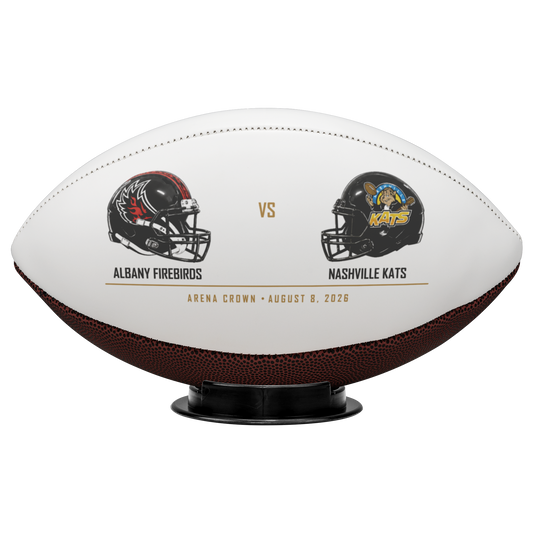
2026 Arena Crown Commemorative Football
Regular price $69.99 USDRegular priceUnit price per -
Beaumont Renegades AF1 Football
Regular price $69.99 USDRegular priceUnit price per -
Michigan Arsenal AF1 Football
Regular price $69.99 USDRegular priceUnit price per -
Nashville Kats AF1 Football
Regular price $69.99 USDRegular priceUnit price per -
Minnesota Monsters AF1 Football
Regular price $69.99 USDRegular priceUnit price per -
Kentucky Barrels AF1 Football
Regular price $69.99 USDRegular priceUnit price per -
Washington Wolfpack AF1 Football
Regular price $69.99 USDRegular priceUnit price per -
Albany Firebirds AF1 Football
Regular price $69.99 USDRegular priceUnit price per



Recently Viewed
AF1 Footballs — Officially Licensed Game Balls
Game-quality footballs for all eight Arena Football One franchises, plus the 2026 Arena Crown Commemorative. Officially licensed. $69.99.
Royal Retros is the official store of Arena Football One, and this collection is the proof: nine officially licensed game-quality footballs, one for each of the league's eight current franchises plus a commemorative ball marking the 2026 Arena Crown championship. Every football is $69.99, built to real game-quality construction —, and it's the same license Royal Retros uses across its entire AF1 jersey, hat, and drinkware line. If you're outfitting a fan cave, buying a gift for someone who actually throws a ball around, or just want the league's game ball on a shelf, this is the complete, real lineup.
What You Can Shop
Nine active footballs: eight team-branded AF1 game balls and one 2026 Arena Crown Commemorative Football, all $69.99, all one size — footballs don't run on an apparel size chart, there's no S–5XL here, just a single regulation-size ball across the whole line.
Shop by Team
- 2026 Arena Crown Commemorative Football — marking the Nashville Kats' 59-53 win over the Albany Firebirds on August 9, 2026, at F&M Bank Arena in Clarksville, the newest and most timely ball in the lineup.
- Nashville Kats AF1 Football — the reigning 2026 Arena Crown champion's team ball.
- Albany Firebirds AF1 Football — New York's franchise, 2025 champion and 2026 runner-up.
- Kentucky Barrels AF1 Football — the Barrels' team-branded game ball.
- Michigan Arsenal AF1 Football — the Arsenal's team-branded game ball.
- Washington Wolfpack AF1 Football — the Wolfpack, out of Everett, Washington.
- Minnesota Monsters AF1 Football — Minnesota's team-branded game ball.
- Beaumont Renegades AF1 Football — the Renegades' team-branded game ball.
- Oceanside Bombers AF1 Football — the Bombers, out of the San Diego market.
How a Football Is Built
A football isn't a round ball with panels sewn on — it's four leather or composite panels cut to a prolate-spheroid shape, laced together around a rubber bladder that holds the air, with the laces themselves doing double duty as both structural stitching and the grip surface every quarterback actually uses to throw a spiral. That four-panel construction is unusual: a basketball or soccer ball is built from many small panels because it needs to be a true sphere, but a football is deliberately not a sphere, so four larger panels is the efficient way to build the shape. Inside, the bladder is inflated to a set pressure range and the leather or composite cover is stretched taut around it — too loose and the ball goes soft and shapeless, too tight and the seams stress and the ball loses its give. The stitched seams along each panel edge aren't decorative; they're what lets the cover flex under an impact — a catch, a kick, a fall on the turf — without the leather cracking at a stress point.
The Bladder and Inflation
Underneath the leather or composite cover, every football relies on an inner rubber bladder to actually hold air — the cover itself isn't airtight, it's the structural shell around the part that is. Getting the inflation right matters more than casual buyers usually assume: underinflated, a ball goes soft and loses the crisp catch-and-throw feel; overinflated, the seams and panels come under more stress than they're built for and the ball can lose its shape faster over repeated use. That's part of why a game-quality ball, built with a proper bladder and correctly tensioned panels, behaves differently in hand than a cheap novelty ball with a thin liner glued inside a printed shell — the difference isn't just the outer material, it's the whole internal assembly working together.
Leather vs. Composite
Game-quality footballs are built from one of two cover materials, and the difference matters more than it looks like it should. Leather — traditionally cowhide — is the standard for actual game play at every serious level, because leather grips better in a quarterback's hand, especially once it's broken in through use, and it holds its shape through repeated hard impacts better than most synthetics. It does need some care: leather can dry out and crack if it's left in extreme heat or cold, or stored fully deflated for long stretches. Composite — a synthetic cover, often rubber or a synthetic leather blend — is more common in practice balls, youth balls, and balls built for display rather than repeated play, because it's cheaper to produce, doesn't need a break-in period, and tolerates being handled without the same care requirements as real leather. Every football in this AF1 collection is built to game-quality construction rather than the composite display-only standard, which is the detail that separates a real team-branded football from a souvenir with a sticker on it.
Regulation Size — Even Indoors
Arena football is played on a field a fraction of the size of an outdoor professional field, inside an arena built for hockey or basketball more than football — and yet the ball itself isn't scaled down to match. A regulation arena football is essentially the same weight and the same dimensions as a regulation outdoor professional football. Nothing about the ball itself is built for the smaller field; what changes indoors is the game around it — the walls in play, the shorter field, the compressed passing windows — not the equipment. That's worth knowing if you've ever assumed an "arena ball" would be some scaled-down or novelty-sized version of the real thing. It isn't. Every football in this collection is a true regulation-size game ball.
A Short History of the Football's Shape
The modern football's narrow, pointed shape isn't the original design — it's the result of the forward pass. Early football was played with a ball much closer to a rugby ball: rounder, thicker through the middle, built for carrying and kicking rather than throwing a tight spiral. Once the forward pass became a real part of the game in the early twentieth century, the ball itself changed to match — manufacturers narrowed the shape over the following decades specifically to make an accurate, catchable overhand throw possible, since a rounder ball simply doesn't spiral the same way. Panel construction followed a similar simplification: early balls were often built from more, smaller panels; the modern four-panel construction became the standard because it's the most efficient way to build the narrower prolate-spheroid shape without wasting material or adding unnecessary seams. The laces, originally just a practical way to close the ball around the bladder, became the defining grip feature of the throwing game almost by accident — quarterbacks discovered that gripping across the laces improved spin, and lace placement has been standardized around that discovery ever since.
The Laces
The laces run down one panel seam and serve two jobs at once: they're the actual closure that keeps the bladder-and-panel assembly sealed, and they're the primary grip surface a passer uses to impart spin on a throw. That's not a coincidence of design — it's why lace placement, count, and raised profile are all standardized rather than left up to a manufacturer's preference. A composite or display-grade ball still includes laces even when it's never going to be thrown competitively, because a football that looks right has to have them; a football that throws right needs them positioned exactly where generations of quarterbacks have trained their grip to expect them.
Why Ball Sizes Differ by Level of Play
Not every football is the same size, and the differences aren't random — they track hand size and grip strength as players get older. Youth footballs run smaller in circumference specifically so a young player's smaller hand can actually grip and control the ball; as players move up through older youth divisions and into amateur and adult levels, the ball size steps up in stages until it reaches full regulation size. Every football in this collection is built to that top-tier regulation standard — the same size and weight used at the professional level, arena or outdoor, rather than a scaled-down youth or amateur size. That's worth knowing if you're buying for a younger player who's still using a smaller youth ball: a regulation AF1 football is sized for an adult grip, not a youth one.
Display vs. Play — Which One Do You Need?
Not every football in a fan's collection is going to get thrown around, and that's fine — but it does change what actually matters when you're buying one. A ball headed for a display case or a shelf mount benefits most from a clean, consistent leather or composite finish and crisp lettering, since it's never going to take an impact that tests the stitching. A ball that's actually going to get used — backyard catch, a tailgate toss, a kid learning to grip a spiral — needs the real game-quality leather or composite construction and a properly inflated bladder, because a display-grade ball that isn't built to the right pressure tolerance will go soft or lose its shape fast under real use. Every football sold in this collection is built to game-quality standard, so it works either way; the only real decision is whether you plan to throw it.
Care
Keep a leather football away from extreme heat, direct sun for long stretches, and freezing cold storage — all three dry out or stress the leather over time. Don't store any football fully deflated for a long period; a slight amount of internal pressure helps the panels and bladder hold their shape rather than creasing. Wipe a leather ball down after use in wet conditions rather than letting it air-dry with mud or grass still on the surface, since debris left to dry into the leather is harder to clean later and can dull the grain.
Practice Balls vs. Game Balls
Teams and serious players typically keep a real distinction between a practice ball and a game ball, even when both are built to the same regulation size. A practice ball takes far more repeated abuse — thrown, dropped, kicked, left out in whatever weather a team happens to be practicing in that day — so programs generally cycle practice balls out once the cover starts showing heavy wear, long before a game-quality ball would be considered unusable. A game ball, by contrast, gets far lighter handling across a single contest and is often swapped out well before it shows any real wear at all. None of the footballs in this collection are marketed as game-used; they're new, officially licensed, game-quality product built to the same construction standard a team's actual game ball would use, without the wear that comes from being an actual on-field practice or game ball.
Why Game Balls Become Collectible
A football is one of the few pieces of sports memorabilia that can carry meaning two completely different ways — as a game-used or commemorative object tied to a specific result, or simply as team-branded gear that never touched a field. The commemorative ball is the clearer collectible: a ball printed for a specific championship, a specific season, a specific date, is inherently limited to that one moment, the same way a championship ring or a banner is — once that title game is over, that exact commemorative run is done. The 2026 Arena Crown Commemorative Football in this collection is exactly that kind of object, tied to one specific result (Nashville over Albany, 59-53, August 9, 2026) that won't repeat. Team-branded game balls collect differently — less about a single date and more about building a complete set the way a fan might collect a jersey or a tumbler from every franchise in a league, which is easier to do here than almost anywhere else, since Royal Retros is one of the few retailers carrying the full eight-team AF1 football lineup rather than just the marquee two or three teams.
The broader sports memorabilia market treats footballs as one of the most flexible collectible formats precisely because a ball can carry so many different kinds of significance — game-used, player-autographed, team-issued, commemorative, or simply a clean retail piece with a team's mark on it. Each tier commands different interest for different reasons: a game-used ball is valuable because of the specific play or game it was part of, an autographed ball because of the signature, and a clean commemorative or team ball — which is what every product in this collection is — because of the moment or franchise it represents rather than any individual signature or play. None of the footballs sold here are represented as game-used or autographed; they're officially licensed commemorative and team-branded product, which is its own legitimate and more accessible collecting tier.
Quick Buying FAQ
Is AF1 game-ball merchandise from Royal Retros officially licensed? Yes. Royal Retros is the official store of Arena Football One, and every football on this page is licensed team and league product.
Are these real game-quality footballs, or novelty-sized? Game-quality construction, regulation size — not a mini ball, not a display-only toy.
Leather or composite? Check the individual product listing for the specific cover material on each design.
What size is the ball? Regulation professional football size across the entire line — the same dimensions as an outdoor professional football, despite arena football being played on a much smaller indoor field.
Shipping & returns? Standard US shipping, with returns handled through our returns page.
Gift Ideas
- The championship pickup — the 2026 Arena Crown Commemorative Football is the timeliest gift in the whole catalog right now.
- The fan-cave centerpiece — a team football on a display stand next to a team tumbler rounds out a desk or shelf display.
- The backyard-catch gift — a real game-quality ball beats a novelty one for anyone who's actually going to throw it.
- The complete-set project — all eight AF1 team footballs in one place, a genuinely rare thing to be able to collect.
Why Royal Retros
- The official store of Arena Football One. Royal Retros is AF1's official store, and every AF1 team is licensed — league-branded and team-branded product alike. This is the real thing, not a workaround.
- All eight active AF1 franchises covered — plus the 2026 Arena Crown Commemorative, current and complete.
- Game-quality construction on every football, not a display-only novelty.
- The deepest defunct- and current-league apparel and accessory catalog anywhere — footballs are one small corner of a much larger AF1 catalog.
Is AF1 gear from Royal Retros officially licensed?
Yes. Royal Retros is the official store of Arena Football One, and every AF1 team's product — including every football on this page — is officially licensed.
Extended FAQ
Why does the Arena Crown Commemorative Football cost the same as a team ball? Both are built to the same game-quality construction standard; the commemorative ball's value is in its limited, date-specific print run, not a different manufacturing tier.
Do you sell footballs for teams outside AF1? Not in this collection — this page is the complete AF1 football lineup specifically. Check Custom Jerseys for the wider catalog of leagues Royal Retros carries in apparel form.
Why is a four-panel ball harder to build than a round ball? A round ball just needs consistent curvature; a football's prolate-spheroid shape means each of the four panels is cut and stitched to a specific, non-symmetrical curve, and getting the lacing and bladder pressure right so the ball holds that shape is a more exacting process than building a sphere.
Will a leather football scuff if I actually throw it around? Some surface wear is normal and even expected on a leather ball that's actually being used — that's part of the break-in process that also improves grip over time. Heavy scuffing on turf or concrete will happen faster than on grass.
Is the Arena Crown Commemorative Football autographed? No — this is a commemorative team/league product, not a player-autographed memorabilia item. Check the individual product listing for exact specifications.
Do you sell drinkware in the same team lineup? Yes — see the Drinkware collection for the same eight AF1 franchises in officially licensed tumbler form.
Why did the football's shape change from rounder to narrower? The forward pass. Once throwing became central to the game, the ball narrowed over subsequent decades specifically to make an accurate spiral possible — see the history section above.
Are youth and professional footballs interchangeable? No — a youth ball is sized smaller for a smaller hand and grip. Every football in this collection is full regulation adult size.
Does the four-panel construction ever change? Four panels is the standard modern construction across essentially all serious game footballs; it's the efficient way to build the shape without excess seams.
Shop Related Collections
- AF1 — the full Arena Football One catalog.
- AF1 League Gear — league-branded apparel and accessories.
- AF1 Postseason — Arena Crown and playoff-specific product.
- Custom Jerseys — build a full AF1 kit alongside your football.
- Drinkware — AF1 tumblers, same eight-team lineup.
Shop AF1 Footballs at Royal Retros — Officially Licensed Game Balls.