




-
-
CUSTOM
Washington Caps Jersey
Regular price Starting at $121.00 CADRegular priceUnit price per -





Recently Viewed
The Washington Caps Collection — Royal Retros ABA Fan Shop
Heritage Tribute Gear From the Wildest One-Season Franchise in ABA History. Sizes S–5XL.
Royal Retros carries two pieces built around the Washington Caps' single, chaotic 1969-70 ABA season: a green-and-gold jersey in Green, Yellow or White, and a T-shirt in three colorways. The jersey is $84.99 and runs Small through 5XL. The tee is $29.99 and runs Small through 4XL in most colors. This team played only one season, arrived as the defending champion, and left town having played "home" games in Wichita and Mexico City — there is no current Washington Caps store to buy this from. This is heritage tribute apparel built for a franchise most fans have never heard of, and the ones who have can't stop talking about it.
What You Can Shop in the Washington Caps Collection
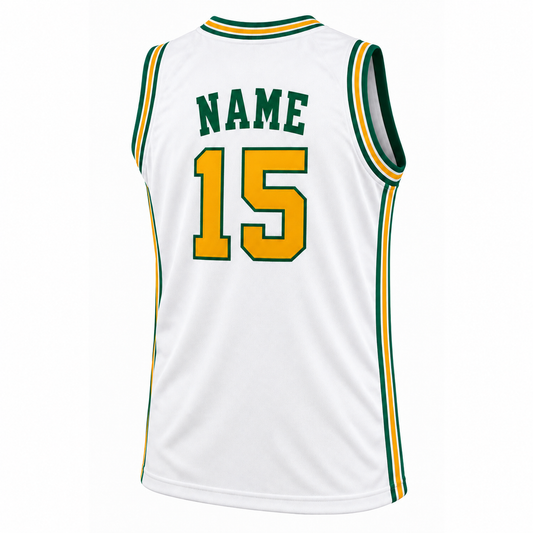
Washington Caps Jersey — The Caps jersey, in the team's real green-and-gold identity (Green, Yellow or White), sewn twill lettering, period-correct fonts pulled from the one season this franchise actually wore the name. $84.99, sizes S–5XL.
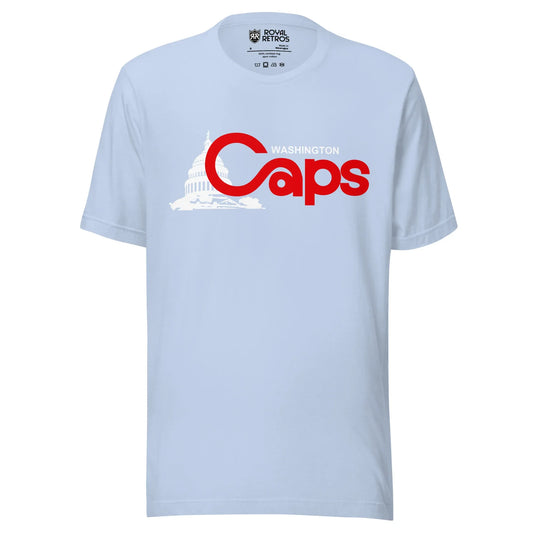
Washington Caps T-Shirt — The Caps tee, in Kelly, Baby Blue (both S–4XL) or Heather Columbia Blue (S–2XL). Soft pre-shrunk cotton, vintage graphics. $29.99.
Sizes — Jerseys run Small through 5XL. Tees run Small through 4XL in Kelly and Baby Blue, Small through 2XL in Heather Columbia Blue. No big & tall upcharge, and no premium pricing for the larger sizes on either style.
Why Royal Retros Is the Home of Washington Caps Throwback Gear
- A team almost nobody else carries. One ABA season, one city, one shot — this collection covers a franchise most throwback retailers skip entirely.
- Real team colors. Green and gold, matching the Caps' actual 1969-70 identity, not a generic reprint.
- Period-correct construction. Era-appropriate fonts and lettering, referenced against photographic source material.
- Sizes S–5XL on jerseys. True family sizing, no big & tall upcharge.
- Connected history. This franchise is also the Oakland Oaks and the Virginia Squires under different names — shop both eras in our Oakland Oaks and Virginia Squires collections.
Quick Buying Questions
What sizes do Washington Caps jerseys and tees come in?
The jersey runs Small through 5XL. The tee runs Small through 4XL in Kelly and Baby Blue, Small through 2XL in Heather Columbia Blue. We don't upcharge for big & tall sizes.
Are these officially licensed?
No. These are heritage tribute reproductions built from period research, not officially licensed product. The Washington Caps played one season, in 1969-70, and the franchise moved on before the name could become a going concern. We build these because a team this strange deserves better than a single generic "vintage ABA" design.
How fast does it ship and what's the return policy?
Stock items ship within 3–5 business days. Sizes and colors move quickly on a small collection like this one. Standard items follow our return policy at /pages/returns.
Gift Ideas for the ABA History Fan
- For the "I bet you didn't know this team existed" gift: The Washington Caps played one season, went from Bay Area champions to Beltway also-rans, and vanished — a genuinely obscure piece of D.C. sports history.
- For the Rick Barry completist: Barry is a Hall of Famer, and the Caps season is one of the least-covered chapters of his career.
- For the ABA collector: Pair a Caps piece with something from our full ABA collection to build out the league's stranger corners.
- For the D.C. sports historian: Round out the story with our Washington D.C. collection.
- Year-round demand. Obscure-franchise nostalgia isn't seasonal — birthdays, Father's Day and the start of basketball season all work.
The Washington Caps: One Season, Coast to Coast to Coast
The Washington Caps existed for exactly one ABA season, 1969-70, and it might be the strangest single season any professional basketball franchise has ever played. The team arrived in Washington, D.C. as the reigning ABA champion under a different name, kept a superstar forward who didn't want to be there, got stuck playing in the wrong division for its new location, ran into a real-estate deal that pushed it out of town within a year, and then moved again to become a three-city regional franchise in Virginia. Nobody has built a throwback collection this specific to that one season — which is exactly why Royal Retros did.
How did a championship team become the Washington Caps?
What makes the story worth telling in detail is how compressed it all was. In roughly eighteen months, this single group of players and this single franchise went from Bay Area champions, to a legally contested cross-country relocation, to a genuinely competitive playoff team stuck in the wrong division and playing "home" games a thousand miles from home, to a second relocation forced by a rival team's owner, to a new identity in a new state. Few franchises in any American pro sports league have packed that much upheaval into two seasons, and almost none of them also happened to feature two future Hall of Famers along the way.
The franchise began in 1967 as an ABA expansion team based in Oakland, California, majority-owned by entertainer Pat Boone. As the Oakland Oaks, the team signed NBA star Rick Barry and, after a year sidelined by a legal dispute with his former team, built a roster around him and head coach Alex Hannum. In 1969 the Oaks won the ABA championship over the Indiana Pacers — with Barry himself injured and unable to play in the Finals, the title coming instead on the strength of Warren Armstrong's playoff run. Off the court, the story was different: Bank of America was threatening to foreclose on a $1.2 million loan, and Boone, who had been losing money for two straight seasons, sold the reigning champions to a group led by attorney Earl Foreman. Foreman moved the franchise to Washington, D.C. for the 1969-70 season, and the team took on a new identity — green and gold, and a new name: the Washington Caps.
How exactly did the Oaks win that 1969 title without their best player?
The Oaks beat the Indiana Pacers four games to one in a series that was closer than the result suggests — three of the five games were decided by single digits, and two went to overtime. Oakland pulled it off without Rick Barry, who had been the ABA's leading scorer that season at 34 points a game but was sidelined by injury for the Finals. Warren Jabali (still playing under the name Warren Armstrong at the time) was named series MVP, capping the championship-clinching Game 5 with 39 points in a 135-131 overtime win on Oakland's home floor. Larry Brown and forward Doug Moe were the other key contributors on that title roster, against an Indiana team led by league MVP Mel Daniels, Roger Brown and Freddie Lewis. It's a genuinely strange footnote in basketball history: a championship won largely without the team's most famous player, by a roster that would be wearing a different city's name on its jersey before the next season tipped off.
Why is a defending champion remembered as such an unstable franchise?
Almost everything that could go wrong for a relocating team went wrong for the Caps. Rick Barry, the team's biggest gate attraction, publicly objected to the move and sat out the first 32 games of the season during a legal fight over his contract before a court forced him to report. Even stranger, when the ABA restructured for the 1969-70 season, the Caps — now based on the East Coast — were kept in the league's Western Division, matched against opponents more than a thousand miles away. The long travel wore on the roster, and to make matters worse, the team ended up playing some "home" games far from Washington entirely, including dates in Wichita, Kansas and Mexico City, because scheduling around the division's geography made a normal home slate impossible.
Where did the Washington Caps actually play, and why did attendance struggle?
The Caps' true home was the Washington Coliseum, an arena in the city's Near Northeast neighborhood best known today as the site of the Beatles' first-ever United States concert in February 1964. By 1969, the surrounding neighborhood was still recovering from the 1968 riots that had followed Dr. Martin Luther King Jr.'s assassination, and fears about the area kept fans away — the Caps averaged fewer than 3,000 fans a game despite fielding a legitimately good, veteran-heavy roster. A planned local television deal fell apart over a financial dispute just before Christmas, cutting off another avenue for the team to build a following in its one season in town.
How good were the 1969-70 Washington Caps, on the court?
Better than their attendance and travel schedule would suggest. The Caps finished 44-40, third in the Western Division, and pushed the Denver Rockets to seven games in the division semifinals before losing the deciding game on the road. Rick Barry, healthy for most of the season after his early holdout, averaged 27.7 points a game — second in the entire ABA — and made the ABA All-Star Game. It remains one of the more overlooked good seasons in the league's short history, buried under the noise of the team's travel schedule and attendance problems.
Why did the Caps move again after just one season?
The push out of Washington had nothing to do with the team's performance. In 1970, the owner of the NBA's Baltimore franchise was preparing to move his own team into the Washington, D.C. market and did not want a competing ABA franchise sharing the city. The other ABA owners pressured Earl Foreman to relocate the Caps a second time in as many years, and Foreman chose to make the team a regional franchise based in Norfolk, Virginia, splitting home games across Norfolk, Hampton, Richmond and, briefly, Roanoke. The team became the Virginia Squires for the 1970-71 season — a franchise that would go on to play in the ABA for six seasons and briefly employ a rookie named Julius Erving before financial trouble ended the run in 1976. Rick Barry, who had already fought one relocation, refused to make the move to Virginia and had his contract sold elsewhere within a week of appearing on a magazine cover in a Squires uniform.
The rival NBA owner behind the push was Abe Pollin, who controlled the Baltimore Bullets and wanted his own team playing in the nation's capital without a competing pro basketball tenant already there. Pollin got his wish: the Bullets eventually moved into the Washington, D.C. area for good in the 1970s. It's a small irony of this franchise's story that the same market forces that brought major-league basketball to Washington on a permanent basis are exactly what pushed the Caps out of town after just one season.
Is this the same team as the Washington Capitals?
No, and the two are frequently confused because of the shared nickname. The Washington Caps were an ABA basketball team that existed only for the 1969-70 season and then relocated to Virginia. The Washington Capitals are a National Hockey League franchise founded in 1974 — four years after the basketball Caps had already left town — as an entirely separate expansion team in an entirely different sport. The two clubs have no shared ownership, roster or history; they only share part of a name and, by historical coincidence, the same city.
Wait — was there also a "Washington Capitols"?
Yes, a third team, and it makes the naming even more tangled. The Washington Capitols were an early professional basketball team that played from 1946 to 1951 as a charter member of the Basketball Association of America and, later, the NBA — coached in their first three seasons by a young Red Auerbach, well before his championship run in Boston. The Capitols are unrelated to both the Washington Caps and the Washington Capitals; they simply happened to play in the exact same building nearly two decades before the Caps did. Between the 1940s-era Capitols, the 1969-70 Caps and the modern Capitals, Washington, D.C. has now fielded three different pro sports franchises with variations on the same name, in two different sports, none of them connected to each other.
What else happened at the arena where the Caps played?
The Washington Coliseum wasn't built for basketball at all — it opened in 1941 as the Uline Arena, primarily an ice-skating and hockey venue, and only picked up the "Washington Coliseum" name in a 1960 rebrand under new ownership. Basketball history ran through the building twice before the Caps ever set foot on its floor: the Washington Capitols played there from 1946 to 1951, and on October 31, 1950, the arena hosted the NBA debut of Earl Lloyd, the first African American player in league history. The same building hosted one of President Eisenhower's 1953 inaugural balls and, most famously, the Beatles' first American concert in February 1964 — meaning the Caps spent their one ABA season playing home games in a building that had already made history several times over in entirely different fields.
Which future Hall of Famers played for the Washington Caps?
Two future Naismith Memorial Basketball Hall of Famers wore a Caps uniform in 1969-70. Rick Barry, already an established NBA and ABA scoring star, averaged 27.7 points a game despite missing the season's first 32 contests in a contract dispute. The other was Larry Brown, then a playmaking guard rather than the championship-winning coach he would later become, who led the entire ABA in assists that season. On the roster that had won the previous year's title, forward Warren Armstrong — who later changed his name to Warren Jabali, the Swahili word for "rock" — had been the 1969 ABA Playoffs MVP, averaging 21.5 points and 9.7 rebounds a game across that postseason run, and he stayed with the franchise into its Washington season, joining Barry as one of the Caps' two representatives in that year's ABA All-Star Game.
What happened to the Caps' players and coaches after 1970?
Several members of that one-season roster went on to far bigger things than the Washington Caps ever achieved. Larry Brown, the playmaking guard who led the ABA in assists during the Caps' lone season, became one of basketball's most respected coaches, eventually winning an NBA championship and an NCAA championship — the only person in basketball history to hold both titles. Doug Moe, part of the title-winning Oaks roster the year before, also became a longtime NBA head coach. Rick Barry's career continued well beyond his one unhappy season in Washington; he eventually returned to the NBA and was inducted into the Naismith Memorial Basketball Hall of Fame. Warren Jabali kept playing in the ABA for several more seasons and was later inducted into multiple halls of fame recognizing his college and professional career. None of them stayed with the franchise itself much longer — by the time it resurfaced as the Virginia Squires, the roster looked almost nothing like the team that had shocked Indiana for a championship or scrapped through a chaotic season in Washington.
What Makes Ours Period-Correct
Construction and accuracy. Sewn-on tackle-twill numbers and lettering where the original build called for it, era-correct fonts and colors, and true-to-original construction — every Washington Caps design is checked against period references before it goes live.
More Frequently Asked Questions
Who were the Washington Caps?
An ABA basketball team that played a single season in Washington, D.C. in 1969-70, after relocating from Oakland as the reigning league champion, before moving again the following year to become the Virginia Squires.
Did the Washington Caps win a championship?
Not as the Washington Caps. The franchise won the 1969 ABA championship while still based in Oakland as the Oakland Oaks, then relocated to Washington for the following season before the team could defend the title under its new name.
Where did the Washington Caps play their home games?
Primarily the Washington Coliseum, the same arena where the Beatles played their first American concert in 1964. Because of a geographically mismatched division alignment, the team also played some "home" games far outside D.C., including in Wichita, Kansas and Mexico City.
What happened to the Washington Caps?
The franchise relocated again after just one season in D.C., becoming the Virginia Squires for 1970-71 and playing in the ABA through the 1975-76 season before folding.
Did Rick Barry play for the Washington Caps?
Yes. Barry had signed with the franchise back when it was the Oakland Oaks, moved with it to Washington despite objecting to the relocation, and averaged 27.7 points a game for the Caps in 1969-70 — second-best in the entire ABA that season.
How many Washington Caps products does Royal Retros carry?
Two — a jersey in the team's real green-and-gold colors and a T-shirt. Both are built around this franchise's single 1969-70 season in Washington, D.C.
Who coached the Washington Caps?
Al Bianchi took over as head coach for the move to Washington, replacing Alex Hannum, who had led the team to its 1969 championship as the Oakland Oaks. Bianchi inherited a roster still built around Rick Barry and steered it to a winning record and a seven-game playoff series despite the franchise's chaotic travel schedule and Barry's extended holdout.
Shop Related Collections
- ABA — The full American Basketball Association catalog Royal Retros carries.
- Oakland Oaks — This same franchise's earlier identity, including its 1969 championship season.
- Legacy Basketball — Every defunct and historic pro basketball franchise Royal Retros carries.
- Virginia Squires — This same franchise's next identity, after its 1970 move to Virginia.
- Washington D.C. — Regional sports history from the Caps' one and only home city.
The Washington Caps at Royal Retros — Heritage Tribute Gear From ABA History. Sizes S–5XL. One City, One Season, 1969–1970.