



-
West Palm Beach Tropics T-Shirt
Regular price $43.00 CADRegular priceUnit price per -
-
CUSTOM
St Petersburg Pelicans Jersey
Regular price Starting at $120.00 CADRegular priceUnit price per -
-
-
St Lucie Legends T-Shirt
Regular price $43.00 CADRegular priceUnit price per -
-
-
-
Bradenton Explorers T-Shirt
Regular price $43.00 CADRegular priceUnit price per -
-
St Petersburg Pelicans T-Shirt
Regular price $43.00 CADRegular priceUnit price per -
-
CUSTOM
West Palm Beach Tropics Jersey
Regular price Starting at $120.00 CADRegular priceUnit price per -
-
CUSTOM
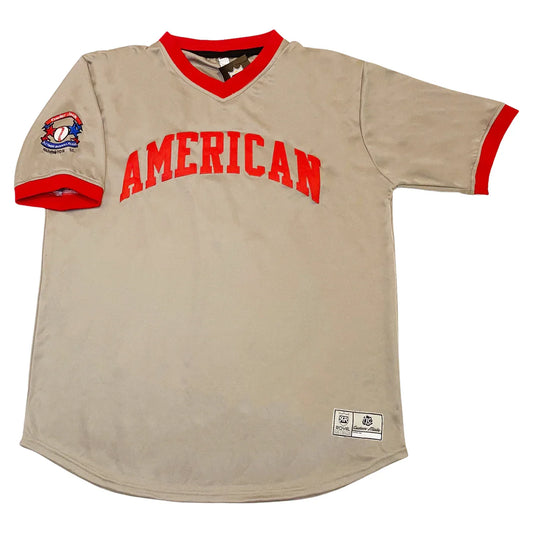
Old Timers Jersey
Regular price Starting at $120.00 CADRegular priceUnit price per -
-
CUSTOM
St Lucie Legends Jersey
Regular price Starting at $120.00 CADRegular priceUnit price per -




Senior Professional Baseball Association — SPBA Fan Shop
Seven real 1989-90 franchises plus the league's Old Timers all-star identity. $29.99 tees, $84.99 jerseys. Sizes S–5XL on jerseys, S–5XL on most tees.
The Senior Professional Baseball Association lasted barely fourteen months, and it is one of the strangest experiments in the history of American professional sports: a real, sanctioned winter league built entirely around players age 35 and older, stocked with recognizable former major leaguers, playing a full schedule in Florida spring-training ballparks in front of crowds that never quite showed up. Royal Retros carries eleven active pieces across seven of the league's real franchises plus a non-team-specific Old Timers design — seven t-shirts at $29.99 and four jerseys at $84.99, all built around a league that most baseball fans have never heard of and that genuinely deserves more attention than it gets.
What You Can Shop
Seven t-shirts, $29.99 each, covering the West Palm Beach Tropics, Orlando Juice, St. Lucie Legends, Sun City Rays, Gold Coast Suns, Bradenton Explorers, and St. Petersburg Pelicans. Four jerseys, $84.99 each, covering the West Palm Beach Tropics, St. Petersburg Pelicans, St. Lucie Legends, and a non-team-specific Old Timers design built around the league's all-star identity rather than any single franchise. Every jersey runs Small through 5XL, and six of the seven t-shirts do too — the St. Petersburg Pelicans t-shirt is the one exception, sized Small through 4XL only. Two of the league's eight original 1989-90 franchises, the Fort Myers Sun Sox and Winter Haven Super Sox, don't currently have active product, and neither does the 1990-91 expansion California club, the San Bernardino Pride.
Shop by Team
- West Palm Beach Tropics — the league's first-season powerhouse, 52-20 and a South Division title by 15 games. T-shirt $29.99 (S–5XL), Jersey $84.99 (S–5XL).
- St. Petersburg Pelicans — the league's first champion, beating the Tropics 12-4 on February 4, 1990. T-shirt $29.99 (S–4XL only), Jersey $84.99 (S–5XL).
- St. Lucie Legends — the South Division's last-place club at 20-51, and still a real part of the league's only season with a complete standings table. T-shirt $29.99 (S–5XL), Jersey $84.99 (S–5XL).
- Bradenton Explorers — runner-up in the North Division, led by a league-leading 17 home runs from their cleanup hitter. T-shirt $29.99 (S–5XL).
- Orlando Juice — third in the North Division at 37-35, one of the more memorably named franchises in the league. T-shirt $29.99 (S–5XL).
- Gold Coast Suns — home to the league's oldest everyday player, a 47-year-old shortstop still stealing bases. T-shirt $29.99 (S–5XL).
- Sun City Rays — one of two clubs added for the abbreviated 1990-91 season, based in Arizona rather than Florida. T-shirt $29.99 (S–5XL).
- Old Timers Jersey — a non-team-specific design built around the league's all-star, veteran-baseball identity rather than one franchise. Jersey $84.99 (S–5XL).
Customization and Sizes
Most jerseys offer name-and-number customization; check the individual listing for what's available on a given design, and note that custom items are final sale. Every jersey on this page runs Small through 5XL. Six of the seven t-shirts match that range; the St. Petersburg Pelicans t-shirt specifically tops out at 4XL rather than 5XL — check the individual listing before ordering a size above 4XL in that one design.
Why Royal Retros
- A genuinely obscure league, covered accurately. Seven real franchises, correct standings, correct championship result — not a generic throwback with the details guessed at.
- Free name-and-number customization on most jerseys.
- The deepest defunct-league apparel catalog anywhere — this eleven-piece page is one narrow, genuinely odd corner of a much larger Florida and legacy-baseball collection.
Quick Buying FAQ
Are these officially licensed? No. These are heritage tribute designs — Royal Retros does not hold a league or team license for the Senior Professional Baseball Association.
What sizes are available? Small through 5XL on every jersey and on six of the seven t-shirts. The St. Petersburg Pelicans t-shirt runs Small through 4XL only.
Can I customize a jersey? Most jerseys offer free name-and-number customization — check the individual listing. Custom items are final sale.
Shipping & returns? Standard US shipping, with returns handled through our returns page.
Gift Ideas
- The Hall of Fame completist — the Old Timers Jersey nods to a league that briefly employed multiple future Hall of Famers past their prime.
- The championship-team fan — the St. Petersburg Pelicans gear marks the league's only crowned champion.
- The obscure-baseball collector — almost no other retailer covers a league this specific, or this short-lived.
What Was the Senior Professional Baseball Association?
The Senior Professional Baseball Association was a real, sanctioned winter baseball league that operated in Florida for the 1989-90 season and part of 1990-91, built entirely around retired and aging players 35 or older, with a lowered minimum of 32 for catchers. It wasn't an exhibition circuit or an old-timers' game series — it was a genuine 72-game professional schedule in its first season, with real standings, a real playoff format, and a real championship, played mostly in the same spring-training ballparks major league clubs used earlier in the year. The idea was straightforward: give recently retired players, many still capable of real competitive baseball, somewhere to keep playing, and give Florida's baseball-hungry winter population something to watch during the months when the sport otherwise went quiet.
Whose Idea Was the SPBA, and Why Florida?
The league was the brainchild of Jim Morley, who pitched it as a baseball equivalent to a senior golf tour — a real competitive circuit built specifically for players who'd aged out of the major leagues but hadn't lost the ability to play at a genuinely high level. Morley's key insight was logistical as much as competitive: Florida is full of spring training and Florida State League ballparks that sit completely empty from November through February, once the parent clubs and their minor-league affiliates have gone home for the winter. Rather than build anything new, the SPBA simply rented out that idle real estate for its own November-to-February schedule, which kept startup costs relatively low and let the league launch in a single season rather than needing years of stadium construction first. Florida's large population of retirees and winter residents was the other half of the pitch — a built-in audience, at least in theory, for a baseball product explicitly built around veteran players rather than the sport's usual young-talent pipeline.
Who Played and Ran the League?
The SPBA's rosters and dugouts read like a scaled-down Hall of Fame ballot. Pitchers Rollie Fingers and Ferguson Jenkins, both future Hall of Famers, and Vida Blue, one of the most electric arms of the 1970s, all played in the league, alongside outfielder Dave Kingman. Earl Weaver and Dick Williams, two of the most respected managers of the previous two decades, both managed clubs. Former outfielder Curt Flood, whose legal challenge to baseball's reserve clause had reshaped the sport's labor system years earlier, served as the league's first commissioner. At the other end of the age spectrum, pitcher Ed Rakow was the league's oldest player at 54 — nearly two decades past a typical playing career's end, and still active on a professional roster.
How Did the First Season Play Out?
The 1989-90 season ran eight teams across two divisions on a 72-game schedule. In the South Division, the West Palm Beach Tropics ran away with the title at 52-20, finishing 15 games ahead of the Fort Myers Sun Sox; the Gold Coast Suns and St. Lucie Legends finished third and fourth. In the North Division, the St. Petersburg Pelicans finished first, narrowly holding off the Bradenton Explorers for the top spot, with the Orlando Juice and Winter Haven Super Sox rounding out the division. Attendance never matched the quality of the baseball on the field — most clubs drew fewer than 1,000 fans a game across the season, a number that undersold just how competitive the actual play was.
Who Won the League's Only Championship?
The SPBA settled its first and only completed championship with an unusual three-game, single-elimination weekend format at the start of February 1990. On February 2, the two second-place division clubs played each other, with the Explorers beating the Sun Sox to earn a shot at the Pelicans. The next day, the Pelicans beat the Explorers 9-2 to advance to the league championship game against the Tropics, the South Division's dominant regular-season club. On February 4, 1990, the Pelicans beat the Tropics 12-4, powered by a home run and three RBIs from first baseman Lamar Johnson, to claim the league's first and, as it turned out, only championship. It's a genuinely unusual playoff structure — a three-team gauntlet rather than a standard bracket — and it produced a clean, well-documented result that stands as the SPBA's entire championship history.
Who Were the Season's Statistical Leaders?
The individual numbers from that first season hold up as real, competitive professional baseball. Infielder Ron Washington of West Palm Beach won the league MVP hitting .359 with a league-leading 73 RBIs; his teammate Mickey Rivers hit .366. Gold Coast's Bert Campaneris, at 47 the oldest everyday player in the league, stole 16 bases. Bradenton's Jim Morrison hit .290 with a league-leading 17 home runs and 55 RBIs. Fort Myers' Tim Ireland posted the league's best batting average at .374, while his teammate Kim Allen led the league with 33 stolen bases. On the mound, West Palm Beach's Juan Eichelberger went 11-5 with a 2.90 ERA, St. Petersburg's Milt Wilcox went 12-3, and Jon Matlack, Tim Stoddard, and Pete Falcone each won 10 games. Bradenton's Rick Lysander saved 11 games, Winter Haven's Bill Campbell posted a 2.12 ERA with 5 saves, and Gold Coast's Joaquín Andújar went 5-0 with a 1.31 ERA — genuinely dominant numbers for a league most fans assume was closer to an exhibition than real competition.
Why Did the League Shrink Before Its Second Season?
Between the 1989-90 and 1990-91 seasons, the SPBA contracted hard. Four of the original eight franchises — Gold Coast, Orlando, St. Lucie, and Winter Haven — folded outright. The West Palm Beach Tropics gave up their fixed home city and became a traveling team, rebranded the Florida Tropics, while the Bradenton Explorers relocated to become the Daytona Beach Explorers. To fill out the schedule, the league added two entirely new clubs outside Florida for the first time: the Sun City Rays in Arizona and the San Bernardino Pride in California. The league also lowered its age minimum to 34 and cut the season down to 56 games — every sign of an operation retrenching hard rather than building toward a stable future.
Why Did the SPBA Fold?
The Senior Professional Baseball Association folded on December 26, 1990, less than halfway through its shortened second season. The collapse was financial at its core: the league never solved its attendance problem, operating costs kept climbing even as revenue didn't, and at least one owner, Philip Breen, disappeared amid FBI scrutiny over embezzlement allegations before the league's final collapse. Contributing factors included site and city selection that didn't reliably draw crowds, and — perhaps most tellingly — a prospective-ownership vetting process that wasn't rigorous enough to keep financially unstable owners out of the league in the first place. A league built on a genuinely good idea folded not because the baseball was bad, but because the business side of it never came together.
How Is the SPBA Remembered Today?
The league shows up today mostly as a footnote in baseball-history retrospectives and a niche interest for card and memorabilia collectors — Pacific Trading Cards produced a full set of SPBA player cards for the 1989-90 season, which remain one of the more accessible ways to see the league's actual rosters and uniforms firsthand. It rarely comes up outside those specialist circles, which is part of what makes it interesting: a league that briefly employed multiple future Hall of Famers, produced a real and well-documented championship, and folded within fourteen months has almost none of the general-public name recognition that its roster of players would otherwise suggest. That gap between the quality of the story and how few people actually know it is exactly the kind of territory a heritage apparel collection is built for.
What Happened to the Players Afterward?
For a handful of players, the SPBA turned out to be a genuine second act rather than a nostalgic farewell tour. Ron Washington, Joaquín Andújar, Paul Mirabella, Danny Boone, and Ozzie Virgil Jr. all signed major league contracts after their time in the Senior League, and Mirabella, Boone, and Virgil actually returned to major league rosters afterward — proof that at least some of the competition in Florida that winter was sharp enough to put players back on a big-league diamond. That's a rare outcome for any senior or veterans' league anywhere in professional sports, and it's part of what separates the SPBA from a pure nostalgia exhibition: for a few players, it worked exactly as intended.
What Made This More Than an Exhibition League?
The easiest mistake to make about the SPBA is assuming it was closer to an old-timers' charity game than a real competitive league. The statistical record argues otherwise: a .374 batting average, a sub-2.00 ERA relief performance, and a 47-year-old shortstop stealing bases at a real professional clip are not exhibition-league numbers — they're the kind of stat line that shows up in a genuinely competitive box score. Teams played to win a real division race and a real, if unusually structured, championship tournament, and at least a handful of players used the league as a legitimate springboard back into affiliated baseball rather than a farewell lap. That combination — real competition, real stakes, and a real (if short) season — is what separates the SPBA from a pure novelty act, even though its business model never came close to working.
Why Do Collectors Care About a League That Lasted One Full Season?
A league this short-lived produces almost no surviving product from its own era — there was no long merchandising run, no years of retail apparel, nothing beyond what the league itself managed to produce and sell during its brief existence. That scarcity is exactly what makes a heritage reproduction collection like this one worth building: the alternative for a fan who wants SPBA gear today is hunting for genuinely rare, decades-old original items rather than finding anything currently in production. A league that folded within fourteen months, with a roster full of recognizable names and a genuinely well-documented championship result, is close to ideal territory for a heritage apparel line — enough real history to build an accurate, detailed collection, and few if any other retailers actively covering it.
What Makes Ours Period-Correct
Construction and accuracy. Sewn-on tackle-twill numbers and lettering where the original build called for it, era-correct fonts and colors, and true-to-original construction — every Heritage design is checked against period references before it goes live.
Extended FAQ
Did every SPBA team make it to a second season? No — four of the original eight 1989-90 franchises folded outright before 1990-91, and two more relocated and rebranded.
Was the SPBA affiliated with major league baseball in any way? No — it operated as an independent winter league, unaffiliated with any major league organization, though many of its players and some of its officials came directly from major league careers.
Why did the Pelicans win the championship despite the Tropics having the better regular-season record? The league used a three-game, single-elimination weekend tournament among its top four teams rather than a standard best-of series bracket, and the Pelicans won all three games they needed to.
Are the Fort Myers Sun Sox or Winter Haven Super Sox covered on this page? Not currently — no active product exists for either franchise right now, despite both having real 1989-90 seasons documented in league standings.
Did any SPBA alumni make it back to the majors? Yes — Paul Mirabella, Danny Boone, and Ozzie Virgil Jr. all played in the majors again after their SPBA stint, among several players who signed major league contracts out of the league.
Why did the league move outside Florida for its second season? To replace the four franchises that folded after the first season, the SPBA added clubs in Arizona and California for 1990-91 — the league's only expansion beyond its original Florida footprint before it folded a few weeks into that same season.
Where did SPBA teams actually play their home games? Spring training and Florida State League ballparks around the state, rented out during the November-through-February window when those facilities would otherwise sit empty for the winter.
Who founded the league? Jim Morley, who conceived of it as a baseball equivalent to a senior professional golf tour, built specifically around players aged 35 and older.
Shop Related Collections
- Custom Jerseys — the full custom jersey catalog across every league Royal Retros carries.
- Florida — the full state catalog, 102 designs, including every SPBA franchise represented here.
- Legacy Baseball — more historic baseball designs beyond the SPBA, 39 pieces.
Shop the SPBA Collection at Royal Retros — 1989-90 Senior League Heritage.