



-
CUSTOM
1971 Bullets Jersey
Regular price Starting at $123.00 CADRegular priceUnit price per -
-
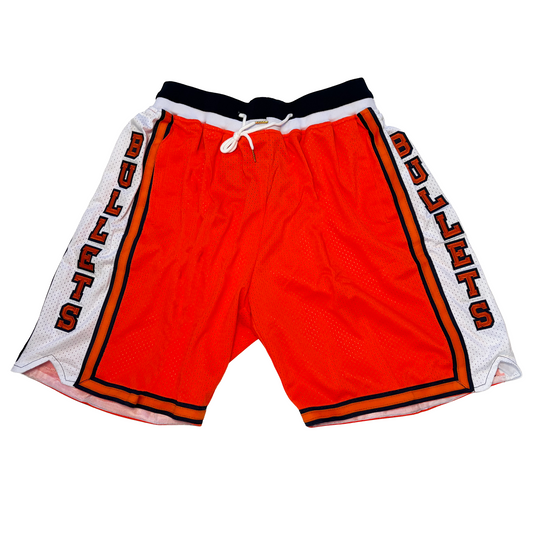
Bullets Basketball Shorts
Regular price $73.00 CADRegular priceUnit price per -
-
CUSTOM
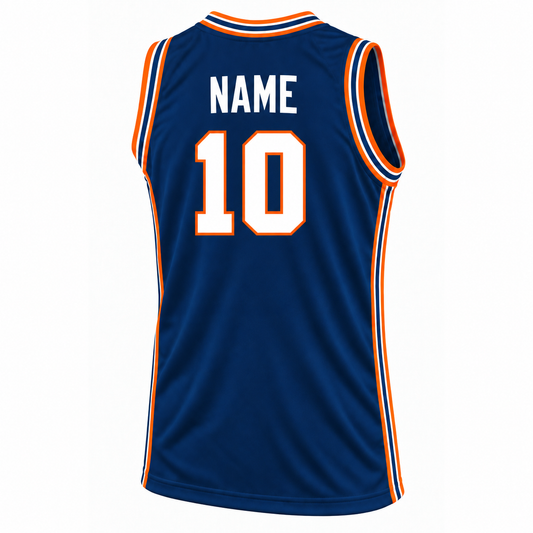
Bullets Jersey
Regular price Starting at $123.00 CADRegular priceUnit price per -






The Bullets Collection — Royal Retros Baltimore-Washington NBA Fan Shop
Heritage Tribute Jerseys and Shorts From the 1971 Finals Team and the Navy-and-Orange Era. Custom Names & Numbers. Sizes S–5XL.
Royal Retros carries three pieces built around one of the NBA's great what-could-have-been-and-then-was runs: the 1971 Finals-era jersey in orange or white, the classic navy-and-orange jersey from the years the franchise finally broke through, and matching basketball shorts in navy, orange or white. Jerseys are $84.99 and run Small through 5XL; the shorts are $49.99 and run Small through 4XL. Most jerseys include free custom name and number. This is heritage tribute apparel — the Bullets name hasn't been on an NBA jersey since the franchise renamed itself in the late 1990s, and nobody else is building throwbacks this specific to the two Finals runs that defined the identity.
What You Can Shop in the Bullets Collection
1971 Bullets Jersey — The 1971 jersey, in orange or white, built around the roster that pulled off a stunning seven-game upset of the New York Knicks to reach that year's NBA Finals. Sewn twill lettering, period-correct fonts. $84.99, sizes S–5XL.
Bullets Jersey — The classic cut, in navy, orange or white, built around the era that delivered the franchise's only championship. $84.99, sizes S–5XL.
Bullets Basketball Shorts — Matching shorts in navy, orange or white to complete either jersey. $49.99, sizes S–4XL.
Customization — Free custom name and number on both jersey styles. Put a franchise legend's number on the back — Wes Unseld, Earl Monroe, Elvin Hayes, Gus Johnson — or your own. Custom items are made to order and final sale.
Sizes — Jerseys run Small through 5XL. Shorts run Small through 4XL. No big & tall upcharge on either.
Shop the Bullets by Era
1971 — The Upset Run. Baltimore entered the 1971 playoffs banged up and was given little chance against the Knicks, but pushed the series to seven games and won it on the road. The Finals themselves were a different story — the Bullets ran into a Milwaukee team playing at a historic level and were swept in four straight, with Wes Unseld, Earl Monroe and Gus Johnson all playing hurt. It's still remembered as one of the great underdog conference runs in NBA history, even though the Finals didn't go their way. Shop the 1971 jersey.
The Navy-and-Orange Era — The Breakthrough. The same nucleus came back for three more Finals trips across the decade, and in 1978 it finally broke through: a seven-game win over the Seattle SuperSonics, capped by a Game 7 road win, the only way a road team has closed out a Finals in franchise history. The navy-and-orange jersey is the look of the team that finally finished the job it started in 1971. Shop the classic jersey.
Why Royal Retros Is the Home of Bullets Throwback Gear
- Two eras, not one generic logo tee. The 1971 upset-run jersey and the classic navy-and-orange championship-era cut, each built to its own look.
- Period-correct construction. Era-appropriate fonts, colors and lettering, referenced against photographic source material.
- Matching shorts. One of the only places carrying basketball shorts built to match the jersey rather than a generic athletic short.
- Free customization on both jersey styles. Add a name and number at no extra cost.
- Sizes S–5XL on jerseys, S–4XL on shorts. True family sizing, no big & tall upcharge.
- Regional depth. This franchise's story runs through both Baltimore and the Washington, D.C. area — shop more of each region's sports history in our Maryland collection and Washington D.C. collection.
Quick Buying Questions
What sizes do Bullets jerseys and shorts come in?
Jerseys run Small through 5XL. Shorts run Small through 4XL. We don't upcharge for big & tall sizes on either.
Can I add my name and number to a Bullets jersey?
Yes — both jersey styles include free custom name and number. Choose a franchise legend or your own. Look for the "Custom" option on the product page. Custom items are final sale.
Which Bullets jersey should I pick — 1971 or the classic cut?
For the underdog Finals run and the injury-riddled sweep that's still talked about fifty years later, go 1971. For the era that actually delivered the franchise's only championship, go with the classic navy-and-orange jersey. Either pairs with the matching shorts.
Are these officially licensed?
No. These are heritage tribute reproductions built from period research, not officially licensed product. The Bullets name hasn't appeared on an NBA jersey since the franchise renamed itself in the late 1990s. We build these because the two Finals runs that made this identity deserve better than a single generic "vintage" design.
How fast does it ship and what's the return policy?
Stock items ship within 3–5 business days. Custom jerseys are sewn to order and typically ship within 7–10 business days. Custom items are final sale. Standard items follow our return policy at /pages/returns.
Gift Ideas for the Bullets Fan
- For the 1971 Finals historian: The 1971 jersey covers one of the most talked-about underdog conference runs in NBA history — even though the Finals themselves went the other way.
- For the championship-era fan: The classic navy-and-orange jersey represents the only title this franchise has ever won.
- For the complete-the-look gift: Pair either jersey with the matching shorts for a full uniform set.
- For the Mid-Atlantic sports completist: This franchise's story runs through both Baltimore and Washington, D.C. — round it out with a piece from our Maryland or Washington D.C. collections.
- Year-round demand. Nostalgia for this era isn't seasonal — Father's Day, birthdays and the start of NBA season all work.
The Bullets: Baltimore to Washington, 1963–1997
The team known as the Bullets from 1963 through the late 1990s began life in the Midwest, relocated to Baltimore in 1963, moved again to the Washington, D.C. area a decade later, and along the way put together one of the more complete NBA runs of the 1970s — four trips to the Finals in eight years and a championship that took nearly the full decade to arrive. This collection is built around that identity: the underdog 1971 team that made the first Finals trip, and the navy-and-orange look of the team that finally broke through in 1978.
The name itself is now retired. The franchise dropped it in the late 1990s and has played under a different name ever since — but for the thirty-four years it wore this one, it produced Hall of Famers, an MVP-and-Rookie-of-the-Year season that had happened only once before in league history, and a Game 7 road championship that no Finals team has matched since.
Why did the Bullets move from Baltimore to Washington?
The franchise that became the Bullets started in Chicago in 1961, relocated to Baltimore in 1963, and spent a decade there before moving again in 1973 to a new arena in Landover, Maryland, just outside Washington, D.C. It played that transitional 1973–74 season simply as the Capital Bullets before settling on the Washington Bullets name in 1974, a name it kept for the next twenty-three years. The Baltimore-to-Washington move was about proximity to a bigger media market and a new, larger arena rather than any failure in Baltimore — the team had been consistently competitive and well-supported in Baltimore through the late 1960s and early 1970s.
Are there two different Baltimore Bullets?
Yes, and they are not the same franchise. An earlier, unrelated Baltimore Bullets played from 1944 to 1954, winning a title in 1948 and folding in November 1954 as the last team to leave the NBA in that early era. That franchise has no connection — no shared ownership, no shared roster continuity — to the Baltimore Bullets that arrived in 1963 after relocating from Chicago, which is the team this collection's jerseys represent. The two clubs share a city and a name, played twenty years apart, and are frequently confused in casual research. If you're looking for 1940s-and-50s-era basketball history, that's a different franchise than the one on this page.
What happened in the 1971 NBA Finals?
Baltimore reached the 1971 Finals by beating the New York Knicks in a seven-game Eastern Conference series that is still remembered as one of the great underdog runs of the era. The Finals themselves were lopsided: Milwaukee, led by a dominant young center and a future Hall of Fame guard, swept Baltimore in four straight games. The Bullets were playing hurt — Wes Unseld, Earl Monroe and Gus Johnson all worked through injuries during the series — and none of the four games was particularly close. It remains the second sweep in NBA Finals history.
Who was Wes Unseld, and why is his rookie season still a record?
Wes Unseld arrived in 1968 and immediately became the identity of the franchise for the next thirteen seasons. In his first year, he averaged 13.8 points, 18.2 rebounds and 2.6 assists and won both NBA Rookie of the Year and NBA Most Valuable Player in the same season — a double that had happened only once before, and has been matched only rarely since. His arrival coincided with a 21-game improvement in the team's record and its first trip to the top of its division in years. Unseld went on to be named Finals MVP in the 1978 championship run, making him one of a small handful of players to win Rookie of the Year, MVP and Finals MVP across a career with the same franchise.
What happened in the 1975 NBA Finals — the other sweep?
After winning 60 games in the regular season — by far the best record in the league — the Washington Bullets entered the 1975 Finals as heavy favorites against a Golden State Warriors team that had gone 48-34. The Warriors swept the series in four games, one of the biggest upsets in Finals history to that point. Washington blew a fourteen-point lead in Game 1 at home and never recovered momentum, with Golden State's leading scorer torching Washington for 36 and 38 points in Games 2 and 3. It remains one of two sweeps this franchise suffered in the decade, bracketing the championship that finally arrived three years later.
How did the Bullets finally win a championship in 1978?
After Finals losses in 1971 and 1975, the Washington Bullets returned to the championship series in 1978 against the Seattle SuperSonics and won it in seven games — the franchise's only NBA title. The series swung wildly: Seattle won Game 1 by out-rebounding Washington badly, Washington answered with an overtime win to even the series, and the deciding stretch came when Washington scored 70 second-half points in a Game 6 blowout at its home arena to force a Game 7. Washington then won that Game 7 on Seattle's home floor, 105–99 — making this team the last to close out an NBA championship on the road in a Game 7, a distinction that still stands. Wes Unseld was named Finals MVP.
Who else defined the Bullets' 1970s championship era?
Alongside Wes Unseld, the era's other cornerstone was Elvin Hayes, a dominant scoring big man who joined the franchise in 1972 and paired with Unseld to form one of the most physical frontcourts in the league through the decade's four Finals trips. Earlier in the era, Earl "the Pearl" Monroe brought a scoring and ball-handling style that made him one of the most watched guards in basketball before he was traded away in 1971, and Gus Johnson gave the team an explosive, above-the-rim forward before knee injuries shortened his career. Together, that run of talent produced four Finals appearances in eight seasons — 1971, 1975, 1978 and 1979 — with the 1978 championship as the payoff.
Which Bullets numbers are retired?
Five numbers from this era hang retired: Earl Monroe's No. 10, Elvin Hayes's No. 11, Gus Johnson's No. 25, Wes Unseld's No. 41 — retired in a ceremony on November 3, 1981 — and Phil Chenier's No. 45. All five still hang in the franchise's arena today, alongside the 1977-78 championship banner, the only banner of its kind the organization has ever raised. It is one of the largest groups of retired numbers from a single era for any NBA franchise, a reflection of just how deep the talent ran across the decade's four Finals trips.
Who was Phil Chenier?
Phil Chenier joined the roster in 1971 as a rookie guard and developed into one of the era's most underrated scorers, twice earning All-Star selections in 1975 and 1976 while averaging over 21 points a game in his best seasons. A back injury shortened his career in the early 1980s, but Chenier's number was retired by the franchise, and he later became a long-tenured television broadcaster covering the team for decades after his playing days ended — one of the few players from the championship era who stayed visibly connected to the franchise for the rest of his career.
Where did the Bullets play, and how did the arena shape the era?
The team's Baltimore years were spent at the Baltimore Civic Center downtown. The December 1973 move to a brand-new arena in Landover, Maryland, gave the franchise a bigger, more modern building just outside Washington, D.C., and that arena hosted every one of the team's Finals runs from 1975 through 1979, including the deciding Game 6 blowout of the 1978 championship series. The arena remained the team's home for the rest of the Bullets era, through the name's retirement in the late 1990s.
How did Elvin Hayes and Earl Monroe join the roster?
Elvin Hayes arrived in a June 1972 trade that sent the team's leading scorer to Houston in exchange for Hayes, a deal that was questioned at the time but ended up supplying the low-post scoring the roster needed to complement Wes Unseld's rebounding and passing — the pairing anchored all four of the decade's Finals trips. Earl Monroe's run with the team ended a year earlier: he was traded to the New York Knicks in November 1971 after a contract dispute, a deal that briefly represented one of basketball's great "what if" storylines given how well Monroe's individual scoring style meshed on paper with Unseld's passing, even though the two only overlapped for parts of three seasons before the trade.
What happened in the 1979 Finals rematch?
Washington and Seattle met again in the 1979 Finals, a rematch of the previous year's championship series. This time Seattle won it, taking the series in five games and closing out the two-year, two-team stretch that had produced one championship each. It closed out the decade-long run of four Finals appearances for this franchise, and no trip back to the championship series followed for many years afterward.
Why navy, orange and white?
Those three colors ran through the entire Baltimore-to-Washington era covered in this collection. Blue and orange had been part of the identity since the Baltimore years, and by the 1970s Finals runs the roster's road and home uniforms both leaned on that same navy-orange-white combination, sometimes trimmed with a bit of copper accenting depending on the exact season. The two jerseys in this collection draw from opposite ends of that stretch — the brighter orange-and-white look of the early-1970s upset run and the deeper navy-forward look of the championship years — which is part of why they read as genuinely different pieces rather than the same shirt in two colorways.
What Makes Ours Period-Correct
Construction and accuracy. Sewn-on tackle-twill numbers and lettering where the original build called for it, era-correct fonts and colors, and true-to-original construction — every Bullets design is checked against period references before it goes live.
More Frequently Asked Questions
Who were the Bullets?
An NBA franchise that played under this name from 1963 to the late 1990s, first in Baltimore and later in the Washington, D.C. area, reaching four NBA Finals in the 1970s and winning one championship, in 1978.
Is this the same team as the 1944-54 Baltimore Bullets?
No. That was a separate, unrelated franchise that folded in 1954. The team this collection represents arrived in Baltimore in 1963 after relocating from Chicago and later moved to the Washington, D.C. area.
Did the Bullets ever win a championship?
Yes — once, in 1978, beating the Seattle SuperSonics in seven games after Finals losses in 1971 and 1975. It remains the only title in the franchise's history under this name.
Who was the best player in Bullets history?
Wes Unseld is the franchise's defining figure — a rebounding and passing center who won Rookie of the Year and MVP in the same 1968-69 season and Finals MVP a decade later in 1978. Elvin Hayes, who arrived in 1972, was his championship-era frontcourt partner.
Why don't the Bullets play under this name anymore?
The franchise's ownership retired the name in the late 1990s and has played under a different name ever since. The team still plays in the Washington, D.C. area today.
How many Bullets products does Royal Retros carry?
Three — the 1971 Finals-era jersey, the classic navy-and-orange jersey, and matching basketball shorts. Every one of them is built around this franchise's Baltimore-to-Washington era, not the years before or after.
Shop Related Collections
- Custom Basketball Jerseys — The full basketball jersey catalog, S–5XL, free name and number on most.
- Maryland — Regional sports history from the team's original home.
- Legacy Basketball — Every defunct and historic pro basketball franchise Royal Retros carries.
- Washington D.C. — Regional sports history from the team's later home.
The Bullets at Royal Retros — Heritage Tribute Jerseys and Shorts. Custom Names & Numbers. Sizes S–5XL. Baltimore to Washington, One Championship, 1963–1997.