





-
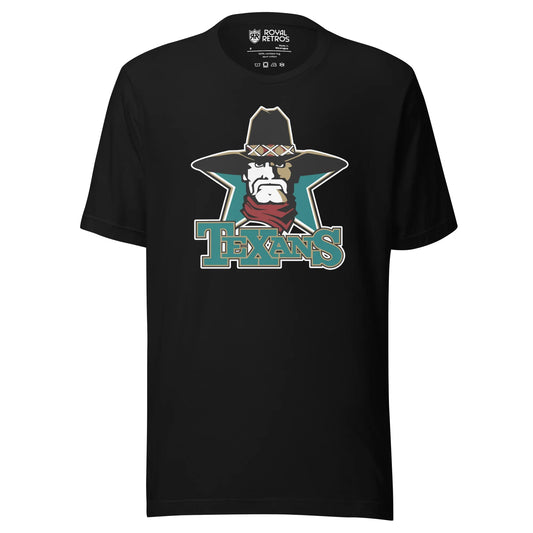
San Antonio Texans T-Shirt
Regular price $29.99 USDRegular priceUnit price per -
-
CUSTOM
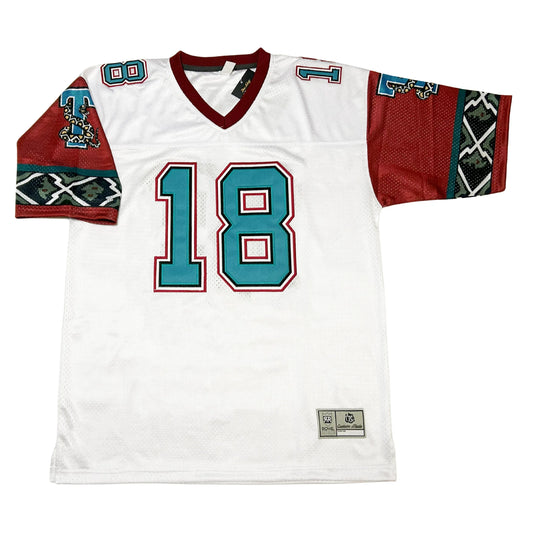
San Antonio Texans Jersey
Regular price Starting at $84.99 USDRegular priceUnit price per -
-
San Antonio Texans Mini Helmet
Regular price $54.99 USDRegular priceUnit price per





The San Antonio CFL Collection — Royal Retros San Antonio CFL Fan Shop
Heritage Tribute Gear From the Best Season the CFL's American Experiment Ever Produced. Custom Sizes S–5XL.
San Antonio's 1995 CFL club played one season of professional football — and it was, by a wide margin, the best season any of the CFL's American expansion clubs produced. Royal Retros carries the deepest throwback collection anywhere online for this one-year club, in the team's teal, gold, black, burgundy and white identity. Three products: a jersey, a five-colorway T-shirt and a mini helmet. The jersey is $84.99, tees are $29.99, and the mini helmet is $54.99. Sizes run Small through 5XL on the jersey and most tees. There is no current San Antonio CFL store to buy this from — this is heritage tribute apparel built for a club that made the playoffs, produced a league scoring champion, and still folded within months of its best season ever.
What You Can Shop in the San Antonio CFL Collection
San Antonio CFL Jersey — The San Antonio CFL jersey in teal or white, sewn twill lettering built to the team's on-field look from its lone 1995 season. Runs Small through 5XL. $84.99.
San Antonio CFL T-Shirt — The San Antonio CFL tee, offered in Black, Athletic Heather and White (S–5XL) and Maroon and Aqua (S–4XL). Soft pre-shrunk cotton, vintage graphics. $29.99.
San Antonio CFL Mini Helmet — A Riddell Speed mini helmet in the team's teal, gold and black scheme. $54.99. A shelf piece for anyone who remembers the Alamodome in 1995.
Sizes — Small through 5XL on the jersey and on Black, Athletic Heather and White tees; Maroon and Aqua run S–4XL. No big & tall upcharge on any style.
Shop by Colorway — Teal, Gold and Burgundy
Teal and White — The primary jersey colors, worn home and away across the club's one season. The jersey is built in both. This is the look from the Alamodome photos and the David Archer highlight reels.
Maroon, Black and Aqua — Everyday colorways for the tee that pull from the club's full teal, gold, black, burgundy and white identity without needing the full uniform look. Shop the San Antonio CFL tee for the full five-colorway lineup.
Why Royal Retros Is the Home of San Antonio CFL Gear
- The best season of the whole American experiment. 12–6, a playoff win, a division-final appearance — no other CFL American club came close to matching this club's 1995 season.
- Full wardrobe from a one-year club. A jersey, a five-colorway tee and a mini helmet — most short-lived CFL American expansion teams get a single generic design if they get anything at all.
- Flat, honest pricing. $84.99 for the jersey, $29.99 for tees, $54.99 for the mini helmet. No "rare team" markup.
- Sizes S–5XL on the jersey. True family sizing, no big & tall upcharge.
- Deep coverage of the CFL's American experiment. Cross-shop with the Sacramento Gold Miners, the franchise's own first two seasons, plus the Birmingham Barracudas and Baltimore Stallions — the five clubs that made up the CFL's mid-1990s push into the United States.
- Texas football roots. This collection sits inside our broader San Antonio collection and Texas collection, alongside the rest of the region's pro and historic sports apparel.
Quick Buying Questions
What sizes does the San Antonio CFL jersey come in?
Small through 5XL on the jersey itself. Tee sizing runs S–5XL in Black, Athletic Heather and White, and S–4XL in Maroon and Aqua.
Is San Antonio CFL gear officially licensed?
No. The club folded in early 1996 and no license currently covers this defunct CFL franchise. These are heritage tribute reproductions, built to look and fit like the real 1995 uniforms, not officially licensed merchandise.
How fast does it ship and what's the return policy?
Stock items ship within 3–5 business days, and standard items follow our return policy at /pages/returns.
Is this the same team as the Sacramento Gold Miners?
Yes — the exact same franchise, ownership and much of the same front office and roster. The club moved from Sacramento to Texas for the 1995 season and was renamed. Shop the Sacramento Gold Miners collection for that franchise's first two seasons.
Gift Ideas for the San Antonio CFL Fan
- For anyone who was at the Alamodome in 1995: The teal or white jersey is the exact look from the club's best and only season there.
- For the CFL completist: Pair this collection with the Sacramento Gold Miners to own the entire arc of one franchise across two markets.
- For the "best team that still didn't survive" collector: No CFL American club had a better season, and it still wasn't enough to save the league's U.S. experiment.
- For the Texas football fan who wants something different: A pro football club that actually called the city home for a season, not a repeat of the usual local gear.
- Year-round demand. One-season novelty franchises like this move steadily for birthdays, Father's Day and the start of football season.
About San Antonio's CFL Club
The San Antonio Texans were a professional football club that played a single Canadian Football League season, 1995, at the Alamodome — the relocated continuation of the Sacramento Gold Miners, brought to Texas by the same ownership group after two seasons in California. In their only year in San Antonio, the club went 12–6, finished second in the CFL's South Division, won a playoff game, and reached the South Division Final before the CFL's American expansion collapsed that winter. It remains, on the field, the single most successful season any of the league's American expansion clubs produced — and it still wasn't enough to keep the experiment alive. Three decades later, the club is remembered less as a footnote than as the proof of concept the CFL's American expansion never quite got to build on: a market, a stadium and a roster that all worked, arriving one season too late to matter to the league's finances.
Why Did the Gold Miners Move to San Antonio?
The franchise's move to Texas was a straight continuation of its Sacramento story, not a new expansion club. Owner Fred Anderson had been unable to secure an upgraded home stadium in California, and with attendance at Sacramento's Hornet Stadium already declining across 1993 and 1994, he relocated the franchise to San Antonio for 1995 — bringing head coach Kay Stephenson, quarterback David Archer and much of the roster with him. Shop the Sacramento Gold Miners collection for the fuller story of how that relocation came about.
The Alamodome — The Only CFL American Stadium Built to Fit the Real Game
San Antonio's club had a genuine structural advantage none of the CFL's other American cities could match: the Alamodome's playing surface was large enough to fit a true, regulation Canadian football field without compromise. It was wide enough for the CFL's full 65-yard field width, and its retractable end-zone seating could pull back far enough to accommodate the CFL's full 150-yard length, 20-yard end zones included. Every other American CFL venue — Legion Field, the Liberty Bowl, Independence Stadium, Memorial Stadium — hosted CFL football on a field that had to be shoehorned into a building designed for the American game. San Antonio's club played the real thing, on a field built to fit it.
David Archer and Kay Stephenson, Continued
The move to Texas didn't reset the franchise's football operation — it extended it. David Archer, who had thrown for over 6,000 yards in his 1993 Sacramento debut, continued as the starting quarterback, and Kay Stephenson stayed on as head coach. That continuity mattered: a team that had already spent two seasons learning the CFL's rules, tempo and roster demands didn't have to relearn them in a new city, and it shows in the season that followed — the best record any of the ownership group's three CFL seasons produced, in any market.
Roman Anderson's Record-Setting Season
Placekicker Roman Anderson, who had also kicked for the Sacramento Gold Miners in 1994, had the individual season of the entire CFL American expansion era in 1995: 235 points, the most scored by any CFL USA player that year, on his way to a postseason CFL All-Star selection. Across his two CFL seasons with the Sacramento and San Antonio clubs, Anderson made 95 of 120 field goal attempts — a 79.2 percent success rate that would have been strong in any era of professional football, American or Canadian.
The 4–5 Start and the Turnaround
San Antonio's 1995 season didn't start like the best year of the CFL's American experiment. The club opened 4–5, a pace that looked like every other struggling American club that year. Then it turned: San Antonio won eight of its final nine games to close the regular season, finishing 12–6 and second in the CFL's South Division behind the Baltimore Stallions. The offense finished with the second-highest scoring output in the entire league, led by Archer's arm and Anderson's foot.
Beating Birmingham 52-9 — the South Division Semi-Final
San Antonio's playoff run opened at home, in the Alamodome, on November 5, 1995: a 52–9 blowout of the Birmingham Barracudas in the South Division Semi-Final, in front of 13,031 fans. It was San Antonio's only home playoff game, its only playoff win, and by a wide margin the most lopsided postseason result the CFL's American expansion ever produced. For Birmingham, it was the last game the Barracudas ever played — their entire one-season competitive history closed out on the wrong side of a blowout, in a building built for a bigger game than either team's American expansion experiment ultimately became.
The South Final in Baltimore — The Last CFL Game Played on American Soil
San Antonio's season ended on the road on November 12, 1995, with a 21–11 loss to the Baltimore Stallions at Memorial Stadium in front of 30,217 fans, in the CFL's South Division Final. Baltimore went on to win the 83rd Grey Cup a week later, becoming the only American CFL franchise ever to claim the league's championship. The San Antonio–Baltimore South Final carries an unusual historical distinction beyond the scoreboard: it was the last Canadian Football League game ever played on American soil. No CFL franchise has played a game inside the United States since.
Why Did the CFL's American Experiment End Anyway?
San Antonio's season proved that a CFL American club could win, draw a real fan base and field a legitimately talented roster. It did not solve the economics that had already sunk four of the league's five U.S. franchises. By the CFL's meetings that winter, ownership across the league had lost confidence in the American expansion project as a whole — the Memphis Mad Dogs had already folded in late 1995, the Birmingham Barracudas and Shreveport Pirates franchises collapsed in early 1996, and with too few American partners left to sustain a South Division, San Antonio's ownership folded the club as well. Only Baltimore's championship franchise survived, relocating north to become the Montreal Alouettes for 1996. For the fuller story of why the CFL tried this five-city gamble and why it collapsed everywhere at once, see the Barracudas collection, which carries the league-wide history in depth.
Why Did San Antonio's Offense Take Off in the Second Half of 1995?
The 4–5 start wasn't a talent problem — it was a timing one. Roman Anderson's kicking game and David Archer's downfield passing both needed a handful of games to fully sync with a receiving corps that had turned over since the Sacramento seasons, and once that chemistry clicked, the club's offense became the second-most productive in the entire CFL. The eight-wins-in-nine closing stretch wasn't a fluke of easy scheduling either — it came against the same South Division gauntlet of American clubs that every other team in the division was also grinding through, which is part of why the 12–6 finish still stands as the high point of the CFL's whole American expansion era.
How Was CFL Football Different From the Game Texas Fans Already Knew?
Like every American CFL expansion club, San Antonio's team played on a 110-yard field with 20-yard end zones, fielded twelve players per side instead of eleven, and worked with only three downs instead of four — rules that rewarded exactly the kind of downfield passing attack that made Archer and the receiving corps so productive in 1995. The CFL also allowed a single point, the "rouge," for a missed kick that goes into the end zone and isn't returned out — a rule with no American equivalent that occasionally turned a close game on a single special-teams play. San Antonio's Alamodome was uniquely suited to all of it, since it was the only American CFL venue built wide and long enough to host the real field dimensions without compromise.
The Legacy of the Best Season the CFL's American Experiment Ever Had
No CFL franchise has played in Texas, or anywhere else in the United States, since San Antonio's 1995 season ended. That makes the club's 12–6 record, its playoff win over Birmingham, and its division-final trip to Baltimore the high-water mark of an experiment that otherwise produced far more losing seasons than winning ones. It is also, quietly, one of the stranger footnotes in North American pro sports: a team that did almost everything right on the field — winning, drawing real crowds, playing in a stadium built to fit the sport correctly — and still didn't survive the business collapse happening around it. Roman Anderson's league-leading scoring season and the club's 52–9 playoff win are still cited, decades later, whenever the CFL's American expansion comes up as a cautionary tale with one genuine bright spot buried inside it.
What Makes Ours Period-Correct
Construction and accuracy. Sewn-on tackle-twill numbers and lettering where the original build called for it, era-correct fonts and colors, and true-to-original construction — every San Antonio CFL design is checked against period references before it goes live.
More Frequently Asked Questions About San Antonio's CFL Club
Who was San Antonio's CFL club?
A professional football club that played a single Canadian Football League season, 1995, at the Alamodome in San Antonio, Texas — the relocated continuation of the Sacramento Gold Miners.
What was the club's record?
12–6, second in the CFL's South Division, after an 8–1 finish to close the regular season following a 4–5 start. The club won its South Division Semi-Final 52–9 over the Birmingham Barracudas before losing the South Final 21–11 to the Baltimore Stallions.
Who was the quarterback?
David Archer, a veteran passer who had spent most of his NFL career with the Atlanta Falcons and had already been the starting quarterback for the franchise's two Sacramento seasons before the move to Texas.
Was this really the last CFL game played in the United States?
The 1995 South Division Final, a 21–11 Baltimore win over San Antonio in front of 30,217 fans at Memorial Stadium, is recognized as the last Canadian Football League game ever played on American soil. No CFL franchise has played a game inside the United States since, and none has seriously attempted to.
Who was Roman Anderson?
The club's placekicker, who scored 235 points in 1995 — the most of any CFL USA player that season — and earned a postseason CFL All-Star selection. He had also kicked for the Sacramento Gold Miners in 1994.
Why did the club fold after such a good season?
The CFL's entire American expansion collapsed by early 1996 due to weak attendance and heavy financial losses across nearly every other U.S. club, even as San Antonio's own season was a genuine success. With too few American partners left to sustain a division, the league shut down its whole American operation, San Antonio included.
Who ran the front office in San Antonio?
General manager Dan Bass moved with the franchise from Sacramento, along with head coach Kay Stephenson — the same front-office continuity that helped the club find its footing quickly enough to close the 1995 regular season on an eight-game-in-nine run.
How many products does Royal Retros carry for this collection?
Three — a jersey, a five-colorway T-shirt and a mini helmet. It's the deepest collection dedicated to this club on the open web.
Did any other American cities have CFL teams besides San Antonio?
Yes — this club was one of five American CFL clubs in the mid-1990s, alongside Birmingham, Memphis, Shreveport and the league champion Baltimore Stallions. Only Baltimore's franchise survived the CFL's retreat back to Canada, relocating north to become the Montreal Alouettes.
Shop Related CFL American Expansion and Texas Collections
- Sacramento Gold Miners — This exact franchise's first two seasons, before relocating to Texas.
- Baltimore Stallions — The CFL's American flagship, 1995 Grey Cup champion, and the club that ended this one's season in the South Final.
- Birmingham Barracudas — The club this franchise beat 52–9 in the South Division Semi-Final.
- Shreveport CFL — A two-season CFL American club from the same South Division.
- International Football HQ — The full collection of CFL, WLAF and other international football apparel we carry.
- San Antonio Collection — San Antonio apparel across every sport we carry.
- Texas Collection — Texas apparel across every sport we carry.
- Custom Football Jerseys — The full football jersey catalog, S–5XL, free name and number on most.
San Antonio's CFL Club at Royal Retros — Heritage Tribute Gear From the Best Season the American Experiment Ever Produced. Sizes S–5XL. 1995, The One That Almost Worked.