




-
Memphis Mad Dogs Replica Jersey
Regular price $69.99 USDRegular priceUnit price per -
Memphis Mad Dogs T-Shirt
Regular price $29.99 USDRegular priceUnit price per -
-
Memphis Mad Dogs Unstructured Hat
Regular price $29.99 USDRegular priceUnit price per -
-
CUSTOM
Memphis Mad Dogs Custom Jersey
Regular price Starting at $84.99 USDRegular priceUnit price per -
-
Memphis Mad Dogs Mini Helmet
Regular price $54.99 USDRegular priceUnit price per



The Memphis Mad Dogs Collection — Royal Retros Memphis Mad Dogs Fan Shop
Heritage Tribute Gear From the CFL's One Wild Season in Memphis. Custom Names & Numbers. Sizes S–5XL.
The Memphis Mad Dogs played exactly one professional football season — 1995, the Canadian Football League's short-lived push into the United States — and Royal Retros carries the deepest Mad Dogs throwback collection anywhere online. Five products built around that single wide-open season: a custom jersey and a replica cut in the team's forest green, a T-shirt available in five colorways, an unstructured hat, and a mini helmet. The custom jersey is $84.99, the replica is $69.99, tees are $29.99, the hat is $29.99, and the mini helmet is $54.99. Sizes run Small through 5XL on the jerseys, with free custom name and number on the custom jersey. There is no current Memphis Mad Dogs store to buy this from — this is heritage tribute apparel built for a franchise that only ever existed for one Memphis fall.
What You Can Shop in the Memphis Mad Dogs Collection
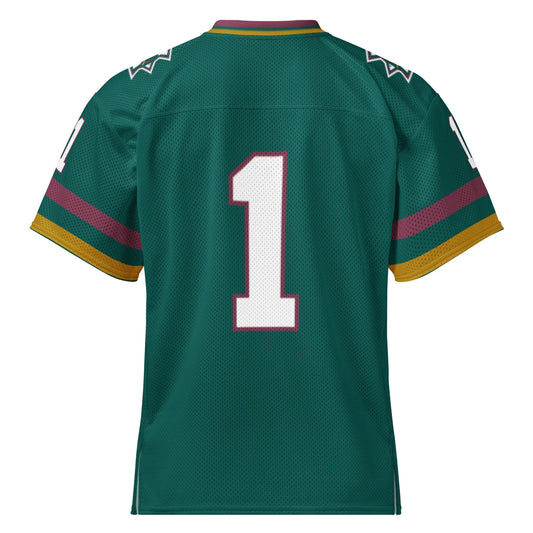
Memphis Mad Dogs Jerseys — The custom jersey in forest green, sewn twill lettering with full name-and-number customization, and the replica jersey for a truer game-worn look at a lower price point. Both run Small through 5XL. $84.99 for the custom build, $69.99 for the replica.
Memphis Mad Dogs T-Shirt — One tee design across five colorways: Maroon, Forest and Tan run Small–4XL, while Athletic Heather and White extend to 5XL. Soft pre-shrunk cotton, vintage Mad Dogs graphics. $29.99.
Memphis Mad Dogs Hat — The unstructured dad hat, adjustable one-size-fits-most, in Maroon or Forest Green. $29.99.
Memphis Mad Dogs Mini Helmet — A Riddell Speed mini helmet in the team's forest green, maroon and gold scheme. $54.99. A shelf piece for anyone who remembers the Liberty Bowl in 1995.
Customization — Free custom name and number is available on the custom jersey. Put a Mad Dogs original on the back or your own name and number. Custom items are made to order and final sale.
Sizes — Small through 5XL on both jerseys. Tee sizing varies by colorway: Maroon, Forest and Tan run S–4XL; Athletic Heather and White run S–5XL. No big & tall upcharge on any style.
Shop by Colorway — Forest Green, Maroon and Gold
Forest Green — The Mad Dogs' primary color and the only shade the jerseys come in. It is the color from the Liberty Bowl photos and the closest thing this franchise has to a signature look.
Maroon, Tan and Gold Accents — The Mad Dogs' full identity ran forest green, gold, maroon, black and white. The tee collection carries that range across five colorways, and the hat comes in Maroon or Forest Green — the two colors that show up most in period photography.
Why Royal Retros Is the Home of Memphis Mad Dogs Gear
- The only team that ever wore this uniform. One season, 1995, and nobody has worn a Mad Dogs jersey competitively since. There is no current club to buy from.
- Full wardrobe from a one-year franchise. Jersey, replica, a five-colorway tee, a hat and a mini helmet — most one-season CFL American expansion teams get a single generic design if they get anything at all.
- Flat, honest pricing. $84.99 for the custom jersey, $69.99 for the replica, $29.99 for tees and the hat, $54.99 for the mini helmet. No "rare team" markup.
- Free customization on the custom jersey. Add a name and number at no extra cost.
- Sizes S–5XL on jerseys. True family sizing, no big & tall upcharge.
- Deep coverage of the CFL's American experiment. Cross-shop the Mad Dogs with the Birmingham Barracudas, Baltimore Stallions, San Antonio CFL and Shreveport CFL — the five clubs that made up the CFL's 1995 push into the United States.
- Tennessee football roots. The Mad Dogs sit inside our broader Tennessee collection, alongside the rest of the state's pro and historic sports apparel.
Quick Buying Questions
What sizes do Memphis Mad Dogs jerseys come in?
Small through 5XL on both the custom and replica jerseys. The hat is adjustable one-size-fits-most, and tee sizing runs S–4XL in Maroon, Forest and Tan, S–5XL in Athletic Heather and White.
Can I add my name and number to a Mad Dogs jersey?
Yes — the custom jersey includes free name and number customization. Choose a Mad Dogs original or your own. Custom items are made to order and final sale.
Is Memphis Mad Dogs gear officially licensed?
No. The franchise folded in late 1995 and no license currently covers this one-season CFL club. These are heritage tribute reproductions, not officially licensed merchandise.
How fast does it ship and what's the return policy?
Stock items ship within 3–5 business days. Custom jerseys are made to order and typically ship within 7–10 business days. Custom items are final sale. Standard items follow our return policy at /pages/returns.
Gift Ideas for the Memphis Mad Dogs Fan
- For anyone who was at the Liberty Bowl in 1995: The jersey or replica in forest green is the exact look from that one fall.
- For the CFL completist: Pair the Mad Dogs with the Birmingham Barracudas or Baltimore Stallions for a set from the league's American expansion era.
- For the "team that only lasted one year" collector: Few pro franchises anywhere have a shorter competitive history than the Mad Dogs — one season, one story, done.
- For the Memphis football fan who wants something different: A pro team that actually called the city home for a season, not a repeat of the usual local gear.
- Year-round demand. One-season novelty franchises like this move steadily for birthdays, Father's Day and the start of football season.
About the Memphis Mad Dogs
The Memphis Mad Dogs were a professional football team that played a single season, 1995, in the Canadian Football League — part of a short, aggressive attempt by the CFL to expand into the United States. They played their home games at Liberty Bowl Memorial Stadium, finished fourth in the CFL's South Division at 9–9, and missed the playoffs by a tiebreaker margin before folding at the league's December 1995 meetings. In that one year, though, the Mad Dogs fielded a Hall of Fame quarterback having an off year, a future NFL Pro Bowl receiver as a rookie, and one of the more star-studded ownership groups in the entire CFL American expansion — and still could not make the business work. Three decades later, the Mad Dogs remain a niche but real piece of Memphis sports history — a team most casual fans have never heard of, and one that the people who were there tend to remember down to the mascot's name.
Why "Mad Dogs" and Not "Hound Dogs"? The Almost-Elvis Name
The franchise almost carried a very different, very Memphis name. Fred Smith originally planned to call an eventual NFL expansion team the Memphis Hound Dogs, an Elvis Presley nod built with the singer's estate involved in the ownership conversation, as part of Memphis' bid for one of the NFL's early-1990s expansion slots. When the NFL awarded those franchises to Carolina and Jacksonville instead, Smith pivoted the whole project to the CFL — and without the Presley estate's involvement in the new venture, "Hound Dogs" became "Mad Dogs," a harder-edged name built around a growling bulldog wordmark rather than a King-era pun. The team's mascot kept a lighter touch on the concept: a real black Labrador retriever named Alien served as the on-field mascot, charging out after kickoffs to retrieve the kicking tee, in a scene period photos and local newspaper coverage both remembered fondly even after the team folded.
Why Was There a CFL Team in Memphis? The American Expansion Gamble
Memphis was part of the same 1995 wave of CFL American expansion that produced the Birmingham Barracudas, joining a South Division built almost entirely of new U.S. clubs alongside San Antonio, Shreveport and the league's flagship Baltimore Stallions. The league's pitch to American ownership groups was the same one it made in every city that year: buy in cheap relative to NFL or MLB expansion prices, inherit a stadium and a football-hungry market, and get in early on a "new" pro sport before anyone else could claim it. The CFL itself was motivated by shrinking Canadian television revenue and several money-losing Canadian franchises, and it hoped expansion fees from five new American ownership groups would help stabilize the league at home even if the American clubs themselves struggled. For the full story of why the CFL tried this five-city gamble and why it collapsed everywhere at once, see the Barracudas collection, which carries the league-wide history in depth. What follows here is Memphis' own version of that same season.
The Mad Dogs' Uniform and Logo, in Detail
The Mad Dogs' primary mark was a yellow-and-black growling bulldog head wearing a spiked collar, flanked by a large "M" and "D" worked into the design — an aggressive, almost punk-rock take on a football logo compared to the more traditional crests worn by most of the league's Canadian clubs. The wordmark treatment carried "MEMPHIS" in white lettering set against a black collar band, with "MAD DOGS" lettered inside a green bone shape below it — a level of illustrative detail that was unusual even by mid-1990s pro-sports branding standards. On the field, that identity translated into jerseys built primarily in forest green, with gold, maroon, black and white used as supporting colors across trim, numbers and accent panels. It is a look that, like several of the CFL's other American expansion brands, reads today as distinctly of its era: bold, a little over-designed, and completely unlike anything a modern pro football team would put on a helmet.
Fred Smith and the FedEx-Backed Ownership Group
The Mad Dogs' ownership group included Fred Smith, the Memphis-based founder of FedEx and one of the most recognizable business figures in the city's history. His involvement gave the Memphis franchise a level of local credibility and access to capital that most of the CFL's other American expansion clubs simply did not have — this was not a speculative outsider swooping into a new market, but a hometown business leader putting his name behind a hometown team, and it followed years of Smith actively working to bring a permanent major professional football franchise to Memphis in one form or another. It did not matter. Even with that backing, the Mad Dogs lost an estimated $3 million to $6 million in their only season, a reminder that name recognition and access to money could slow the CFL American experiment's collapse in some cities, but never stop it. The lesson was the same one every other American CFL ownership group learned that year: a well-capitalized owner could absorb the losses longer, but could not manufacture demand for a sport the market had not asked for.
Pepper Rodgers: Back for Round Two in Memphis
Head coach Pepper Rodgers was already a familiar face to Memphis football fans before the Mad Dogs existed — he had previously coached the Memphis Showboats of the USFL in the 1980s, giving the city's pro football history a strange symmetry: two different failed leagues, one coach in common, a decade apart. Rodgers brought a career built around wide-open, pass-first offensive football, which fit the CFL's rules well on paper, and his hiring was seen locally as a sign that ownership was serious about building a competitive, well-coached product rather than treating the Mad Dogs as a novelty act. On the field in 1995, though, the results were mixed — a 9–9 record, a middle-of-the-pack offense, and a season that ended in disappointment rather than triumph despite talent at several key positions.
The Mad Dogs' First Season, Game by Game
Memphis opened its only season on June 29, 1995, on the road, losing 24-18 at the Calgary Stampeders — a competitive debut against an established Canadian club. The home opener followed on July 7 against the BC Lions and ended in a 31-13 loss, a rough welcome for the Liberty Bowl crowd that turned out for the franchise's first home date. The Mad Dogs found their footing soon after, including an 11-5 home win over the Saskatchewan Roughriders on July 14 that showed the defense could win a low-scoring, physical game even when the offense sputtered. That pattern — a stout defense (364 points allowed, middle of the pack) paired with the league's least productive offense (346 points scored) — defined the season, and it is the single biggest reason a team with a Hall of Fame-track quarterback and a future NFL Pro Bowl receiver still finished two games under a winning record.
Damon Allen's One Forgettable-by-His-Standards Season
The Mad Dogs' starting quarterback in 1995 was Damon Allen, who would go on to a 23-season CFL career, over 72,000 career passing yards, and induction into the Canadian Football Hall of Fame in 2012 and Canada's Sports Hall of Fame in 2018. Memphis, by his own standards, was one of his worst statistical years: 3,211 passing yards but only 11 touchdowns against 13 interceptions, a modest return for a passer who would finish his career as one of professional football's most productive quarterbacks ever, at any level. Allen left Memphis after the single season, signed with the BC Lions for 1996, and went on to play more than a decade further — proof that the Mad Dogs' one disappointing season said more about the team around him than about Allen himself.
Joe Horn's Rookie Season Before the NFL
Wide receiver Joe Horn caught 71 passes for 1,415 yards in 1995, by far the most productive season of any Mad Dogs skill player and one of the better receiving years anywhere in the CFL that season. Horn would go on to seven seasons with the New Orleans Saints, four Pro Bowl selections, and one of the most famous touchdown celebrations in NFL history — pulling a cell phone out from behind the goalpost padding in 2003 to call his mother — long after the Mad Dogs folded. He is, alongside Allen, one of two players on the 1995 Memphis roster whose careers meaningfully outlasted the team itself. For a franchise that existed for less than a full calendar year, producing one Hall of Fame-track passer and one future NFL Pro Bowl receiver in the same season is an unusually strong on-field legacy for such a short-lived club.
Liberty Bowl Memorial Stadium and the Complication Nobody Saw Coming
The Mad Dogs played at Liberty Bowl Memorial Stadium, a large multi-purpose stadium that gave the team plenty of room to grow into if the market had responded. It never got the chance. An NFL franchise — the Houston Oilers, which relocated out of Houston in 1997 and eventually became the Tennessee Titans — was working through its own relocation plans during this period, and Memphis was one of several Tennessee-area markets connected to that team's transition, with the Liberty Bowl discussed as a possible temporary home while a permanent stadium was built elsewhere in the state. That backdrop made it clear, even before the Mad Dogs' first season ended, that any long-term future for a second pro football tenant at the Liberty Bowl was going to be complicated at best.
Why Did Mad Dogs Attendance Collapse in the Fall?
Memphis ranked last among all thirteen CFL teams in attendance during the 1995 season, with several late-season home games drawing fewer than 10,000 fans and a season average that settled around 14,550 — respectable by minor-league standards, but nowhere near what a team playing in a stadium built for well over 60,000 needed to turn a profit. As in the CFL's other American markets that year, Memphis-area fans had a full autumn sports calendar already claimed by other football, and a brand-new Canadian-rules league fighting for a foothold in October and November found itself competing for attention it never fully won. Early-season crowds had been reasonable enough to give the ownership group hope, but the gap between a good CFL crowd and a stadium built to hold four to five times as many people became harder to ignore as the season wore on, and it showed up directly in the balance sheet by December.
The Business Collapse — Sold, Then Folded
By the end of the 1995 season, the financial picture was clear enough that ownership did not wait for a second year to find out if things would improve. The Memphis Mad Dogs folded outright at the CFL's meetings on November 30, 1995 — the first of the league's five American clubs to go, roughly a month before the Birmingham Barracudas' own sale and shutdown played out. With published loss estimates in the $3 million to $6 million range for a single season, there was no realistic path to a second year, even with FedEx-level backing behind the ownership group. League officials in Canada reportedly viewed Memphis' quick exit as an early warning sign for the rest of the American expansion, one that the remaining four clubs would confirm within weeks.
How Was CFL Football Different From the Game Memphis Fans Already Knew?
Like every American CFL expansion club, the Mad Dogs played on a 110-yard field with 20-yard end zones, fielded twelve players per side instead of eleven, and worked with only three downs instead of four — rules that rewarded exactly the kind of downfield passing attack Pepper Rodgers built his career on, at least in theory. The extra pressure of three downs is part of why passing volume ran high across the CFL's American clubs in 1995, even in a season, like Damon Allen's, that didn't produce great efficiency numbers. The CFL also allowed a single point, the "rouge," for a missed kick that goes into the end zone and isn't returned out — a rule with no American equivalent that occasionally turned a close game on a single special-teams play. For the full breakdown of how CFL rules differed from the American game, see the Barracudas collection, which covers the rules story in depth.
Memphis' Long History of Almost-Successful Pro Football
The Mad Dogs were not Memphis' only brush with a pro football league that didn't survive. Pepper Rodgers' earlier stop coaching the USFL's Memphis Showboats in the 1980s was itself part of a longer pattern — a football-hungry city that has repeatedly attracted ambitious new leagues without ever landing a permanent major franchise of its own. That pattern continued well after 1995 with other short-lived Memphis pro football ventures in the decades since. Royal Retros carries the full depth of that story across our Tennessee collection, where every one of the city's defunct pro football clubs gets its own callout and, where we carry the merchandise, its own dedicated collection. The throughline across all of them is the same one the Mad Dogs demonstrated in 1995: strong local ownership, real football interest, and still no path to a second season once the numbers came in.
What Happened After the Mad Dogs Folded?
The CFL's remaining American clubs did not last much longer. Within weeks of the Mad Dogs' collapse, the Barracudas were shut down too, San Antonio's ownership folded its own franchise, and only the Baltimore Stallions — the league's flagship American success story — survived, relocating north to become the Montreal Alouettes for 1996. No CFL franchise has played in Memphis, or anywhere else in the United States, since. Damon Allen and Joe Horn's post-Memphis careers are the clearest through-line the Mad Dogs left behind; the franchise itself never played another down. Even Alien the mascot's story ends with the team's: there is no public record of what became of him after the franchise folded, one more small loose thread in a season full of them.
Could Memphis Get Another Pro Football Team Someday?
Not likely in the CFL's case — the league's American expansion is now treated as a cautionary tale inside Canadian football rather than a blueprint to repeat, and no serious proposal to return a CFL franchise to Memphis or any other American city has surfaced in the decades since 1995. The Liberty Bowl itself has stayed busy with other football over the years, but a second full-time professional tenant on the level the Mad Dogs' ownership group envisioned has never returned. For collectors, that finality is part of the appeal: the Mad Dogs kit is not a "the team might come back" throwback — it is a closed chapter, frozen at exactly one season, that will not be reopened or reissued by a new ownership group down the road. Whatever pro football Memphis sees next, it will not wear forest green and gold under the Mad Dogs name.
What Makes Ours Period-Correct
Construction and accuracy. Sewn-on tackle-twill numbers and lettering where the original build called for it, era-correct fonts and colors, and true-to-original construction — every Memphis Mad Dogs design is checked against period references before it goes live.
More Frequently Asked Questions About the Memphis Mad Dogs
Who were the Memphis Mad Dogs?
A professional football team that played one season, 1995, in the Canadian Football League as part of the league's attempt to expand into the United States. They played at Liberty Bowl Memorial Stadium in Memphis, Tennessee and finished 9–9.
Why did the Memphis Mad Dogs only last one season?
Attendance ranked last in the CFL, with several late-season home games drawing fewer than 10,000 fans, and published losses of $3 million to $6 million made a second season financially unworkable even with a well-funded ownership group. The team folded at the CFL's December 1995 meetings, the first of the league's American clubs to go that off-season.
What was the Mad Dogs' record?
9–9, fourth place in the CFL's South Division, missing the playoffs.
Who was the Mad Dogs' quarterback?
Damon Allen, who went on to a 23-season CFL Hall of Fame career, started for Memphis in 1995. It was a down year by his standards: 3,211 yards, 11 touchdowns and 13 interceptions.
Was there an NFL connection to why the Mad Dogs left the Liberty Bowl available?
Yes, indirectly — the Houston Oilers, a franchise that relocated out of Houston in 1997 and eventually became the Tennessee Titans, were connected to Tennessee-area relocation plans during this same period, which was one more sign that a long-term future for a second pro football tenant at the Liberty Bowl was unlikely.
Is Memphis Mad Dogs gear officially licensed?
No. The franchise folded in 1995 and no license currently covers this one-season CFL club. These are heritage tribute reproductions, not officially licensed merchandise.
How many Memphis Mad Dogs products does Royal Retros carry?
Five — a custom jersey, a replica jersey, a T-shirt in five colorways, an unstructured hat and a mini helmet. It's the deepest Mad Dogs-specific collection on the open web.
Did any other American cities have CFL teams besides Memphis?
Yes — Memphis was one of five American CFL clubs in 1995, alongside Birmingham, San Antonio, Shreveport and the league champion Baltimore Stallions. Only Baltimore's franchise survived the CFL's retreat back to Canada, relocating north to become the Montreal Alouettes.
What was the Mad Dogs' original planned name?
Memphis Hound Dogs — an Elvis Presley-themed name Fred Smith originally planned for an NFL expansion bid. When the NFL passed Memphis over for Carolina and Jacksonville and the project moved to the CFL instead, the name changed to Mad Dogs.
Did the Mad Dogs have a mascot?
Yes — a real black Labrador retriever named Alien, who ran onto the field after kickoffs to retrieve the kicking tee. He was a genuine fan favorite during the team's one season.
What did the Memphis Mad Dogs logo look like?
A growling yellow-and-black bulldog head in a spiked collar, flanked by an "M" and "D," with "MEMPHIS" lettered across a black collar band and "MAD DOGS" set inside a green bone shape. It's one of the more distinctive designs to come out of the CFL's entire American expansion era.
What happened to Damon Allen and Joe Horn after the Mad Dogs folded?
Damon Allen signed with the BC Lions for 1996 and played more than a decade further, retiring in 2007 as professional football's all-time leading passer by yardage at the time and entering the Canadian Football Hall of Fame in 2012. Joe Horn eventually reached the NFL, spending seven seasons with the New Orleans Saints and earning four Pro Bowl selections.
Was Memphis' CFL team connected to the city's other defunct pro football teams?
Only loosely, through coach Pepper Rodgers, who had previously led the USFL's Memphis Showboats before taking the Mad Dogs job a decade later. Otherwise each Memphis pro football venture — USFL, CFL and the ones that came after — operated under separate ownership, in a separate league, in a separate era. Shop the full Tennessee collection to browse every Memphis-area throwback franchise we carry.
Shop Related CFL American Expansion and Tennessee Collections
- Baltimore Stallions — The CFL's American flagship and 1995 Grey Cup champion, before relocating north to become the Montreal Alouettes.
- Birmingham Barracudas — Memphis' South Division rival, another one-season 1995 CFL American club.
- San Antonio CFL — The market that outlasted Memphis by one round of CFL ownership meetings before folding itself.
- Shreveport CFL — The only American club with a losing record in both of its CFL seasons.
- International Football HQ — The full collection of CFL, WLAF and other international football apparel we carry.
- Tennessee Collection — Memphis and Tennessee apparel across every sport we carry.
- Custom Football Jerseys — The full football jersey catalog, S–5XL, free name and number on most.
The Memphis Mad Dogs at Royal Retros — Heritage Tribute Gear From the CFL's One Wild Memphis Season. Custom Names & Numbers. Sizes S–5XL. 1995, Once and Never Again.