




-
1980's Portland Beavers T-Shirt
Regular price $29.99 USDRegular priceUnit price per -
-
NEW
Portland Beavers Long Sleeve T-Shirt
Regular price $34.99 USDRegular priceUnit price per -
-
CUSTOM
2009 Portland Beavers Jersey
Regular price Starting at $84.99 USDRegular priceUnit price per -
-
CUSTOM
1981 Portland Beavers Jersey
Regular price Starting at $84.99 USDRegular priceUnit price per -
-
CUSTOM
1968 Portland Beavers Jersey
Regular price Starting at $84.99 USDRegular priceUnit price per -
-
CUSTOM
1979 Portland Beavers Jersey
Regular price Starting at $84.99 USDRegular priceUnit price per -
-
CUSTOM
1961 Portland Beavers Jersey
Regular price Starting at $84.99 USDRegular priceUnit price per -
-
CUSTOM
1950 Portland Beavers Jersey
Regular price Starting at $84.99 USDRegular priceUnit price per -
-
Portland Beavers Black/White Snapback
Regular price From $33.12 USDRegular priceUnit price per -
-
Portland Beavers T-Shirt
Regular price $29.99 USDRegular priceUnit price per -
-
Portland Beavers Unstructured Hat
Regular price $29.99 USDRegular priceUnit price per -
-
CUSTOM
1956 Portland Beavers Jersey
Regular price Starting at $84.99 USDRegular priceUnit price per -


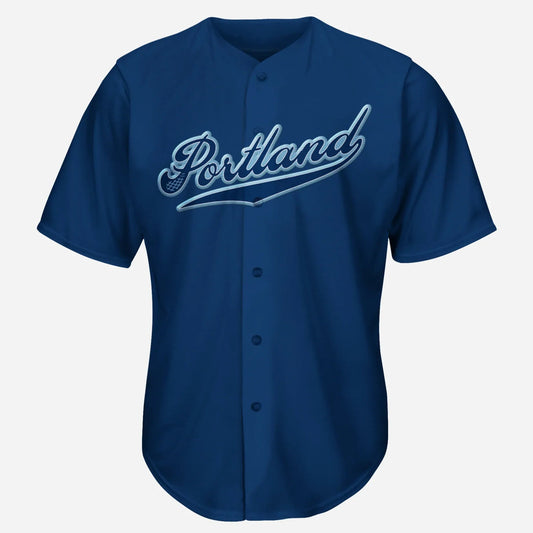


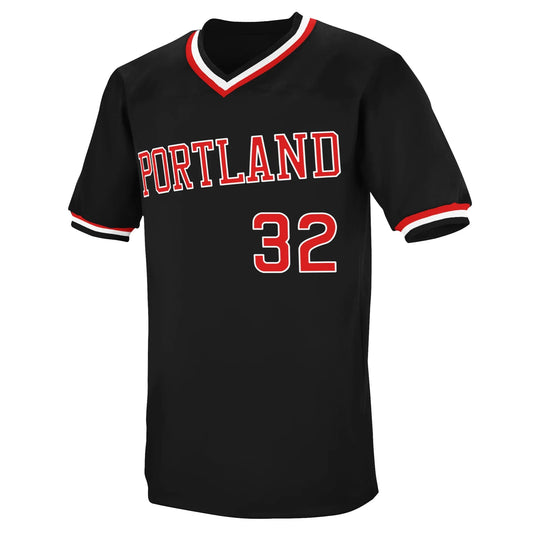


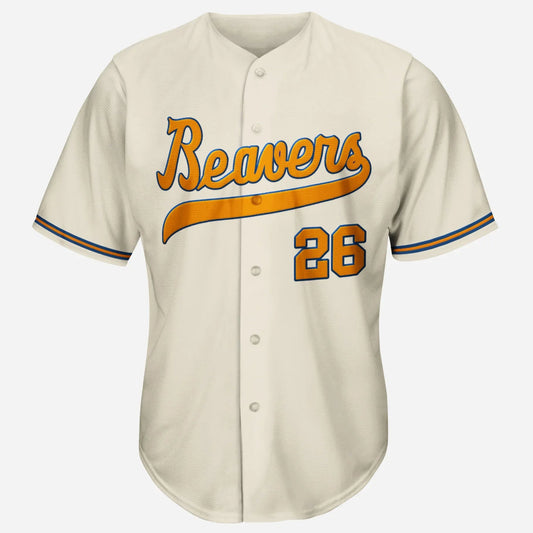










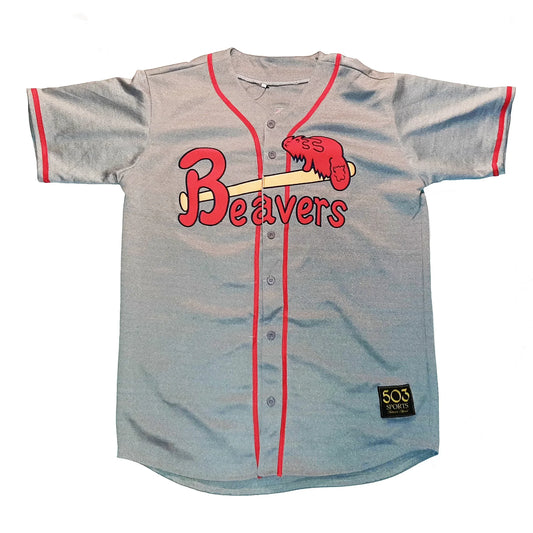


The Portland Beavers Collection — Royal Retros Portland Beavers Fan Shop
Authentic Portland Beavers PCL Throwbacks. Custom Names & Numbers. Sizes S–5XL. Seven Eras, 1950 Through 2009.
Royal Retros carries the deepest Portland Beavers throwback collection on the open web — 11 products built around seven year-specific Pacific Coast League jerseys spanning six decades of Portland baseball: 1950, 1956, 1961, 1968, 1979, 1981 and 2009. No other vintage retailer carries the Beavers era by era. Every jersey is $84.99. Hats run $29.99–$34.99, tees $29.99. Free custom name and number on most jerseys. Sizes Small through 5XL, with no big & tall upcharge. Whether you grew up at Vaughn Street, sat through the Civic Stadium years, or watched the last out at PGE Park in September 2010, there is a Beavers jersey here from the era you remember.
What You Can Shop in the Portland Beavers Collection
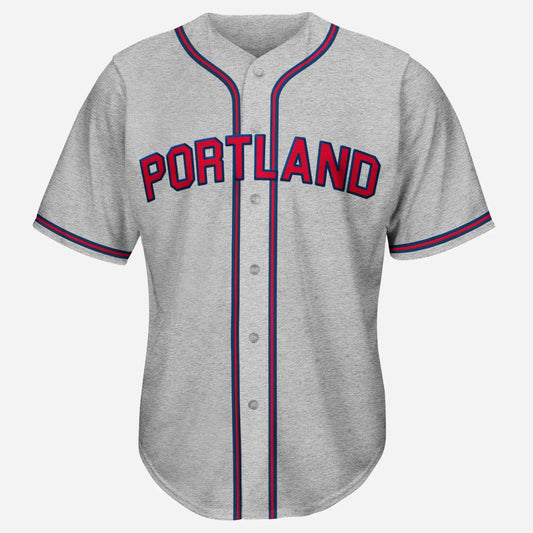
Portland Beavers Jerseys — Seven year-specific throwbacks, each cut and lettered to its own era: the 1950 and 1956 flannels from the tail end of the Vaughn Street years and the move into Multnomah Stadium, the 1961 and 1968 button-fronts from the Civic Stadium affiliate era, the 1979 and 1981 pullovers from the franchise's second life, and the 2009 jersey from the final Triple-A chapter downtown. Sewn twill lettering, period-correct fonts and color, home and road styling by year. Free custom name and number on most styles. $84.99.
Portland Beavers Hats — The unstructured dad hat ($29.99) with the classic Portland "P," and the black and white five-panel snapback ($33.12–$34.99) for a cleaner modern look. One-size-fits-most adjustable backs.
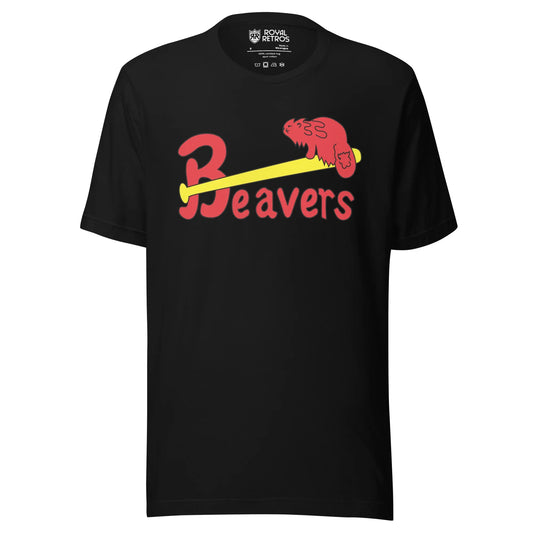
Portland Beavers T-Shirts — The classic Beavers tee and the 1980's Portland Beavers tee, both soft pre-shrunk cotton with vintage PCL logo work. $29.99, sizes S–5XL.
Customization — Free custom name and number on most jerseys. Put a Beavers original on the back — Luis Marquez, Frank Austin, Eddie Basinski, Joe Brovia, Lou Piniella — or your own name and number. Custom items are made to order and final sale.
Sizes — Small through 5XL on virtually every product. No big & tall upcharge.
Shop the Beavers by Era — What Each Jersey Year Means
1950 — The Last Vaughn Street Decade. The 1950 Beavers played in the wooden ballpark at NW 24th and Vaughn that had housed Portland baseball since 1901, in the era when the Pacific Coast League was baseball's unofficial third major league and the West Coast had no big-league team of its own. The 1950 flannel is the jersey of that world: long PCL seasons, all-night train rides down the coast, and a Portland roster one season removed from becoming the third PCL club to integrate. Shop the 1950 jersey.
1956 — The Move to Multnomah Stadium. In 1956 the Beavers left aging Vaughn Street Park for Multnomah Stadium, a 28,870-seat football venue renovated to take baseball — later renamed Civic Stadium in 1967 and PGE Park in 2000. It was also two years after 2,400 Portlanders bought public stock subscriptions in their own ball club, one of the great community-ownership stories in minor league baseball. The 1956 jersey marks the year the Beavers changed addresses. Shop the 1956 jersey.
1961 — The Satchel Paige Season. The 1961 Beavers, affiliated that year with the St. Louis Cardinals, signed 55-year-old Satchel Paige — already a legend, already past his MLB career — and put him on the mound for roughly 25 innings across five appearances. It remains the most improbable line in the franchise's record book, and 1961 is the jersey collectors ask for by year. Shop the 1961 jersey.
1968 — The Cleveland Years at Civic. The 1960s Beavers were a proving ground. A Cleveland-fed pipeline produced a young Luis Tiant, who went 28-8 across two Portland seasons including a 15-1, 2.04 ERA year in 1964, and the 1966–68 clubs featured a young Lou Piniella, who hit .303 with 38 home runs over three Portland seasons before an 18-year major league career and a long run as a big-league manager. The 1968 jersey is the Civic Stadium look at its cleanest. Shop the 1968 jersey.
1979 — The Comeback Season. Portland went five years without Triple-A baseball. From 1973 through 1977 the only pro ball in town belonged to the independent Portland Mavericks. The PCL brought the Beavers back as an expansion club in 1978, and in 1979 new owner Dave Hersh tied the team to the Pittsburgh Pirates and filled Civic Stadium with giveaways, promotions and a pullover-era look that is pure late-'70s minor league baseball. Shop the 1979 jersey.
1981 — Tiant Comes Home. Luis Tiant, seventeen years after his Portland breakout and after a full major league career with Cleveland, Boston and New York, pulled a Beavers uniform back on in 1981. That circle-closing season is why the 1981 jersey carries more weight than its record does. Shop the 1981 jersey. Pair it with the 1980's Beavers tee for the full Civic Stadium decade — the 1982 renovation year drew more than 272,000 fans, and the 1983 club won the pennant.
2009 — The Last Chapter Downtown. The final Portland Beavers ran from 2001 to 2010 as the Triple-A affiliate of the San Diego Padres, playing downtown at the ballpark by then called PGE Park. The 2009 jersey is the modern Beavers look — the one most fans under 40 actually watched — one season before the club played its last home game and the stadium was converted for Major League Soccer. Shop the 2009 jersey.
Why Royal Retros Is the Home of Portland Beavers Throwback Gear
- Seven distinct eras, not one generic logo tee. 1950, 1956, 1961, 1968, 1979, 1981 and 2009 — each jersey built to the year it represents. Most retailers carry a single "vintage Portland" design, if any.
- Period-correct construction. Era-appropriate fonts, colors, plackets and lettering, referenced against photographic source material for each season.
- Flat, honest pricing. Every Beavers jersey is $84.99. Hats $29.99–$34.99. Tees $29.99. No era surcharge and no "collector's" markup.
- Free customization on most jerseys. Add a name and number at no extra cost on eligible items.
- Sizes S–5XL. True family sizing, no big & tall upcharge.
- Deep Pacific Coast League coverage. Cross-shop the Beavers with the San Francisco Seals, Hawaii Islanders, Sacramento Solons, PCL Padres and the broader West Coast Minors collection.
- Oregon roots. The Beavers sit alongside the Portland Mavericks in our Oregon collection — the two halves of Portland's pro baseball story.
Quick Buying Questions
What sizes do Portland Beavers jerseys come in?
Small through 5XL on every jersey style. Hats are adjustable one-size-fits-most. We don't upcharge for big & tall sizes.
Can I add my name and number to a Beavers jersey?
Yes — most styles include free custom name and number. Choose a Beavers original or your own. Look for the "Custom" option on the product page. Custom items are final sale.
Which Beavers jersey year should I pick?
If you remember Vaughn Street or the early Multnomah Stadium years, go 1950 or 1956. If you want the Satchel Paige season, 1961. For the Civic Stadium affiliate era and the Tiant–Piniella pipeline, 1968. For the franchise's second life and the Tiant homecoming, 1979 or 1981. If you watched Triple-A ball downtown before 2010, the 2009 jersey is your era.
What are the jerseys made from?
Heavyweight twill on the replica builds with sewn-on lettering and numbers, era-correct flannel styling on the earliest years, pre-shrunk cotton on tees. Construction follows the source year rather than a single house pattern.
How fast does it ship and what's the return policy?
Stock items ship within 3–5 business days. Custom jerseys are sewn to order and typically ship within 7–10 business days. Custom items are final sale. Standard items follow our return policy at /pages/returns.
Gift Ideas for the Portland Beavers Fan
- For the lifelong Portlander: Match the jersey to the ballpark they grew up in — 1950 or 1956 for Vaughn Street and early Multnomah, 1968 or 1979 for Civic, 2009 for PGE Park.
- For the PCL historian: Portland played in the Pacific Coast League's very first season in 1903 and was the only original city still in the league for its 2003 centennial. That is a jersey with a real claim behind it.
- For the Satchel Paige collector: The 1961 Beavers put a 55-year-old Paige on a PCL mound. Few franchises can offer a jersey with that story attached.
- For the Timbers fan with a long memory: The ballpark downtown became a soccer stadium because the Beavers left it. The 2009 jersey is the last full season of that other life.
- For the minor league completist: Seven eras of one franchise is a collection in itself, not a single souvenir.
- Year-round demand. Beavers nostalgia isn't seasonal — Father's Day, birthdays and the Opening Day itch all work.
About the Portland Beavers
The Portland Beavers were Portland, Oregon's professional baseball franchise for more than a century — five separate incarnations of the club, six minor league classifications, two ballparks and 104 years between the first pitch and the last. Portland was in the Pacific Coast League for its founding 1903 season, then playing as the Browns, and when the PCL celebrated its centennial in 2003, Portland was the only city that had been there at the start. No other franchise in the league could say that.
Across that century the Beavers won eight Pacific Coast League pennants — 1906, 1910, 1911, 1913, 1914, 1932, 1936 and 1983 — plus a first-place finish in 1945 and a division title in 1965. Six Baseball Hall of Famers wore a Portland uniform. An Olympic gold medalist played 35 games in the outfield. A 55-year-old Satchel Paige pitched for them. The team integrated before most of professional baseball, and its most famous manager publicly attacked the color line thirty years before Jackie Robinson. For a minor league club in a mid-sized western city, the Beavers accumulated an extraordinary amount of history.
Before the Beavers — Webfoots, Browns and Giants (1901–1906)
Professional baseball in Portland predates the Beavers name by five years. The ballpark at NW 24th and Vaughn hosted its first professional game on May 22, 1901, when the local club was known as the Webfoots and played in the Pacific Northwest League. In 1903 the Portland franchise left the Northwest League for the upstart Pacific Coast League, renaming itself the Browns and taking part in the PCL's very first season — a founding membership that would still be a selling point a hundred years later.
The club cycled through identities in those early years, playing as the Giants before the ownership change that produced the name that stuck. In 1906, Walter H. McCredie and his uncle, Judge William Walter McCredie, bought the Portland Giants and renamed the team through a newspaper naming contest. "Beavers" was the winning entry — a nod to Oregon's state animal and to the fur trade that built the region's early economy. The new Beavers won the Pacific Coast League pennant in their first season under the name.
The McCredie Dynasty (1906–1921) — Five Pennants in Nine Years
The McCredies are the founding figures of Portland baseball. Judge W.W. McCredie, a lawyer, congressman and judge, provided the capital and the front-office authority. His nephew Walter McCredie ran the ball club on the field, managing Portland from 1905 to 1917 and again from 1919 to 1921 — one of the longest managerial tenures in Pacific Coast League history.
Under Walter McCredie the Beavers won PCL pennants in 1906, 1910, 1911, 1913 and 1914 — five flags in nine seasons, including four in five years starting in 1910. The 1914 club went 113-84 and represented the high-water mark of the McCredie era; the following year the Los Angeles Times called him "a major league manager in every sense of the word." He never had another winning season as a manager after that peak, which is its own kind of story: the entire dynasty was compressed into a single decade, and the man who built it spent the rest of his career in its shadow.
The McCredies also built the ballpark that housed it. Ahead of the 1912 season they opened a refurbished Vaughn Street Park with a capacity of roughly 12,000 — reportedly the finest minor league facility of its time, notable for individual theater-style seats in the grandstand rather than the bench seating standard everywhere else. The same year, the Pacific Coast League was promoted from Class A to Double-A. From 1910 to 1915 the Beavers ran a working agreement with the Cleveland Indians, an arrangement resembling the modern major-minor affiliation decades before affiliation was formalized. The 1915 Portland roster included future Hall of Fame pitcher Stan Coveleski.
"I Don't Think the Color of the Skin Ought to Be a Barrier in Baseball"
The most remarkable chapter in Portland Beavers history has nothing to do with a pennant. After the 1914 season, Walter McCredie signed Lang Akana — born in Hawaii in 1889 to a Chinese father and a Hawaiian mother — to play for the Beavers. Word got out. According to reporting in The Oregonian at the time, Pacific Coast League players said they would boycott games if Akana took the field for Portland, and PCL officials joined McCredie's own players in blocking the signing. Akana never played a game as a Beaver.
McCredie's response was to say the quiet part out loud, in public, in 1915: "I don't think the color of the skin ought to be a barrier in baseball." That is more than three decades before Jackie Robinson signed with Brooklyn, and it came from a manager who had already spent years testing organized baseball's unwritten exclusion rules. He finally met Akana in person two years later, when he brought the Beavers to Honolulu for spring training.
The episode sits at the front of a longer Portland thread. When the Beavers signed shortstop Frank Austin and outfielder Luis Marquez in 1949, they became the third Pacific Coast League club to integrate and the first in the league to sign Latino players — a full generation after their most famous manager had been overruled for trying.
Vaughn Street Park — Portland's First Great Ballpark (1901–1955)
Vaughn Street Park, at NW 24th and Vaughn in Northwest Portland, opened with a single 3,000-seat grandstand behind home plate. Seating expanded to 6,000 in 1905, and the 1912 rebuild pushed capacity to roughly 12,000. It was a wooden, tight-cornered, unmistakably early-century ballpark, and it housed the best baseball the city ever saw.
Everything that mattered in the franchise's first half-century happened there: the McCredie pennant run, the 1924 arrival of the Shibe family, the 1930s pennants, Jim Thorpe in the outfield, the postwar clubs of Eddie Basinski and Joe Brovia, and the 1949 integration of the roster. Two men gave the place its continuity — head groundskeeper Rocky Benevento and radio broadcaster Rollie Truitt, both of whom started with the organization in the late 1920s and stayed into the 1960s, spanning four decades, five owners and two ballparks. When the Beavers moved out after the 1955 season, they left 55 years of Portland baseball on that corner.
The Shibe Era and the Philadelphia Connection (1924–1930)
In 1924 the Beavers were bought by John Shibe and Tom Shibe — owners of the Philadelphia Athletics — who purchased both the ball club and Vaughn Street Park outright and affiliated Portland with the A's. It gave the Beavers a direct line into one of the strongest organizations in the American League during Connie Mack's second great run. The 1924 Portland roster included future Hall of Fame catcher Mickey Cochrane, who would go on to two MVP awards and a career that defined the position in his era.
The Shibe ownership also brought the two men who became the franchise's institutional memory. Rocky Benevento took over as head groundskeeper in the late 1920s and Rollie Truitt began calling Beavers games on the radio in the same period. Both stayed with the club until the 1960s.
Jim Thorpe in a Beavers Uniform (1922)
Walter Klepper purchased the Beavers in 1921, and in 1922 he signed Jim Thorpe — Olympic gold medalist in the pentathlon and decathlon, professional football pioneer, and by most accounts the most versatile athlete in American sports history. Thorpe played 35 games in the Portland outfield that season. He was past his baseball prime and near the end of his playing career, but for 35 games the Portland Beavers had the greatest all-around athlete of the twentieth century in their lineup.
The 1930s and 1940s — New Owners, Two More Pennants
Ownership turned over repeatedly through the Depression. Tom Turner bought the team in 1931; the Beavers won the PCL pennant in 1932. E.J. Schefter purchased the club after the 1934 season, and Portland took another pennant in 1936. Attendance rose and fell with the economy through the decade — the PCL was expensive to travel and Portland was its northern anchor.
William Klepper bought the Beavers again in 1942, and he was the owner when the club finished first in 1945. The war years reshaped rosters across the league, and the immediate postwar period produced some of the most-loved Portland teams: infielder Eddie Basinski arrived in 1947 and stayed through 1956, hitting .258 with 89 home runs across a Portland career that spanned both ballparks, and outfielder Joe Brovia became one of the signature Pacific Coast League sluggers of the era. These are the teams the 1950 jersey represents.
1954 — When 2,400 Portlanders Owned the Ball Club
In 1954 the Beavers sold shares in the franchise through public stock subscriptions, and 2,400 members of the community bought in. It is one of the genuinely unusual ownership stories in minor league baseball — a fan-owned Triple-A club decades before community ownership became a talking point in American sports. Two years later, that community-owned team moved into a new home.
Multnomah Stadium, Civic Stadium, PGE Park — One Building, Three Names
The Beavers' second home has had almost as many names as the franchise has had lives. Multnomah Stadium, a 28,870-seat football venue, was renovated for baseball ahead of the 1956 season. It was renamed Civic Stadium in 1967, then PGE Park in 2000, and it stayed the center of Portland professional baseball for the better part of five decades. Seating capacity for baseball varied considerably over the years as the configuration changed.
The building hosted the 1961 Satchel Paige appearances, the mid-1960s Cleveland pipeline, the 1965 division title, the entire second Beavers era from 1978 onward, and the final Triple-A decade from 2001 to 2010. A public-money renovation ahead of the 1982 season paid off immediately — the Beavers drew more than 272,000 fans that year, and the 1983 club won the pennant. Its baseball life ended after 2010, when the city began converting it for Major League Soccer.
The Affiliate Era — Paige, Tiant and Piniella (1957–1972)
The Brooklyn Dodgers and New York Giants moved west in 1957, taking Los Angeles and San Francisco out of the Pacific Coast League and permanently changing what the PCL was. The league had operated as something close to a third major league, with its own star system and fans who followed PCL clubs instead of distant East Coast teams. After 1957 it became a development circuit, and attendance across the minors fell through the 1960s. PCL clubs formally attached themselves to major league organizations for financial stability.
Portland's affiliations moved around, and each one left a mark. As a St. Louis Cardinals affiliate in 1961, the Beavers signed 55-year-old Satchel Paige — Hall of Famer, Negro Leagues legend, the most famous pitcher of his generation — and pitched him roughly 25 innings across five appearances. As a Cleveland affiliate in the mid-1960s, Portland got a young Luis Tiant, who posted a 28-8 record across two Beavers seasons including a 15-1, 2.04 ERA campaign in 1964; the 1964 club finished a single game out of first in the West Division. The 1966–68 Beavers featured Lou Piniella, who hit .303 with 38 home runs over three Portland seasons before an 18-year major league playing career, a Rookie of the Year award, and a long second career managing in the big leagues. The Beavers won the division in 1965.
The club played in Portland through 1972 and then left. That is the era the 1961 and 1968 jerseys come from.
The Gap Years and the Mavericks (1973–1977)
When the Beavers left after the 1972 season, Portland didn't go dark — it got stranger, and for five years arguably better. The independent Portland Mavericks, a Class A Northwest League club owned by actor Bing Russell, took over Civic Stadium with open tryouts, unaffiliated castoffs and a total disregard for how minor league baseball was supposed to be run. They drew crowds that embarrassed affiliated clubs several classifications above them.
The Mavericks are the other half of Portland's baseball identity: the Beavers are the century-long institution, the Mavericks the five-year folk legend that filled the hole the Beavers left. Collectors almost always end up wanting both.
The Second Beavers — Return, Pennant, and Departure (1978–1993)
The Pacific Coast League restored Portland as an expansion franchise in 1978. The new Beavers went back to Civic Stadium, back to a Cleveland affiliation, and to a new owner in Leo Ornest. Dave Hersh bought the club in 1979, switched the affiliation to the Pittsburgh Pirates, and ran the operation on promotions, giveaways and entertainment — the late-1970s minor league playbook at full volume. Local businessmen Ron Tonkin and Doug Goodman became major stockholders after the 1979 season, and the city put public money into a Civic Stadium renovation in 1982 that helped push attendance past 272,000.
The Beavers switched to a Philadelphia Phillies affiliation in 1983 and won the pennant that same year — the franchise's eighth and last. Then came the episode Portland fans still bring up: in 1985, new owner Joe Buzas tried to rename the team the Portland Phillies. The public reaction was strong enough that the plan collapsed and the Beavers name survived. Buzas moved the franchise to Utah in 1993 anyway, where it became the Salt Lake City Bees.
Portland wasn't empty for long. The Single-A Bend Rockies relocated to Portland in 1995 and played six seasons at Civic Stadium before Triple-A returned. The 1979 and 1981 jerseys belong to this second life of the franchise.
2001–2010 — Triple-A Downtown, and the Last Out
The final Portland Beavers arrived in 2001, when the Albuquerque Dukes relocated north as the Triple-A affiliate of the San Diego Padres and took the old name back. For ten seasons they played downtown at PGE Park — the same building that had been Multnomah and Civic Stadium — with a light-rail stop at the gate, one of the most genuinely urban ballpark experiences in professional baseball.
The end came from outside the sport. Portland won a Major League Soccer expansion bid, the stadium was slated for conversion, and every proposal for a new Beavers ballpark fell through. The Beavers won their season finale 6–5 over the Las Vegas 51s on September 6, 2010 — the last Portland Beavers home game ever played. Owner Merritt Paulson sold the club to San Diego Padres ownership later that year, and the franchise moved to Tucson, Arizona for 2011. It was sold again in 2014 and became the El Paso Chihuahuas. That franchise still plays in the Pacific Coast League today.
That ending is why the 2009 jersey hits differently than an ordinary throwback. It isn't nostalgia for a distant era — it's the last one, and most of the people who watched it still live in the city.
The Hall of Famers Who Wore Portland
Six players who spent time with the Portland Beavers were later inducted into the National Baseball Hall of Fame:
- Satchel Paige — Negro Leagues legend and the most famous pitcher of his era, who pitched for the Beavers in 1961 at age 55.
- Mickey Cochrane — one of the greatest catchers in baseball history, on the 1924 Portland roster during the Shibe ownership.
- Stan Coveleski — spitball-era ace, with the Beavers in 1915 during the Cleveland working agreement.
- Dave Bancroft — Deadball-era shortstop and later a manager, out of the McCredie-era pipeline.
- Harry Heilmann — four-time American League batting champion.
- Heinie Manush — .330 lifetime hitter across a seventeen-year major league career.
Add Jim Thorpe's 35 games in 1922, Luis Tiant's 28-8 breakout, and Lou Piniella's three .300-ish seasons, and the Portland roster history holds up against any minor league franchise in the country.
Where the Beavers Rank in Pacific Coast League History
The Pacific Coast League is the most storied minor league in American baseball, and for the first half of the twentieth century it functioned as something close to a third major league — long seasons, high salaries, players who spent entire careers on the West Coast rather than chasing an East Coast call-up. Portland was a founding member in 1903 and, in 2003, the only original city still in the league at its centennial.
Eight pennants puts the Beavers solidly in the league's upper tier, behind the perennial powers but ahead of most. What sets Portland apart is longevity and continuity of identity: five incarnations of the club, two world wars, a Depression, two ballparks, a five-year disappearance, a relocation to Utah, a return, and a final decade downtown — all under one name that a newspaper contest picked in 1906. Compare that against PCL contemporaries like the San Francisco Seals, the Sacramento Solons, the PCL Padres and the later Hawaii Islanders, and the Portland story is the longest continuous thread in the league.
Portland Baseball After the Beavers
Portland has been without affiliated professional baseball since 2010 — the largest American metropolitan area in that position for much of the time since. Summer collegiate and independent baseball have filled part of the gap, and organized efforts to bring a Major League Baseball expansion or relocation club to Portland have surfaced repeatedly, with stadium sites proposed and abandoned more than once.
That vacuum is exactly why Beavers gear moves the way it does. There is no current team to buy a jersey from. For a Portland baseball fan, the throwback is the jersey — and the collection covers every era anyone still remembers.
What Makes Ours Period-Correct
Construction and accuracy. Sewn-on tackle-twill numbers and lettering where the original build called for it, era-correct fonts and colors, and true-to-original construction — every Portland Beavers design is checked against period references before it goes live.
More Frequently Asked Questions About the Portland Beavers
Who were the Portland Beavers?
Portland, Oregon's professional baseball franchise, playing mostly in the Pacific Coast League from 1903 (as the Browns) and under the Beavers name from 1906 through 2010, across five separate incarnations of the club.
How many pennants did the Beavers win?
Eight PCL pennants — 1906, 1910, 1911, 1913, 1914, 1932, 1936 and 1983 — plus a first-place finish in 1945 and a division title in 1965. The first five came under manager Walter McCredie.
Where did the Portland Beavers play?
Vaughn Street Park in Northwest Portland from 1901 through 1955, then Multnomah Stadium from 1956 — renamed Civic Stadium in 1967 and PGE Park in 2000 — through the franchise's final season in 2010.
Did Satchel Paige play for the Portland Beavers?
Yes. The 1961 Beavers, then affiliated with the St. Louis Cardinals, signed Paige at age 55 and pitched him roughly 25 innings across five appearances.
Did Lou Piniella play for the Beavers?
Yes. Piniella played three seasons in Portland from 1966 to 1968, hitting .303 with 38 home runs, before an 18-year major league playing career and a long run as a big-league manager.
Did Luis Tiant pitch for Portland?
Twice. Tiant went 28-8 across two Beavers seasons in the mid-1960s, including 15-1 with a 2.04 ERA in 1964, on his way to Cleveland. He returned to Portland in 1981 near the end of his career.
Which Hall of Famers played for Portland?
Six: Dave Bancroft, Mickey Cochrane, Stan Coveleski, Harry Heilmann, Heinie Manush and Satchel Paige. Jim Thorpe also played 35 games for the Beavers in 1922.
When did the Beavers integrate?
In 1949, with shortstop Frank Austin and outfielder Luis Marquez — the third PCL club to integrate and the first in the league to sign Latino players. Manager Walter McCredie had tried to sign Lang Akana, a Hawaiian player of Chinese descent, back in 1914, but PCL officials and his own players blocked it.
Why did the Portland Beavers leave?
The city won a Major League Soccer expansion bid and converted PGE Park for soccer after the 2010 season. With no replacement ballpark, the franchise was sold and moved to Tucson, Arizona for 2011, later becoming the El Paso Chihuahuas.
What happened to the Beavers franchise?
It still plays in the Pacific Coast League — as the El Paso Chihuahuas, by way of Tucson.
How many Portland Beavers products does Royal Retros carry?
11 — seven year-specific jerseys, two hats and two T-shirts. It's the deepest Beavers-specific collection on the open web.
Shop Related Pacific Coast League and Oregon Collections
- Portland Mavericks — The independent Northwest League club that held Portland baseball together from 1973 to 1977.
- San Francisco Seals — The PCL's marquee franchise and a Beavers rival from 1903 onward.
- Hawaii Islanders — The PCL's most remote outpost, 1961–1987.
- Sacramento Solons — Longtime PCL rival up and down the Valley.
- PCL Padres — San Diego's Pacific Coast League era, before the majors arrived.
- West Coast Minors — The full West Coast minor league collection.
- Historic Minor League Baseball — Every minor league franchise we carry.
- Negro Leagues Collection — Where Frank Austin, Luis Marquez and Satchel Paige came from.
- Oregon Sports Collection — Portland and Oregon apparel across every sport.
- Custom Baseball Jerseys — The full baseball jersey catalog, S–5XL, free name and number on most.
The Portland Beavers at Royal Retros — Authentic PCL Throwbacks. Custom Names & Numbers. Sizes S–5XL. Vaughn Street to PGE Park, 1906–2010.