

-
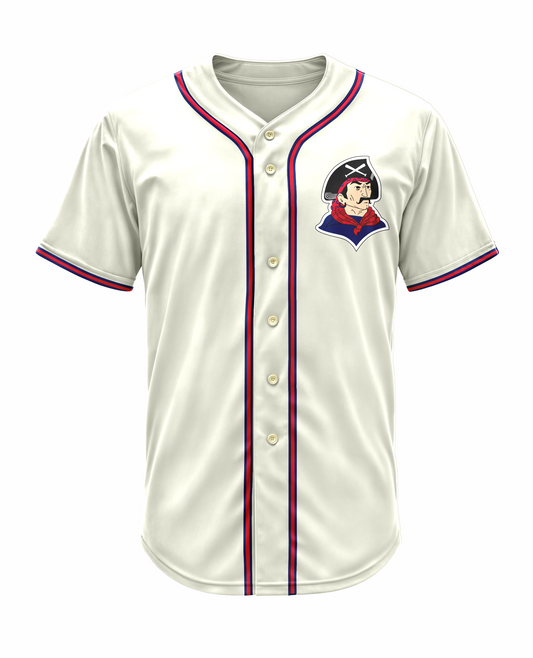
CUSTOM
Swashbuckler Jersey
Regular price Starting at $120.00 CADRegular priceUnit price perSale price Starting at $120.00 CAD -
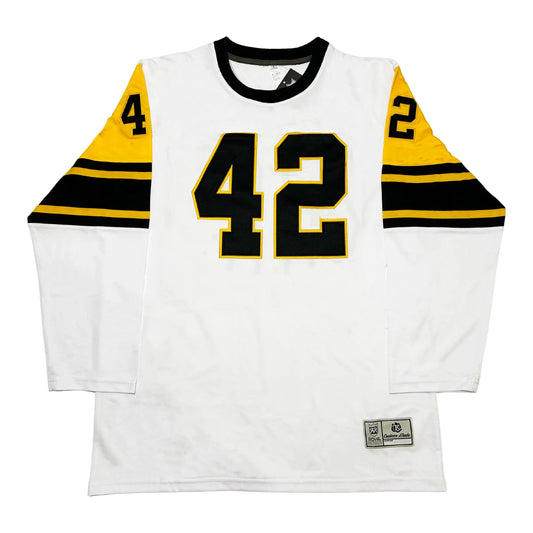
CUSTOM
Steel Curtain Jersey
Regular price Starting at $162.00 CADRegular priceUnit price perSale price Starting at $162.00 CAD -
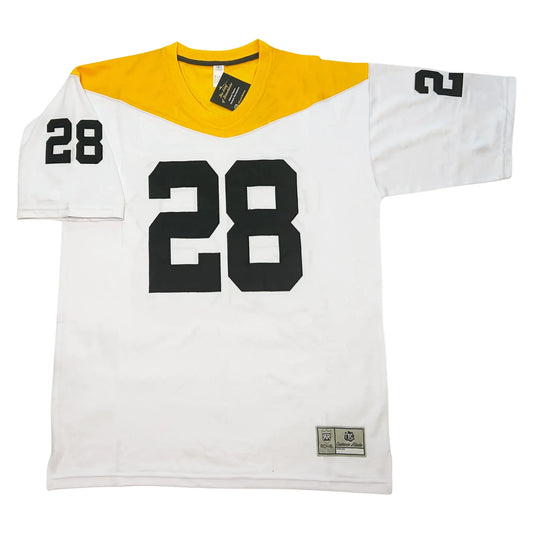
CUSTOM
Steel City Jersey
Regular price Starting at $162.00 CADRegular priceUnit price perSale price Starting at $162.00 CAD -
CUSTOM
Pittsburgh Baseball Jersey
Regular price Starting at $120.00 CADRegular priceUnit price perSale price Starting at $120.00 CAD -
CUSTOM
Rhode Island Steelers Jersey
Regular price Starting at $162.00 CADRegular priceUnit price perSale price Starting at $162.00 CAD
Three Rivers Stadium — Steel City Heritage Collection
Five active designs built around the concrete rivers-edge stadium that hosted a decade of Pittsburgh baseball and football championships. $84.99–$114.99. Sizes S–5XL.
Three Rivers Stadium stood for barely three decades — opened in 1970, imploded in 2001 — but it packed an unusual amount of championship history into that short run. Built where the Allegheny and Monongahela Rivers meet to form the Ohio, the round, multi-purpose concrete bowl hosted two World Series winners and four Super Bowl champions from the same two Pittsburgh franchises, along with two of the most replayed moments in American sports history. This collection is five active designs pulled from that run: two baseball jerseys, two football jerseys built around the Steel City identity and its famous defense, and one genuinely obscure design tied to a same-named minor-league team three states away. Every jersey runs $84.99 for baseball or $114.99 for football, sized Small through 5XL.
What You Can Shop
Five active jerseys: two baseball designs at $84.99 and three football designs at $114.99, every one of them sized Small through 5XL. A sixth design, a cream football jersey, is currently archived and not for sale — this page only describes what's actually purchasable today.
Shop by Design
- Swashbuckler Jersey — a gray or cream baseball design built around Pittsburgh's swashbuckler visual identity, S–5XL, $84.99.
- Pittsburgh Baseball Jersey — a gray design with red or navy trim, general Pittsburgh baseball heritage, S–5XL, $84.99.
- Steel City Jersey — a black or white football design built around Pittsburgh's Steel City identity, S–5XL, $114.99.
- Steel Curtain Jersey — honoring the defense that anchored four championship teams, in black, white, yellow, or cream, S–5XL, $114.99.
- Rhode Island ACFL (Rhode Island Steelers) Jersey — a genuinely obscure 1966 farm-team throwback, explained in full below, black, white, or yellow, S–5XL, $114.99.
Customization and Sizes
Every jersey on this page runs a true Small through 5XL. Check each individual listing for available colorways and any name-and-number customization — not every design offers identical add-ons.
Why Royal Retros
- Real Pittsburgh history, not a generic throwback. Every design ties to a specific championship run, defense, or genuinely obscure minor-league footnote.
- A full Small–5XL run on every active piece.
- The deepest defunct-league apparel catalog anywhere — this five-piece page is one narrow slice of a much larger Pittsburgh and Pennsylvania collection.
Quick Buying FAQ
Are these officially licensed? No. These are heritage tribute designs — Royal Retros does not hold a league or team license for the Pittsburgh baseball and football history represented here.
What sizes are available? Small through 5XL on every active jersey.
Can I customize a jersey? Check the individual product listing — customization options vary by design.
Shipping & returns? Standard US shipping, with returns handled through our returns page.
Gift Ideas
- The 1970s dynasty fan — the Steel Curtain Jersey marks the defense behind four championship teams in a six-year span.
- The baseball loyalist — the Swashbuckler Jersey and Pittsburgh Baseball Jersey both nod to two World Series-winning eras.
- The obscure-football collector — the Rhode Island ACFL Jersey is the kind of one-season minor-league trivia most fans have never heard of.
What Was Three Rivers Stadium?
Three Rivers Stadium was a round, multi-purpose concrete stadium in Pittsburgh, built at the point where the Allegheny and Monongahela Rivers join to form the Ohio River — the "three rivers" the name refers to directly. Construction took more than two years and cost roughly $55 million, and the finished building seated 47,971 for baseball and as many as 59,000 for football. It opened on July 16, 1970, with Pittsburgh's baseball club losing 3-2 to Cincinnati in the first game played there, and it stood for just over three decades before the city moved both its baseball and football teams into separate, purpose-built stadiums and demolished the old multi-purpose bowl in 2001.
Why Was It Built Round and Shared Between Two Sports?
Three Rivers Stadium belonged to a wave of "cookie-cutter" multi-purpose stadiums built across the country in the late 1960s and early 1970s — round or oval concrete bowls designed to host both baseball and football reasonably well, at a time when cities were reluctant to fund two separate single-sport stadiums. Cincinnati, Philadelphia, and St. Louis all built close architectural cousins to Three Rivers around the same years, and all of them shared the same basic tradeoff: a shape that worked adequately for two sports rather than ideally for either one. That generation of stadiums fell out of favor by the 1990s, as cities went back to building sport-specific ballparks and football stadiums — Three Rivers' own replacements, a baseball-only park and a football-only stadium built on either side of the old site, are a textbook example of that later shift.
How Many Championships Did Three Rivers Stadium Host?
Between the two Pittsburgh franchises that shared it, Three Rivers Stadium was home to six professional championships in three decades — two baseball titles and four football titles — which is an unusually concentrated run of success for one building. Pittsburgh's baseball club won the World Series in 1971 and again in 1979, the latter behind a veteran-led team that rallied around a "we are family" identity that became one of the most recognizable clubhouse mottos in the sport. Pittsburgh's football club, meanwhile, won four championships across the 1970s alone, built around a dominant defensive line that earned its own nickname and is still referenced today as one of the greatest defensive units in the sport's history. No other building of its era hosted that concentrated a run of championship success from two different sports at once.
What Was the Steel Curtain?
The Steel Curtain was the nickname for Pittsburgh's dominant 1970s defensive front, built around a Hall of Fame defensive tackle whose combination of size, speed, and relentless technique redefined what teams expected from an interior lineman. That defense anchored all four of the decade's championship runs, and its reputation is part of why the phrase still gets used generically today to describe any exceptional pass rush or defensive front, in Pittsburgh and well beyond it. The design on this page borrows that identity directly rather than referencing any individual player or the team name itself — a defense's nickname has a way of outliving even the roster that earned it.
What Was the Immaculate Reception?
The Immaculate Reception is the name given to a single fourth-down play from a December 23, 1972, playoff game at Three Rivers Stadium, when a deflected pass was caught just before it hit the ground and returned for a game-winning touchdown in the final seconds. It remains one of the most replayed and most argued-over plays in professional football history, still debated decades later over exactly how the ball deflected and whether the catch was legal under the rules of the time. The play happened at Three Rivers itself, in front of a home crowd that watched a losing game turn into a signature moment of franchise history in the space of a few seconds — the kind of single play that ends up defining a stadium's identity almost as much as any full season does.
Roberto Clemente's Final Milestone
On September 30, 1972, less than three months before the Immaculate Reception game, Pittsburgh's right fielder recorded his 3,000th career hit at Three Rivers Stadium — a milestone reached by very few players in the sport's history. It turned out to be his final regular-season hit: he was killed in a plane crash on New Year's Eve that same year, while flying relief supplies to earthquake victims in Nicaragua. That combination — a legendary milestone and a tragic ending within the same few months, both tied to the same building — is part of why Three Rivers Stadium carries more emotional weight in Pittsburgh sports history than its relatively short lifespan would otherwise suggest.
Why Did Three Rivers Stadium Close?
Three Rivers Stadium closed the way most of its cookie-cutter contemporaries eventually did: both of its tenant franchises wanted a purpose-built home rather than a shared multi-purpose bowl. Pittsburgh's baseball club played its final game there on October 1, 2000, and moved into a new baseball-only riverside ballpark the following season; the football club made a similar move into its own new stadium around the same time. With both tenants gone, the old stadium had no further use, and it was imploded on February 11, 2001, clearing the site for the riverfront development that followed. The split into two single-sport stadiums, built almost side by side near the old site, is a near-perfect illustration of why the cookie-cutter era ended everywhere it had taken hold.
What Was the "We Are Family" Season?
The 1979 season is remembered in Pittsburgh baseball history almost as much for its clubhouse identity as for its results. That team, led by a veteran first baseman who served as its emotional anchor, adopted a disco anthem as an unofficial theme song and rallied around a family-first identity that stuck through a hard-fought World Series win. It capped a decade that had already produced one other championship, in 1971, giving the franchise two titles at Three Rivers Stadium across the building's first ten years alone. The nickname has outlived most of the players who earned it — "we are family" still gets invoked in Pittsburgh sports conversation decades later, a rare case of a season's off-field identity becoming as memorable as anything that happened on the field.
How Dominant Was Pittsburgh's 1970s Football Dynasty?
Four championships in six seasons is a remarkable pace by any measure, and it was built on two things happening at once: a defensive front that ranks among the most feared units the sport has produced, and a drafting run that stacked the roster with future Hall of Famers at nearly every level. The Steel Curtain defensive line got most of the attention, but the same era's teams also built dominant units in the secondary and at linebacker, giving Pittsburgh a defense that was difficult to attack from any angle. All four championships were won at the tail end of seasons that started and were played at Three Rivers Stadium, which means the building itself has as strong a claim to "home of a dynasty" as any stadium in professional football history — a run that some later teams have matched in total championships but few have matched in the sheer concentration of talent that produced them.
What Replaced Three Rivers Stadium?
Pittsburgh's baseball club moved into a new, baseball-only riverside ballpark for the 2001 season, built along the Allegheny River with downtown skyline views that the enclosed, symmetrical Three Rivers Stadium never offered. The football club moved into its own new stadium around the same time, built on part of the old Three Rivers footprint itself. Splitting one shared multi-purpose building into two sport-specific ones wasn't unique to Pittsburgh — nearly every city that had built a cookie-cutter stadium in the 1970s went through the same transition within a few years of each other, as the design fell out of favor across the sport almost simultaneously. What made Pittsburgh's version notable is how directly the football stadium reused the old site, putting the new building nearly on top of where the old one had stood for three decades.
Collecting Three Rivers-Era Memorabilia
Gear tied to a specific, closed venue has a different collecting logic than a standard team jersey — it's dated by definition, since nothing produced today can claim to represent a building that no longer exists. That's part of the appeal for a fan who wants something more specific than a generic modern team design: a Three Rivers-era jersey ties directly to a fixed, closed chapter of Pittsburgh sports history rather than an ongoing, ever-changing current roster. The two eras this page draws from — the two-title baseball run and the four-title football dynasty — both happened entirely within the Stadium's own lifespan, which means every design here represents a genuinely finished story rather than a still-unfolding one.
The Odd Rhode Island Connection Behind This Page
The Rhode Island Steelers were a real minor-league football team, and their name is not a coincidence — in 1966, the Atlantic Coast Football League club, based in Pawtucket, Rhode Island, and playing out of McCoy Stadium, formally became a farm-team affiliate of Pittsburgh's NFL franchise, complete with a head coach who was a former Pittsburgh player himself. The arrangement never had much time to develop: the team drew fewer than 3,000 fans to any home game that season, needed league financial assistance just to keep operating, and withdrew from the league partway through 1966 after opening with five losses and a tie. It's a genuinely obscure footnote — a real Pittsburgh farm-team affiliation that lasted less than one full season, in a state that most fans would never associate with Pittsburgh football at all. Because "Steelers" is also the name of Pittsburgh's current NFL franchise, this page and its product listing use the "Rhode Island ACFL" form to refer to the 1966 team specifically, keeping the two entirely separate organizations clearly distinct.
What Happened to the Three Rivers Site?
The land where Three Rivers Stadium stood is now split between the baseball-only ballpark and football-only stadium that replaced it, both built on the same general riverfront footprint, along with additional riverside development. A small marker near the site notes home plate's former location — one of the few physical traces of the original stadium left standing after the 2001 implosion. It's a common fate for stadiums of this era: the building itself disappears almost entirely, but the site keeps hosting the sport it was built for, just in newer, more specialized form.
Why Did Cities Stop Building Shared Stadiums?
The cookie-cutter era lasted barely two decades, and its collapse came down to a simple mismatch: baseball wants an intimate, asymmetrical park built around sightlines to the infield, while football wants a symmetrical bowl built around sightlines to a rectangular field, and no single design serves both goals particularly well. Fans and teams tolerated that compromise through the 1970s and '80s because building two stadiums seemed financially unrealistic, but by the 1990s new revenue streams from luxury suites, retail development, and sport-specific amenities made single-purpose stadiums the more profitable long-term bet in almost every market that had gone the shared-stadium route. Three Rivers Stadium's replacement by two separate buildings on nearly the same footprint is as clean an illustration of that industry-wide shift as exists anywhere in professional sports.
What Makes Ours Period-Correct
Construction and accuracy. Sewn-on tackle-twill numbers and lettering where the original build called for it, era-correct fonts and colors, and true-to-original construction — every Heritage design is checked against period references before it goes live.
Extended FAQ
Did the Rhode Island Steelers ever play a game at Three Rivers Stadium? No — they were based in Pawtucket, Rhode Island, and played their entire brief existence at McCoy Stadium. Their connection to this collection is the 1966 farm-team affiliation, not shared geography.
How many total championships were won by teams playing at Three Rivers Stadium? Six across three decades — two baseball titles and four football titles from the two Pittsburgh franchises that shared the building.
Was the Immaculate Reception controversial at the time? Yes — the exact sequence of the deflection was disputed immediately after the play, and it remains one of the most debated single plays in football history.
Why did Pittsburgh split into two stadiums instead of building one replacement? By the late 1990s, cities had largely abandoned the shared multi-purpose stadium model in favor of sport-specific venues, and Pittsburgh's two franchises followed that same national shift.
Is there anything left of the original stadium today? Very little — a small marker near the site notes where home plate once stood, but the building itself was fully demolished in the 2001 implosion.
Why does the Rhode Island Steelers product use "ACFL" instead of the team's full historic name? To keep the 1966 minor-league affiliate clearly distinct from Pittsburgh's current NFL franchise, which shares the same nickname today.
Did Three Rivers Stadium host any events besides baseball and football? Its size and central location made it a natural host for large public gatherings beyond its two main tenants, in the same way most stadiums of its era doubled as general-purpose event venues.
How does Three Rivers Stadium's championship count compare to other stadiums of its era? Six total titles across two sports in three decades is an unusually high number even among its cookie-cutter contemporaries — most shared multi-purpose stadiums built in the same years hosted far less sustained success from either tenant.
Is the "Steel Curtain" name still used today? The phrase has become a generic way to describe any dominant defensive front, in football commentary well beyond Pittsburgh, which is part of why it works as a design reference on its own.
Shop Related Collections
- Atlantic Coast Football League — more from the Rhode Island Steelers' 1966 league, 14 designs.
- Custom Jerseys — the full custom jersey catalog across every league Royal Retros carries.
- Legacy Baseball — more historic baseball designs beyond Pittsburgh, 39 pieces.
- Legacy Football — the wider historic football catalog, 124 designs.
- Other Football — more historic football beyond the ACFL, 78 designs.
- Pittsburgh — the full Pittsburgh catalog, 50 designs.
Shop the Three Rivers Stadium Collection at Royal Retros — Pittsburgh Baseball & Football Heritage.