



-
CUSTOM
Cleveland Baseball Jersey
Regular price Starting at $84.99 USDRegular priceUnit price per -
-
CUSTOM
Cleveland Pullover Baseball Jersey
Regular price Starting at $84.99 USDRegular priceUnit price per -
-
CUSTOM
The Pound Jersey
Regular price Starting at $114.99 USDRegular priceUnit price per -
-
CUSTOM
Kardiac Kids Jersey
Regular price Starting at $114.99 USDRegular priceUnit price per -
-
-
CUSTOM
Cleveland Bronchos Jersey
Regular price Starting at $84.99 USDRegular priceUnit price per -
-
CUSTOM
Cleveland Spiders Jersey
Regular price Starting at $84.99 USDRegular priceUnit price per -
-
CUSTOM
Jersey Jays Jersey
Regular price Starting at $114.99 USDRegular priceUnit price per -
-
CUSTOM
AAFC Champions Jersey
Regular price Starting at $114.99 USDRegular priceUnit price per -
-
CUSTOM
Cleveland Buckeyes NLB Jersey
Regular price Starting at $84.99 USDRegular priceUnit price per -









Cleveland Municipal Stadium — The Muni Lot Collection
Ten active designs pulled from 65 years of lakefront Cleveland sports: AAFC champions, Kardiac-era football, Negro American League baseball, and the old Cleveland ballclub names that came before either. $29.99–$114.99. Sizes S–5XL.
Cleveland Municipal Stadium is gone — imploded in pieces between late 1996 and the spring of 1997 — but the gravel-and-asphalt parking lot on its old footprint never closed. Cleveland fans still call it the Muni Lot, and it's still the epicenter of gameday tailgating on the lakefront today, four decades after it first became a tradition. This collection is built around that same idea: the stadium is history, but what happened on the field, and in that parking lot, is still worth wearing. Ten active designs cover Cleveland's old ballclub names, the Negro American League team that once shared the neighborhood, and the football era that ran from a four-time AAFC champion through a nerve-wracking 1980 team still remembered by a nickname. Every jersey is $84.99–$114.99, the one t-shirt is $29.99, and everything runs Small through 5XL.
What You Can Shop
Five baseball jerseys, four football jerseys, and one t-shirt — ten pieces in total, all $84.99 for baseball, $114.99 for football, $29.99 for the t-shirt, all sized Small through 5XL. Most jerseys offer two or three color options; check the individual listing for what's available on a given design. Two more designs currently sit in draft status and aren't purchasable, and one archived cream jersey isn't for sale either — this page only describes what's actually active right now.
Shop by Design
- Cleveland Buckeyes NLB Jersey — honoring the 1945 Negro American League champions, in gray or cream, S–5XL, $84.99.
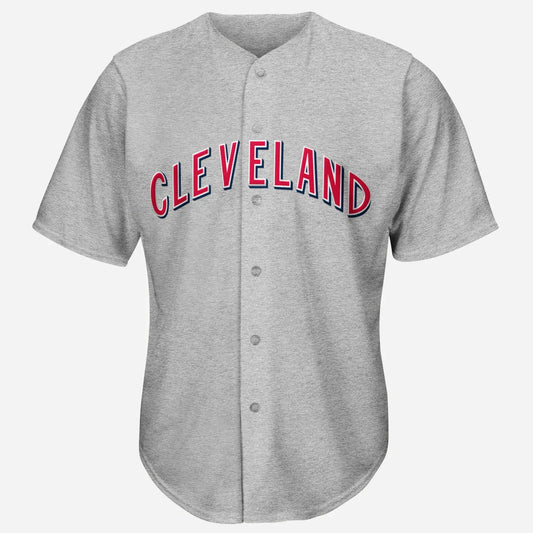
- Cleveland Pullover Baseball Jersey — a classic gray pullover cut, the style of jersey Cleveland's American League club wore for decades at the Stadium, S–5XL, $84.99.
- Cleveland Bronchos Jersey — the American League franchise's short-lived early-1900s nickname, in cream or navy, S–5XL, $84.99.
- Cleveland Baseball Jersey — a gray design with piping or button-down styling, general Cleveland baseball heritage, S–5XL, $84.99.
- Cleveland Spiders Jersey — the franchise's 1890s National League identity, in gray, cream, or black, S–5XL, $84.99.
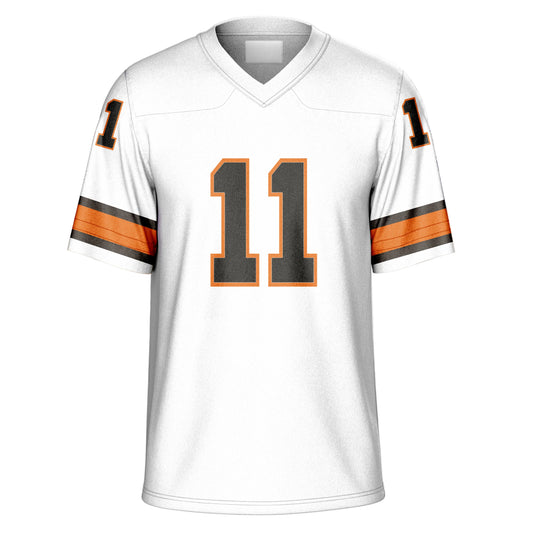
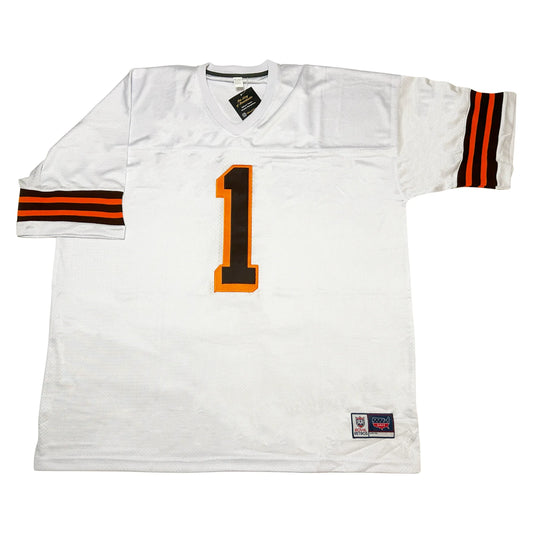
- The Pound Jersey — a nod to the Stadium's famous end-zone bleacher section, in brown, white, or brown with orange numbers, S–5XL, $114.99.
- Kardiac Kids Jersey — for the nerve-wracking 1980 football season, brown or white, S–5XL, $114.99.
- AAFC Champions Jersey — marking Cleveland's four-year sweep of every All-America Football Conference title, brown or white, S–5XL, $114.99.
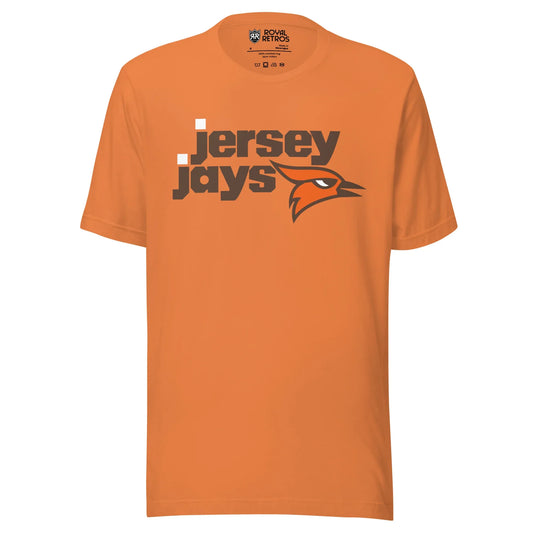
- Jersey Jays Jersey — a 1969 Continental Football League team with a real Cleveland farm-team tie (see below), in brown, orange, white, or cream, S–5XL, $114.99.
- Jersey Jays T-Shirt — the same design in tee form, six color options, S–5XL, $29.99.
Customization and Sizes
Every jersey on this page runs a true Small through 5XL, and the t-shirt matches that same range — there's no shortened size run here the way there is on some other product categories at Royal Retros. Check each individual listing for available colorways and any name-and-number customization options; not every design offers the same add-ons.
Why Royal Retros
- Real Cleveland history, not a generic throwback. Every design on this page ties to a specific team, season, or venue detail — the AAFC dynasty, the 1945 Buckeyes, the Kardiac Kids, the Dawg Pound-era Stadium.
- A full Small–5XL run on every active piece, jerseys and tee alike.
- The deepest defunct-league apparel catalog anywhere — this ten-piece page is one narrow slice of a much larger Cleveland and Ohio collection.
Quick Buying FAQ
Are these officially licensed? No. These are heritage tribute designs — Royal Retros does not hold a league or team license for the Cleveland baseball and football history represented here.
What sizes are available? Small through 5XL on every active jersey and the t-shirt.
Can I customize a jersey? Check the individual product listing — customization options vary by design.
Shipping & returns? Standard US shipping, with returns handled through our returns page.
Gift Ideas
- The AAFC completist — the AAFC Champions Jersey marks a four-year title run most fans outside Cleveland have never heard of.
- The Negro Leagues history buff — the Cleveland Buckeyes NLB Jersey honors a real 1945 championship club.
- The Kardiac-era loyalist — for anyone who remembers 1980 as the year every Sunday came down to the final minute.
- The tailgate veteran — The Pound Jersey is built for anyone who's actually stood in the Muni Lot on a fall Sunday.
What Was Cleveland Municipal Stadium?
Cleveland Municipal Stadium was a 78,000-plus-seat multi-purpose stadium on the city's Lake Erie shoreline, built on reclaimed lakefront land and completed on July 1, 1931, after Cleveland voters approved a $2.5 million bond issue in 1928. Designed by the Osborn Engineering Company with the architectural firm Walker & Weeks, it opened as the largest-capacity outdoor sports venue in the world at the time — a genuinely oversized building for a city that, in its first years, didn't yet have a full-time tenant to fill it. That changed within a few seasons, and for the next 65 years the Stadium hosted essentially every major team Cleveland fielded: professional baseball, professional football, championship fights, and eventually the tailgate culture that outlived the building itself.
Why Was It Called "The Muni Lot"?
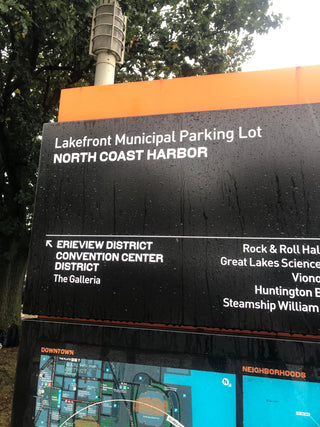
The Muni Lot is the large public parking lot on the Stadium's old footprint, and the name is short for exactly what it is — the municipal lot. The tailgating tradition there traces to the late 1980s, when fans arriving early for football games started treating the open lakefront lot as a pregame destination in its own right rather than just a place to park. That habit never depended on the Stadium standing — when the old building came down in the mid-1990s and a new stadium went up on the same site, the lot stayed exactly where it was, and the tailgate culture simply carried over intact. Today the Lakefront Municipal Parking Lot still runs the same routine on football Sundays, now as a paid lot, and it remains one of the most recognizable tailgate scenes in professional sports — arguably the single piece of the old Stadium complex with the strongest ongoing identity of its own.
How Did Baseball End Up at Municipal Stadium?
Cleveland's American League club played its first game at the new Stadium on July 31, 1932, a 1-0 loss to the Philadelphia Athletics in front of a reported crowd of 80,184 — a major-league attendance record at the time, set in a building that most of the city's baseball fans still found impractically large for a regular-season game. For the next fourteen years, the club actually split its home schedule between the more intimate League Park and the cavernous lakefront Stadium, using the bigger building mainly for weekend and holiday dates where a bigger crowd was expected. That changed in 1947, when the franchise moved to the Stadium full-time, and the ballpark stayed the club's only home through the 1993 season, before the team relocated to a new downtown ballpark in 1994. The Stadium's cavernous size cut both ways — it swallowed up modest weekday crowds, but on the right night it could hold more fans than almost any ballpark in the sport, a fact borne out by the long-standing single-game World Series attendance record the building set during the club's 1948 championship run.
Older Names on the Same Franchise
Two of the baseball designs on this page — the Cleveland Bronchos and the Cleveland Spiders — represent nicknames the city's ballclub wore well before Municipal Stadium existed. The Spiders were Cleveland's National League entry through the 1890s, playing out of League Park across town, and folded after the 1899 season. The Bronchos were a brief early-1900s nickname for the city's brand-new American League franchise, worn for only a couple of seasons before the club settled on other names, including Indians, later in the decade. Neither team ever set foot in the Stadium that opened in 1931 — they're included here as part of Royal Retros' broader sweep of Cleveland baseball heritage, not because either franchise actually played on the lakefront.
Why Do Cleveland's Old Baseball Names Keep Changing?
Cleveland's American League franchise has worn more names over its history than almost any other club in the sport, cycling through Bronchos, Naps, and other short-lived identities in its first two decades before landing on the name it carried for most of the twentieth century, and it has since moved on from that name too. That churn is part of why a Cleveland baseball collection can legitimately include several different-looking jerseys representing the same underlying franchise across different eras — the team on the field kept changing its identity even when the city, and eventually the ballpark, stayed the same.
How Did Cleveland Win Four Straight Pro Football Championships?
Cleveland's football team joined the brand-new All-America Football Conference in 1946 and simply never lost a championship in the league's entire four-year existence, winning all four AAFC titles from 1946 through 1949, with three of those four championship games played at Municipal Stadium itself. That level of sustained dominance is rare in any professional league — a franchise going undefeated in championship games across an entire league's lifespan — and it's the reason the AAFC Champions Jersey on this page references a run most football fans outside Cleveland have never actually heard the details of, since the AAFC folded after 1949 and its history gets overshadowed by the NFL that absorbed several of its franchises the following year.
What Were the Kardiac Kids?
The "Kardiac Kids" nickname belongs to Cleveland's 1980 football team, earned because twelve of that season's sixteen regular-season games were decided by seven points or fewer — a run of nail-biters dramatic enough that the nickname stuck to the whole era, not just the one season. That team's playoff run ended on January 4, 1981, at Municipal Stadium, in a divisional-round loss decided by a single interception thrown into the end zone on a play now remembered by its own play-call nickname — thrown, fittingly, in subzero wind-chill conditions that made the whole afternoon feel like exactly the kind of down-to-the-wire heartbreak the Kardiac Kids had specialized in delivering, win or lose, all season long.
What Was "The Pound"?
The Pound references the raucous bleacher section behind one end zone at Municipal Stadium, where fans in the mid-1980s started embracing a "dog" persona to match a defense their own coach had nicknamed after himself barking at his players in practice. What started as a defensive in-joke turned into one of the most recognizable fan sections in professional football, complete with dog masks, biscuits thrown onto the field, and a section identity that outlasted the Stadium itself — the same bleacher culture picked right back up when the new stadium opened on the same site in 1999. It's the kind of grassroots fan tradition that a league license can't really capture, which is exactly why it works as a design on its own rather than needing a team name attached to it.
Who Were the Cleveland Buckeyes?
The Cleveland Buckeyes were the city's Negro American League franchise from 1942 to 1950, and in 1945 they were the best team in Black baseball — a 52-20-2 regular season, a Negro American League pennant, and a four-game sweep of the reigning champions in that year's Negro World Series. That series was played across multiple Cleveland venues, including games at both the club's usual home at League Park and at Municipal Stadium itself, tying the Buckeyes directly to the Stadium even though League Park was their primary home. Until the Buckeyes arrived, no Negro League franchise based in Cleveland had lasted more than a single season — the 1945 championship remains the high point of the only Black baseball club in the city's history to build any real staying power.
The Odd Cleveland Connection Behind the Jersey Jays
The Jersey Jays never played a game in Cleveland — they were a Jersey City, New Jersey, minor-league football team that existed for two seasons, 1969 through 1971, playing first in the Continental Football League and then in the Atlantic Coast Football League before folding. Their inclusion in a Cleveland Stadium collection comes down to one specific fact: in 1969, the Jays served as a farm-team affiliate of Cleveland's NFL franchise, a real minor-league development relationship rather than a coincidence of naming. It's a genuinely obscure piece of trivia — a team that never set foot on the Stadium's turf, tied to the building anyway through a front-office relationship most fans, in Cleveland or New Jersey, have long since forgotten.
Why Did the Stadium Close, and What Happened to the Muni Lot?
The Stadium lost its baseball tenant first, when Cleveland's American League club moved to a new downtown ballpark for the 1994 season, and its football tenant a year and a half later, when the football franchise played its final game at the Stadium on December 16, 1995, shortly before an ownership relocation moved the team to Baltimore for the 1996 season. Demolition began in November 1996 and wrapped up by the following spring, clearing the lakefront site entirely. A restored Cleveland football franchise returned in 1999, playing in a brand-new stadium built on the exact same footprint — and the Muni Lot, which had never actually been part of the building itself, simply kept running through the whole transition. That's the real story behind why this collection is titled the way it is: the Stadium came down, the team went away and came back, but the parking lot next to it has been hosting the same tailgate for closing in on four decades now, uninterrupted.
What Was Cleveland's Last Championship at the Stadium?
Cleveland's football team won an NFL championship at Municipal Stadium on December 27, 1964, beating the heavily favored Baltimore club 27-0 in front of a home crowd that watched the underdogs shut out one of the most talented rosters in the league. That win turned out to be the last professional sports championship the city celebrated for more than five decades — it wasn't until the Cavaliers won an NBA title in 2016 that Cleveland ended the drought, which means the 1964 championship banner hung in fans' memory, if not literally over the field, for the entire back half of the Stadium's existence. It's a useful data point for understanding just how much weight Cleveland sports fans put on the Stadium years: an entire generation grew up with 1964 as the last time the city actually won anything.
More Than a Sports Venue
Municipal Stadium's sheer size made it a natural host for events well beyond baseball and football. Its capacity made it a regular site for large boxing cards and other big-ticket events through the middle of the twentieth century, the same way a handful of other oversized multi-purpose stadiums around the country did double duty as boxing venues before purpose-built arenas took over that role. That dual identity — a building simultaneously too big for a routine weekday baseball crowd and exactly right for a heavyweight fight or a football doubleheader — is part of what made the Stadium such an unusual piece of civic infrastructure. Few buildings anywhere hosted a Negro League World Series, an unbeaten four-year football dynasty, and a Cardiac-level playoff heartbreak all under the same roof.
What Makes Ours Period-Correct
Construction and accuracy. Sewn-on tackle-twill numbers and lettering where the original build called for it, era-correct fonts and colors, and true-to-original construction — every Heritage design is checked against period references before it goes live.
Extended FAQ
Did the Cleveland Spiders or Bronchos actually play at Municipal Stadium? No — both predate the Stadium's 1931 opening by decades. They're included as part of Royal Retros' broader Cleveland baseball heritage lineup, not because either team played on the lakefront.
What happened to the AAFC? The league folded after the 1949 season; several of its stronger franchises, including Cleveland's, joined the NFL the following year.
Is the Muni Lot still open today? Yes — it's now a paid lakefront lot serving the stadium that replaced the original Municipal Stadium, and it remains one of the most recognizable tailgate scenes in professional football.
Why did the Cleveland Buckeyes play games at two different ballparks? League Park was their regular home, but bigger events — including games of their 1945 Negro World Series sweep — were sometimes shifted to the larger Municipal Stadium to accommodate demand.
Was the Jersey Jays' Cleveland tie a coincidence? No — it was a real 1969 minor-league farm-team affiliation, documented in Continental Football League records, even though the team itself was based and played in New Jersey.
Why does the football side of this page reference nicknames instead of a team name? Royal Retros avoids naming any currently active NFL franchise in titles and shopping links — the designs use venue and era nicknames like the Pound and the Kardiac Kids instead, while the full story is told in the history sections above.
Shop Related Collections
- AAFC — the full All-America Football Conference catalog, 21 designs.
- Continental Football League — more from the Jersey Jays' 1969 league, 12 designs.
- Legacy Baseball — more historic baseball designs beyond Cleveland, 39 pieces.
- Legacy Football — the wider historic football catalog, 124 designs.
- New Jersey — more designs from the Jersey Jays' actual home state, 41 pieces.
- NLB — the full Negro Leagues heritage catalog, 175 designs.
- Ohio — the full state catalog, 102 designs.
- Other Football — more historic football beyond the AAFC and CFL, 78 designs.
Shop the Muni Lot Collection at Royal Retros — Cleveland Baseball & Football Heritage.