



-
CUSTOM
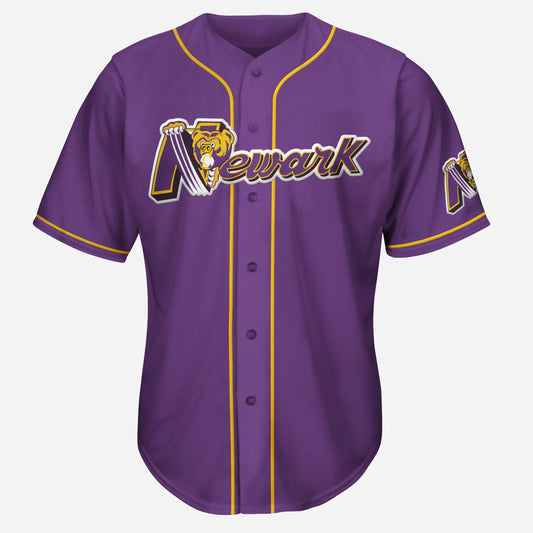
2000's Newark Bears Jersey
Regular price Starting at $84.99 USDRegular priceUnit price per -
-
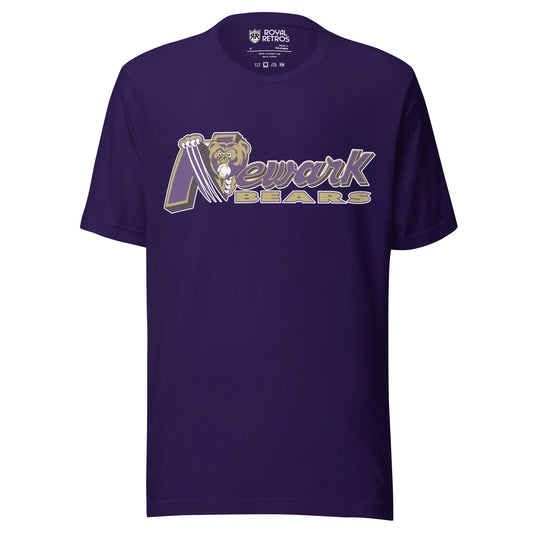
2000's Newark Bears T-Shirt
Regular price $29.99 USDRegular priceUnit price per -
-
CUSTOM
Newark Bears Jersey
Regular price Starting at $84.99 USDRegular priceUnit price per -





The Newark Bears Collection — Royal Retros Newark Bears Fan Shop
Authentic Newark Bears Throwbacks. Custom Names & Numbers. Sizes S–5XL.
Royal Retros carries three Newark Bears throwbacks spanning two completely different eras of the same name — the classic International League club that many historians still call the greatest minor league team ever assembled, and the independent Atlantic League revival that brought Rickey Henderson and the Canseco brothers back to New Jersey seven decades later. The classic-era jersey is $84.99 in White or Gray, the modern-era jersey is $84.99 in Black, Purple or White, and the tee is $29.99. Sizes run Small through 5XL, with free custom name and number on the jerseys. There is no current professional team playing as the Newark Bears — the name has been silent since 2013 — which makes this small collection one of the only places left to wear either era.
What You Can Shop in the Newark Bears Collection
Newark Bears Jersey (Classic) — A twill-lettered throwback in White or Gray, echoing the look of the Ruppert Stadium era. Sized Small through 5XL, with free custom name and number on request. Put a name from the 1937 lineup on the back — Charlie Keller, Joe Gordon — or your own. $84.99. Shop the classic jersey.
2000's Newark Bears Jersey — A modern-era throwback in Black, Purple or White, matching the Atlantic League Bears' original purple-and-black color scheme. Sized Small through 5XL, with free custom name and number on request. $84.99. Shop the modern jersey.
2000's Newark Bears T-Shirt — Soft, pre-shrunk cotton in three colorways: Black and White run Small through 5XL, and Team Purple runs Small through 4XL. $29.99. Shop the tee.
Customization — Free custom name and number on both jersey styles. Custom items are made to order and final sale.
Sizes — Small through 5XL on both jerseys and most tee colorways (Team Purple runs through 4XL).
Shop the Bears by Era
The Classic Bears — Ruppert Stadium, 1926–1949. The white and gray colorway represents the International League era, when Newark ran as the New York Yankees' top farm club and fielded the 1937 team many historians call the single greatest minor league club ever assembled. If you want the Yankees-pipeline history — the Governors' Cup years, the Junior World Series titles, Hall of Fame managers — start here. Shop the classic jersey.
The Modern Bears — Atlantic League, 1998–2013. The purple, black and white colorway represents the independent-league revival, founded by a Newark-born former Yankees catcher and built into a team that briefly employed Rickey Henderson at 44 and both Canseco brothers at once. If your Newark baseball memory is a Riverfront Stadium ticket stub rather than a black-and-white photo, this is your era. Shop the modern jersey or the modern tee.
Why Royal Retros Is the Home of Newark Bears Throwback Gear
- Two full eras, not one generic logo. The 1930s–40s Yankees-farm-club look and the 2000s independent-league look are genuinely different uniforms, and both are represented here.
- Flat, honest pricing. Jerseys $84.99, tee $29.99. No "collector's" markup for a defunct-team throwback.
- Free customization on both jersey styles. Add a name and number at no extra cost.
- Sizes S–5XL on nearly everything. True family sizing, no big & tall upcharge.
- Deep Northeast baseball coverage. Cross-shop the Bears alongside the Montreal Royals — Newark's opponent in two International League championship series — and the rest of our New Jersey collection.
Quick Buying Questions
What sizes do the Newark Bears jerseys come in?
Small through 5XL on both the classic (White/Gray) and modern (Black/Purple/White) jerseys. The tee runs Small through 5XL in two colorways and Small through 4XL in Team Purple.
Can I add my name and number to a Bears jersey?
Yes — free custom name and number on request, on either jersey style. Custom items are made to order and final sale.
Which era should I pick?
If your Newark baseball memory is your grandfather's stories about the Yankees' great farm club, go with the classic White or Gray jersey. If you remember Rickey Henderson or the Canseco brothers at Riverfront Stadium, the Purple, Black or White modern jersey is your era.
How fast does it ship and what's the return policy?
Stock items ship within 3–5 business days. Custom jerseys are sewn to order and typically ship within 7–10 business days. Custom items are final sale. Standard items follow our return policy at /pages/returns.
Gift Ideas for the Newark Bears Fan
- For the Yankees-history buff: The 1937 Bears are widely considered the greatest minor league team ever built — a jersey with a legitimate claim behind it.
- For the Rickey Henderson collector: Henderson played for the Bears at 44 and 45 years old, still stealing bases and still an All-Star.
- For the Newark native: The modern Bears were founded by a Newark-born former Yankees catcher who brought professional baseball back to the city after a 50-year gap.
- For the baseball-history trivia fan: A Newark Bears pitcher's contract dispute went all the way to the U.S. Supreme Court.
- Year-round demand. Bears nostalgia isn't seasonal — birthdays, Father's Day and Opening Day itch all work.
Who Were the Newark Bears?
The Newark Bears were New Jersey's most decorated minor league baseball franchise across two entirely separate eras. The first ran from 1926 to 1949 in the International League, when Newark was the New York Yankees' top farm club and fielded a 1937 team that many baseball historians still call the greatest minor league club ever assembled. The second ran from 1998 to 2013 as an independent Atlantic League and Canadian American Association franchise, founded by a Newark-born former Yankees catcher and built around a genuine parade of major league name recognition — Rickey Henderson, both Canseco brothers, and more than a dozen other players with real big-league careers.
Both eras share a name, a city and, loosely, a lineage — the modern franchise was deliberately named after the old one — but they represent two very different kinds of baseball fifty years apart: one an affiliated powerhouse built to develop Yankees, the other an independent-league operation built to entertain a city that had gone half a century without professional baseball.
Why Do People Call the 1937 Newark Bears the Greatest Minor League Team Ever?
The 1937 Bears won the International League pennant by 25½ games, finishing 109-43 with a team batting average around .300 and 140 home runs — video-game numbers for a minor league club. The pitching staff matched the offense: Joe Beggs went 21-4, Atley Donald 19-2, Vito Tamulis 18-6 and Steve Sundra 15-4. The everyday lineup included Charlie Keller, Joe Gordon, Spud Chandler and George McQuinn, all of whom went on to real major league careers, several of them with the Yankees teams that dominated the American League into the 1940s.
The legend was cemented in the postseason. Newark fell behind the American Association champion Columbus Red Birds three games to none in the Junior World Series — the annual matchup between the champions of the two top minor leagues — and won the next four straight to take the title. A team that dominant, that stocked with future major leaguers, capping the season with a comeback like that, is why "the 1937 Newark Bears" still gets cited as a standalone answer whenever the question of the greatest minor league team of all time comes up.
Jacob Ruppert and the Yankees Farm System
Jacob Ruppert, the beer baron who owned the New York Yankees, bought the Newark franchise in 1931 and made it the flagship of the Yankees' growing farm system — the top rung of the ladder a Yankees prospect climbed on the way to the Bronx. Newark stayed one of the organization's top farm clubs for the rest of the franchise's existence, and the arrangement produced results well beyond the 1937 team: the Bears won the International League's Governors' Cup championship four times (1932, 1937, 1938 and 1940) and captured three Junior World Series titles (1932 over the Minneapolis Millers, 1937 over the Columbus Red Birds, and 1940 over the Louisville Colonels), reaching the championship round seven times in all.
The organization also attracted major league royalty to the dugout. Hall of Famer Walter Johnson managed the Bears in 1928, and Hall of Famer Tris Speaker served as player-manager in 1929 and 1930 — both years before Ruppert's purchase turned Newark into a true Yankees pipeline, but both signs of how seriously the International League's flagship city took its baseball even before the dynasty years arrived.
Newark vs. Montreal — Two International League Championship Battles
Newark's fiercest rival in the pennant chase during the 1940s was the Montreal Royals — the same Montreal Royals whose Delorimier Stadium later hosted Jackie Robinson's 1946 breakthrough season. The two clubs met for the International League championship twice: Newark won in 1941, four games to three. Montreal won the rematch in 1945, also four games to three, and beat Newark again in the 1946 opening round. The 1945 series, in particular, put a championship-caliber Newark club across the diamond from a Montreal roster that would field Robinson the very next season.
Ruppert Stadium and the End of the Classic Bears
Ruppert Stadium, the Bears' home in Newark's Ironbound section, hosted every game of the Yankees-farm-club era before it was demolished in 1967. The Bears left Newark after the 1949 season, relocating to Springfield, Massachusetts, a year after the Negro National League's Newark Eagles had also left the city. Between the two departures, Newark went without professional baseball for roughly the next fifty years — a long, quiet stretch for a city that had once hosted a Yankees flagship farm club and a Negro Leagues powerhouse in the same seasons.
The Newark Bears Pitcher Who Took Baseball to the Supreme Court
George Toolson, a veteran pitcher in the Yankees system whose career had run through Newark, refused to report when the organization reassigned him to the Double-A Binghamton Triplets for the 1950 season. Rather than accept the move, Toolson sued, challenging the legality of professional baseball's reserve clause — the rule binding a player to his team even after his contract term ended. The case, Toolson v. New York Yankees, reached the United States Supreme Court, which ruled 7-2 in 1953 to uphold both the reserve clause and baseball's broader antitrust exemption. It remains one of the more consequential legal footnotes to come out of a single player's stint with a minor league club, and Newark's Yankees-farm-system connection put it squarely at the center of the case.
Why Did Professional Baseball Leave Newark for Fifty Years?
There was no single scandal or collapse — the Bears simply relocated after the 1949 season as the Yankees reorganized their farm system, and the Negro National League's Newark Eagles had already left a year earlier as the Negro Leagues themselves began losing players and attention to a newly integrating major league game. With both of the city's major professional clubs gone within a year of each other, Newark went without an affiliated professional baseball team from 1950 until the new independent Bears arrived in 1998 — one of the longest gaps of any major Northeastern city in the twentieth century.
1998 — Rick Cerone Brings Baseball Back to Newark
The modern Newark Bears were founded in 1998 by Rick Cerone, a Newark native and former New York Yankees catcher, who deliberately revived the old Bears name for his new independent Atlantic League franchise. The timing outran the construction schedule: the 1998 club played its "home" games more than 60 miles away at Harbor Yard in Bridgeport, Connecticut, while its actual ballpark was still being built, and split part of its 1999 home slate at Skylands Park in Augusta, New Jersey, before Bears & Eagles Riverfront Stadium finally opened in Newark on July 16, 1999. The new stadium's name honored both of the city's earlier baseball legacies — the Bears and the Negro Leagues' Newark Eagles — in a single building.
Rickey Henderson, the Canseco Brothers, and the Modern Bears' Big Names
The Atlantic League and Canadian American Association eras of the Newark Bears drew a genuinely deep bench of players with real major league resumes. Ozzie Canseco played for the Bears in 2000 and 2001, and his brother Jose Canseco joined him for part of the 2001 season — two brothers with major league home run pedigrees playing the same independent-league outfield. Rickey Henderson, the all-time stolen base king, played the first half of the 2003 season with Newark and was named Most Valuable Player of the Atlantic League All-Star Game at age 44; after a brief look from the Los Angeles Dodgers that ended at season's end, Henderson returned to the Bears for 2004 at age 45. Pitcher Jose Lima started the 2003 season with Newark before the Kansas City Royals signed him away and he won his first seven decisions in the majors.
The rest of the alumni list reads like a who's-who of recognizable big-league names who passed through New Jersey on their way somewhere else, or on their way back: Edgardo Alfonzo, Armando Benitez, Carl Everett, Keith Foulke, Brian Giles, Pete Incaviglia, Jim Leyritz, Ramiro Mendoza and Scott Spiezio, among others. The Bears won two Atlantic League championships in this era, in 2002 and 2007.
Ruppert and Effa — the Mascots Who Connected Two Eras
The modern Bears' two mascots, anthropomorphic bears named Ruppert and Effa, were a direct nod to Newark's full baseball history rather than just the Bears' own. Ruppert honored Jacob Ruppert, the Yankees owner whose 1931 purchase built the great 1930s Bears teams. Effa honored Effa Manley, who owned and operated the Negro National League's Newark Eagles and remains the only woman inducted into the National Baseball Hall of Fame. The modern Bears also retired two numbers that belonged to no Newark Bears player at all — 21 for Roberto Clemente and 42 for Jackie Robinson, the latter retired throughout all of professional baseball — a gesture toward the sport's broader history rather than the franchise's own roster.
Why Did the Newark Bears Fold Again?
The modern Bears' finances were shakier than their roster. Owner Marc Berson's ownership group filed for Chapter 11 bankruptcy in October 2008, and the team's survival was genuinely in doubt until the Bases Loaded Group — led by former Bears general manager Tom Cetnar — bought the club and guaranteed a line of credit to keep it in the Atlantic League. The franchise changed hands again in 2010, sold to Dr. Douglas Spiel and Danielle Dronet, and moved from the Atlantic League to the Canadian American Association for the 2011 season. The Can-Am League announced in November 2013 that Newark would not return for 2014, and the team's remaining assets were auctioned off in April 2014 — closing the book on the Bears name in Newark for a second time.
What Makes Ours Period-Correct
Construction and accuracy. Sewn-on tackle-twill numbers and lettering where the original build called for it, era-correct fonts and colors, and true-to-original construction — every Newark Bears design is checked against period references before it goes live.
More Frequently Asked Questions About the Newark Bears
Who were the Newark Bears?
A New Jersey professional baseball franchise across two eras: the International League Bears from 1926 to 1949, the New York Yankees' top farm club, and the independent Atlantic League and Canadian American Association Bears from 1998 to 2013.
Why do people call the 1937 Bears the greatest minor league team ever?
They went 109-43, won the pennant by 25½ games, hit .300 as a team with 140 home runs, and rallied from down three games to none to win the Junior World Series over the Columbus Red Birds — with future major leaguers Charlie Keller, Joe Gordon and Spud Chandler in the lineup.
Did the Newark Bears ever play the Montreal Royals?
Yes — twice, for the International League championship. Newark won in 1941, four games to three. Montreal won the rematch in 1945, also four games to three, and beat Newark again in the 1946 opening round.
Did Rickey Henderson really play for the Newark Bears?
Yes. Henderson played for the Bears in 2003, when he was named MVP of the Atlantic League All-Star Game at age 44, and returned for 2004 at age 45.
Did the Canseco brothers play for Newark?
Yes. Ozzie Canseco played for the Bears in 2000 and 2001, and his brother Jose Canseco joined him for part of the 2001 season.
What was Toolson v. New York Yankees?
A Supreme Court case brought by veteran pitcher George Toolson after the Yankees organization tried to reassign him away from Newark. The Court ruled 7-2 in 1953 to uphold baseball's reserve clause and its antitrust exemption.
Why did the Newark Bears leave in 1949?
The franchise relocated to Springfield, Massachusetts, after the 1949 season as the Yankees reorganized their farm system. Combined with the Negro National League's Newark Eagles leaving a year earlier, the city went without professional baseball for roughly the next fifty years.
Why did the modern Newark Bears fold?
Financial trouble. The club filed for Chapter 11 bankruptcy in 2008, changed hands twice more, moved leagues in 2011, and was discontinued after the 2013 season when the Canadian American Association announced it would not return for 2014.
How many Newark Bears products does Royal Retros carry?
Three — a classic-era jersey, a modern-era jersey, and a modern-era T-shirt in three colorways. A small collection covering two very different chapters of the same name.
Shop Related Northeast Baseball Collections
- Custom Baseball Jerseys — The full baseball jersey catalog, S–5XL, free name and number on most.
- Custom Jerseys — Every custom jersey Royal Retros carries, across every sport.
- Hats — The full hat catalog, snapbacks and unstructured styles alike.
- Historic Minor League Baseball — Every minor league franchise Royal Retros carries.
- Legacy Baseball — More defunct and historic baseball franchises across the country.
- Montreal Royals — Newark's rival in two International League championship series, and where Jackie Robinson broke through in 1946.
- New Jersey — Newark and New Jersey sports apparel across every sport and era.
- Snapback Hats — The full snapback catalog.
Newark Baseball at Royal Retros — Authentic Throwbacks. Custom Names & Numbers. Sizes S–5XL.