




-
CUSTOM
New Jersey Swamp Dragons Custom Jersey
Regular price Starting at $84.99 USDRegular priceUnit price per -
-
New Jersey Swamp Dragons T-Shirt
Regular price $29.99 USDRegular priceUnit price per -
-
New Jersey Swamp Dragons Hoodie
Regular price $59.99 USDRegular priceUnit price per -
-
New Jersey Swamp Dragons Replica Jersey
Regular price $69.99 USDRegular priceUnit price per
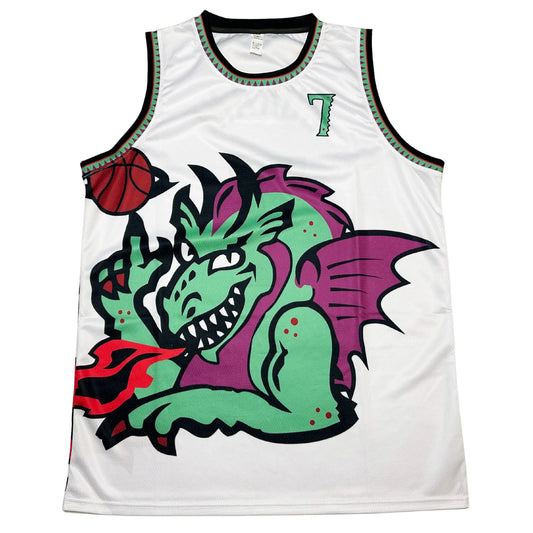


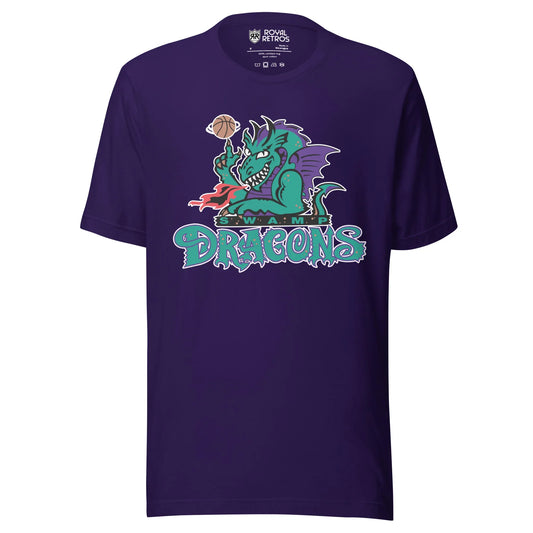


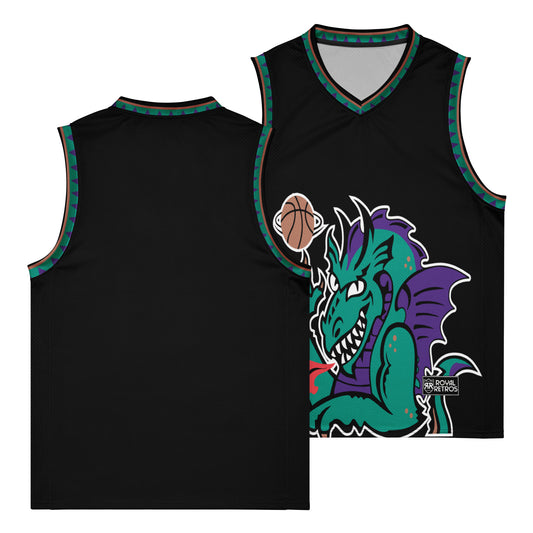
New Jersey Swamp Dragons — The Rebrand That Almost Happened
In 1994, the NBA's Board of Governors voted 26-1 to approve this identity. The one "no" vote belonged to the team itself. $29.99–$84.99. Sizes S–5XL.
The Swamp Dragons never played a single game — there was no team, no season, no roster, no arena banner. What there was, for a few months in 1994, was a fully designed NBA identity, approved by nearly every owner in the league, that died at the last possible second because of a single vote cast by the same franchise that had proposed it. Royal Retros built the uniform that never officially existed: a jersey, a replica jersey, and a t-shirt, all in the teal, purple, and black color scheme the real design team actually settled on. Jerseys run $84.99, replicas $69.99, and the t-shirt $29.99, all sized Small through 5XL.
What You Can Shop
Three active pieces: a $84.99 jersey in black, white, or teal; a $69.99 replica jersey with a blank-back or numbered option; and a $29.99 t-shirt. All three are sized Small through 5XL.
Shop by Design
- New Jersey Swamp Dragons Jersey — the full-build jersey, in black, white, or teal, S–5XL, $84.99.
- New Jersey Swamp Dragons Replica Jersey — a lighter replica cut, blank-back or numbered, S–5XL, $69.99.
- New Jersey Swamp Dragons T-Shirt — the same identity in tee form, five color options, S–5XL, $29.99.
Sizes and Customization
Every piece on this page runs Small through 5XL. Check the individual listing for available colorways and any name-and-number options — the replica jersey specifically offers a blank-back or a numbered version.
Why Royal Retros
- A genuinely rare kind of product — an identity that was designed and approved but never actually issued as team merchandise, built accurately rather than guessed at.
- The real color scheme — teal, purple, and black, matching what the actual design team settled on in 1994.
- The deepest defunct- and proposed-identity apparel catalog anywhere — this three-piece page is one narrow corner of a much larger proposed-teams collection.
Quick Buying FAQ
Are these officially licensed? No. The Swamp Dragons identity never became an official NBA team mark — the rebrand vote failed — so this is a heritage tribute design, not licensed product.
What sizes are available? Small through 5XL on all three pieces.
Can I customize the replica jersey? Yes — it offers a blank-back option or a numbered version. Check the listing for details.
Shipping & returns? Standard US shipping, with returns handled through our returns page.
Gift Ideas
- The 90s NBA trivia fan — almost nobody outside dedicated basketball-history circles knows this story in full.
- The "what could have been" collector — a genuinely unique category: real design work for a team identity that was never actually issued.
- The New Jersey basketball loyalist — a specific, dated piece of the state's basketball history, not a generic throwback.
What Were the Swamp Dragons?
The Swamp Dragons were a proposed new identity for the New Jersey Nets, developed and formally voted on by the NBA's Board of Governors in 1994. The team never took the court under that name — the rebrand failed at the final step — but the identity itself was real: a finished color scheme, a finished logo concept, and a serious push through the league's ownership structure that came within a single vote of actually happening.
Why Did the Nets Want to Change Their Name in the First Place?
By the mid-1990s, the New Jersey Nets were in real trouble as a brand. Playing in the shadow of two New York franchises across the river, the team drew from a smaller regional fan base, its merchandise sales ranked dead last in the league, and its existing logo was widely seen as forgettable. The team's seven-person ownership group, known informally as the "Secaucus 7," decided the answer might be a sharper, more marketable identity rather than a fresh coat of paint on the same one.
Why "Swamp Dragons" Specifically?
The trigger was competitive: two brand-new NBA expansion franchises, based in Toronto and Vancouver, were known to be heading toward cartoonish, mascot-driven names and logos — a direction that turned out to be exactly right, as those franchises became the Raptors and the Grizzlies. Nets leadership took note and decided a bolder, more cartoonish identity might solve their own merchandising problem. According to the most detailed account of the process, the team's vice president first floated "Swamp Rats" as a working name, a nod to the marshy Meadowlands terrain the team's arena sat on. After further discussion, the team landed on "Swamp Dragons" instead, paired with a cartoonish dragon logo and a color scheme of teal, purple, and black — a palette very much of its era, similar in spirit to several other NBA identities introduced around the same years.
Who Were the "Secaucus 7"?
The Nets were owned in the mid-1990s by a seven-person ownership group informally nicknamed the "Secaucus 7," after the New Jersey town near the team's Meadowlands home. That structure — seven separate owners sharing a single team, with voting responsibility on league matters rotating among them rather than resting with one principal owner — was unusual even by the standards of professional sports ownership, and it turned out to matter enormously for the Swamp Dragons proposal. A single-owner franchise makes a decision like a rebrand with one voice; a seven-person rotating structure means the person who happens to be holding the pen on a given vote can single-handedly reverse a position the whole group had already agreed to. That's essentially what happened here.
The Cartoonish-Mascot Era of 1990s Sports Branding
The Swamp Dragons pitch didn't come out of nowhere — it was a direct response to a real branding trend sweeping professional sports in the early-to-mid 1990s. Expansion and rebranded franchises across multiple leagues leaned hard into bold, cartoonish, mascot-driven identities during this window: NBA expansion teams landing on names like the Raptors and the Grizzlies, NHL expansion clubs adopting names built around a cartoon-friendly creature, and a general industry shift toward identities that photographed well on a young fan's bedroom wall and sold easily at a mall kiosk. The Nets' front office was reading that trend correctly — the two incoming NBA expansion franchises they were watching really did go cartoonish, and it really did work commercially for both of them. The Swamp Dragons proposal was New Jersey trying to get ahead of a wave that was about to define an entire era of sports merchandising, rather than trailing behind it with an outdated identity.
How Close Did the Vote Actually Come?
Once the design work was finished, the Nets brought the proposal to then-commissioner David Stern, who by his own account hated the idea from the start. Stern agreed to let it go to a full Board of Governors vote on one condition: all seven members of the Nets' own ownership group had to support it first. They did. The team then lobbied the league's other owners directly, and by the time the formal vote happened, it was already clear the proposal had broad support. New Jersey state officials pushed back over the word "Swamp" in the name, but that objection didn't stop the vote from moving forward. When the Board of Governors actually voted, the result came in 26-1 in favor — a resounding endorsement by the league's other ownership groups.
So Why Did It Fail?
Here is the detail that makes this story genuinely strange rather than just a rejected pitch: the one "no" vote came from the Nets themselves. The team's seven owners rotated responsibility for casting the franchise's official vote on league matters, and on this particular vote, that responsibility fell to co-owner David Gerstein. Despite the team having pushed the idea for months and lined up support from nearly the entire league, Gerstein got cold feet at the last minute and voted against the change he himself was representing. The rebrand needed the support of the team it affected, not just a league supermajority — and with the Nets' own vote going the wrong way, the Swamp Dragons identity died on the spot, despite a 26-1 result that would have been an overwhelming mandate in almost any other context.
What Happened to the Teams That Inspired the Pitch?
The two expansion franchises the Nets were watching when they commissioned the Swamp Dragons design both went on to have very different paths from each other. The Toronto club built around its cartoonish new identity eventually became a genuine championship franchise years later, proving the branding bet could coexist with real on-court success rather than being purely a merchandising gimmick. The Vancouver club had a rockier run, relocating to Memphis after only a handful of seasons in its original city — a reminder that a bold new identity alone doesn't guarantee a franchise's long-term stability in its original market. Both outcomes happened well after the Nets' own vote had already failed, but they're a useful reminder that the Nets weren't chasing a fantasy in 1994 — the branding trend they were reacting to was real, and it reshaped how professional sports teams marketed themselves for years afterward.
What Happened to the Nets Afterward?
The New Jersey Nets kept their existing name and identity for the better part of two more decades, eventually rebuilding around a different core of players and reaching the NBA Finals in the early 2000s before the franchise relocated to Brooklyn and adopted a new city and branding under that identity. That later, successful rebrand — a real relocation and a real new identity, unlike the Swamp Dragons proposal — is a different chapter of the same franchise's history, and it's the identity the team competes under today. The Swamp Dragons remain a closed, one-time proposal from years before that later move, never revived and never repurposed for the franchise's actual eventual rebrand.
Why Does This Story Still Get Told?
Few proposed-but-rejected sports rebrands come with this much documented detail — a finished color scheme, a named logo concept, a specific vote count, and a specific named individual whose last-minute decision changed the outcome. Most "what almost happened" sports stories are vague by comparison; this one has a scoreboard. That level of documentation is part of why the story keeps resurfacing in NBA retrospectives decades later, and it's exactly the kind of genuinely odd, well-sourced footnote that a heritage apparel collection can do justice to in a way a generic throwback design never could.
Why Do Collectors Care About an Identity That Never Shipped?
Most sports memorabilia represents something that actually happened — a game, a season, a championship. A never-issued identity like the Swamp Dragons is a different category entirely: there's no game-worn version to chase, no original retail run to hunt down, because nothing was ever produced for sale in 1994. Everything that exists under the Swamp Dragons name today is, by definition, a modern tribute recreation, which levels the playing field in an unusual way — there's no "original" grail item competing with a reproduction, because the original was a design file and a vote tally, not a shipped product. That makes this one of the purest examples of a heritage build anywhere in Royal Retros' catalog: a faithful recreation of a real, documented design, made because the real thing never had the chance to exist in the first place.
How Rare Is a Story Like This?
Sports history is full of vague "they almost changed the name" rumors that don't hold up to scrutiny once someone tries to source them properly. The Swamp Dragons story is unusual precisely because it doesn't fall apart under that scrutiny — it comes with a specific finished color scheme, a named logo concept, a documented vote count, and, thanks to a league executive who later spoke about it publicly, a specific named individual whose last-second decision changed the outcome. Very few "what almost happened" sports footnotes come with that level of corroborated detail, which is part of why this particular story keeps resurfacing in NBA retrospectives decades after the vote itself, and why it holds up as a genuinely deep well of history for a three-piece apparel collection this narrow.
What Makes Ours Period-Correct
Construction and accuracy. Sewn-on tackle-twill numbers and lettering where the original build called for it, era-correct fonts and colors, and true-to-original construction — every Heritage design is checked against period references before it goes live.
Extended FAQ
Did the Swamp Dragons ever actually play a game? No — the identity was never adopted. The team continued under its existing name after the 1994 vote failed.
Who cast the deciding vote? Co-owner David Gerstein, representing the Nets' seven-person ownership group on its rotating voting duty, voted against the change he had helped push for months earlier.
What made the Nets consider a mascot-style name in the first place? Two incoming NBA expansion franchises were expected to go with cartoonish branding, which turned out to be accurate — they became the Raptors and the Grizzlies — and the Nets wanted to compete on the same ground.
What colors would the Swamp Dragons have worn? Teal, purple, and black, based on the finished 1994 design work.
Where does the franchise play today? The team relocated from New Jersey to Brooklyn years after the failed 1994 vote and competes under a different identity today — a separate, later rebrand unrelated to the Swamp Dragons proposal.
Why did the commissioner allow the vote at all if he disliked the idea? He agreed to let it proceed only once all seven Nets owners had unanimously backed the plan themselves — a condition the team met before the league-wide vote.
Was "Swamp Dragons" the team's first choice of name? No — an early working name, "Swamp Rats," was reportedly floated first before the team settled on the more polished "Swamp Dragons" concept.
Did any other team almost change its name around the same era? The broader early-to-mid-1990s sports branding trend that inspired the Swamp Dragons pitch produced several real cartoonish rebrands league-wide, though the Swamp Dragons proposal is one of the few from that era that got all the way to a league vote and still failed.
Is there an official photo or game-worn version of the Swamp Dragons uniform? No — because the identity was never adopted, nothing was ever manufactured for retail or game use in 1994. Everything sold under this name today is a modern tribute build.
Shop Related Collections
- New Jersey — the full state catalog, 41 designs.
- New York — the wider regional catalog, 143 designs.
- Proposed Teams — more identities that came close but never quite happened, 34 designs.
Shop the Swamp Dragons Collection at Royal Retros — The 1994 Rebrand That Almost Happened.