Custom Hockey Jerseys — 178 Throwback Designs from Every League Hockey Ever Tried
178 Custom Hockey Jersey Designs. WHA, RHI, IHL, PCHA, Defunct NHL & International. Free Name & Number. Sizes S–5XL Plus Goalie Cut. $89.99–$119.99.
Royal Retros carries 178 custom hockey jersey designs, and the catalog is built the way a serious collector would build it — not around the handful of famous throwbacks every other shop carries, but around every hockey league that ever tried to make it. That means the WHA that bid up Bobby Hull and Gordie Howe, the International Hockey League that briefly tried to out-expand the NHL itself, the mid-1990s Roller Hockey International boom, the earliest professional circuit on the Pacific coast, a century of minor pro hockey across two dozen states, and the Olympic and international sweaters that carried the sport before any of those leagues existed. Every jersey is made to order with free personalization — add a name and any number in the customization screen before checkout, no upcharge. Standard sizes run Small through 5XL at $89.99, with a dedicated Goalie Cut available on most designs at $119.99. Roller Hockey International's sublimated jerseys run their own range, XS through a built-in goalie-sized 5XL, all at a flat $89.99. If a hockey team wore it and the league it played in stopped existing, there is a real chance we build it.
Shop Custom Hockey Jerseys by League
World Hockey Association (WHA), 1972–1979 — Roughly 35 designs, the largest single group in this collection. The WHA was the last serious rival major league in North American hockey, and it spent seven seasons signing away NHL stars and teenagers the NHL wasn't yet willing to sign — the Cincinnati Stingers put an 18-year-old Mark Messier on the ice in 1978–79 before he ever played a top-tier professional game elsewhere. We carry the Chicago Cougars, Houston Aeros, Vancouver Blazers, Philadelphia Blazers, Cincinnati Stingers, Minnesota Fighting Saints, Cleveland Crusaders, Calgary Cowboys, Michigan Stags, Los Angeles Sharks, New York Golden Blades, New York Raiders, Jersey Knights, San Diego Mariners, Ottawa Nationals, Toronto Toros, Birmingham WHA Bulls, Phoenix Roadrunners, Denver Spurs, and the four franchises that survived into the 1979 NHL merger — Hartford WHA, Quebec WHA, Winnipeg WHA, and WHA Racers, the Indianapolis franchise remembered today for a 17-year-old Wayne Gretzky's first professional contract. Shop the full run in World Hockey Association.
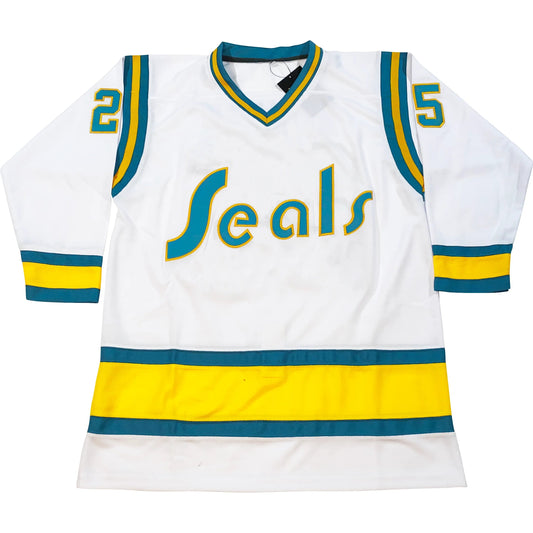
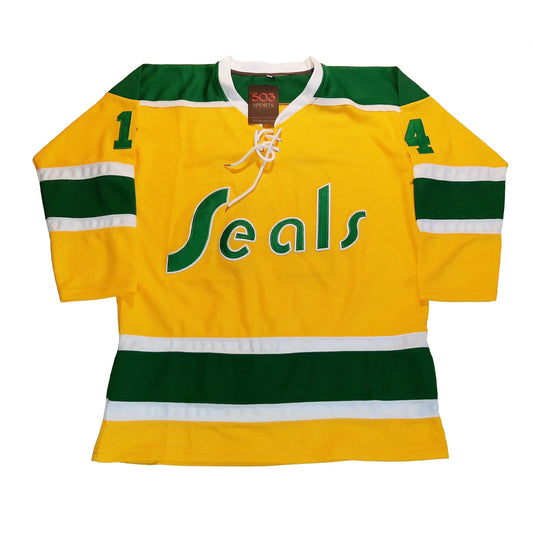
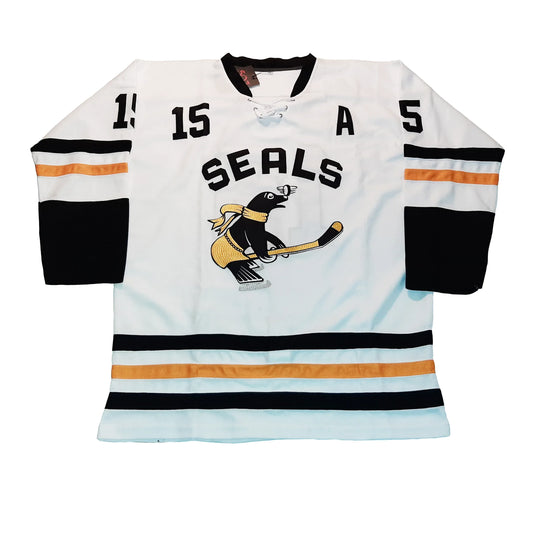
Defunct NHL franchises — Roughly 35 designs across every era of NHL teams that no longer exist under their original name or city. The early-league group covers the NHL's first fifteen seasons: New York Americans, Detroit Cougars, Toronto St Patricks, Philadelphia Quakers, Montreal Wanderers, Montreal Maroons, Quebec Bulldogs, Hamilton Tigers, and Pittsburgh's early NHL club. The mid-century and modern group covers California Golden Seals (multiple eras, including the white-skate years), Cleveland Barons, Atlanta Flames, Kansas City Scouts, Minnesota North Stars (multiple eras and a concept design), Colorado Rockies Hockey, Hartford Whalers, and Quebec Nordiques — the Nordiques design here traces the actual franchise from its 1972 WHA founding through the Stastny brothers' 1980 defection and a Peter Forsberg-and-Joe Sakic-stocked roster before the 1995 move to Denver. Shop the whole era at Legacy Hockey or Historic Hockey.
International Hockey League (IHL) — 20 designs. The IHL is one of the oldest minor pro leagues in North America, and by the 1990s it was trying to out-expand the NHL directly, planting big-arena franchises like the Detroit Vipers, Las Vegas Thunder, Atlanta Knights and Cleveland Lumberjacks before the whole thing folded in 2001. The Vipers alone are worth a look — Hall of Famer Gordie Howe took a single ceremonial shift in Vipers colors in 1997 at age 69, becoming the only player in pro hockey history to compete in six different decades. We also carry the league's older-school clubs: Toledo Mercurys, Flint Generals, Kansas City Blades, San Francisco Spiders, San Antonio Dragons, Dayton Gems, Port Huron Flags, Quebec Rafales, Madison Monsters, and the 1950s Johnstown Jets. Shop International Hockey League (IHL).
International & Olympic hockey — 16 designs spanning national-team sweaters from the 1960 and 1980 "Miracle on Ice" USA rosters through 1964, 1968 and 1984 USA teams, Canada Cup and Summit Series Team Canada jerseys, and the CCCP, Czechoslovakia, Switzerland, Germany and Finland national programs. We also carry Canada's 1950 Edmonton Mercurys, world hockey champions, and the 1920 Winnipeg Falcons and Winnipeg Maroons, Olympic-era Canadian hockey clubs. Shop the full run at International Hockey.
Central Hockey League (CHL), two separate eras — 14 designs. The original CHL ran 1963–1984 as a mid-tier development league; a second, unrelated CHL launched in 1992 across Texas and the Southwest before folding into the ECHL in the mid-2010s. Between both eras we carry the Tulsa Oilers, Omaha Knights, Topeka Scarecrows, Topeka Tarantulas, Austin Ice Bats, Lubbock Cotton Kings, Albuquerque Six-Guns, Seattle Totems, and a Cincinnati Stingers design from the CHL's second era — a different club from the WHA-era Stingers above, sharing only a city and a name. Shop Central Hockey League.
Roller Hockey International (RHI), 1993–1999 — 13 designs. RHI ran in NHL and NBA arenas over the summer, riding the mid-1990s in-line skating boom, and its team names lean gloriously over-the-top: Anaheim Bullfrogs (RHI's only multi-time champion, with Murphy Cup titles in 1993 and 1997), Vancouver Voodoo, Calgary Rad'z, San Jose Rhinos, Las Vegas Flash, Orlando Jackals, Atlanta Fire Ants, Long Island Jawz, Oakland Skates, Ottawa Loggers, Pittsburgh Phantoms, New Jersey Rockin Rollers, and the Detroit Motor City Mustangs. RHI jerseys are sublimated Replica builds only, XS through a built-in goalie-sized 5XL, all at $89.99 flat — no Pro Stitched option and no separate Goalie Cut upcharge. Browse the whole league at Roller Hockey International.
Western Hockey League (WHL), minor pro era — 10 designs of the minor pro WHL, not to be confused with today's major junior league of the same name. This is the West Coast circuit that carried the Denver Spurs, Seattle Totems, WHL San Diego Gulls, WHL Canucks, WHL Stampeders, Salt Lake Golden Eagles, Winnipeg Warriors, Los Angeles Blades, Billings Bighorns, and WHL Phoenix Roadrunners through the mid-20th century, well before any current major league franchise carried those city names. Shop Western Hockey League.
Pacific Coast Hockey Association / Pacific Coast Hockey League (PCHA/PCHL) — Six designs from hockey's earliest professional circuit on the West Coast, founded in 1911 by brothers Frank and Lester Patrick. The Vancouver Millionaires won the Stanley Cup in 1915 — the first West Coast team ever to do it — behind Hall of Famers Cyclone Taylor and Frank Nighbor. We also carry the Portland Rosebuds, Victoria Cougars, Spokane Canaries, Seattle Ironmen and Los Angeles Monarchs. Shop the era at Pacific Coast Hockey Association.
American Hockey League (AHL), vintage era — Five designs of AHL clubs from decades before the league's modern one-city-one-affiliate structure: Providence Reds, St Louis Flyers, a 1960s-era Cleveland Barons AHL club (a different franchise from the 1976–78 NHL Cleveland Barons above), Binghamton Whalers, and the Albany River Rats.
Independent, regional and minor pro leagues — Roughly 14 more designs from clubs and small leagues that never fit a neat national bracket, including the East Coast Hockey League's Huntsville Channel Cats, Mobile Mysticks, Tallahassee Tiger Sharks and Atlantic City Boardwalk Bullies; the Eastern Hockey League's Johnstown Jets — the real-life team behind the 1977 film Slap Shot — and River Vale Skeeters; the Western Professional Hockey League's Waco Wizards; and independents like the Baton Rouge Kingfish, Beast of New Haven, Richmond Robins, Louisville Icehawks, Lowell Lock Monsters, Baltimore Hockey Clippers, Quebec Aces and Niagra Falls Thunder. None of these clubs ever built a national following the way a WHA or NHL franchise did, but each one was a real local team with its own arena, its own box score, and — for a few seasons at least — its own hold on a city's hockey identity. That local-first character is exactly what makes this tier of the catalog hardest to find anywhere else; most vintage sellers stop well short of a Waco Wizards or a Baltimore Hockey Clippers design.
Proposed teams that never played a game — Two designs: the Hampton Roads Rhinos and the Florida Block Busters, franchises that were announced but folded before ever taking the ice. See Proposed Teams for the full house-wide list, which spans more than just hockey.
Shop by Team — The Names Fans Keep Asking For
A handful of franchises in this catalog carry stories bigger than their win-loss record. WHA Racers lasted only four WHA seasons, but they are the team that signed a 17-year-old Wayne Gretzky to his first professional contract in the summer of 1978. The Vancouver Millionaires won the 1915 Stanley Cup, the first time a West Coast club ever claimed the trophy, and remain one of the most decorated early-era franchises in this entire collection. The Anaheim Bullfrogs are the only multi-time Roller Hockey International champion, winning Murphy Cups in both the league's first season and its last. The Cincinnati Stingers gave an 18-year-old Mark Messier his first professional ice time before he built a career elsewhere. The Johnstown Jets are the real team behind Slap Shot — the film's Hanson Brothers were modeled on Johnstown's actual Carlson brothers. And the Detroit Vipers hold one of hockey's strangest footnotes: on October 3, 1997, Gordie Howe took a single ceremonial shift in Vipers colors at age 69, making him the only player in pro hockey history to compete in six different decades. Every one of these designs, and more than a hundred and seventy others, ships from the same $89.99–$119.99, Small–5XL-plus-Goalie-Cut catalog.
Construction, Builds & the Goalie Cut
Every custom hockey jersey in this collection is built from 100% polyester and made to order once you submit your personalization. Standard designs come in two build styles, chosen in the customization screen: Pro Stitched, with authentic stitched-on numbers and lettering for a heavier, more durable, classic on-ice look, and Replica, with high-quality printed graphics on lightweight, breathable fabric built for everyday wear rather than the rink. Roller Hockey International's sublimated jerseys are Replica-build only — there is no Pro Stitched option on RHI designs, which keeps their price flat at $89.99 regardless of size. Most standard designs also offer a dedicated Goalie Cut, a boxier, roomier fit sized for pads and equipment rather than a skater's build, priced at $119.99. RHI jerseys handle this differently: their largest size is labeled "5XL (Goalie)" and built into the standard $89.99 lineup rather than sold as a separate upcharge.
Customization
Free personalization is included on every jersey in this collection — add a name, a number, or custom text in the customization screen before you check out, with no charge for the option. Because every jersey is made to order around your personalization, customized jerseys are final sale once production starts; there are no returns or exchanges on a completed custom order. Exact lead time is shown in the customization screen itself before you commit to a purchase, since production timing can vary by design and build style.
Sizes
Standard (non-RHI) jerseys run Small through 5XL at $89.99, with a separate Goalie Cut size at $119.99 available on most designs — that upcharge covers the roomier goalie-specific pattern, not a bigger person's size. Roller Hockey International's sublimated jerseys run their own range, XS through 5XL, all at a flat $89.99, with the 5XL doubling as the built-in goalie size. Not every colorway on every design carries every size — check the specific product page before ordering if you need a less common size or an unusual color combination.
Why Royal Retros for Custom Hockey Jerseys
-
178 active jersey designs across a dozen-plus leagues and eras. WHA, IHL, CHL, RHI, WHL, AHL, ECHL, EHL, WPHL, PCHA/PCHL, defunct NHL, international and Olympic hockey, all in one collection.
-
Free personalization on every design. Name and number included at no extra charge in the customization screen.
-
A real Goalie Cut, not a guess. Most designs offer a dedicated goalie-pattern size, not just a bigger skater cut.
-
Depth no fan-site or general vintage seller matches. Most retailers carry a handful of famous WHA and defunct-NHL names. We carry the entire Roller Hockey International roster, the IHL's overexpansion era, and the Pacific coast's founding franchises.
-
Heritage tribute product, honestly labeled. Every jersey below is a vintage-inspired reproduction built from historical team identities, not an official league or team product.
Quick Buying FAQ
What size should I order?
Standard jerseys run Small through 5XL at $89.99, and most designs also offer a dedicated Goalie Cut at $119.99 for a roomier, equipment-friendly fit. If you skate as a goalie, order the Goalie Cut rather than sizing up a standard build — it is a different pattern, not just a bigger version of the same jersey. RHI sublimated jerseys run their own XS–5XL range with the goalie fit built into the 5XL.
What are these jerseys made of?
100% polyester across the whole collection. Pro Stitched builds use authentic stitched-on numbers and lettering for a heavier, more durable, classic on-ice look; Replica builds use high-quality printed graphics on lighter, more breathable fabric built for everyday wear. RHI sublimated jerseys are Replica-build only.
How does personalization work?
Every jersey includes free personalization — add a name, a number, or custom text in the customization screen before checkout. There is no upcharge for this option on any design in the collection.
How fast does it ship?
Every jersey here is made to order around your personalization, so lead time is shown directly in the customization screen before you complete your order. Because production is tied to your specific name and number, times can vary by design.
What is the return policy on a custom jersey?
Custom jerseys are final sale once production starts, since each one is built around your personalization and can't be resold as a standard item. Double-check spelling, numbers and size selection before submitting your order.
Are these officially licensed?
No. Every jersey in this collection is a vintage-inspired heritage tribute reproduction, built from historical team identities and not affiliated with, endorsed by, or licensed by any team, league or organization. That is true across the entire catalog, from the earliest PCHA designs to the most recent IHL and RHI clubs.
Why don't I recognize most of these teams?
Because most of them do not exist anymore. This collection is built around leagues and franchises that folded, merged or relocated — the WHA, the IHL's boom-and-bust 1990s, Roller Hockey International's one-decade run, and a century of minor pro clubs that came and went with the local economy. If a team here is unfamiliar, that is the whole premise of the catalog, not a gap in your hockey knowledge.
Do you carry T-shirts to match these jerseys?
Yes — a separate collection carries throwback T-shirts across many of these same leagues. See Hockey T-Shirts for that catalog. Note that T-shirts and custom jerseys are built and returned differently: T-shirts are stock items with standard returns, while jerseys are made to order around your personalization and are final sale.
The Hockey Sweater's Evolution — Why Wool, Why "Sweaters," and What Changed
Hockey jerseys are still called "sweaters" today, in official rulebooks included, because they originally were sweaters in the literal sense. Hockey took shape as an outdoor winter sport in the early 1900s, and its earliest players wore actual knitted wool sweaters, adapted from general cold-weather sportswear rather than purpose-built athletic equipment. That vocabulary outlasted the material by decades — you will still hear a modern NHL broadcast refer to a jersey as a "sweater," a direct holdover from the wool-knit era this collection's earliest PCHA and original-era NHL designs represent.
How did hockey sweater material change over the decades?
It moved from heavy wool knits in the sport's first half-century, to sturdier two-ply cotton-blend knits — the kind of durable, mid-century athletic fabric that also showed up in period varsity and letterman garments — through the middle of the 20th century, and finally to today's lightweight synthetic knits once polyester athletic fabric became the industry standard. Every jersey in this collection is built from that modern endpoint, 100% polyester, which is lighter, more breathable and far more colorfast than the wool the sport started with — but the looser, boxier silhouette of an original wool-era sweater is exactly what a dedicated Goalie Cut is built to echo today.
Why did old hockey sweaters have laced collars?
Because a laced or tied neck opening was the simplest way to adjust the fit of a knitted wool garment before ribbed knit collars and stretch fabrics existed. A rawhide or cord lace at the crew neck let a player tighten or loosen the collar by hand, which mattered on a hand-finished knit sweater far more than it does on a modern engineered-knit jersey. That laced collar is one of the clearest visual markers of an early-era hockey sweater, and it largely disappeared once manufacturers moved to set-in ribbed collars and, later, the V-neck and modern crew cuts seen across this collection's later-era designs.
Why Do So Many of These Hockey Leagues No Longer Exist?
Because professional hockey below the NHL has spent a century running as a high-turnover business, and the jerseys in this collection are the physical record of that turnover. The WHA, Roller Hockey International, the IHL's 1990s expansion era, and the long list of regional minor pro circuits underneath them folded, merged or contracted for some combination of the same three reasons: they spent more chasing NHL-level ambitions than their markets could support, they depended on a fad or a bidding war with a natural expiration date, or they simply could not out-travel their own geography on minor league budgets.
Why did the WHA fold?
The WHA folded in 1979 because the bidding war it started against the NHL for top talent was never financially sustainable across a dozen-plus markets at once. Franchises relocated constantly chasing viable arenas and paying fan bases — the Los Angeles Sharks became the Michigan Stags, then the Baltimore Blades, then folded outright before the league's final season, and the Ottawa Nationals became the Toronto Toros, then the Birmingham WHA Bulls. Only four franchises were healthy enough to survive into the 1979 NHL merger: Hartford WHA, Quebec WHA, Winnipeg WHA and the Edmonton WHA club. Every other team, including the young, talent-stacked Cincinnati Stingers, folded outright or was bought out in the merger settlement.
Why did the International Hockey League fold in 2001?
The IHL's 1990s expansion outran its own revenue. Big-arena franchises like the Detroit Vipers, Las Vegas Thunder and Atlanta Knights carried NHL-level costs without NHL-level television and gate money to match, and several clubs lost money for years before ownership groups gave up. The league stopped operating after the 2000–01 season, and its stronger surviving franchises moved into the American Hockey League, which by then had solidified its position as the sport's primary development league. The IHL's older, pre-expansion clubs — Toledo Mercurys, Flint Generals, the 1950s-era Johnstown Jets — represent the league's more traditional identity, before the big-arena era changed its economics.
What was the Central Hockey League, and why are there two of them in this collection?
Two unrelated leagues have carried the Central Hockey League name. The original CHL ran from 1963 to 1984 as a mid-tier development league feeding NHL rosters — the era a franchise like the WHA-era Cincinnati Stingers' pro hockey roots trace back to. A second, unrelated CHL launched in 1992 across Texas and the Southwest — the league behind the Austin Ice Bats, Albuquerque Six-Guns and Lubbock Cotton Kings in this collection — before eventually folding its membership into the ECHL in the mid-2010s. The city, team and years on a given jersey are the only reliable way to tell which CHL a design belongs to, since the league name alone does not disambiguate them.
Why did in-line roller hockey disappear after just one decade?
Because Roller Hockey International's business was built directly on top of the mid-1990s in-line skating boom, and that boom peaked and declined within the same decade. RHI played in NHL and NBA arenas over the summer off-season and briefly became a real television property, with teams like the Anaheim Bullfrogs, Vancouver Voodoo and Atlanta Fire Ants drawing real crowds. Without the broader in-line trend feeding new fans into the sport, attendance and sponsorship revenue thinned out league-wide, and RHI stopped operating after the 1999 season — one of the most distinctive one-decade sports leagues in American history.
What was hockey's first fully professional West Coast league?
The Pacific Coast Hockey Association, founded in 1911 by brothers Frank and Lester Patrick, was hockey's first fully professional league on the West Coast, and it ran as a genuine rival to the early NHL for top talent and the Stanley Cup itself — the Vancouver Millionaires won the Cup outright in 1915. The Patricks' PCHA is also credited with several rules innovations that became standard across hockey, including the blue line and allowing goaltenders to leave their feet to make a save. The league folded into the Western Canada Hockey League in 1924, and its regional descendants, including the Pacific Coast Hockey League and later the minor pro Western Hockey League, carried West Coast professional hockey through the middle of the 20th century.
Why do so many minor-pro hockey teams keep folding or relocating?
Because minor pro hockey runs on thin margins in mid-sized markets, and travel between clubs adds cost that bigger markets never have to absorb — leagues like the second-era CHL and the Western Professional Hockey League covered enormous stretches of the American South and Southwest, markets with almost no hockey tradition before these clubs showed up. A single ownership change, a lost arena lease, or one bad attendance year was often enough to end a franchise or send it looking for a new city, which is exactly why teams like the Waco Wizards, Beast of New Haven and Lowell Lock Monsters changed names, changed towns, or simply stopped playing within a decade of starting.
How to Date a Vintage-Style Hockey Sweater
Four details tell you roughly which era a hockey sweater's design belongs to, and this collection's build styles are made to match them intentionally.
-
Collar style. A laced or tied crew neck points to the earliest wool-knit era; a plain ribbed crew or set-in V-neck points to the mid-century transition; today's engineered-knit crew, seen across this collection's modern builds, is the current standard.
-
Fabric weight and finish. Heavier, matte-knit wool textures belong to the earliest designs; a smoother, tighter two-ply knit belongs to the mid-century transition; a light, slightly sheened synthetic knit — like the 100% polyester used across every jersey in this collection — is the modern standard.
-
Striping and trim. Multiple thin stripes stacked at the cuffs and hem, sometimes called "candy stripes," are typical of pre-1970s designs; cleaner, wider single- or double-stripe blocks are typical of the 1970s onward.
-
Lettering and numbers. Sewn-on felt or chenille lettering points to the earliest and mid-century eras; screen-printed or heat-applied graphics point to the 1970s onward; the Pro Stitched build available on most designs here recreates the classic sewn-on look with modern materials, while the Replica build uses printed graphics for a lighter, more casual finish.
How to Identify an Authentic Vintage-Style Hockey Jersey
-
Check that the team and era actually existed. A jersey claiming to be a specific league's team should match a real franchise from that league's actual run of years — the WHA operated 1972–1979, RHI 1993–1999, and the IHL's expansion era ran through the 1990s until its 2001 folding.
-
Match the collar and fabric to the era. A laced collar and heavy knit belong to the sport's earliest decades; a lighter, engineered synthetic knit belongs to today's builds. A jersey claiming a 1920s identity in a modern synthetic build is a modern remix, not a period reproduction, and should be labeled as such.
-
Look for an honest licensing disclaimer. Every jersey in this collection is vintage-inspired tribute apparel, and the product page says so directly. A seller claiming blanket official licensing across an entire mixed-era hockey catalog is a red flag.
-
Verify the city and league match. Several teams in this catalog moved cities or leagues mid-history — the Los Angeles Sharks became the Michigan Stags, then the Baltimore Blades — so a jersey should specify which city-era it represents rather than mixing eras.
-
Royal Retros standard: every design in this collection is built from team, year and league information referenced against the franchise's actual documented history before it goes live.
More Frequently Asked Questions About Custom Hockey Jerseys
How many custom hockey jersey designs does Royal Retros carry?
178 active designs across a dozen-plus leagues and eras, from the 1911-founded Pacific Coast Hockey Association through the WHA, IHL, CHL, RHI, defunct NHL clubs, and international/Olympic national teams.
What leagues are covered in this collection?
The World Hockey Association, defunct NHL franchises, the International Hockey League, Roller Hockey International, the Central Hockey League (both eras), the minor-pro Western Hockey League, the American Hockey League, the East Coast Hockey League, the Eastern Hockey League, the Western Professional Hockey League, the Pacific Coast Hockey Association/League, international and Olympic national teams, and a range of independent regional minor leagues.
Is there a Goalie Cut on every design?
Most standard (non-RHI) designs offer a dedicated Goalie Cut at $119.99. RHI sublimated jerseys build the goalie fit into their largest size, 5XL, at the standard $89.99 price instead of offering it as a separate cut. Check the specific product page to confirm availability on a given design.
Do any of these teams still exist today under their current identity?
No currently-operating major professional franchise is represented by its current, live identity anywhere in this collection. Every design covers a team, era or league that has folded, merged, relocated under a different name, or — in two cases, the Hampton Roads Rhinos and Florida Block Busters — never played a season at all.
What is the difference between the WHA and the defunct-NHL designs in this collection?
The WHA (1972–1979) was a separate rival major league that operated alongside the NHL before four of its franchises merged in. The "defunct NHL" designs are teams that played in the NHL itself under a name or in a city that no longer exists — the California Golden Seals, Atlanta Flames, Kansas City Scouts, Minnesota North Stars and Colorado Rockies Hockey among them.
What is the oldest team represented in this collection?
The Vancouver Millionaires, Portland Rosebuds and Victoria Cougars all trace back to the Pacific Coast Hockey Association's 1911 founding, alongside the NHL's own first-fifteen-seasons clubs — the New York Americans, Detroit Cougars, Toronto St Patricks, Montreal Wanderers and Hamilton Tigers — making them the oldest identities in the entire catalog.
Why do some jerseys use a league prefix instead of just a city and team name?
Several city-and-team combinations in hockey history have been reused by a different, currently-operating league or franchise since — a modern Hartford Whalers identity, a modern Winnipeg Jets, a modern Vancouver Canucks. Where that overlap exists, this collection's product titles use a league-prefixed form like "WHA Racers" or "WHL Canucks" to make clear which historic franchise and era the jersey represents.
Can I get a jersey personalized with a name that isn't a real player's?
Yes. The free personalization on every jersey in this collection accepts any name, number or short custom text you choose — it is not limited to rosters from the team's actual playing days. Most customers do pick a real player from the franchise's history, but the option is yours in the customization screen.
Is a Pro Stitched build worth the difference over a Replica build?
It depends on how you plan to wear it. Pro Stitched gives you authentic sewn-on numbers and lettering and a heavier, more durable fabric closer to what an actual on-ice jersey feels like — the better choice if you want something built to last through regular wear or a game-day environment. Replica uses lighter, printed graphics on more breathable fabric, which suits casual everyday wear better than a heavier on-ice build. Both styles are available on every standard (non-RHI) design at the same price point.
Shop Related Hockey Collections
Custom Hockey Jerseys at Royal Retros — 178 Designs from Every League That Tried. Free Name & Number. Sizes S–5XL Plus Goalie Cut. $89.99–$119.99.