




-
CUSTOM
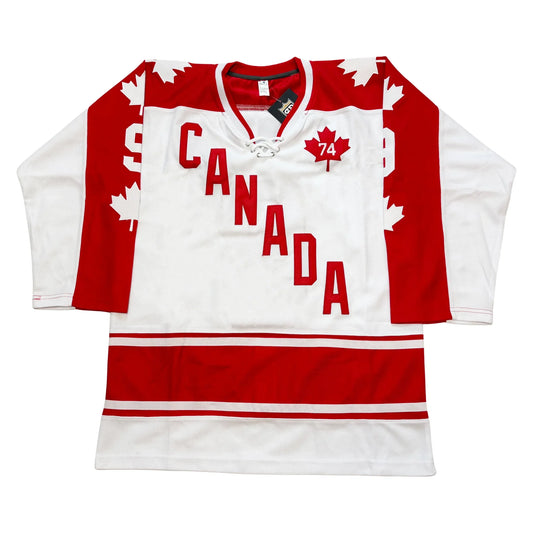
Canada Cup Team Canada Jersey
Regular price Starting at From $89.99 USDRegular priceUnit price per -
-
CUSTOM
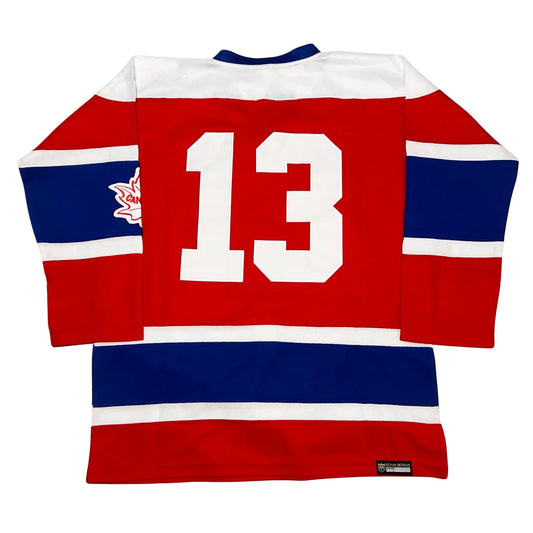
1964 Canada Hockey Jersey
Regular price Starting at From $89.99 USDRegular priceUnit price per -
-
CUSTOM
Summit Series Canada Jersey
Regular price Starting at From $89.99 USDRegular priceUnit price per -






Canada Hockey — Royal Retros Team Canada Fan Shop
Heritage Team Canada Jerseys From Three Landmark Eras. Custom Names & Numbers. Sizes S–5XL. The Maple Leaf, Made to Order.
Royal Retros carries heritage Team Canada jerseys built around three of the most important eras in international hockey history: the 1964 Olympic program that gave Canada its first true national team, the 1972 Summit Series that turned a hockey series into a Cold War national moment, and the Canada Cup years that followed. We stock three in-stock custom jerseys — the Summit Series jersey in Red or White, the 1964 jersey in Red, and the Canada Cup jersey in Red or White — each $89.99 for a standard cut and $119.99 for a goalie cut, with free custom name and number on the standard build. Sizes run Small through 5XL. This is streetwear built around the biggest moments in Canadian hockey history, not a generic maple-leaf logo tee.
Shop by Colorway — Red or White
Red — the color most associated with Team Canada internationally, available across all three jerseys in this collection. It's the shade people picture first when they think of the Summit Series or a Canada Cup final.
White — the away look, available on the Summit Series and Canada Cup jerseys. A cleaner, more everyday-wearable option for anyone who wants the Team Canada identity without the boldest possible colorway.
Customization — every jersey offers free name and number personalization. Put your own name and number on the back, or a legend's — Paul Henderson, Bobby Orr, Wayne Gretzky, Mario Lemieux. Custom items are made to order and are final sale.
Sizes — Small through 5XL on every jersey in the collection, plus a Goalie Cut on all three. We do not upcharge for big & tall sizes.
Shop by Era — Three Moments That Built Canadian Hockey Identity
1964 — Canada's First National Team. Before 1964, Canada sent club teams to the Olympics and world championships. The 1964 jersey represents the first true national program, built specifically to compete on the international stage. Shop the 1964 jersey.
1972 — The Summit Series. Eight games against the Soviet Union that turned into the defining moment in Canadian hockey history, capped by a goal that Canadians of a certain generation can describe from memory. Shop the Summit Series jersey in Red or White.
1976–1991 — The Canada Cup Years. Five best-on-best tournaments that included some of the greatest hockey ever played, from a Daryl Sittler overtime winner to the Gretzky-to-Lemieux goal still replayed today. Shop the Canada Cup jersey in Red or White.
Everyday Wear, Not Just Game Day
A Team Canada jersey from this collection works well past the final buzzer of whatever game inspired it. The Red colorway pairs naturally with denim and neutral outerwear for a bold, single-color statement piece, while the White works as a lighter layering option that doesn't compete with the rest of a fit. None of these jerseys are tied to a single current roster or season, which means none of them go out of style the way a modern player jersey can the moment a trade happens — the 1972 Summit Series jersey has read the same way for more than fifty years, and it will read the same way in another fifty.
Sizes and Customization
All three jerseys run Small through 5XL in a standard cut, with a Goalie Cut available on every style. Every jersey offers free custom name and number on the standard cut — add your own name, or a piece of the roster history behind whichever era you pick. Custom jerseys are made to order and are final sale.
Why Royal Retros Is the Home of Team Canada Throwback Gear
- Three real eras, not one generic maple leaf. The 1964 national team, the 1972 Summit Series and the Canada Cup years each get their own jersey, built to that era's actual look.
- Free customization on every jersey. Add your own name and number at no extra cost on the standard cut.
- Sizes Small through 5XL. No big & tall upcharge on any product in the collection.
- Goalie Cut available on all three jerseys. A detail most throwback sellers skip entirely.
- Deep hockey cross-shopping. Pair a Team Canada jersey with the wider custom hockey jersey range, Legacy Hockey or the broader Canada catalog in a single order.
Quick Buying Questions
What sizes do Team Canada jerseys come in?
Small through 5XL on all three jerseys, plus a Goalie Cut on every style. We do not upcharge for big & tall sizes.
Can I customize a Team Canada jersey?
Yes — every jersey in this collection offers free custom name and number on the standard cut. Custom items are made to order and are final sale.
What do Team Canada jerseys cost?
$89.99 for the standard cut, $119.99 for the Goalie Cut, across all three jerseys.
Which colorway should I get — Red or White?
Red is the bolder, more traditionally recognized Team Canada look and is available on all three jerseys. White is the lighter away option, available on the Summit Series and Canada Cup jerseys, and works well if you want something a little more understated.
How fast does it ship and what is the return policy?
Custom items with a personalized name or number are made to order and ship within 7–10 business days. Custom items are final sale. Standard items follow our return policy at /pages/returns.
Gift Ideas from the Canada Hockey Collection
- For the Paul Henderson generation — the Summit Series jersey with a custom name and number, honoring the eight games that defined a hockey country.
- For the deep hockey historian — the 1964 jersey, covering the program that started it all before most fans were watching.
- For the Gretzky-Lemieux era fan — the Canada Cup jersey, built around the tournament that produced one of the sport's most replayed goals.
- For the goalie in your life — any of the three jerseys in the Goalie Cut.
Who Built Canada's First National Hockey Team?
Father David Bauer, a priest and former hockey player, proposed the idea to the Canadian Amateur Hockey Association in 1962 after Canada's amateur club representatives had slipped to bronze at the 1956 Olympics and silver in 1960. Rather than sending whichever Canadian club team happened to be the reigning senior champion, as had been the country's practice, Bauer built a genuine national program from scratch, based at a Canadian university campus and made up of top university-aged players training together for a full season before international competition. Goaltender Seth Martin, who had already won a world championship with a club team in 1961, forward Brian Conacher, defenseman Roger Bourbonnais and Marshall Johnston were among the players who built that first roster's identity. It was a structural bet that a dedicated, season-long national program would outperform Canada's old system of sending its best available club team — and the bet shaped how Canada has approached international hockey ever since.
What Happened to Canada at the 1964 Innsbruck Olympics?
Canada's first national team played a full slate of exhibition games from October 1963 through February 1964 before the Olympics opened in Innsbruck, Austria, and the results on the ice were genuinely strong: five wins and two losses, with the only losses coming against Czechoslovakia and the Soviet Union. Canada, Sweden and Czechoslovakia all finished the tournament with identical 5-2 records, which meant the medals came down to a tiebreak. Canadian officials believed they had won bronze based on goal differential among just the three tied teams' head-to-head games. The International Ice Hockey Federation instead applied a tiebreak using goal differential across all seven games each team had played in the tournament, a method that favored Czechoslovakia's larger overall margin. Canada finished fourth, without a medal, in what remains one of the most disputed tiebreak rulings in Olympic hockey history — a heartbreaking result for a program built specifically to prove Canada could still compete at the top of international hockey.
Why Did Canada Withdraw From International Hockey in 1970?
Father David Bauer's national team program kept going after 1964, winning bronze medals at the 1966 and 1967 World Championships and again at the 1968 Olympics. But the deeper problem the program was built to solve never went away: Canada's amateur players, university-aged or otherwise, were falling further behind Soviet and European teams that trained as full-time state-supported programs while calling themselves amateurs. By 1970, Canadian officials had concluded that an amateur-only national team simply could not compete fairly, and Canada withdrew from international competition entirely rather than keep entering a tournament format it viewed as rigged against a genuinely amateur country. That withdrawal set up the conditions for the biggest change in the sport's international history: when Canada returned to the world stage in 1972, it came back with its full complement of NHL professionals instead of amateurs, in the Summit Series.
Why Was the 1972 Summit Series Such a Big Deal for Canada?
The Summit Series mattered because Canada expected to win easily and very nearly didn't. By 1972, Canada's amateur club teams could no longer keep pace with the best European programs, and Canada had actually withdrawn from international competition in 1970 rather than keep losing with amateur-only rosters. The Summit Series was the answer: an eight-game showcase pitting Canada's National Hockey League professionals, playing for the country for the first time on this stage, against the Soviet Union's national team. Most Canadians expected a rout. Instead, the Soviets won Game 1 in Montreal 7–3, an outright shock that reset expectations for the rest of the series and turned it into a genuine referendum on which country actually played the best hockey in the world.
How Did the Summit Series Actually End?
Canada trailed for most of the series. After splitting the first four games in Canada and dropping Game 5 in Moscow, Canada faced a must-win stretch down 3-1-1 with three games left, all on Soviet ice. Paul Henderson scored the winning goal in Game 6, the winning goal again in Game 7, and then the winning goal a third straight time in Game 8 — with 34 seconds left on the clock, beating a young Soviet goaltender who would go on to become one of the position's greatest players. Canada won the series four games to three, with one tie, and Henderson's final goal remains one of the most replayed moments in Canadian sports history, a single shot that an entire generation of Canadians can describe from memory decades later.
What Was the Canada Cup, and Why Did It Matter?
The Canada Cup was a best-on-best tournament held five times between 1976 and 1991, bringing together Canada, the Soviet Union, Czechoslovakia, Sweden, Finland and the United States in a format the Olympics of that era couldn't match, since the Olympics were restricted to amateur players while the NHL's professional stars sat out. Canada won four of the five tournaments. The first, in 1976, ended with Daryl Sittler scoring the championship-winning goal against Czechoslovakia. The second, in 1981, was the exception — the Soviet Union routed Canada 8–1 in a one-game final, still remembered as one of the most lopsided results in the tournament's history. Canada answered by winning the next two, including a dramatic 1984 semifinal overtime winner from Mike Bossy against the Soviets before beating Sweden in the final.
What Happened in the 1987 Canada Cup Final?
The 1987 tournament produced what many consider the greatest best-on-best hockey ever played. Canada and the Soviet Union split the first two games of the best-of-three final, each decided in overtime by a 6–5 score. In the deciding Game 3, with the score tied 5–5 and under two minutes left, Canada's coach sent out a line of Wayne Gretzky, Mario Lemieux and Dale Hawerchuk for a defensive-zone faceoff. Gretzky fed Lemieux for the winning goal in the final minute, a give-and-go that remains one of the most replayed highlights in hockey history and clinched Canada's third Canada Cup title.
How Did the Canada Cup Era End?
The tournament's fifth and final edition came in 1991, when Canada beat the United States in a two-game sweep of the best-of-three final at Copps Coliseum in Hamilton, Ontario, for the country's fourth Canada Cup championship in five tries. It was the last time the event was held under the Canada Cup name — the tournament was later restructured and rebranded, but the five editions covered in this collection remain the ones most associated with the format's golden years, from Sittler's 1976 winner through Gretzky-to-Lemieux in 1987.
Why Does Hockey Carry So Much National Identity in Canada?
Few countries treat one sport as central to their national self-image the way Canada treats hockey, and the three eras in this collection are a big part of why. The 1964 national team was built specifically because Canada's amateur club teams could no longer credibly claim to represent the country's best hockey against a rising Soviet and European program — a genuine identity crisis for a country that had long assumed it was simply the best at the sport by default. The 1972 Summit Series turned that anxiety into open Cold War theater, professional NHL players facing the Soviet national team for the first time with genuine doubt about the outcome, and Canada's come-from-behind win became a foundational national memory instead of just a hockey result. The Canada Cup years that followed kept that best-on-best format alive for nearly two decades, through a lopsided Soviet blowout in 1981 and some of the most celebrated individual moments in the sport's history in 1984 and 1987. Together, the three eras trace hockey's evolution in Canada from assumed birthright, to genuine international contest, to a tournament format built specifically because Canada needed to keep proving it.
Extended Team Canada FAQ
What is the 1964 jersey based on?
Canada's first true national hockey team program, formed after Canada's amateur club teams fell behind the top European countries at the 1956 and 1960 Olympics. The team trained together as a dedicated national squad rather than sending an existing club team to represent the country, a structural change that shaped how Canada has approached international hockey ever since.
What is the Summit Series jersey based on?
The 1972 eight-game series between Canada's NHL professionals and the Soviet Union's national team — the first time NHL players represented Canada on this stage. Canada won the series 4-3-1, capped by Paul Henderson's series-winning goal with 34 seconds left in Game 8.
What is the Canada Cup jersey based on?
The Canada Cup, a best-on-best tournament held five times between 1976 and 1991. Canada won four of the five editions, including the celebrated 1987 final decided by a Wayne Gretzky-to-Mario Lemieux goal in the final minute of Game 3.
Did Canada win every Canada Cup?
No. The Soviet Union won the 1981 tournament outright, beating Canada 8–1 in a one-game final. Canada won the other four editions — 1976, 1984, 1987 and 1991.
Are these officially licensed?
No. These are heritage tribute reproductions built around specific eras of Canadian international hockey, not officially licensed product. We build them because these three moments deserve real, era-specific designs rather than one generic maple-leaf jersey.
Is this gear connected to any hockey federation or team?
No. Royal Retros is an independent throwback and tribute apparel shop. We are not affiliated with, endorsed by, or sponsored by Hockey Canada, the International Ice Hockey Federation, or any federation, team or player named on this page.
How many Team Canada products does Royal Retros carry?
Three in-stock custom jerseys, each built around a different era — 1964, the 1972 Summit Series and the Canada Cup years.
What is the difference between the three jerseys?
The 1964 jersey is Red only, representing Canada's first national team program. The Summit Series jersey and the Canada Cup jersey are each available in Red or White, representing two different multi-year stretches of Team Canada history. All three run S–5XL with a Goalie Cut and free customization on the standard cut.
Shop Related Collections
- Custom Hockey Jerseys — the full custom jersey range across every league and program we cover.
- Canada — the wider Canadian sports catalog across every sport we stock.
- Legacy Hockey — 70-plus defunct and historic hockey franchises.
- Custom Jerseys — the full custom jersey catalog across every sport Royal Retros carries.
Team Canada at Royal Retros — Heritage Jerseys From Three Landmark Eras. Custom Names & Numbers. Sizes S–5XL. The Maple Leaf, Made to Order.