




-
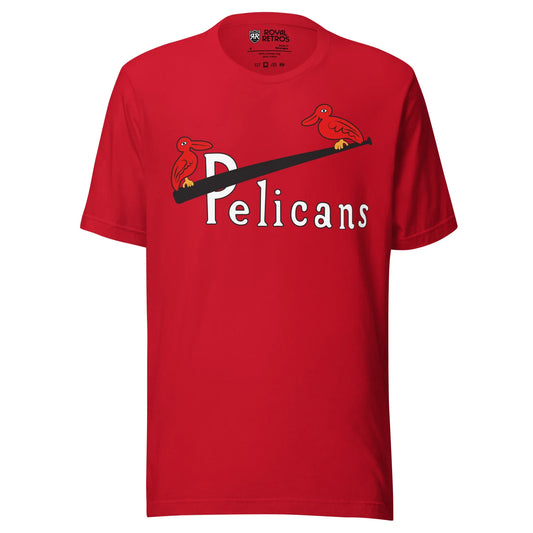
New Orleans Pelicans T-Shirt
Regular price $29.99 USDRegular priceUnit price per -
-
New Orleans Pelicans Baseball Snapback Hat
Regular price $34.99 USDRegular priceUnit price per -
-
NEW
New Orleans Pelicans Blackout Snapback Hat
Regular price $34.99 USDRegular priceUnit price per -
NEW
New Orleans Pelicans Long Sleeve T-Shirt
Regular price $34.99 USDRegular priceUnit price per -
-
New Orleans Pelicans Unstructured Hat
Regular price $29.99 USDRegular priceUnit price per -
-
CUSTOM
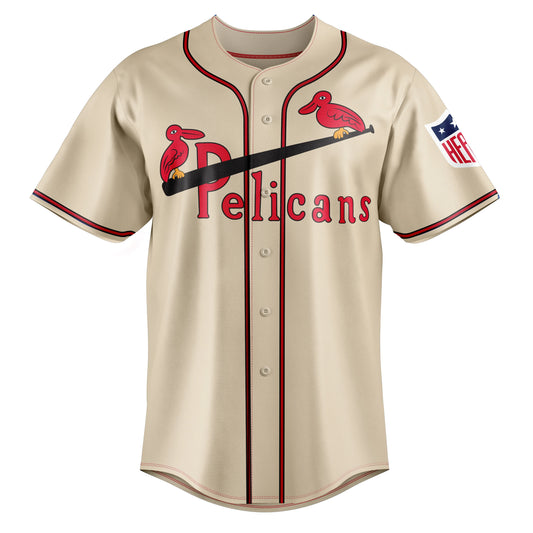
1942 New Orleans Pelicans Baseball Jersey
Regular price Starting at $84.99 USDRegular priceUnit price per -
-
CUSTOM
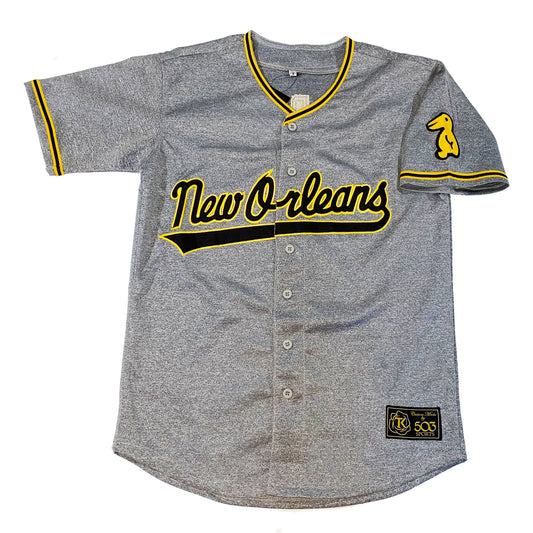
1950 New Orleans Pelicans Baseball Jersey
Regular price Starting at $84.99 USDRegular priceUnit price per -







The New Orleans Pelicans Baseball Collection — Royal Retros New Orleans Pelicans Baseball Fan Shop
Authentic New Orleans Pelicans Baseball Throwbacks. Custom Names & Numbers. Sizes S–5XL.
Royal Retros carries five New Orleans Pelicans Baseball throwbacks built around one of the longest-running franchises in Southern minor league history — a club that played professional baseball in New Orleans from 1887 to 1959, won twelve pennants across two different Southern leagues, and once had Shoeless Joe Jackson leading the league in hitting. The 1942 and 1950 jerseys are $84.99 each in Cream or Gray, sizes Small through 5XL, with free custom name and number. The tee is $29.99 in five colorways, and the hats run $29.99–$34.99. There is no current professional baseball team playing as the Pelicans — the name has belonged to a different sport in New Orleans since 2013 — which makes this small collection one of the only places left to wear the baseball history the name actually started with.
What You Can Shop in the New Orleans Pelicans Baseball Collection
1942 New Orleans Pelicans Baseball Jersey — A twill-lettered throwback in Cream or Gray, sized Small through 5XL, with free custom name and number on request. $84.99. Shop the 1942 jersey.
1950 New Orleans Pelicans Baseball Jersey — The same Cream or Gray construction from a different pennant-contending season, Small through 5XL, free custom name and number. $84.99. Shop the 1950 jersey.
New Orleans Pelicans T-Shirt — Soft, pre-shrunk cotton in five colorways: Black, Red, Athletic Heather and White run Small through 5XL, and Natural runs Small through 4XL. $29.99. Shop the tee.
New Orleans Pelicans Baseball Snapback Hat — A structured five-panel snapback in Black or Black/Natural, one-size-fits-most. $34.99. Shop the snapback.
New Orleans Pelicans Unstructured Hat — A relaxed dad-hat build in Black, one-size-fits-most adjustable back. $29.99. Shop the hat.
Customization — Free custom name and number on both jerseys. Custom items are made to order and final sale.
Sizes — Small through 5XL on both jerseys and most tee colorways (Natural runs through 4XL). Hats are one-size-fits-most.
Shop the Pelicans by Era
1942 — The Pittsburgh Years Approaching. The Cream 1942 jersey represents the World War II-era Pelicans, playing out of Pelican Stadium in the years just before the club's long run as a Pittsburgh Pirates affiliate began. Shop the 1942 jersey.
1950 — Postwar Pelican Stadium Baseball. The 1950 jersey captures the club in its final decade at Pelican Stadium, a few years before the ballpark's 1957 demolition ended more than four decades of baseball on the same Mid-City site. Shop the 1950 jersey.
Why Royal Retros Is the Home of New Orleans Pelicans Baseball Throwback Gear
- Two full jersey eras, not one generic logo. The 1942 and 1950 jerseys are built to their own seasons, not a single house pattern stretched across seven decades.
- Flat, honest pricing. Jerseys $84.99, tee $29.99, hats $29.99–$34.99. No "collector's" markup for a defunct-team throwback.
- Free customization on both jerseys. Add a name and number at no extra cost.
- Sizes S–5XL on nearly everything. True family sizing, no big & tall upcharge.
- Deep Southern baseball coverage. Cross-shop the Pelicans alongside our Louisiana collection and the rest of our historic minor league baseball catalog.
Quick Buying Questions
What sizes do the New Orleans Pelicans jerseys come in?
Small through 5XL, in Cream or Gray, on both the 1942 and 1950 styles. The tee runs Small through 5XL in four colorways and Small through 4XL in Natural. Hats are one-size-fits-most.
Can I add my name and number to a Pelicans jersey?
Yes — free custom name and number on either jersey. Custom items are made to order and final sale.
Which jersey year should I pick?
If your family's New Orleans baseball memory runs through the war years and the early Pittsburgh Pirates affiliation, go 1942. If you remember postwar Pelican Stadium closer to the ballpark's final decade, go 1950.
How fast does it ship and what's the return policy?
Stock items ship within 3–5 business days. Custom jerseys are sewn to order and typically ship within 7–10 business days. Custom items are final sale. Standard items follow our return policy at /pages/returns.
Gift Ideas for the New Orleans Pelicans Baseball Fan
- For the Shoeless Joe Jackson collector: Jackson's only Pelicans season, 1910, produced a league batting title — a jersey with one of the great individual seasons in Southern Association history behind it.
- For the New Orleans baseball historian: Professional baseball in New Orleans under this name dates to 1887 — one of the longest continuous minor league identities in the South.
- For the trivia fan: A Pelicans manager is credited with inventing the "rain check" in 1889 — a piece of stadium culture every baseball fan uses without knowing where it came from.
- For the Tony La Russa or Danny Murtaugh completist: Both future World Series-winning managers passed through the Pelicans organization, decades apart.
- Year-round demand. Pelicans baseball nostalgia isn't seasonal — birthdays, Father's Day and Opening Day itch all work.
Who Were the New Orleans Pelicans?
The New Orleans Pelicans were New Orleans, Louisiana's professional baseball franchise for the better part of a century, playing continuously — under one name — from 1887 to 1959, with a brief one-season revival in 1977. Originally organized in 1865 as an amateur social and sporting club, the Pelicans turned professional in 1887, playing in the original Southern League before becoming a founding member of the reorganized Southern Association in 1901. Across that run they won three pennants in the 1880s and '90s, nine more Southern Association pennants in the twentieth century, and two Dixie Series championships, while producing four future Hall of Famers, two future World Series-winning managers, and one of the most famous single seasons in minor league history. Few franchises anywhere in American minor league baseball can point to that combination of longevity, sustained success and individual star power in one uninterrupted 72-year run.
Why Was New Orleans Baseball Called the Pelicans?
The brown pelican has been Louisiana's official state symbol since the 1800s, appearing on the state flag and seal, and the New Orleans ballclub took the name when it turned professional in 1887 — a direct nod to state identity rather than to any person or earlier team. The name stuck for more than a century of baseball, long enough that when the city's NBA franchise rebranded in 2013, it adopted "Pelicans" specifically citing this baseball club's history as part of the reasoning. The basketball team and the baseball team are entirely separate organizations from different centuries; this collection is built entirely around the original baseball Pelicans.
Shoeless Joe Jackson's Pelicans Season
Shoeless Joe Jackson — later at the center of the 1919 Black Sox scandal, but in 1910 simply one of the best pure hitters in baseball — spent his only season with New Orleans that year, batting .354 to win the Southern Association batting title and leading the Pelicans to an 87–53 record and the pennant. The following season, in the American League with the Cleveland Naps, Jackson hit .408 — a number that still ranks among the best single-season batting averages in major league history. His brief stop in New Orleans sits at the front end of one of the most talented, and ultimately tragic, careers in the sport — a single Southern Association season that still gets cited by baseball historians whenever the conversation turns to Jackson's early career.
1905 — A Pennant Won Under Quarantine
The Pelicans' first twentieth-century pennant, in 1905, came under genuinely strange circumstances. A yellow fever epidemic forced New Orleans into quarantine that season, and the Pelicans were compelled to play many of their scheduled home games on the road rather than in front of their own fans. They won the pennant anyway, finishing 84-45 — a championship earned almost entirely away from home, in the middle of a public health crisis, decades before that kind of disruption would sound familiar to modern sports fans.
The Ballpark That Moved a Quarter Mile by Mule Team
New Orleans baseball changed addresses several times in its first decades: Sportsman's Park at the foot of Canal Street from 1887 to 1900, Athletic Park from 1901 to 1907, and Pelican Park on South Carrollton Avenue starting in 1908. In 1914, rather than tear down the wooden grandstand at Pelican Park and build new, the club had the entire structure moved a quarter-mile down South Carrollton Avenue to its intersection with Tulane Avenue in Mid-City — a genuinely unusual piece of ballpark engineering for the era, accomplished with mule teams rather than modern machinery. That relocated grandstand became the heart of the ballpark that housed the Pelicans for the next forty-three years, first as Heinemann Park (1915–1936, named for club shareholder Alexander Heinemann) and then, after both Heinemann and owner Charles Somers died, as Pelican Stadium from 1936 until its demolition after the 1957 season.
The 1933–34 Dixie Series Champions
Manager Larry Gilbert led the Pelicans to back-to-back Southern Association pennants in 1933 and 1934, and both times New Orleans went on to win the Dixie Series — the annual postseason championship between the Southern Association champion and the Texas League champion — beating the San Antonio Missions in 1933 and a Galveston-based Texas League champion in 1934. It remains the high point of the club's twentieth-century run; the Pelicans never won another Southern Association pennant after 1934, though the organization would continue fielding competitive teams for another quarter-century.
Hall of Famers and Future Managers Who Wore a Pelicans Uniform
Four players who spent time with New Orleans went on to the National Baseball Hall of Fame: pitcher Dazzy Vance, shortstop Joe Sewell, pitcher Bob Lemon, and Earl Weaver — the legendary Baltimore Orioles manager, inducted for his managerial career rather than his playing days. The organization also produced two future World Series-winning managers on the bench rather than the field: Danny Murtaugh managed the Pelicans in the 1950s during the club's Pittsburgh Pirates affiliation before leading the Pirates themselves to the 1960 World Series title, and Tony La Russa played a reserve infield role for the briefly revived 1977 Pelicans before a Hall of Fame managerial career that included World Series titles with the Oakland Athletics and St. Louis Cardinals.
Abner Powell and the Invention of the Rain Check
Pelicans manager Abner Powell is credited with inventing the perforated rain check in 1889 — the torn-ticket-stub system that lets a fan who bought a ticket to a rained-out game return for a future one. It is one of those pieces of everyday stadium culture that nearly every baseball, football or concert-goer has used without ever knowing where it started, and it started with a New Orleans Pelicans manager solving a very practical New Orleans problem: frequent rain.
The Pittsburgh Pirates Years
New Orleans cycled through several major league affiliations over the decades — including stretches tied to the Cleveland Indians in the 1930s, the St. Louis Cardinals in the early 1940s, the Brooklyn Dodgers in the mid-1940s, and the Boston Red Sox right after World War II — but the longest and best-remembered run came with the Pittsburgh Pirates from 1948 to 1956. First baseman Zeke Bonura, a New Orleans native who had already had a productive major league career, played out part of his career with the Pelicans, and the Pirates affiliation set up the Danny Murtaugh managerial tenure that gave New Orleans a direct link to a future World Series championship a few years later, once Murtaugh moved up to manage Pittsburgh itself.
Where the Pelicans Rank Among Southern Association Franchises
The Southern Association fielded some of the most storied names in American minor league baseball for six decades — the Atlanta Crackers, the Nashville Vols, the Memphis Chickasaws, the Birmingham Barons. New Orleans stands with the best of them: twelve pennants across two different Southern leagues, two Dixie Series titles, four Hall of Famers, and a 92-year run under one name and one identity, broken only by relocation rather than any collapse in the standings. Few Southern cities can point to a baseball identity that ran essentially unbroken from Reconstruction-era amateur ball through the Eisenhower administration.
What sets the Pelicans apart from most of their Southern Association contemporaries is the sheer range of era-defining moments the franchise touched almost by accident — a pennant won under a public health quarantine, a Hall of Fame-caliber season from a player who became one of the most famous figures in the sport's history for entirely different reasons a decade later, an invention that outlived the team itself and became permanent stadium culture everywhere, and a ballpark that moved down the street by mule power rather than being torn down and rebuilt. Most franchises get one good story. New Orleans collected a full shelf of them across seven decades.
1977 — One Last Season, Inside the Superdome
The Pelicans name returned to professional baseball for exactly one season in 1977, when Tulsa oil businessman A. Ray Smith relocated his Triple-A Tulsa Oilers to New Orleans and revived the old name for a St. Louis Cardinals-affiliated club playing home games inside the brand-new Louisiana Superdome — an entirely different kind of ballpark experience than anything the original Pelicans had ever known. The roster included a young reserve infielder named Tony La Russa, who spent most of his playing time at second base for that 1977 club years before he became one of the winningest managers in major league history. The Superdome experiment lasted a single season; the franchise relocated to Springfield, Illinois afterward and was eventually renamed the Louisville Redbirds, closing the door on the Pelicans name in professional baseball for good.
Why Did the New Orleans Pelicans Leave?
The Pelicans didn't collapse on the field — the franchise was sold to Little Rock after the 1959 season as the Southern Association itself was nearing the end of its run; the league folded entirely after 1961. New Orleans went without an affiliated minor league team for nearly two decades afterward, until the brief 1977 Superdome revival described above.
The name didn't stay retired forever — it just moved to a different sport entirely, outside the game that originally built it. In January 2013, New Orleans' NBA franchise — then owned by the same family that owned the city's NFL team — rebranded from the Hornets to the Pelicans, drawing explicitly on this baseball history as part of the rationale. The basketball Pelicans and the baseball Pelicans are unrelated organizations from different eras of New Orleans sports, and this collection covers only the original: the club that played from 1887 to 1959.
What Makes Ours Period-Correct
Construction and accuracy. Sewn-on tackle-twill numbers and lettering where the original build called for it, era-correct fonts and colors, and true-to-original construction — every New Orleans Pelicans Baseball design is checked against period references before it goes live.
More Frequently Asked Questions About the New Orleans Pelicans
Who were the New Orleans Pelicans?
New Orleans, Louisiana's professional baseball franchise from 1887 to 1959, playing in the original Southern League and then the Southern Association, with a brief one-season revival in 1977.
Did Shoeless Joe Jackson really play for New Orleans?
Yes. Jackson's only Pelicans season, 1910, produced a .354 batting average and the Southern Association batting title, and the club went 87–53 to win the pennant. He hit .408 in the majors the very next year.
Is the baseball Pelicans the same organization as the NBA Pelicans?
No. They are separate organizations from different eras of New Orleans sports. The NBA franchise adopted the Pelicans name in 2013, explicitly citing this baseball club's history, more than five decades after the original Pelicans left New Orleans.
Did the Pelicans ever win a championship?
Twelve Southern Association or Southern League pennants across their history (1887, 1889, 1896, 1905, 1910, 1911, 1915, 1918, 1923, 1926, 1927 and 1934), plus back-to-back Dixie Series titles in 1933 and 1934.
Who invented the baseball "rain check"?
Pelicans manager Abner Powell, credited with introducing the perforated rain check ticket system in 1889 — still standard practice at ballparks and stadiums today.
Why did the New Orleans Pelicans leave?
The franchise was sold to Little Rock after the 1959 season as the Southern Association wound down; the league folded entirely after 1961. A one-season Superdome revival followed in 1977 before the team relocated for good.
How many New Orleans Pelicans products does Royal Retros carry?
Five — two year-specific jerseys (1942 and 1950), a T-shirt in five colorways, and two hat styles. A small collection built around one of the longest-running franchise names in Southern baseball.
Shop Related Southern Baseball Collections
- Custom Baseball Jerseys — The full baseball jersey catalog, S–5XL, free name and number on most.
- Custom Jerseys — Every custom jersey Royal Retros carries, across every sport.
- Hats — The full hat catalog, snapbacks and unstructured styles alike.
- Historic Minor League Baseball — Every minor league franchise Royal Retros carries.
- Legacy Baseball — More defunct and historic baseball franchises across the country.
- Louisiana — New Orleans and Louisiana sports apparel across every sport and era.
- Snapback Hats — The full snapback catalog.
New Orleans Baseball at Royal Retros — Authentic Pelicans Throwbacks. Custom Names & Numbers. Sizes S–5XL.