




Shop Detroit Vipers
-
-
Detroit Vipers Foam Trucker Hat
Regular price $29.99 USDRegular priceUnit price per -
-
-
CUSTOM
Detroit Vipers Jersey
Regular price Starting at $89.99 USDRegular priceUnit price per -

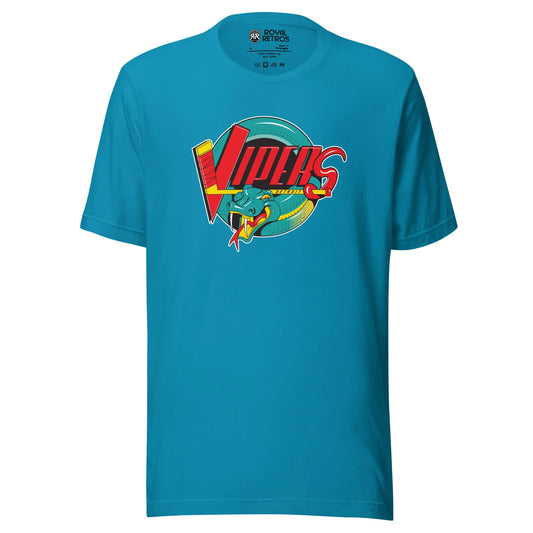


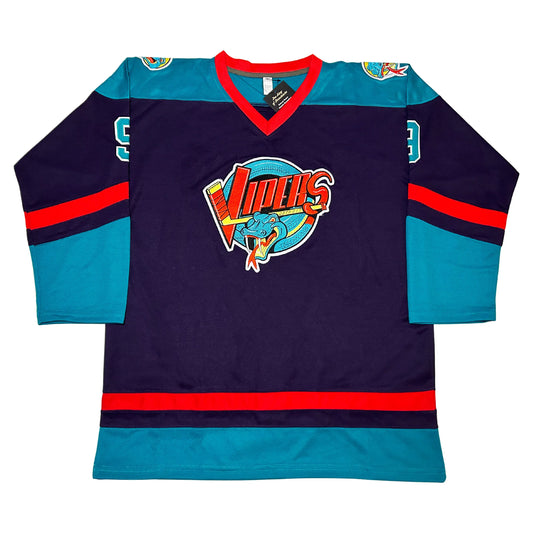


Detroit Vipers Throwback Apparel — Royal Retros Detroit Vipers Fan Shop
1997 Turner Cup Champions. Custom Names & Numbers. Sizes S–5XL.
Royal Retros' Detroit Vipers shop is your home for throwback apparel honoring the 1997 Turner Cup champions — the franchise that gave Detroit a second hockey identity from 1994 to 2001 at The Palace of Auburn Hills. Every piece is built to wear, with free custom name and number on most jerseys and sizes Small through 5XL.
What you can shop here: Detroit Vipers throwback jerseys in two construction options — Pro Stitched (authentic stitched numbers and lettering, classic on-ice look) and Replica (high-quality printed graphics, lightweight and vibrant for everyday wear) — featuring the team's iconic purple, black, and silver palette and the snake mark on the chest. Vipers t-shirts and hoodies pair those graphics with soft cotton and mid-weight fleece. The Vipers foam-trucker hat carries the logo embroidered front. Each piece is a careful reproduction of the Palace-era design, not a generic blank: the same colorway, the same typography, the same uniform identity that Detroit hockey fans remember from the late-90s IHL era.
The Detroit Vipers Story
Detroit's Second Hockey Franchise
When professional hockey returned to Detroit at the major-minor level in October 1994, it arrived as the Detroit Vipers — a relocated International Hockey League (IHL) franchise that had been the Salt Lake Golden Eagles, one of the great minor-league dynasties of the previous two decades. The franchise had won back-to-back IHL Turner Cups in Salt Lake City in 1986–87 and 1987–88, capping a dynastic run — but by the early 1990s the league's economics demanded relocation to a larger market. Detroit, with its hockey-saturated culture and Bill Davidson's available Palace of Auburn Hills, was the chosen destination.
The move was orchestrated by William Davidson, the legendary Detroit businessman who already owned the NBA's Detroit Pistons and the city's premier indoor venue. Davidson saw a market that the Detroit Red Wings — then in the middle of their late-90s Stanley Cup dynasty — didn't fully serve: families looking for affordable hockey tickets, the suburban Oakland County hockey audience built around the Palace, and corporate-entertainment buyers who wanted a hockey product they could host for half the price of a Red Wings ticket. The Vipers weren't trying to be Detroit's only hockey team. They were trying to be Detroit's second hockey team, and the Palace was their stage.
The franchise's identity was designed from the start to feel distinct from the Red Wings' classic winged-wheel red and white. The Vipers chose purple, black, and silver — a colorway that had almost no precedent in pro hockey at the time — and named the team after the Dodge Viper sports car under a sponsorship arrangement with Chrysler. The result was one of the most visually distinctive uniforms in late-90s North American professional hockey, and a brand identity that gave the Vipers a clear silo from their NHL neighbors downtown.
The Palace of Auburn Hills Era
From their 1994 founding through their 2001 folding, the Vipers played every home game at The Palace of Auburn Hills, the 22,076-seat arena that Davidson had built in 1988 for the Pistons. The arrangement was unusual for an IHL franchise — most of the league's teams played in 8,000- to 16,000-seat arenas — but the Palace's scale gave the Vipers an immediate visual signature. When the team drew strong crowds (and especially during their 1996–97 championship run), Vipers home games looked and felt like major-league hockey games. The franchise regularly drew over 10,000 fans per game in their peak years and topped 20,000 for marquee playoff dates.
Sharing an arena with the NBA Pistons created an unusual operational rhythm. Vipers home games rotated around the Pistons' schedule, with quick ice-to-court conversions in between, and Davidson's ownership of both franchises meant the Vipers had access to first-class facilities, training, and marketing infrastructure that most of their International Hockey League (IHL) opponents couldn't match. The Vipers shared the Palace's pre-game atmosphere with the Pistons, used the same broadcast crews, and benefited from cross-promotional season-ticket bundles that turned Pistons fans into Vipers fans almost by default.
The arena itself was a character in the Vipers' story. Built in suburban Auburn Hills rather than downtown Detroit, the Palace was easier for the surrounding suburban hockey audience to access than the Red Wings' Joe Louis Arena. The atmospheric capacity — 22,076 — meant Vipers games rarely felt empty even when attendance dipped, and the building's amenities pulled corporate-entertainment audiences that the older Joe Louis couldn't.
Building a Contender (1994–1996)
The Vipers' inaugural 1994–95 season was a transition year — the relocated Salt Lake Golden Eagles roster mixed with new acquisitions, learning a new arena, and finding an identity in a hockey-saturated market. Detroit went 32–37–11 in their first season, missing the playoffs but establishing a fanbase that would carry them through the next half-decade.
The franchise sharpened in 1995–96, improving to 43–30–9 and securing their first IHL playoff appearance, though they fell in the second round to the Utah Grizzlies. The lessons of those first two seasons informed how the Vipers' coaching staff approached building the roster: emphasize veteran scoring, mix in talented prospects on their way to the major-league level, and play a fast, hard-hitting style that matched the Palace's atmosphere. The pieces were in place for a championship run, and the 1996–97 season would deliver it.
The 1996–97 Turner Cup Championship Run
The 1996–97 Detroit Vipers were the franchise's high-water mark. The roster combined IHL All-Star captain Stan Drulia with rookie Russian phenom Sergei Samsonov — who would win the league's Garry F. Longman Memorial Trophy as Rookie of the Year that season — center Peter Ciavaglia, and the veteran leadership of a roster built specifically to win a championship. Goaltender Jeff Reese anchored the crease, and the Vipers played the kind of two-way, possession-heavy hockey that wins playoff series.
The regular season established Detroit as one of the IHL's elite teams. The Vipers reached the Turner Cup Finals after a hard-fought playoff run — an opening-round series, conference matchups that tested every part of the roster, and ultimately a six-game Turner Cup Final against the Long Beach Ice Dogs that delivered the championship to the Palace of Auburn Hills.
Samsonov's rookie campaign was the offensive engine, but the championship was a team accomplishment in the truest sense. Drulia provided the captain's leadership through every round. Reese stood tall in the crease when the Ice Dogs threatened to push the series longer. Ciavaglia and the supporting cast filled in the scoring sheets through grinding playoff hockey. When the final horn sounded at the Palace and the championship-clinching banner was raised, Detroit had its first — and ultimately only — major hockey trophy outside of the Red Wings' Stanley Cup era.
The 1996–97 Turner Cup remains the only championship banner the Detroit Vipers ever raised, and it earned them a permanent place in the franchise lore of International Hockey League (IHL) history. For a city accustomed to Red Wings excellence, the Vipers' championship — won under the same arena lights where the Pistons played — was Detroit's other hockey trophy, and it's the moment the modern Vipers throwback aesthetic is anchored to. The 1997 Turner Cup Champions jersey design — the purple-and-silver palette, the snake mark, the typography — is what every Vipers throwback now references.
Gordie Howe's Six-Decade Shift (October 3, 1997)
One of the most extraordinary moments in professional hockey history happened in a Vipers uniform on October 3, 1997, at The Palace of Auburn Hills. Hall of Famer Gordie Howe — 69 years old and decades removed from his last competitive professional shift — laced up his skates one final time for the Detroit Vipers during a regular-season game against the Kansas City Blades.
The single ceremonial shift, arranged as a tribute to Howe's career and to mark the unique distinction it would create, made Howe the only player in pro hockey history to compete in six different decades — the 1940s, 50s, 60s, 70s, 80s, and 90s. Mr. Hockey took one shift, did not record a point, returned to the bench, and the building stood for what may have been the loudest ovation in Vipers history.
The moment was as much a Detroit hockey event as a Vipers event: Howe's Red Wings legacy and his return to the Detroit ice in Vipers colors collided in a single shift that has become one of the most-talked-about events of late-90s minor-league hockey. National media covered the shift. Local Detroit broadcasters treated it like a major-league moment. The image of Howe in Vipers purple — at age 69, on the Palace ice he'd never played on as a Red Wing — became a permanent piece of Vipers iconography. To this day Howe's one-shift cameo is one of the first things hockey historians cite when they discuss the team, and the Vipers themselves carried it forward as part of their franchise identity through their remaining seasons.
The Vipers as a Pipeline: Key Players
Beyond Howe's cameo, the Vipers were a real talent factory. Their championship-era rosters mixed seasoned IHL veterans with younger players on their way up to the major-league level, and several names from the Vipers' Palace years went on to substantial top-tier careers.
Sergei Samsonov used his 1996–97 IHL Rookie of the Year campaign in Detroit as the springboard to a long top-tier professional hockey career. Drafted by the Boston Bruins in the 1997 entry draft, the Russian winger went on to win the Calder Trophy as Rookie of the Year at the major-league level the following season — making him one of the rare players to win Rookie of the Year honors in back-to-back leagues. Samsonov played 14 seasons at hockey's highest professional level and finished his career as one of the most accomplished alumni of late-90s IHL hockey.
Stan Drulia was a long-time IHL standout who anchored the Vipers' locker room as captain across multiple seasons, including the 1996–97 championship year. An IHL All-Star and one of the most respected veteran leaders in the league, Drulia represented the kind of high-IQ, accountable veteran presence that great championship teams need behind their star rookies.
Peter Ciavaglia centered key minutes for the Vipers across their peak years, contributing two-way play and offensive depth that complemented Samsonov and Drulia. A versatile veteran who logged significant minutes in every situation, Ciavaglia was the type of secondary player every championship roster needs.
Jeff Reese shared goaltending duties for Detroit during the championship season, anchoring the crease in key playoff moments. A veteran of multiple top-tier organizations earlier in his career, Reese brought big-game experience to a Vipers team that needed it during the 1997 playoff run.
Beyond the championship core, dozens of professional hockey careers rotated through the Vipers' rosters across the franchise's seven seasons — players completing distinguished IHL careers, players on the way up to the major-league level, and the kind of skilled depth that gave the Vipers an unusually deep developmental identity for a secondary-tier team.
The Late-1990s Decline
The Vipers remained competitive in the seasons following their 1997 championship, but the franchise — and the IHL itself — began showing strain in the late 1990s. The IHL's ambitious 1990s expansion (the league grew to as many as 19 teams at its peak) had inflated player salaries beyond what most franchise economics could sustain, and the league's positioning as a "third major league" alongside the top-tier league and the official top minor-league affiliate became increasingly hard to maintain.
Detroit's specific challenges were market-related: even with Davidson's deep pockets and the Palace's prime venue, the Vipers were always a second hockey choice in a city where the Red Wings won three Stanley Cups between 1997 and 2002. Attendance softened from the championship-era peaks, season-ticket renewals slipped, and the league-wide financial pressures that would eventually claim the entire IHL began visibly biting into the Vipers' operations by the 1999–2000 season.
The Vipers tried to recapture their championship magic through additional playoff runs, but the post-1997 seasons saw earlier exits and shrinking rosters. By 2000, the writing was on the wall — not just for Detroit, but for the entire league.
2001: The Final Season and the IHL's Collapse
The 2000–01 Vipers played what would become their final season under the looming shadow of the IHL's financial troubles. By the spring of 2001 it had become clear that the league couldn't continue as constituted, and the IHL formally ceased operations after the 2000–01 season — the end of a league that had operated continuously since 1945.
Six IHL franchises — including the Grand Rapids Griffins, Houston Aeros, Chicago Wolves, Manitoba Moose, Milwaukee Admirals, and Utah Grizzlies — were absorbed by the American Hockey League for the 2001–02 season as part of a merger arrangement. The Vipers were not among the six. The Detroit market, already saturated by Red Wings hockey, made the Vipers a less attractive candidate for continuation, and Davidson chose to wind down the franchise rather than push for a spot in the AHL.
The franchise folded with the league. The Palace went on to host Pistons games, concerts, and other events for another decade and a half before its own demolition in 2020, but Detroit's IHL hockey identity ended with the IHL itself. Bill Davidson, the man who had brought the Vipers to Detroit, would continue to own the Pistons until his death in 2009 — but he never brought another professional hockey franchise to the Palace.
The Vipers Legacy
More than two decades after their folding, the Detroit Vipers remain one of the most-remembered franchises of late-1990s North American professional hockey at the secondary tier. The combination of the Palace stage, the 1997 championship banner, the Gordie Howe six-decade shift, and the distinctive purple-and-silver aesthetic gave the Vipers a brand identity that has long outlived the team.
Detroit hockey fans who came of age in the 1990s remember the Vipers as a different kind of game-day experience: more accessible than Red Wings games, more atmospheric than most IHL venues, and capped by a championship year that became one of the defining moments of the secondary-tier hockey era. The Vipers throwback jersey — the snake logo, the purple-black-silver palette, the typography of the Davidson-era IHL — is one of the most-requested pieces of Legacy Hockey apparel in Royal Retros' catalog. For fans who watched the Vipers at the Palace, the Vipers throwback is a piece of Detroit hockey history that the Red Wings dynasty era never overshadowed.
Why Royal Retros for Detroit Vipers Throwbacks
Royal Retros builds Detroit Vipers throwback apparel for collectors who want the Palace-era design rendered with the same care the originals were made with. Every piece in this collection is built to wear and built to last.
- Period-correct twill, stitched numbers, and authentic detailing on Pro Stitched jerseys.
- Free custom name and number on most jersey styles — add the player who defined your Vipers fandom, or your own.
- Sizes Small through 5XL across most products.
- Two jersey construction options: Pro Stitched (heavyweight, authentic stitched numbers and lettering, classic on-ice look) and Replica (high-quality printed graphics, lightweight and breathable for everyday wear).
- Made-to-order jerseys — see each product page for current customization lead times.
- Detroit Vipers t-shirts, hoodies, and headwear pair the same vintage IHL-era graphics with apparel built for daily wear.
Detroit Vipers FAQ
What sizes are available?
Small through 5XL across most products. See each product page for exact size availability and goalie sizing on jerseys.
Can I customize a Detroit Vipers jersey?
Yes — most jerseys include free custom name and number. Customized jerseys are made to order and are final sale (no returns or exchanges on customized items).
Are these authentic Detroit Vipers reproductions?
Every piece in this collection is a vintage-inspired reproduction designed to honor the original Palace of Auburn Hills–era Detroit Vipers identity: the snake logo, the purple-black-silver colorway, and the typography of the 1994–2001 IHL franchise. These are unaffiliated throwbacks made for historical and artistic purposes — see the disclaimer below.
How long does shipping take?
Stock items typically ship within 3–5 business days. Made-to-order jerseys take longer — see each product page for current customization and production lead times.
What was the Detroit Vipers' biggest accomplishment?
The 1996–97 Turner Cup championship — defeating the Long Beach Ice Dogs in a six-game final at The Palace of Auburn Hills. The championship banner from that season remains the only major trophy the franchise raised in seven seasons of IHL play.
Who was Gordie Howe's connection to the Vipers?
Hall of Famer Gordie Howe played a single ceremonial shift for the Vipers on October 3, 1997, at age 69. The shift made Howe the only player in pro hockey history to play professionally in six different decades — the 1940s, 50s, 60s, 70s, 80s, and 90s.
Detroit Vipers at Royal Retros — 1997 Turner Cup Champion Throwbacks. Custom Names & Numbers. Sizes S–5XL.
Vintage-inspired reproductions — not affiliated with, endorsed by, or sponsored by any team, league, or organization. Used for historical and artistic purposes only.